Wellness Tourism in India: Why the World Is Looking Beyond the Holiday
There was a time when a holiday meant seeing as much as possible.
Three cities in four days.
Five monuments before lunch.
And perhaps a photograph proving that everyone was having a wonderful time.
Wellness tourism is quietly challenging that model.
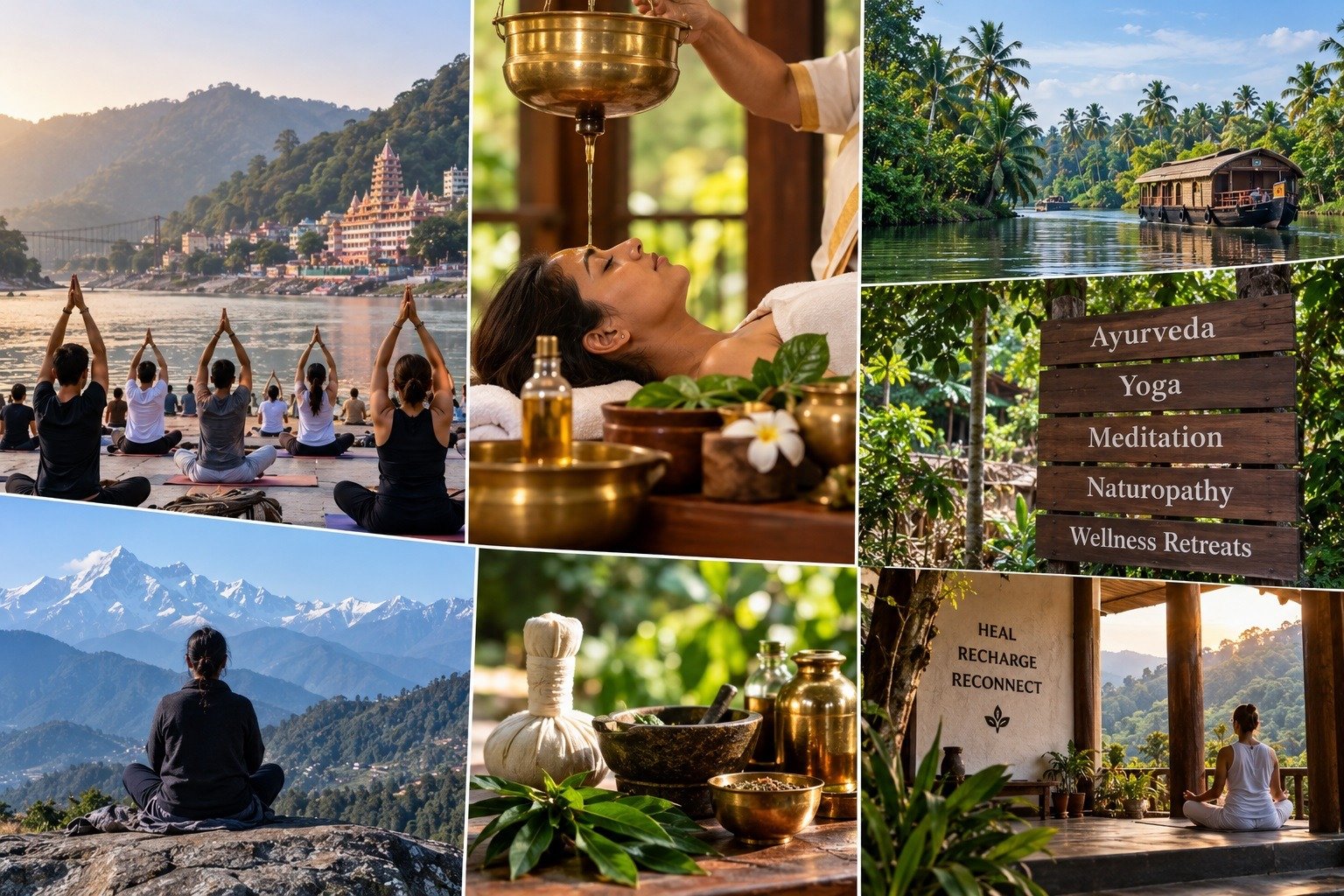
The modern wellness traveller may be perfectly happy to spend several days doing considerably less: practising yoga, receiving an Ayurveda treatment, learning meditation, walking through a forest, eating differently, sleeping properly and — revolutionary idea — not checking email every seven minutes.
India is particularly well placed for this shift because wellness here is not a recently invented hotel category.
Yoga, Ayurveda, meditation and naturopathy have deep roots in India’s cultural and knowledge traditions.
The country’s official tourism platform now treats wellness as a distinct travel experience encompassing yoga, Ayurveda, meditation and naturopathy.
The opportunity is substantial. But the real challenge is making India’s wellness reputation match the quality, safety and credibility expected by international travellers.
India has an unusual advantage: wellness is already part of the culture
Many countries have built wellness industries around spas, fitness centres and luxury retreats.
India has those too.
But it also has something different: living traditions of practice and learning.
Ayurveda, yoga and meditation are not simply products created for tourists. They are practised across India in institutions, clinics, ashrams, schools and communities.
The Ministry of Tourism’s Incredible India platform presents yoga and wellness through a combination of Ayurveda, yoga, naturopathy, Vedanta, meditation, retreats and nature-based experiences.
That gives India a powerful proposition:
wellness can be a destination experience rather than merely a hotel amenity.
A visitor can travel to Rishikesh to study yoga, Kerala for Ayurveda, Mysuru for yoga traditions, Maharashtra for meditation and wellness retreats, or the Himalayan region for a combination of nature, quiet and structured programmes.
Kerala: where Ayurveda meets tourism
Kerala has perhaps become India’s most internationally recognisable Ayurveda-wellness destination.
The attraction is not difficult to understand.
Tropical landscapes, traditional Ayurveda practices, coastal resorts and established tourism infrastructure allow wellness programmes to be combined with longer stays.
But Ayurveda tourism should not be reduced to the familiar image of an oil massage beside a swimming pool.
Authentic Ayurvedic care can involve consultation, diet, therapies, medicines and structured treatment plans.
That distinction matters.
A spa treatment marketed with an Ayurvedic label is not automatically equivalent to treatment delivered within a properly supervised Ayurvedic healthcare setting.
For travellers seeking treatment rather than relaxation, credentials, practitioner qualifications, treatment protocols and medical disclosures matter considerably more than the number of candles in the treatment room.
Rishikesh: yoga became a global travel language
Few Indian destinations have influenced international perceptions of Indian wellness as strongly as Rishikesh.
The city combines the Ganga, Himalayan foothills, ashrams, yoga schools, meditation centres and spiritual traditions.
The official Incredible India platform highlights Rishikesh’s wellness ecosystem and identifies places such as Parmarth Niketan, where visitors can undertake yoga and related spiritual programmes.
The attraction is increasingly international.
Someone may arrive in Rishikesh for a yoga course and stay for meditation.
Another traveller may arrive for a spiritual retreat and discover Indian philosophy.
Another may simply want a break from the permanently switched-on modern lifestyle.
The interesting economic development is that wellness can encourage longer stays than conventional sightseeing.
A monument may take two hours.
A structured yoga or meditation programme can take days or weeks.
That changes what visitors spend on accommodation, food, transport and local services.
Maharashtra has a wellness story of its own
Wellness tourism is not limited to Kerala and Uttarakhand.
Maharashtra has an increasingly visible wellness ecosystem stretching from Pune and Nashik to hill destinations such as Mahabaleshwar.
In Pune, the official Incredible India platform highlights Ayurveda, yoga, meditation, fasting retreats and holistic wellness programmes.
Nashik combines wellness with a very different destination proposition — vineyards, religious heritage, nature and meditation. The city’s tourism profile includes the Vipassana International Academy and Ayurveda-oriented experiences.
Mahabaleshwar offers another model, combining hills, nature, yoga, meditation, Ayurveda and naturopathy.
This suggests that India’s wellness map is becoming more geographically diverse.
The next wellness destination does not necessarily need to be a famous spiritual city.
It needs good practitioners, a compelling environment, accessibility, credible programmes and an experience people are willing to travel for.
From luxury retreats to structured wellness
India has also developed a premium wellness-retreat segment.
Properties such as Ananda in the Himalayas and Vana have helped position Indian wellness within the international luxury market. Incredible India’s own wellness material highlights Ananda’s combination of Ayurveda, yoga and Vedanta, while Vana combines Ayurveda with Tibetan healing traditions, yoga and natural therapies.
This premium segment matters because international wellness travellers often stay longer and spend more than ordinary leisure tourists.
But there is an important distinction between luxury wellness and wellness itself.
A ₹50,000-a-night retreat may provide an exceptional experience.
It does not mean wellness must cost ₹50,000 a night.
India’s broader opportunity lies in creating credible programmes across different price points — from traditional centres and yoga institutions to clinical wellness programmes and high-end retreats.
The e-AYUSH visa changes the proposition
India has also been developing a more targeted framework for international wellness and traditional-medicine travel.
The AYUSH Visa, introduced in 2023, was designed to facilitate foreign visitors travelling to India for treatment under recognised AYUSH systems. KPMG’s Heal in India report identifies the AYUSH visa as part of India’s effort to expand medical and wellness travel.
This is important because international wellness travel is not simply a tourism issue.
It sits at the intersection of:
tourism + healthcare + traditional knowledge + hospitality + aviation + regulation.
That makes the sector considerably more complex than the word “retreat” suggests.
The cost advantage is real — but needs context
India’s healthcare cost advantage is frequently cited in discussions about international medical tourism.
KPMG’s 2025 report says treatments in India can cost up to 90% less than in Western countries, while highlighting India’s large network of accredited hospitals and growing AYUSH ecosystem.
But this statistic should not be stretched to mean that every Ayurvedic programme, wellness retreat or meditation course is automatically 90% cheaper than an equivalent service overseas.
Healthcare procedures, clinical treatment and wellness experiences are different markets.
For DOONITED readers, that distinction is important.
A good wellness story should not become a sales brochure.
The next opportunity may be preventive wellness
The most interesting future market may lie between conventional tourism and medical tourism.
People increasingly travel because they want to improve sleep, manage stress, develop healthier habits, practise yoga, learn meditation, change diet or simply spend time in nature.
That is preventive and lifestyle-oriented wellness rather than treatment for a specific disease.
India has a natural advantage here because yoga, meditation, Ayurveda and nature-based experiences can be combined into longer programmes.
But credibility will become increasingly important.
As the market expands, travellers will want answers to straightforward questions:
Who is providing the treatment?
What are their qualifications?
What exactly does the programme involve?
What evidence supports a particular health claim?
What happens if a participant has a medical condition?
What are the safety protocols?
The wellness industry that can answer those questions clearly will have a stronger long-term foundation than one relying entirely on words such as detox, healing and rejuvenation.
Technology may actually help wellness tourism
It sounds slightly contradictory.
A wellness retreat is supposed to help us escape technology.
Yet technology can improve the travel experience.
Online consultations, digital booking, multilingual information, telemedicine follow-up and personalised programmes can make wellness travel easier for international visitors.
KPMG’s Heal in India report highlights digital integration, telemedicine and the development of a more coordinated medical and wellness ecosystem.
The trick is knowing when technology should disappear.
The best digital wellness experience may ultimately be the one that gets you checked in, gives you the information you need and then politely gets out of the way.
The environmental question
Wellness tourism depends heavily on something that cannot be manufactured in a factory:
a pleasant environment.
Clean rivers.
Quiet forests.
Fresh air.
Mountain landscapes.
Healthy food.
Green spaces.
That creates a paradox.
If thousands of people travel to a fragile mountain destination seeking peace, excessive construction and congestion can destroy the very product they came to experience.
Wellness tourism therefore needs sustainable tourism principles — responsible water use, waste management, energy efficiency, local sourcing, careful construction and respect for carrying capacity.
A wellness resort that requires a small environmental disaster to provide a “nature experience” has misunderstood the assignment.
The DOONITED View
India’s wellness opportunity is bigger than selling Ayurveda packages to foreign tourists.
It is about building a credible Indian wellness ecosystem in which traditional knowledge, qualified practitioners, modern safety standards, hospitality, nature and technology work together.
The country already possesses many of the ingredients.
The challenge is quality control.
India should resist the temptation to turn every massage centre into an “international wellness destination” and every herbal product into a miracle cure.
Instead, it should build trust through qualifications, transparency, research, responsible claims and consistent visitor experiences.
That would make India’s greatest wellness advantage — its heritage — commercially useful without reducing that heritage to a marketing slogan.
Because the future of wellness tourism may not belong to the place promising to “transform your life in three days.”
It may belong to the destination that simply helps you sleep better, breathe slower, learn something meaningful and return home with habits that last longer than the holiday.
The Learning Point
India’s wellness-tourism opportunity lies not merely in its ancient traditions, but in how responsibly those traditions are adapted for the modern traveller.
The global traveller may come looking for Ayurveda, yoga or meditation.
What will make them return is trust, quality, authenticity and a genuinely better experience.


World Beyond the News
Why Elephants Stay Close to Their Herd
Elephants live in highly social family groups and use calls, touch and body movements to maintain strong bonds.
Most of the Deep Ocean Remains Difficult to Explore
Extreme pressure, darkness and distance make deep-ocean exploration one of Earth’s greatest scientific challenges.
Spacecraft Can Travel Without Traditional Roads
Spacecraft use carefully calculated trajectories and gravity assists to travel enormous distances through space.
Why Movie Trailers Are Released in Stages
Major films often use teaser trailers, full trailers and final promotional spots to build awareness over time.