India’s Young Biotech Innovators: From Lab Experiments to Real-World Solutions
One in which young scientists, researchers, students and entrepreneurs are increasingly being encouraged to take ideas beyond the laboratory and test whether they can work in the real world.
For years, biotechnology in India was associated primarily with research laboratories, pharmaceutical manufacturing and vaccines.
That picture is changing.
Today, biotechnology increasingly intersects with artificial intelligence, engineering, climate science, agriculture, diagnostics, advanced materials and industrial manufacturing.
The scale of that transformation is becoming visible. NITI Aayog’s July 2026 roadmap estimates India’s bioeconomy at $195.3 billion in 2025, up dramatically from about $10 billion in 2014, and says the country now has more than 10,000 biotech startups. The roadmap sets out an ambition to take the bioeconomy towards $691 billion by 2035. These are roadmap projections rather than guaranteed outcomes, but they illustrate the scale of the opportunity policymakers now see.
The more interesting question, however, is not how many startups India has.
It is what young Indian innovators are trying to build.
Biotechnology Is Moving Out of the Textbook
Modern biotechnology is no longer limited to producing medicines.
It can involve microorganisms engineered for industrial applications, biological approaches to environmental pollution, new diagnostic technologies, alternative proteins, biomaterials, precision therapeutics and biological systems combined with computing and engineering.
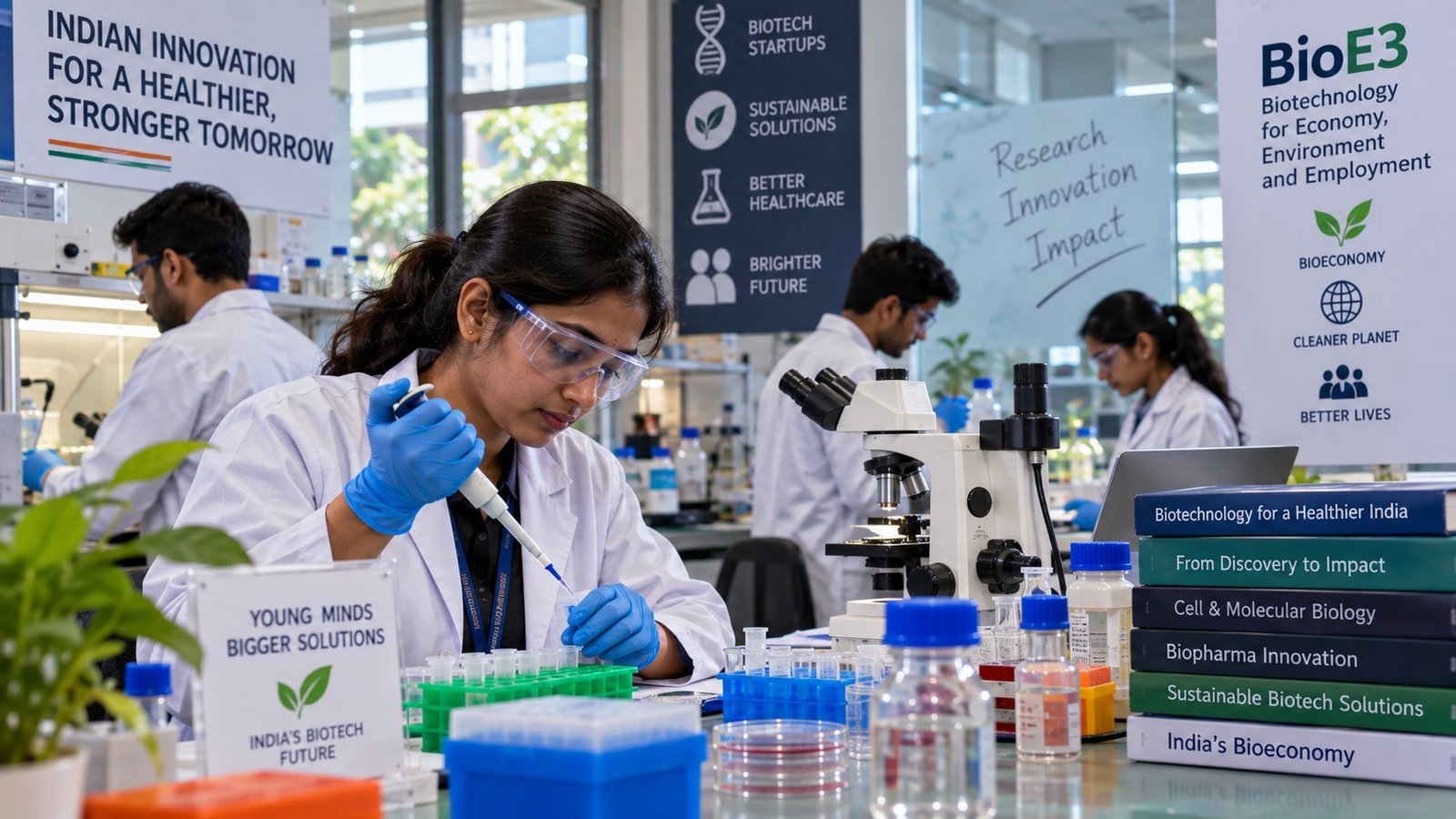
The government’s BioE3 Policy — Biotechnology for Economy, Environment and Employment — is designed around precisely this transition.
DBT says the policy is being implemented with BIRAC to help startups, SMEs, industry and academia access shared infrastructure for pilot and pre-commercial-scale biomanufacturing. Its Biofoundries, Biomanufacturing Hubs and Bio-AI Hubs are intended to support areas including bioplastics, bio-based chemicals, enzymes, functional foods, smart proteins and advanced therapeutics.
This matters because one of biotechnology’s biggest problems is not always discovering something.
It is making enough of it reliably, safely and economically.
A laboratory experiment can work beautifully in a small flask.
A commercial process has to survive thousands of litres.
Biology, unfortunately, does not read the PowerPoint presentation.
The “Valley of Death” Between Discovery and Business
Young researchers often encounter what is commonly called the valley of death — the difficult stage between demonstrating that an idea can work and proving that it can become a viable product.
A promising diagnostic may require clinical validation.
A biological material may need manufacturing scale-up.
A medical device may require regulatory approval.
A new therapeutic may require years of testing.
A climate technology may need to demonstrate that it is economically competitive, not merely scientifically interesting.
This is where India’s institutional architecture is becoming important.
BIRAC’s Biotechnology Ignition Grant (BIG) is specifically designed to help innovators establish and validate proof of concept and move promising ideas closer to commercialisation. The current scheme provides up to ₹50 lakh in grant-in-aid for up to 18 months, alongside mentoring and support through BIRAC’s partner network.
It is not a guarantee of success.
It is something arguably more useful at the earliest stage:
a chance to find out whether the idea actually works.
Young Researchers Are Crossing Disciplinary Boundaries
The new generation of biotech innovators is also less likely to think in neat academic boxes.
A diagnostic problem can become a synthetic-biology problem.
A prosthetic problem can become a bioengineering problem.
A pollution problem can become a materials-science and biotechnology problem.
This interdisciplinary approach is visible in the kinds of projects emerging through India’s innovation ecosystem.
The user’s cited examples include student teams working on bacteria-based diagnostic concepts for tuberculosis, bioelectronic prosthetic concepts and biological approaches to chronic skin conditions.
These should be understood as research and innovation projects, not automatically as clinically proven treatments or commercially validated products.
That distinction is crucial.
Biotechnology is one field where the distance between an exciting prototype and a safe product can be enormous.
A good idea deserves encouragement.
It also deserves testing.
The Climate Side of Biotechnology Is Getting Interesting
Some of the most imaginative youth projects are appearing at the intersection of biology and environmental problems.
One example highlighted in the supplied material is Plas-Stick, developed by Indian teenagers using discarded tamarind seeds in an approach aimed at helping remove microplastics from water.
Whether an early-stage environmental innovation ultimately scales is a separate question.
But the idea itself illustrates a larger shift in thinking:
waste can become a biological resource.
India produces enormous quantities of agricultural and food-processing residues. Biotechnology could potentially convert some of those materials into useful chemicals, fuels, biomaterials or other products.
The BioE3 framework explicitly includes bio-based chemicals, bioplastics and other bio-manufacturing applications among its priority areas.
This is where India’s scale becomes both an opportunity and a challenge.
A technology that works in a laboratory must eventually prove that it can work with India’s raw materials, infrastructure, economics and environmental conditions.
AI Is Entering the Biological Laboratory
There is another important development hiding inside the biotech transformation.
Biology is becoming increasingly computational.
AI can help researchers analyse biological datasets, identify patterns, optimise experiments and support discovery. India’s BioE3 architecture explicitly includes Bio-AI Hubs, recognising that biological innovation and artificial intelligence are increasingly connected.
This creates a new kind of scientist.
The future biotech researcher may need to understand biology, statistics, computation, engineering and entrepreneurship — not necessarily at expert level in everything, but enough to collaborate across disciplines.
That changes the meaning of “lab-to-market.”
The laboratory itself is becoming more digital.
India Has a Strong Foundation — But the Hard Work Is Ahead
India has several advantages in biotechnology.
It has a large scientific workforce, major pharmaceutical and vaccine manufacturing capabilities, established research institutions, a substantial healthcare market and a growing startup ecosystem.
NITI Aayog’s 2026 roadmap describes India’s vaccine manufacturing base and generics and biosimilars industry as established strengths, while identifying AI-enabled biotechnology and next-generation biomanufacturing as areas for the next phase of growth.
But the country should avoid confusing startup numbers with scientific success.
Ten thousand companies do not mean ten thousand breakthrough technologies.
A patent does not automatically mean a commercial product.
A prototype does not equal a clinically validated medical intervention.
And an investment announcement does not guarantee manufacturing at scale.
Biotechnology rewards patience.
The Next Generation Needs More Than Grants
Funding is important, but young scientists need an entire ecosystem.
They need access to laboratories.
They need mentors.
They need intellectual-property support.
They need clinical and industrial partners.
They need regulatory guidance.
They need pilot manufacturing facilities.
And eventually, they need customers.
This is precisely why shared infrastructure under BioE3 is significant. DBT’s model is not simply to give every startup its own expensive laboratory. It is to create infrastructure that multiple innovators can use to test and scale technologies.
That can potentially reduce one of the biggest barriers facing early-stage biotech companies: the cost of moving from a promising experiment to a reproducible process.
A Nagpur Student, a Bengaluru Researcher or a Delhi Founder Should Be Able to Start From an Idea
The geographical dimension matters too.
India’s biotechnology opportunity should not become concentrated in a handful of established metropolitan clusters.
A young researcher in Nagpur, Hyderabad, Ahmedabad, Guwahati or a smaller university town should ideally be able to access the same national innovation infrastructure, mentoring and pathways to commercialisation.
This is where public investment can have a particularly useful role.
Private capital tends to follow opportunities that are already becoming visible.
Public infrastructure can help create the opportunities that do not yet have a market.
That is especially important in deep science.
The Real Innovation May Be the Ecosystem
India’s young biotech innovators are therefore part of a much larger experiment.
The country is attempting to connect:
research → prototype → validation → scale-up → manufacturing → market.
That sounds simple on paper.
It is anything but.
A breakthrough can fail because the manufacturing process is too expensive.
A startup can fail because regulatory approval takes longer than its funding runway.
A useful technology can fail because nobody knows how to distribute it.
And an excellent scientist may discover that running a company requires an entirely different skill set.
The ecosystem must be designed around those realities.
DOONITED View: India Should Measure Biotech by What Leaves the Laboratory
There is a natural temptation to celebrate every young innovator as the next biotechnology superstar.
India should encourage ambition — but resist premature mythology.
The more meaningful celebration comes later.
When a diagnostic reaches a patient.
When a biological process operates reliably at industrial scale.
When a climate technology survives real-world conditions.
When a research discovery becomes an affordable product.
When an Indian biotech company exports something that the world actually needs.
That is the moment when “innovation” becomes an economic and social outcome.
The encouraging part is that India is increasingly building the infrastructure for that journey.
BioE3 provides the policy framework.
BIRAC provides early-stage support.
Research institutions provide scientific capability.
Biomanufacturing hubs can help close the scale-up gap.
And a growing generation of young scientists is supplying something no policy can manufacture on its own:
curiosity.
Learning Point
India’s biotech opportunity is not simply about discovering more things. It is about becoming better at converting discoveries into safe, scalable and useful products.
The country’s young scientists do not need every experiment to succeed.
They need an ecosystem where failure produces knowledge, promising research receives patient support, and successful science has a credible path to the market.
The laboratory is where the idea begins.
The real test begins when the laboratory door opens.

World Beyond the News
Birds Can Navigate Using Earth’s Magnetic Field
Several bird species can sense Earth’s magnetic field, helping them navigate during long-distance migration.
Fermentation Is a Global Food Tradition
People across continents have used fermentation for centuries to preserve food and create distinctive flavours.
Modern Batteries Store Energy Chemically
Rechargeable batteries repeatedly move ions between electrodes, allowing electrical energy to be stored and released.
Why Songs Become Global Hits
Streaming platforms, short-form video, playlists and international collaborations can rapidly carry music across borders.