Before You Buy Gold, Read the Six-Digit Code: How BIS Hallmarking Changed the Indian Jewellery Counter
For generations, buying gold in India depended heavily on the reputation of the jeweller and the buyer’s ability to judge purity. HUID has changed that equation. Here is what the BIS hallmark actually tells consumers—and what it does not.
Buying gold in India has traditionally involved a familiar ritual.
A customer walks into a jewellery shop, examines a necklace or bangle, asks about its purity, negotiates over making charges and eventually relies on the jeweller’s reputation before paying a substantial amount of money.
Today, there is another step that can take less than a minute.
Look closely at the jewellery.
Find the BIS mark.
Check the purity or fineness.
Then find the six-digit alphanumeric HUID.
That small code represents one of the biggest changes in India’s modern gold market.
The Bureau of Indian Standards says hallmarking is the official determination and recording of the proportionate precious-metal content in an article. Its purpose is to provide consumers with third-party assurance that the purity represented by the article corresponds with what they are paying for.
The important point is that hallmarking is not merely a decorative stamp.
It is part of India’s consumer-protection architecture for precious metals.
What exactly is a gold hallmark?
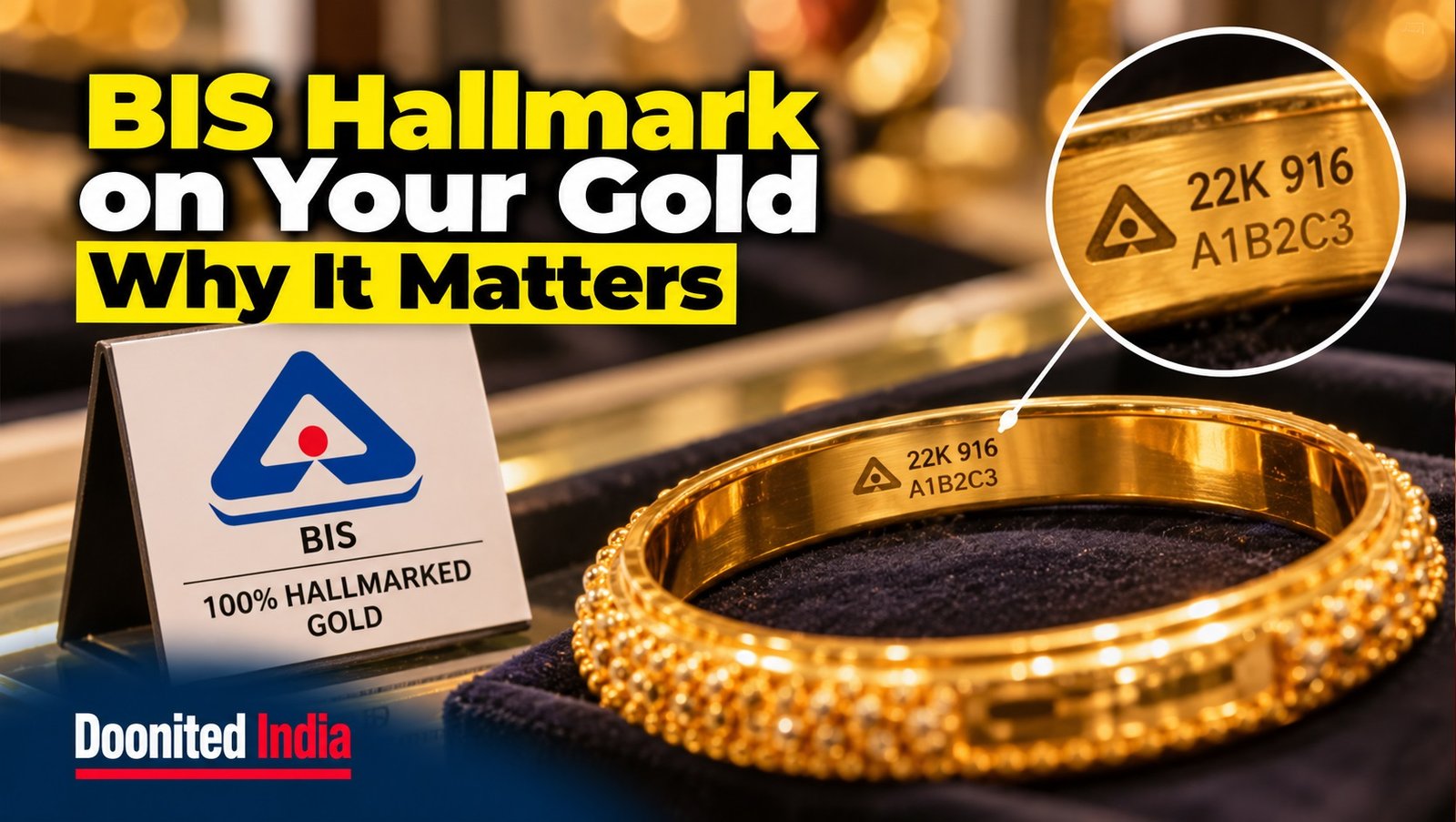
A modern BIS hallmark on gold jewellery consists of three mandatory components:
- the BIS Standard Mark;
- the purity/fineness of the gold; and
- the six-digit alphanumeric HUID — Hallmark Unique Identification number.
BIS says HUID was introduced into the hallmarking system on 1 July 2021 and is unique to each hallmarked item and traceable through the BIS system.
For example, a marking such as 22K916 indicates 22-carat gold with a fineness of 916 parts per thousand.
BIS currently lists six permitted gold jewellery/artefact fineness grades under the relevant standard: 14K (585), 18K (750), 20K (833), 22K (916), 23K (958) and 24KS (995).
That means “gold jewellery” is not one uniform product.
Two pieces that look almost identical can have different fineness.
The number matters.
HUID is the part buyers should not ignore
The HUID is perhaps the most consumer-friendly development in the system.
BIS describes it as a unique six-digit alphanumeric identification number assigned to each hallmarked jewellery article. Consumers can enter the number into the BIS Care App’s “Verify HUID” facility to obtain information associated with the hallmarked article.
That makes the buying process less dependent on visual inspection or verbal assurance.
A customer does not have to become an expert in metallurgy.
Instead, the customer can use a government-backed verification mechanism.
The BIS Care App is available for Android and iOS and includes “Verify HUID” among its consumer functions. BIS says the app also provides access to standards information, laboratories and complaint facilities.
It is a small technological intervention with a large psychological effect.
The question at the jewellery counter is no longer only:
“Do I trust this jeweller?”
It can also be:
“Can I verify what I am being told?”
How does the hallmarking process actually work?
There is an important misconception worth clearing up.
A consumer does not normally take a newly purchased necklace to a government office and ask for it to be hallmarked.
The system operates through registered jewellers and recognised Assaying & Hallmarking Centres.
BIS states that manufacturers, wholesalers, distributors and retailers selling hallmarked precious-metal articles must obtain BIS registration. Registered jewellers can send jewellery to recognised Assaying & Hallmarking Centres for testing and hallmarking.
At the Assaying & Hallmarking Centre, the article undergoes purity testing using recognised assaying procedures.
If it meets the applicable standard, the hallmark is applied.
This separation is important.
The retailer sells the product.
The recognised hallmarking infrastructure performs the purity assessment.
BIS provides the regulatory framework and surveillance.
The objective is to create a chain of accountability rather than leave the buyer entirely dependent on the seller.
The bill matters almost as much as the stamp
There is another detail that consumers sometimes overlook.
A hallmark does not replace the invoice.
BIS says the bill for hallmarked precious-metal jewellery should contain details including the description of each article, net weight of precious metal, purity in carat and fineness, and hallmarking charges.
That document becomes important if a dispute later arises.
Imagine a customer buys a gold bracelet, keeps the jewellery but loses the invoice.
Years later, a dispute develops over its purity, weight or transaction details.
The hallmark is useful, but the purchase documentation provides another layer of evidence.
For an expensive purchase, keeping the invoice is not bureaucracy.
It is part of owning the asset responsibly.
What if the jewellery turns out to be below the marked purity?
This is where hallmarking becomes more than a confidence-building exercise.
BIS says a consumer can have jewellery or a sample tested at a BIS-recognised Assaying & Hallmarking Centre on a chargeable basis. The centre is required to issue an assay report identifying the article as marked.
BIS also states that if hallmarked jewellery is found to have lower purity than the marked purity, the customer is entitled to compensation under the applicable rules. Its consumer guidance specifies compensation at twice the amount of the difference calculated for the purity shortfall, plus testing charges, subject to the applicable framework.
That is a significant consumer safeguard.
It also explains why buying from a properly registered jeweller and keeping the original invoice matters.
Three things buyers should check before paying
The process can be reduced to a practical three-part check.
1. Check the hallmark
Look for the BIS Standard Mark, purity/fineness marking and HUID.
Do not assume that the word “gold” on a product description tells you its purity.
2. Verify the HUID
Use the official BIS Care App’s Verify HUID function.
BIS says the facility allows consumers to verify hallmarked gold jewellery carrying a HUID.
If the number cannot be verified as expected, stop and ask questions before completing the purchase.
3. Check the invoice
Make sure the bill records the article, net precious-metal weight, purity/fineness and applicable hallmarking details.
A beautiful jewellery box is not documentation.
The invoice is.
HUID does not answer every question
This is where consumers should avoid giving the system more power than it actually has.
A verified HUID is important evidence of the hallmarked article’s identity and associated information.
But it does not mean that every aspect of the purchase is automatically favourable.
It does not tell you whether the making charge is competitive.
It does not tell you whether a particular design carries a large premium.
It does not tell you whether buying jewellery is the best investment choice for your financial objective.
And it does not eliminate the need to check the weight and invoice.
Hallmarking addresses purity and traceability.
It is not a universal price-quality guarantee.
That distinction is critical.
A perfectly hallmarked necklace can still be expensive.
The tiny HUID reflects a much bigger change
India’s gold market has always been built partly on trust.
Families often return to the same jeweller for decades. Recommendations travel through generations. Reputation remains commercially powerful.
But modern consumers increasingly expect something more than reputation.
They want verification.
That is part of a much larger change taking place across India’s consumer economy.
Digital payments reduced the need to trust cash handling.
Online banking reduced dependence on physical branches.
Product certification allows consumers to inspect standards.
HUID brings some of that verification culture into the jewellery market.
The technology is not dramatic.
There is no futuristic machine at the counter.
There is simply a tiny code engraved on a valuable object and a government verification system behind it.
Yet that changes the balance of information between seller and buyer.
The jewellery box is becoming more transparent
For international readers, India’s hallmarking system offers an interesting lesson.
Gold is simultaneously a cultural object and a financial asset in India. That makes consumer confidence unusually important.
A wedding necklace can carry sentimental value.
A bangle may be inherited.
A coin may be purchased as savings.
A gold article may eventually become collateral.
The same underlying metal can travel through several economic roles during its lifetime.
In that environment, knowing exactly what one owns matters.
The HUID system does not eliminate every risk in the gold market.
It does something more practical.
It gives consumers a tool with which to ask better questions.
The DOONITED view
India does not need to abandon the traditional trust that surrounds gold.
It needs to modernise it.
The strongest version of that trust is not blind faith in a familiar shopkeeper. It is a combination of reputation, regulation, documentation and independent verification.
That is what makes the six-digit HUID more important than it looks.
For decades, a gold buyer’s strongest protection might have been the family jeweller’s reputation.
Today, the buyer can carry another form of protection in a smartphone.
Before paying for gold, look beyond the shine. Check the mark. Check the purity. Verify the HUID. Read the invoice.
Because when the purchase is worth thousands—or lakhs—trust should have evidence behind it.


World Beyond the News
Octopuses Can Change Their Appearance
Octopuses can rapidly alter their skin colour and texture to communicate, camouflage themselves and respond to danger.
Some Cities Exist Across Two Continents
A small number of cities are geographically associated with two continents, creating unusual cultural and geographic identities.
Earth’s Climate Is Measured in Many Ways
Scientists track temperature, atmospheric gases, sea level, ice cover and other indicators rather than relying on a single climate number.
Streaming Changed How Audiences Discover Shows
Recommendation systems and global streaming releases allow audiences to discover programmes far beyond their original markets.