How India’s Marathon Runners Are Rewriting the Distance Story
From the hills of Himachal to the Asian Games podium, Sawan Barwal’s record-breaking run is a reminder that endurance sport is built on patience, preparation and the courage to challenge old assumptions.
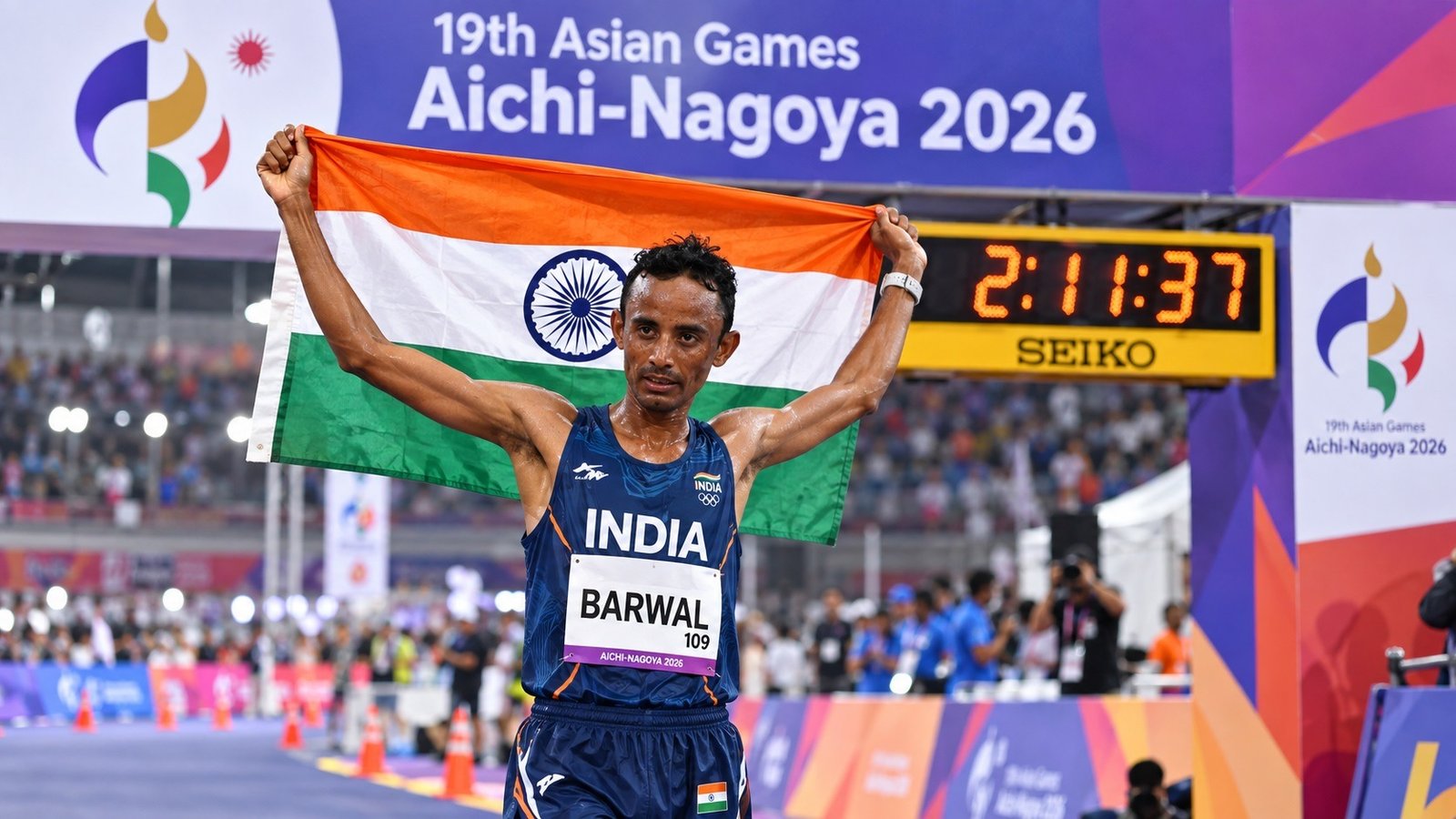
India’s marathon story has a new milestone. On September 26, 2026, Sawan Barwal won silver in the men’s marathon at the Asian Games in Aichi-Nagoya, Japan, ending a 44-year wait for an Indian medal in the event. The 28-year-old Army athlete from Himachal Pradesh completed the 42.195-kilometre race in 2:11:37, setting a new national record and improving the mark he had established earlier this year.
The silver is historic. But the more revealing story is how Barwal reached this point—and what his performance says about the possibilities and persistent challenges facing Indian distance running.
A national record, rewritten twice in one year
Before Nagoya, Barwal had already made headlines at the Rotterdam Marathon in April 2026. He clocked 2:11:58, breaking the Indian national record associated with the late Shivnath Singh, whose 2:12:00 mark had stood since 1978.
In Nagoya, Barwal took another 21 seconds off his own record. The Asian Games performance was only his second competitive marathon, making the result especially notable.
A marathon is not simply a longer version of a 5,000-metre or 10,000-metre race. It demands a different relationship with pace, fatigue, fuelling and decision-making. A runner can be exceptionally fast over shorter distances and still struggle to manage the final kilometres of a marathon.
Barwal’s progression shows what can happen when track experience is converted into marathon-specific preparation. It also challenges the assumption that Indian athletes cannot compete at this level over 42.195 kilometres.
The record is not proof that every barrier has disappeared. It is proof that the benchmark can move.
The making of a marathon runner
Barwal comes from Joginder Nagar in Himachal Pradesh’s Mandi district. He began running as a teenager after being drawn into athletics through a local track and his elder brother’s involvement in the sport. He later competed in middle- and long-distance events before making the transition to the marathon. He joined the Indian Army in 2019 through the sports quota.
His shift to marathon running was a substantial change in training and race strategy. According to reporting by The Indian Express, coach Scott Simmons guided the transition, with Barwal building his preparation around long sessions, high weekly mileage and marathon simulations. The report put his training volume at around 190 kilometres a week.
That figure gives a sense of the workload, but mileage alone does not explain a marathon result. Training must be balanced with recovery, nutrition, injury management and the ability to sustain a carefully planned pace under race conditions.
In Nagoya, Barwal stayed among the leading runners as the race developed. He remained in contention through the later stages, but Yamashita ultimately pulled away to secure gold. Barwal held on for silver and a national record.
There is a useful lesson in that finish: a runner does not need to lead every kilometre to produce a landmark performance. In endurance racing, restraint can be as important as aggression. Sometimes the most consequential move is not making a move too early.
Why this medal matters beyond the podium
India’s previous Asian Games marathon medal came in 1982, when Hosur Kukkappa Seetharan won bronze in New Delhi. Before that, Chhota Singh won gold and Surat Singh Mathur bronze at the inaugural Asian Games in 1951. Barwal’s silver is India’s fourth medal in the event at the continental Games—and the first won outside India.
The long gap between medals does not mean India lacked runners or that no progress occurred in the intervening years. It does, however, show how rarely Indian marathon running has translated its participation into Asian Games podium finishes.
Barwal’s achievement gives distance running a high-profile moment at a time when Indian athletics is producing record performances across events. It may also encourage young athletes to consider the marathon as a serious competitive pathway rather than only a mass-participation or recreational event.
But inspiration alone cannot build a sustainable pipeline. A successful distance-running system needs trained coaches, access to safe routes and tracks, sports science, physiotherapy, nutrition support, competition opportunities and financial security for athletes. It also needs enough depth that one exceptional runner does not become the entire story.
The support system behind an individual achievement
Marathon medals are awarded to individuals, but they are rarely individual achievements in the literal sense. Coaches help design training and pacing strategies. Sports organisations provide competition access. Medical and recovery support help athletes withstand the demands of preparation. For an Army athlete such as Barwal, institutional support is also part of the wider sporting framework.
The details of Barwal’s preparation underline the value of specialist coaching and a structured transition between events. Moving from track racing to the marathon requires more than simply adding kilometres. The athlete must adapt to a longer duration of effort and develop the judgement to manage changing race conditions.
This is where India’s next phase of progress will be measured: not only in whether another runner can match Barwal’s time, but in whether more athletes can receive the support needed to approach that level.
The marathon is also unforgiving. Training loads that look impressive on paper can become counterproductive without adequate recovery. A national record should not be treated as an invitation for young runners to imitate elite mileage without expert supervision. The lesson is disciplined preparation, not simply running farther.
The challenge after the breakthrough
A historic medal can draw attention to a sport, but maintaining that attention is difficult. Athletics often receives a burst of national interest around major Games, while the day-to-day development of athletes happens far from the spotlight.
India will need to turn this result into a longer-term conversation about distance running: how talent is identified, how coaching quality is strengthened, how athletes access international races and how promising runners are protected from injury and burnout.
There is also a need to recognise performance across the field. Kartik Karkera’s participation in the same Asian Games marathon is part of the broader picture. A strong national programme requires several competitive athletes, not just one medal contender.
DOONITED View: Treat the medal as a beginning, not a finish line
Sawan Barwal’s run is a story of personal persistence, but its wider significance lies in the questions it puts before Indian sport.
Can India create more pathways from track events into road racing? Can promising runners receive sustained coaching and sports-science support? Can athletics administrators keep the focus on development after the medal ceremonies end?
The temptation after a landmark result is to declare a new era overnight. The more useful response is to study what worked, preserve the support that made it possible and widen access for the next generation.
A marathon is completed one kilometre at a time. A durable sporting system is built in much the same way.
Learning Point
A breakthrough changes what people believe is possible; a strong system helps make that breakthrough repeatable. Barwal’s national record and Asian Games silver are reasons to celebrate—and a reminder that India’s next challenge is to build the coaching, competition and athlete-support structures that allow more distance runners to thrive.


World Beyond the News
Dolphins Use Individual Signature Whistles
Bottlenose dolphins develop distinctive whistles that function somewhat like individual acoustic identifiers.
The Pacific Is Earth’s Largest Ocean
The Pacific Ocean covers more area than any other ocean basin and stretches between Asia, Australia and the Americas.
Artificial Intelligence Learns Statistical Patterns
Modern machine-learning systems identify patterns in large datasets and use those patterns to generate predictions or outputs.
Why Some Stories Spread So Quickly
Emotion, novelty, visual appeal and easy sharing can make a story travel rapidly across social platforms.