India’s Triathletes Set Their Sights on Aqaba: Elite and Age-Group Squad Prepares for Asian Championship
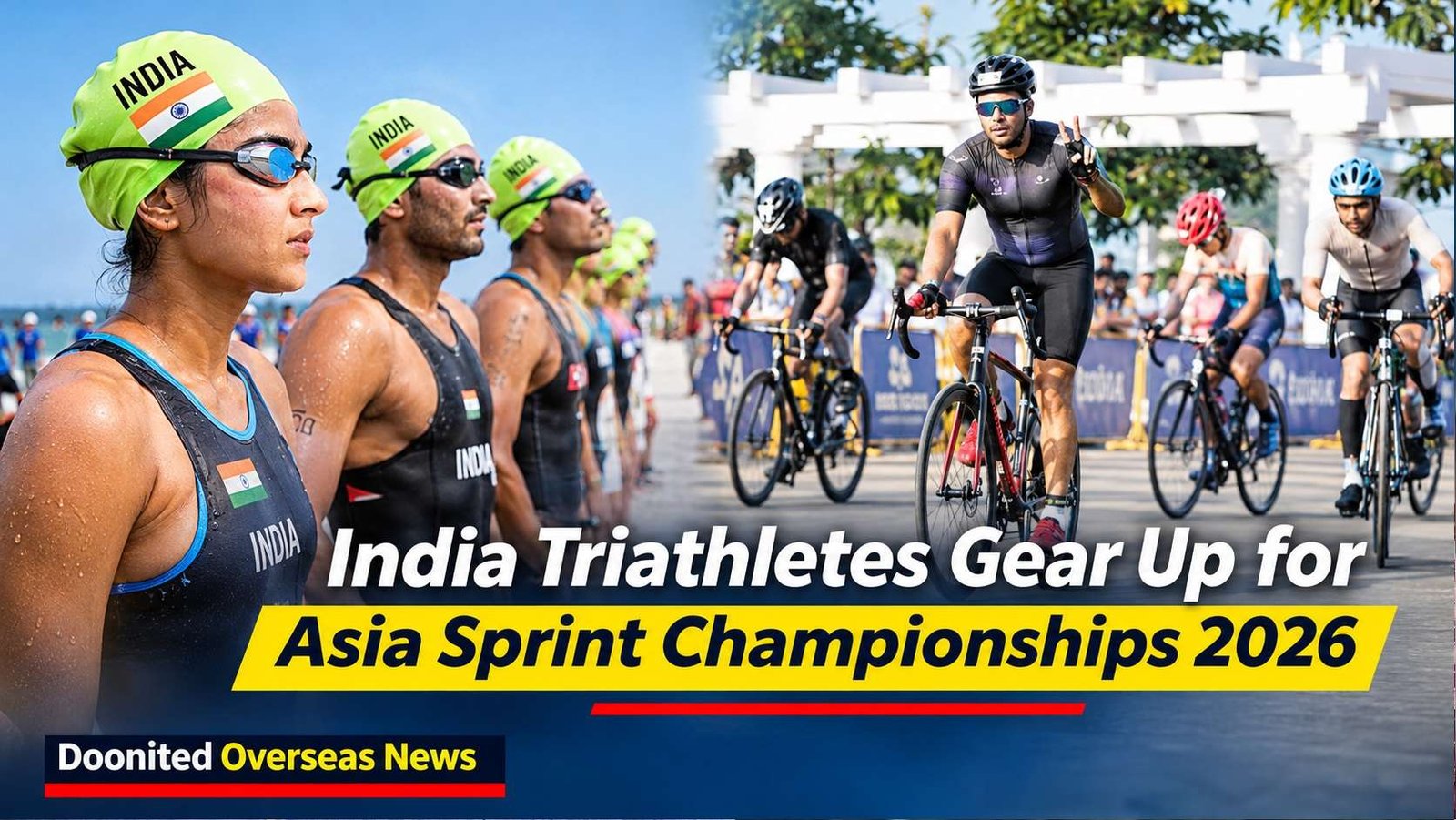
India’s triathlon contingent is preparing for an international test in Jordan, with athletes selected through the Indian Triathlon Federation’s national championship in Pune set to compete at the 2026 Asia Triathlon Sprint Championships in Aqaba.
The championship will bring elite and age-group competitors to the coastal city on the Red Sea. According to World Triathlon’s event information, the competition begins on November 26, with the elite races and age-group championship scheduled across the following days.
For India, the event is an opportunity to measure its developing triathlon talent against competitors from across Asia. The selection also highlights the sport’s multiple pathways, from elite racing to amateur age-group participation.
Pune provided the selection platform
The Indian Triathlon Federation (ITF) conducted its miniOrange National Triathlon Championship at the Shree Shiv Chhatrapati Sports Complex in Balewadi, Pune, on August 15–16, 2026.
The federation announced the selected contingent on September 9. Its published selection announcement says the top three finishers in the senior, Under-23 and amateur age-group categories secured qualification for the Aqaba competition.
The elite men’s category produced a particularly close finish. Karnataka’s KP Yajat won in 57 minutes and 25.43 seconds, narrowly ahead of Adarsh MS of the Services Sports Control Board, who recorded 57:25.46. Sarungbam Athouba Meitei of Manipur finished third in 58:07.50.
The difference between the first two recorded times was just 0.03 seconds, or 30 milliseconds. It demonstrated the narrow margins that can separate competitors in sprint-distance triathlon.
In the elite women’s event, Tamil Nadu’s Keerthi Sakthivel finished first in 1:03:35.04. Maharashtra’s Dolly Patil followed in 1:04:17.17, while Mansi Mohite took third place in 1:05:39.85.
These results give the Indian contingent two prominent names to follow in Aqaba, although performances at the national championship do not guarantee the same outcomes against an international field.
A wider pathway beyond elite competition
The selection announcement also identifies amateur competitors across age groups, including 16–19, 20–24, 25–29, 30–34, 35–39, 40–44, 45–49, 50–54, 55–59 and 60-plus categories.
Athletes listed by the federation include Thokchom Gautam Singh of Manipur, Sargam Bathre of Madhya Pradesh, Uday Haridas Jadhav of Maharashtra, Nongmaithem Nelshi of Manipur, Devika Sarma of Assam, Jalaj Arora of Delhi and several others.
The published list also shows representation from states including Meghalaya, Karnataka, Uttar Pradesh, Andhra Pradesh and West Bengal.
This broader participation is significant because triathlon is not restricted to professional athletes. Its combination of swimming, cycling and running creates opportunities for competitors at different stages of their sporting lives. Age-group championships allow amateur athletes to represent their country in an international competitive setting without being part of the elite professional category.
The ITF’s website describes separate development pathways for children, age-group participants, professional athletes and para-triathletes. Such pathways are important to building a wider sporting base, although long-term progress will depend on coaching, access to facilities, athlete support and regular competition.
Aqaba presents a different race environment
The Aqaba championship will take place at AYLA, a coastal development in Jordan’s Red Sea city. The official event information describes a sea swim, followed by a technically demanding cycling course with rolling terrain and a rolling run course.
The event’s published course information gives indicative air temperatures of 21–25°C and water temperatures of 23–24°C. These are event-page conditions, not a guaranteed race-day weather forecast.
The transition from swimming to cycling and then running makes triathlon a demanding test of endurance, pacing and technical preparation. Athletes must manage their effort across all three disciplines rather than treating each section as an independent race.
The Aqaba course will therefore provide a different competitive setting from the national event in Pune. Familiarity with open-water swimming, cycling in a technical field and maintaining running pace after the first two disciplines will be important.
The ITF has announced plans for a two-week national preparation camp, focusing on open-water swimming, transition speed and drafting tactics. It has also indicated that athletes who finished just outside the qualifying positions may be invited to join the training environment. The federation’s announcement describes these as planned preparations; the completion and final details of the camp should be confirmed separately.
What the championship means for Indian triathlon
India’s participation in Aqaba is one step in the longer development of a sport that requires coordinated investment across swimming, cycling and athletics.
A wider age-group base can help build participation and create a stronger sporting culture. At the elite level, however, progress must ultimately be measured through international results, consistency and the ability to compete against established Asian programmes.
For Indian sports followers living abroad, the championship offers an opportunity to follow national athletes competing on an international stage. The event also provides a useful measure of how India’s emerging triathlon ecosystem is developing beyond domestic competition.
The next milestone is the race itself. Aqaba will reveal how well the selected athletes translate their national performances into international competition—and whether India’s growing participation can produce stronger results at the Asian level.
Originally published on Doonited Overseas: Read the original article

World Beyond the News
Bees Communicate Where Food Is
Honeybees use movement patterns known as waggle dances to communicate information about food locations.
Street Food Reflects Local History
Many famous street foods developed from migration, trade, local ingredients and the everyday needs of working communities.
A Day on Venus Is Extremely Long
Venus rotates so slowly that one rotation relative to distant stars takes longer than its trip around the Sun.
Human Achievement Continues to Push Limits
Athletes, engineers, scientists and explorers regularly establish new benchmarks in speed, endurance, scale and precision.