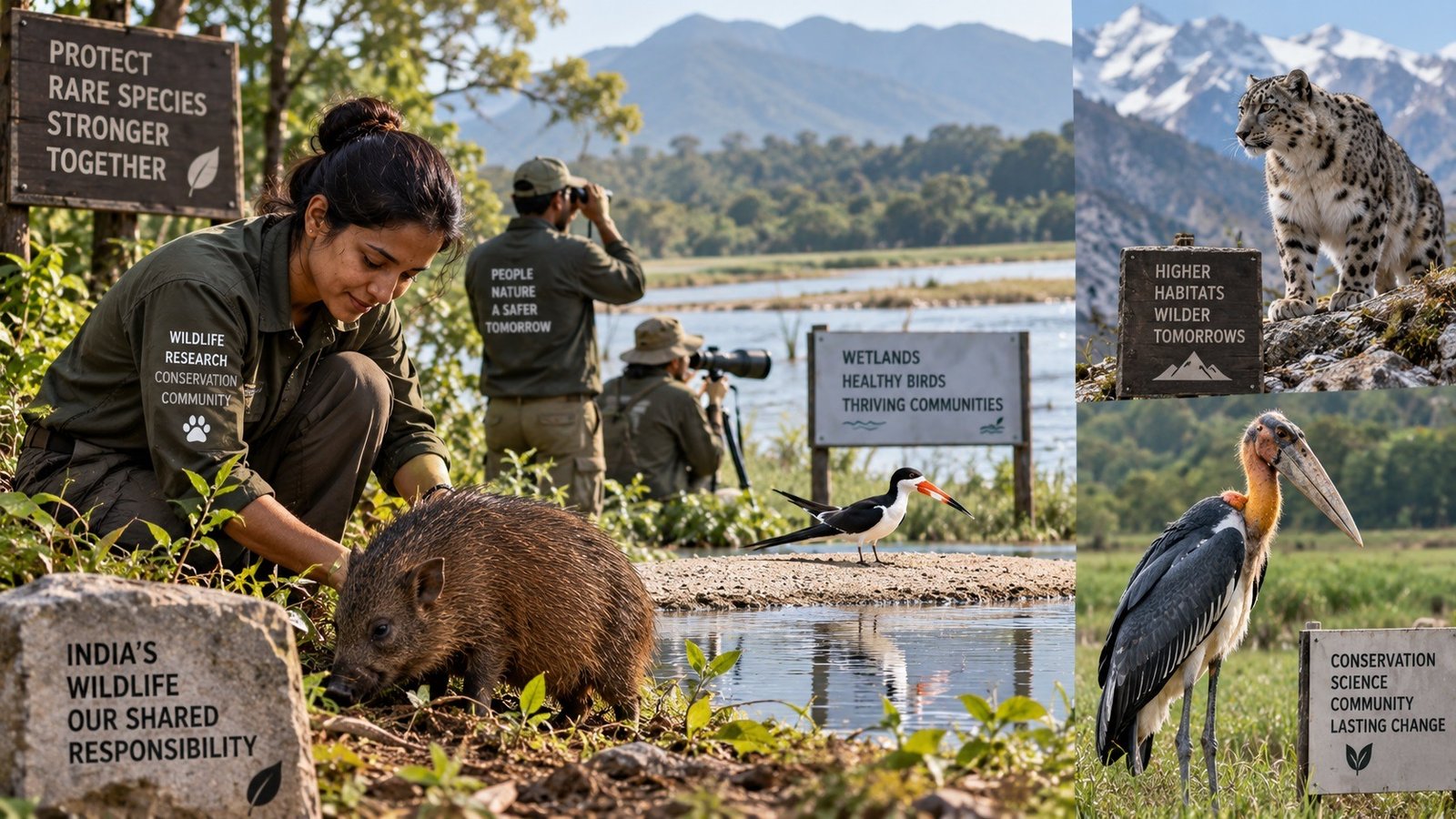
The People Saving Species Most of Us Rarely Notice
India’s wildlife conservation story is often told through tigers, elephants and rhinos. But some of the country’s most remarkable conservation battles involve animals that many Indians would struggle to recognise — and people whose names rarely make national headlines.
Ask someone to name an Indian conservation success story and the chances are good that the answer will involve a tiger.
Fair enough. Tigers deserve the attention.
But India’s forests, grasslands, rivers and mountains contain hundreds of other species whose survival depends on people working far from television cameras and tourist jeeps.
A tiny wild pig in Assam.
A strange-looking stork that villagers once regarded as a nuisance.
A river bird with a bizarre lower bill.
A high-altitude predator that can kill livestock.
These animals have something in common.
Their conservation depends not simply on wildlife sanctuaries, but on patient science, local communities, field workers and people willing to spend years protecting creatures most of the country barely knows exist.
The World’s Smallest Wild Pig Has a Very Big Story
In the tall grasslands of Assam lives the pygmy hog, regarded as the world’s smallest wild pig.
It is also one of India’s most threatened mammals.
The animal was once thought to be extinct before being rediscovered in 1971. Habitat loss left only a tiny surviving wild population in Assam, particularly around Manas. The species is closely tied to tall grassland ecosystems, which provide food, nesting material and shelter.
Then conservationists tried something that required considerably more patience than a press conference.
They started again.
The Pygmy Hog Conservation Programme, established in 1995–96, developed captive-breeding facilities, prepared animals for release and worked on grassland restoration.
The starting point was almost painfully small: six pygmy hogs were brought into captivity in 1996 to establish an insurance population.
By June 2026, the programme reported that 194 pygmy hogs had been bred and released, including 15 released into the Kuribeel grasslands of Manas National Park — the same landscape from which the conservation programme’s original captive population had been established.
But the real story is bigger than 194 pigs.
Pygmy hogs are considered an indicator species. Their presence tells conservationists something about the health of the grassland ecosystem itself.
Protect the pig, and you are also protecting its habitat.
And that habitat supports Bengal floricans, elephants, rhinos, tigers and numerous other species.
In other words, the tiny pig has accidentally become a very effective ambassador for a very large landscape.
Conservation Is Also About Grass
This is one of the least glamorous truths in wildlife conservation.
Saving an animal often means saving something that humans barely notice.
Grass.
At Manas, conservation teams are restoring grasslands, managing invasive plants and monitoring pygmy hog populations. Community members, including people from the Bodo community, are participating in habitat restoration and receiving practical training.
The programme now involves a wider team working across multiple sites, with monitoring, radio telemetry, captive breeding and reintroduction forming part of the conservation effort.
It is not cinematic.
There is no dramatic chase scene.
There is a lot of grass.
And that may be precisely the point.
Conservation success is often built from thousands of ordinary field decisions.
Along the Chambal, the Riverbank Becomes a Nursery
Travel west from Assam to the Chambal and the conservation problem changes.
Here, sandbanks along the river provide breeding habitat for species including the Indian Skimmer, one of India’s most distinctive river birds.
The bird’s unusual bill makes it look as if evolution gave it a rather eccentric engineering project.
But its survival is anything but funny.
Nest sites can be vulnerable to predators, cattle, human disturbance and changing river conditions.
Wildlife Trust of India developed a community-based nest protection programme in the National Chambal Sanctuary, working with local communities, the Forest Department and conservationists.
In one documented pilot, two Indian Skimmer nesting sites were protected. The programme recorded 42 active nests and 54 fledglings at those sites.
That is a useful lesson in conservation.
The people protecting wildlife do not always need to be carrying tranquiliser darts or sitting in a research laboratory.
Sometimes they are simply watching a sandbank.
And making sure that nobody accidentally destroys a nest.
The Gharial Needs the Same River
The Chambal story also involves the gharial, one of India’s most distinctive and threatened crocodilians.
Its extraordinarily narrow snout is adapted largely for catching fish, and it depends heavily on riverine habitats and suitable sandy banks for breeding.
The National Chambal Sanctuary is therefore important not just for one species but for an entire river ecosystem. Wildlife Trust of India describes the sanctuary as a major breeding area for gharials, Gangetic dolphins and threatened riverine birds including the Indian Skimmer.
This makes river conservation an unusually complicated task.
Protecting wildlife means dealing with sand extraction, fishing practices, river flow, disturbance and the condition of nesting islands.
A crocodile cannot file a complaint about a badly managed river.
The ecosystem has to speak through its biology.
In Ladakh, Saving a Snow Leopard Can Mean Helping a Shepherd
At the opposite end of India’s landscape is the snow leopard.
The animal has become an international symbol of Himalayan wilderness, but conservationists have long understood a simple problem:
A predator cannot survive peacefully if the people sharing its habitat are paying the price.
Snow leopard attacks on livestock can create serious economic losses for mountain communities.
The conservation approach associated with Rinchen Wangchuk and the Snow Leopard Conservancy-India Trust sought to change that relationship by connecting conservation with local livelihoods.
Predator-proof livestock corrals reduced vulnerability to attacks, while community-based tourism and Himalayan homestays created opportunities for local families to benefit from the presence of snow leopards. The Snow Leopard Conservancy describes these interventions as part of a broader effort to transform the animal from a perceived competitor into a valuable community asset.
Rinchen Wangchuk died in 2025, but the community-conservation model he helped develop continues through the organisation and its local partnerships.
The principle is powerful:
If wildlife protection costs local people their livelihood, conservation becomes extremely difficult to sustain.
If protecting wildlife can also generate income, reduce losses and strengthen community pride, the equation changes.
The Hargila Army: When a “Ugly” Bird Became a Village Symbol
Then there is Assam’s Greater Adjutant Stork, locally known as hargila.
It is a large, unusual-looking bird with an unfortunate public-relations history.
Its scavenging habits did not exactly make it popular.
In Assam, however, conservation efforts led by biologist Dr. Purnima Devi Barman helped turn the bird into a symbol of community pride.
The Hargila Army, a grassroots network of rural women, has become one of the most recognisable examples of community-led bird conservation in India. National Geographic reported in 2025 that the network numbered around 20,000 women, reflecting how far the movement had expanded beyond conventional wildlife organisations.
The strategy was not simply to tell villagers that the stork was endangered.
It was to make the bird socially valuable.
Women became conservation advocates.
Nesting trees on private land became worth protecting.
The bird became part of local identity rather than merely another entry in an endangered-species report.
That is a profound shift.
You cannot place a forest guard beside every tree where a bird chooses to nest.
But you can build a community that notices when that tree is threatened.
The Conservation Hero Is Often a Team
There is another important correction to the idea of the “conservation hero.”
Wildlife stories sometimes become too dependent on one charismatic individual.
But the pygmy hog programme is a collaboration involving conservation organisations, the Assam Forest Department, the Government of India, the IUCN Wild Pig Specialist Group and other partners.
The Chambal nesting work similarly combines researchers, communities and government agencies.
The snow leopard model depends on local families as well as conservation organisations.
And the Hargila story belongs as much to the women who protect the bird as to the scientists who helped establish the conservation programme.
Perhaps “guardian” is therefore a better word than “hero”.
A hero can save the day.
A guardian stays for the next decade.
Why Lesser-Known Species Matter
There is a temptation to divide wildlife into “important” animals and everything else.
That is ecologically dangerous.
An ecosystem is not a celebrity guest list.
Small mammals influence vegetation.
Birds move nutrients and seeds.
Predators regulate prey.
Grasslands store carbon, support livestock systems and provide habitat.
Rivers support fish, birds, reptiles, agriculture and human communities.
Protecting a species can therefore mean protecting an entire ecological relationship.
The pygmy hog is a particularly good example: its conservation requires maintaining the grassland system on which numerous other species depend.
DOONITED View: India’s Conservation Story Needs More Than Tigers
India should continue protecting its tigers.
But perhaps the country also needs to become better at noticing the animals that do not have the same public-relations budget.
The pygmy hog will never generate the same tourist excitement as a tiger walking across a safari road.
The Indian Skimmer does not roar.
The gharial is unlikely to appear on a luxury wildlife brochure as often as a leopard.
The Greater Adjutant is not going to win a beauty contest.
And the snow leopard may spend days making sure nobody sees it at all.
Yet each represents a different conservation lesson.
Protect habitats. Work with communities. Use science. Create economic incentives. Stay for the long term.
That may be India’s most important wildlife formula.
Conservation is not successful merely because an animal survives inside a protected boundary.
It succeeds when the landscape around that animal becomes resilient enough for the species — and the people living alongside it — to have a future.
Learning Point
The best conservation stories are not always about rescuing an animal. They are about changing the relationship between people, wildlife and habitat.
A tiny pig brought back from six founders.
A riverbank watched through nesting season.
A snow leopard turned from livestock threat into community asset.
A stork transformed from village nuisance into village pride.
These are not four unrelated stories.
They are four versions of the same idea:
Wildlife survives when conservation becomes something people can participate in, understand and ultimately take ownership of.
India’s most important wildlife guardians may therefore be the people whose names we rarely hear — quietly doing the work long after the headlines have moved elsewhere.


World Beyond the News
Birds Can Navigate Using Earth’s Magnetic Field
Several bird species can sense Earth’s magnetic field, helping them navigate during long-distance migration.
Fermentation Is a Global Food Tradition
People across continents have used fermentation for centuries to preserve food and create distinctive flavours.
Modern Batteries Store Energy Chemically
Rechargeable batteries repeatedly move ions between electrodes, allowing electrical energy to be stored and released.
Why Songs Become Global Hits
Streaming platforms, short-form video, playlists and international collaborations can rapidly carry music across borders.