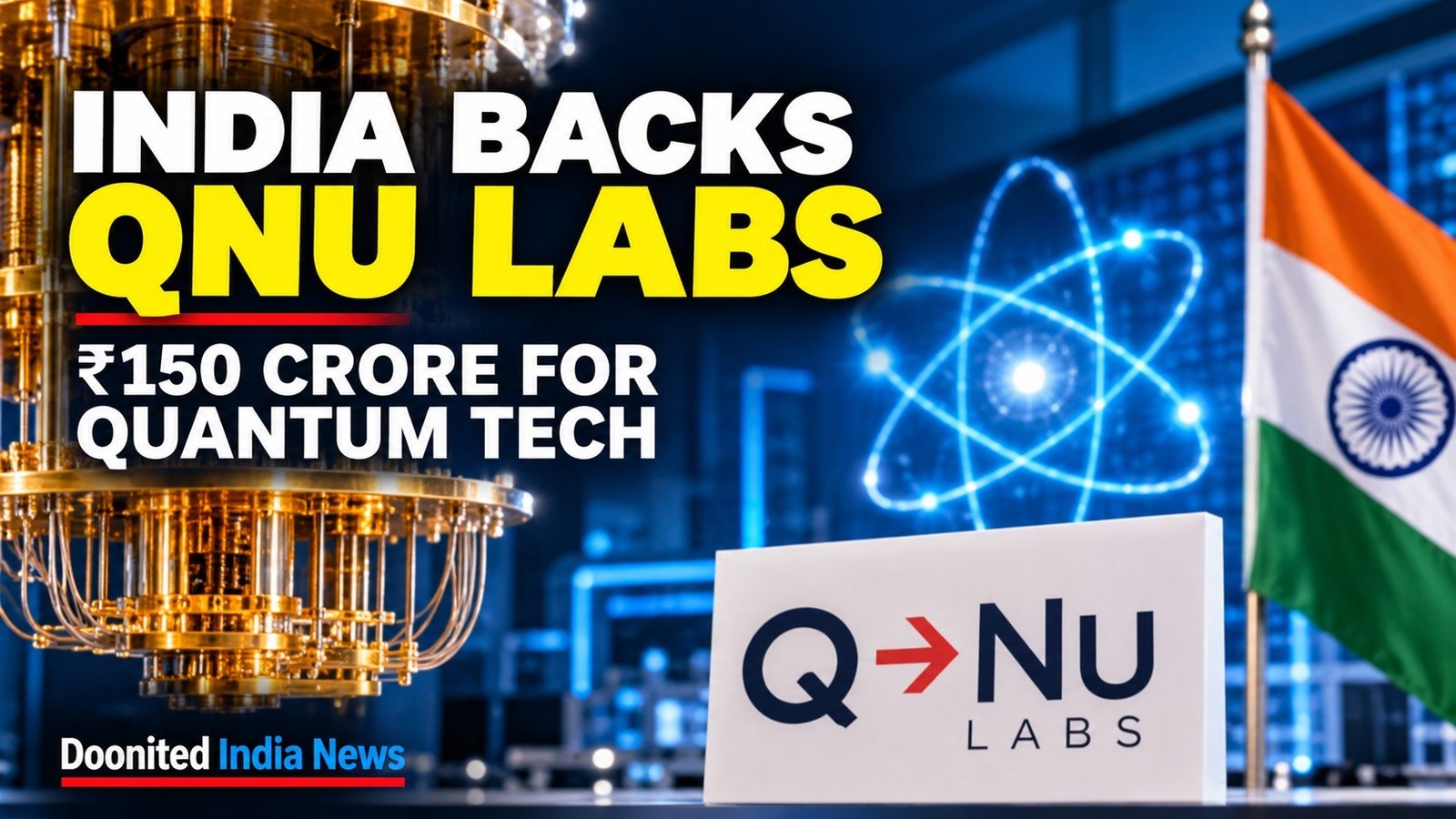
India’s ₹150-Crore Quantum Security Bet: Can QNu Labs Turn Research into Trusted Networks?
Standfirst: India has committed ₹150 crore in support for Bengaluru-based QNu Labs to develop indigenous quantum-secure communications and sensing technologies. The wider ₹300-crore programme aims to move several technologies from development-stage prototypes towards operational systems. It is a significant step for India’s strategic technology ambitions—but the real test will be reliability, independent validation, integration and adoption, not the funding announcement alone.
A cyberattack can steal information without breaking into a building. A forged device identity can undermine a network. A manipulated navigation signal can mislead a vehicle, while inaccurate timing can disrupt systems that depend on precise coordination. These threats are different, but they share a common weakness: modern infrastructure increasingly depends on digital trust.
India is now making a substantial investment in technologies intended to strengthen that trust. On 16 October 2026, the government’s Technology Development Board (TDB), under the Department of Science and Technology (DST), signed an agreement to provide ₹150 crore in support to Bengaluru-based QNu Labs under the Research Development and Innovation (RDI) Fund. The company’s wider project is valued at ₹300 crore and is intended to develop an indigenous technology backbone for India’s Quantum Secure and Sensing Networks (IQSN).
The financing is being provided through optionally convertible debt, not simply as an unconditional grant. The project aims to advance technologies currently described at Technology Readiness Levels (TRLs) 4–5 towards TRL 9, the stage associated with systems demonstrated in operational environments.
The ambition is significant: develop more of the technology India needs to secure communications, authenticate devices, protect navigation and maintain reliable timing. But funding research and deploying dependable infrastructure are two very different milestones.
What makes quantum-secure communication different?
Conventional digital security relies heavily on mathematical cryptography. Encryption protects information, while digital signatures, authentication systems and secure protocols help establish who is communicating and whether information has been altered.
Quantum technologies offer additional approaches, including quantum key distribution (QKD). In a QKD system, quantum states—often carried by photons—are used to establish shared encryption keys. Under the appropriate protocol and implementation, attempts to intercept the quantum transmission can be detected through changes in the observed signals.
The distinction matters because future advances in quantum computing could threaten some widely used public-key cryptographic systems. Information stolen and stored today might, in certain circumstances, be decrypted later if a sufficiently capable quantum computer becomes available. Security planners call this the “harvest now, decrypt later” risk.
However, quantum communication is not a universal replacement for cybersecurity. QKD does not encrypt every message by itself, prevent all forms of hacking or eliminate weaknesses in the devices and networks around it. It also requires specialised equipment and carefully engineered links.
Post-quantum cryptography (PQC) is a separate approach. It uses mathematical algorithms designed to resist attacks from both conventional and quantum computers and can often be deployed through software and system updates. For many organisations, PQC migration will be a central part of preparing for the quantum era, whether or not they deploy QKD.
India’s long-term security strategy will need to assess how these approaches complement one another, rather than treating any single technology as a complete solution.
Four pillars, one security ecosystem
According to the government’s announcement, QNu Labs’ programme is organised around four connected areas.
Network security: The company plans to advance quantum-secure communications, including chip-based and satellite-based QKD. Satellite links could eventually help connect distant locations where extending fibre networks is difficult, although operational performance depends on link design, weather, pointing accuracy and ground infrastructure.
Identity security: Physical unclonable functions (PUFs) and trusted platform modules (TPMs) can help establish device identity and protect cryptographic operations. Their value depends on secure implementation, resistance to physical and digital attacks, and integration with the systems they are meant to protect.
Location integrity: Quantum sensing, including compact quantum magnetometers, could support navigation or detect magnetic anomalies in environments where satellite navigation is unavailable or unreliable. These technologies may be useful in defence and other specialised applications, but practical performance must be established under real operating conditions.
Time integrity: High-precision atomic clocks and secure time-distribution systems could strengthen networks that depend on accurate synchronisation. Telecommunications, financial infrastructure and critical industrial systems all rely on dependable timing, though a clock alone cannot guarantee that every part of a network is secure.
The value of this approach lies in integration. A protected communication link can still be undermined if an endpoint is compromised, a device identity is forged or the surrounding system is poorly configured. Combining secure communications with trusted devices, navigation and timing may offer a more complete foundation.
That is the programme’s promise. Whether the four areas can be integrated into a reliable, affordable and maintainable system remains to be demonstrated.
India’s wider quantum strategy
The investment sits within a broader national effort. India’s National Quantum Mission, approved in April 2023 with an outlay of ₹6,003.65 crore for 2023–24 to 2030–31, supports research and development in quantum computing, communications, sensing and related technologies.
One of its objectives is to develop secure quantum communication links, including satellite-based connections and inter-city quantum key distribution. The government reported in April 2026 that a 1,000-kilometre quantum communication network had been demonstrated using indigenous technology developed by QNu Labs under the mission.
That milestone provides relevant context: the company is not entering the field solely through the newly announced funding. But a long-distance demonstration and a fully operational national network are not the same thing. A demonstration establishes that a defined technical objective can be achieved under specified conditions; operational deployment additionally requires reliability, maintenance, security assurance, interoperability and a sustainable cost model.
The distinction is especially important when public funding is involved. The ₹150-crore support is a major commitment to a particular company and project, but it does not mean the proposed systems are already ready for use across defence, banking, telecommunications or power infrastructure.
The difficult journey from prototype to deployment
The programme aims to move technologies from TRL 4–5 towards TRL 9. In practical terms, that means progressing from validated components or prototypes towards systems proven in their intended operational environment.
Several hurdles stand between those stages.
First, fibre networks impose physical limits. Optical signals weaken over distance, and quantum states cannot simply be amplified using ordinary optical repeaters without disrupting the quantum information. Longer-distance systems therefore require carefully designed architectures, including trusted nodes or more advanced quantum-repeater approaches. Each has different security and engineering trade-offs.
Second, laboratory performance must survive real conditions. Satellite and free-space optical links face atmospheric turbulence, background light, pointing errors and changing weather. Hardware intended for commercial or government networks must also tolerate temperature variation, vibration, maintenance cycles and component ageing.
Third, products must work with existing infrastructure. Telecom operators, banks and public agencies cannot replace entire networks just to accommodate one new technology. Equipment needs tested interfaces, secure key management, compatibility with established cryptographic systems and clear procedures for failures and upgrades.
Finally, commercial reliability matters as much as technical novelty. Buyers need evidence of security, independent testing, service support, predictable costs and dependable manufacturing. A system may work in a controlled demonstration yet remain too expensive or complex for widespread use.
The government’s announcement does not provide a public breakdown of milestones, deployment sites, named customers or the full financing terms. These are reasonable items for stakeholders to watch as the project progresses.
What should India measure next?
The most meaningful indicators of progress will be practical rather than promotional:
Independent validation: Are the systems tested by qualified, independent evaluators under realistic conditions?
Operational demonstrations: Can they function reliably over relevant distances and across changing environments?
Interoperability: Can they integrate with existing telecom, financial and government networks?
Domestic manufacturing: Can critical components be manufactured and supported at a dependable quality and cost?
Real customers: Do government agencies or commercial operators deploy the systems and continue using them after pilot projects?
Clear public accountability: Are project milestones and outcomes disclosed sufficiently to show how the public investment is being used?
These measures would help distinguish scientific progress from commercial readiness. They would also give other Indian deep-technology companies a clearer example of what it takes to move from promising research to products that customers can trust.
Strategic technology needs proof, not just promise
India’s investment in QNu Labs addresses a legitimate strategic need. Secure communications, trusted navigation and reliable timing are increasingly important to digital infrastructure, and domestic expertise can give the country more control over how critical systems are developed and maintained.
Yet technological sovereignty should not be confused with domestic ownership alone. A system is strategically valuable when it performs reliably, can be independently assessed, can be maintained over time and offers a credible alternative to existing solutions.
The ₹150-crore commitment creates an opportunity to advance indigenous quantum technology. Its lasting significance will depend on what follows: robust testing, transparent milestones, successful integration and adoption by real users. Quantum security will not remove every cyber risk, and it should complement—not replace—sound conventional cybersecurity and post-quantum cryptography planning.
The real achievement will not be the announcement of a quantum-secure network. It will be a network that continues to protect critical communications when conditions are difficult, attackers are persistent and the system is no longer operating in a laboratory.
Learning point
When assessing advanced-technology funding, distinguish three milestones: money committed, technology demonstrated and a product deployed successfully. Each matters, but only the last establishes that the technology is delivering dependable value in its intended environment.


World Beyond the News
Dolphins Use Individual Signature Whistles
Bottlenose dolphins develop distinctive whistles that function somewhat like individual acoustic identifiers.
The Pacific Is Earth’s Largest Ocean
The Pacific Ocean covers more area than any other ocean basin and stretches between Asia, Australia and the Americas.
Artificial Intelligence Learns Statistical Patterns
Modern machine-learning systems identify patterns in large datasets and use those patterns to generate predictions or outputs.
Why Some Stories Spread So Quickly
Emotion, novelty, visual appeal and easy sharing can make a story travel rapidly across social platforms.