How Indian Women’s Cricket Built Its Own Big League
There was a time when women’s cricket in India had to fight for something more basic than records: regular matches, regular visibility and regular belief.
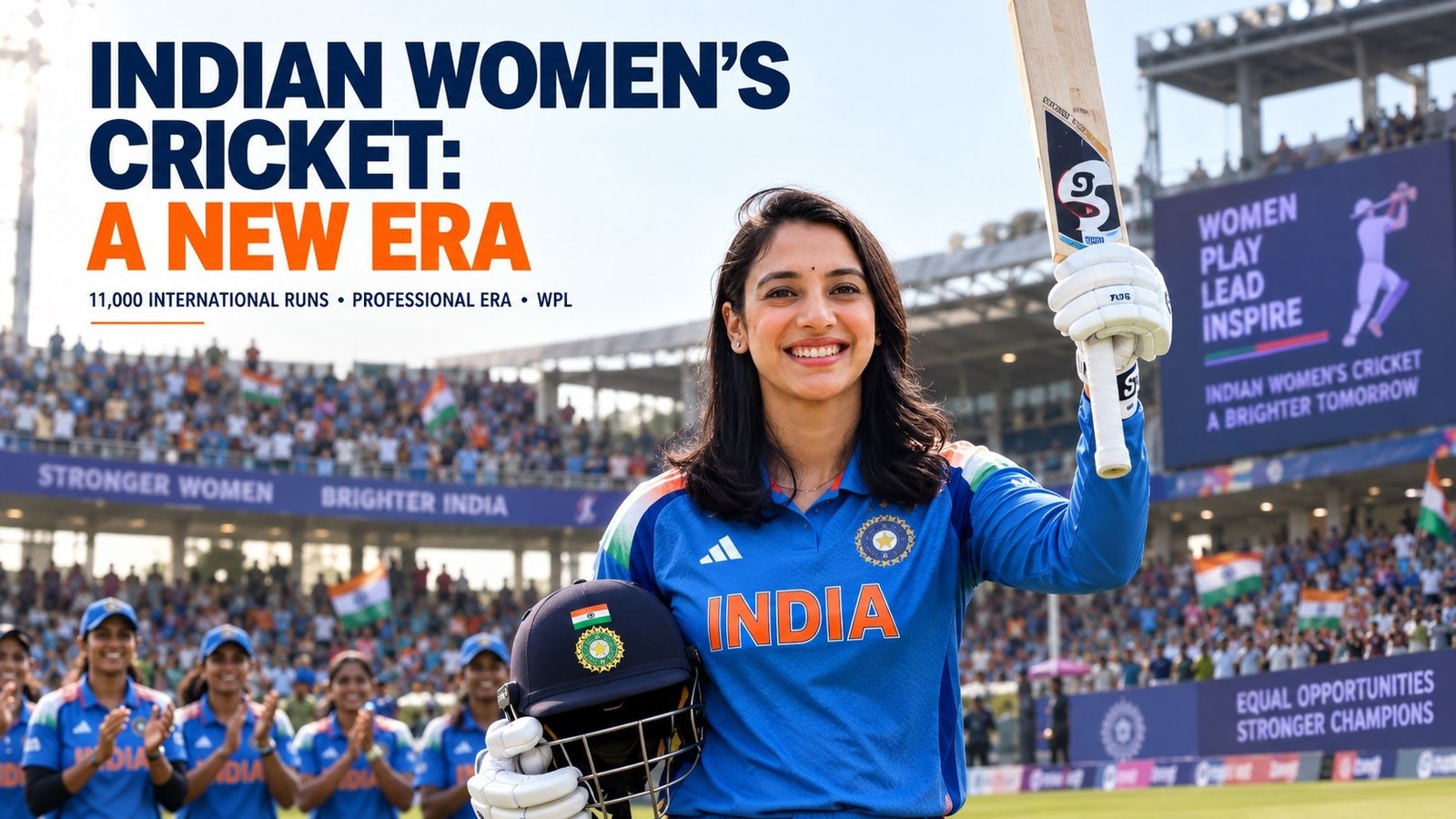
On September 22, 2026, Smriti Mandhana walked into the Aichi-Nagoya Asian Games women’s cricket final needing only a handful of runs for another personal landmark.
Ten balls later, history had changed.
Mandhana became the first woman cricketer to reach 11,000 international runs during India’s gold-medal match against Sri Lanka in Nisshin, Japan. She eventually made 79 from 45 balls, including five fours and seven sixes, as India scored 216 for 3 and defeated Sri Lanka by 147 runs to retain the Asian Games women’s cricket gold.
It was an individual milestone.
But it also tells a much bigger Indian story.
The rise of Mandhana is inseparable from the rise of the ecosystem around her.
Eleven thousand runs did not arrive overnight
Mandhana made her international debut in 2013.
By September 2026, she had become the leading run-scorer in women’s international cricket across formats, overtaking players including Mithali Raj and Australia’s Meg Lanning. The ICC had already recorded Mandhana at 10,880 international runs and 18 centuries earlier in September 2026.
The arithmetic is impressive.
The history behind the arithmetic is more interesting.
Mandhana belongs to a generation that inherited a considerably more structured women’s game than the one available to many of India’s earlier players.
That does not diminish what earlier generations achieved.
Quite the opposite.
It explains why their work matters.
Before the spotlight, there was the struggle for structure
Indian women’s cricket existed long before the current television era.
But opportunities were more limited: fewer international matches, smaller domestic visibility, less commercial attention and far fewer professional pathways.
The transformation has been incremental.
BCCI’s move toward formal player contracts created a more predictable professional framework. The 2025–26 senior women’s contracts include Grade A players such as Smriti Mandhana, Harmanpreet Kaur and Jemimah Rodrigues, alongside players in Grades B and C.
Then came a particularly important change.
In October 2022, the BCCI announced equal international match fees for contracted women and men cricketers: ₹15 lakh for a Test, ₹6 lakh for an ODI and ₹3 lakh for a T20I at the time of the announcement.
That was not the same thing as eliminating every difference in cricket economics.
It was, however, a significant institutional statement:
international women’s cricket was professional cricket.
Then came the WPL
If equal match fees changed the conversation around professional status, the Women’s Premier League changed the commercial landscape.
The inaugural WPL was played in 2023, with five franchises and 22 matches. BCCI’s auction process attracted 1,525 registrations, with 409 players eventually included in the auction list.
The media-rights deal was also substantial.
Viacom18 secured the WPL’s global television and digital rights for the 2023–27 cycle for ₹951 crore, equivalent to ₹7.09 crore per match according to BCCI’s announcement.
Five franchise bids for the inaugural teams brought another ₹4,669.99 crore in combined bids.
Suddenly, women’s cricket was not simply asking for a larger slice of the cricket audience.
It had its own league, its own franchises, its own auction and its own commercial ecosystem.
And young Indian players could see a professional pathway that went beyond hoping to make the national side.
Visibility changes ambition
This may be the least measurable but most important part of the transformation.
A young girl watching Mandhana bat today is seeing something different from a young girl watching women’s cricket two decades ago.
She can watch international cricket live.
She can follow domestic competitions.
She can see the WPL auction.
She can watch Indian players share dressing rooms with international stars.
She can imagine cricket as a career rather than merely an extracurricular activity.
That psychological change matters.
Sports ecosystems do not grow only because administrators build tournaments.
They grow because children begin to believe the pathway exists.
Mandhana’s record is bigger than one batter
There is an amusing contradiction in sports statistics.
A record book makes history look like an individual activity.
Eleven thousand runs appear beside one name.
But those runs required coaches, teammates, opponents, medical teams, strength and conditioning staff, domestic competitions, selectors, travel infrastructure, pitches, broadcasting, contracts and thousands of hours of practice.
Even the milestone itself arrived in a team achievement.
India did not merely watch Mandhana reach 11,000.
The team won gold.
Mandhana and Shafali Verma opened with a 99-run partnership in the final, India reached 216 for 3, and Sri Lanka were dismissed for 69.
Mandhana’s milestone was therefore embedded inside a larger demonstration of India’s current depth.
And the next generation is already visible
The significance of professionalisation is that Mandhana should not be the endpoint.
She should be part of the middle of the story.
Shafali Verma is already an established international player. Richa Ghosh’s unbeaten 49 from 22 balls in the Asian Games final showed another generation capable of producing high-impact performances.
The BCCI’s current Grade C contract list also includes younger players such as G Kamalini, Vaishnavi Sharma, Tejal Hasabnis and Sree Charani.
That is what a functioning sporting system is supposed to produce:
not one superstar, but a pipeline.
The WPL is important — but it cannot solve everything
There is a danger in treating the WPL as the final answer.
A franchise league can create money, visibility and elite competition.
It cannot by itself create a nationwide sporting ecosystem.
The less glamorous machinery matters enormously:
- school-level participation;
- state associations;
- domestic tournaments;
- quality coaching;
- safe sporting environments;
- access to facilities;
- strength and conditioning;
- medical support;
- opportunities outside major cricket centres.
The BCCI’s 2026–27 domestic calendar contains 1,788 matches across age groups and formats, including senior, U23, U19 and U15 women’s competitions.
That is the kind of infrastructure that makes a professional league sustainable.
The glamorous bit is the televised final.
The real factory is the match being played on an ordinary afternoon somewhere else.
The economics of visibility
There is another change worth noticing.
Women’s cricket now has commercial value that can be measured.
BCCI’s WPL media-rights deal, franchise investments and player auctions demonstrate that broadcasters and businesses see a market in women’s cricket.
That creates a virtuous possibility:
more visibility → more audience → more commercial value → more investment → better infrastructure → stronger players → better cricket → more visibility.
Of course, real markets are never that tidy.
Audience figures fluctuate. Player careers are short. Sponsorships change. Injuries happen. Franchise economics can be complicated.
But the fundamental shift is unmistakable.
Women’s cricket is increasingly being treated not as a charitable extension of men’s cricket, but as a sporting property with its own audience and commercial logic.
The Mandhana effect is also cultural
Mandhana’s significance extends beyond statistics.
She represents a particular kind of sporting normalisation.
A girl can now grow up seeing an Indian woman opening a major international innings, playing in packed stadiums, appearing in global tournaments and becoming a central figure in a professional league.
That visibility can change what “sportswoman” means in everyday Indian life.
It does not mean every girl will become a cricketer.
It means fewer girls need to explain why they want to try.
That is progress of a different kind.
There is still unfinished work
Celebrating the transformation should not mean pretending every structural problem has disappeared.
Access remains uneven across India.
Elite women’s cricket is much more visible than grassroots women’s sport generally.
And professional opportunity is concentrated among a relatively small number of players.
The next phase should therefore be about depth rather than merely spectacle.
If India wants the Mandhana of 2040, it needs the cricket grounds, coaches, competitions and support systems of 2030.
The superstar is the visible tip.
The ecosystem is the iceberg.
DOONITED View: The biggest Mandhana record is not 11,000
Eleven thousand runs is an extraordinary cricket statistic.
But the more interesting number may be impossible to put in a scorebook.
It is the number of young Indian girls who now see professional women’s cricket as a normal career possibility.
Mandhana did not create the entire transformation.
Nor did the WPL.
Nor did equal pay.
Nor did television.
The change came from many pieces fitting together over time.
Earlier generations created the foundation.
Institutions built more professional structures.
Broadcasters expanded visibility.
The WPL created a commercial platform.
And players such as Mandhana, Harmanpreet Kaur and others turned opportunity into performance.
That is how sporting revolutions usually happen.
Not with one dramatic announcement.
With enough small structural changes that eventually produce something everyone can see.
And on September 22, 2026, everyone could see it.
11,000 runs.
An Asian Games gold medal.
And a women’s cricket ecosystem that looks very different from the one India once knew.
Learning Point
A sporting superstar can inspire a generation.
But a sporting system gives that generation somewhere to go.
India’s challenge now is not simply to produce another Smriti Mandhana.
It is to ensure that thousands of young girls have the opportunity, coaching, competition, facilities and professional pathways necessary to discover whether they could become one.
That is the real meaning of a cricket record.
The number belongs to Mandhana.
The possibility belongs to the next generation.


World Beyond the News
Why Elephants Stay Close to Their Herd
Elephants live in highly social family groups and use calls, touch and body movements to maintain strong bonds.
Most of the Deep Ocean Remains Difficult to Explore
Extreme pressure, darkness and distance make deep-ocean exploration one of Earth’s greatest scientific challenges.
Spacecraft Can Travel Without Traditional Roads
Spacecraft use carefully calculated trajectories and gravity assists to travel enormous distances through space.
Why Movie Trailers Are Released in Stages
Major films often use teaser trailers, full trailers and final promotional spots to build awareness over time.