Young India Is Learning to Solve Problems, Not Just Live With Them
India’s young generation is entering adulthood with a different relationship to problems. Instead of automatically accepting inconvenience as permanent, more young Indians are asking a deceptively simple question: why can’t this be fixed?
For generations, Indians became exceptionally good at adapting.
A delayed government service? Find a workaround.
A complicated form? Know someone who understands the system.
A broken appliance? Repair it.
A difficult journey? Leave earlier.
A career with limited choices? Choose the stable option and make it work.
There was wisdom in this culture of endurance. Scarcity teaches resourcefulness.
But India is now producing a generation that has grown up with smartphones, instant information, digital payments, online learning, global exposure and rapidly changing technology.
For many young Indians, the first response to friction is increasingly not “How do I live with this?”
It is:
“Why does this work this way in the first place?”
That is a subtle but important cultural change.
From Jugaad to Problem-Solving
India’s famous jugaad culture has often been celebrated as evidence of creativity under constraints.
But there is a limitation to permanent improvisation.
A workaround solves an individual problem.
A system solves the problem for everybody.
Young Indians are increasingly moving between those two ideas.
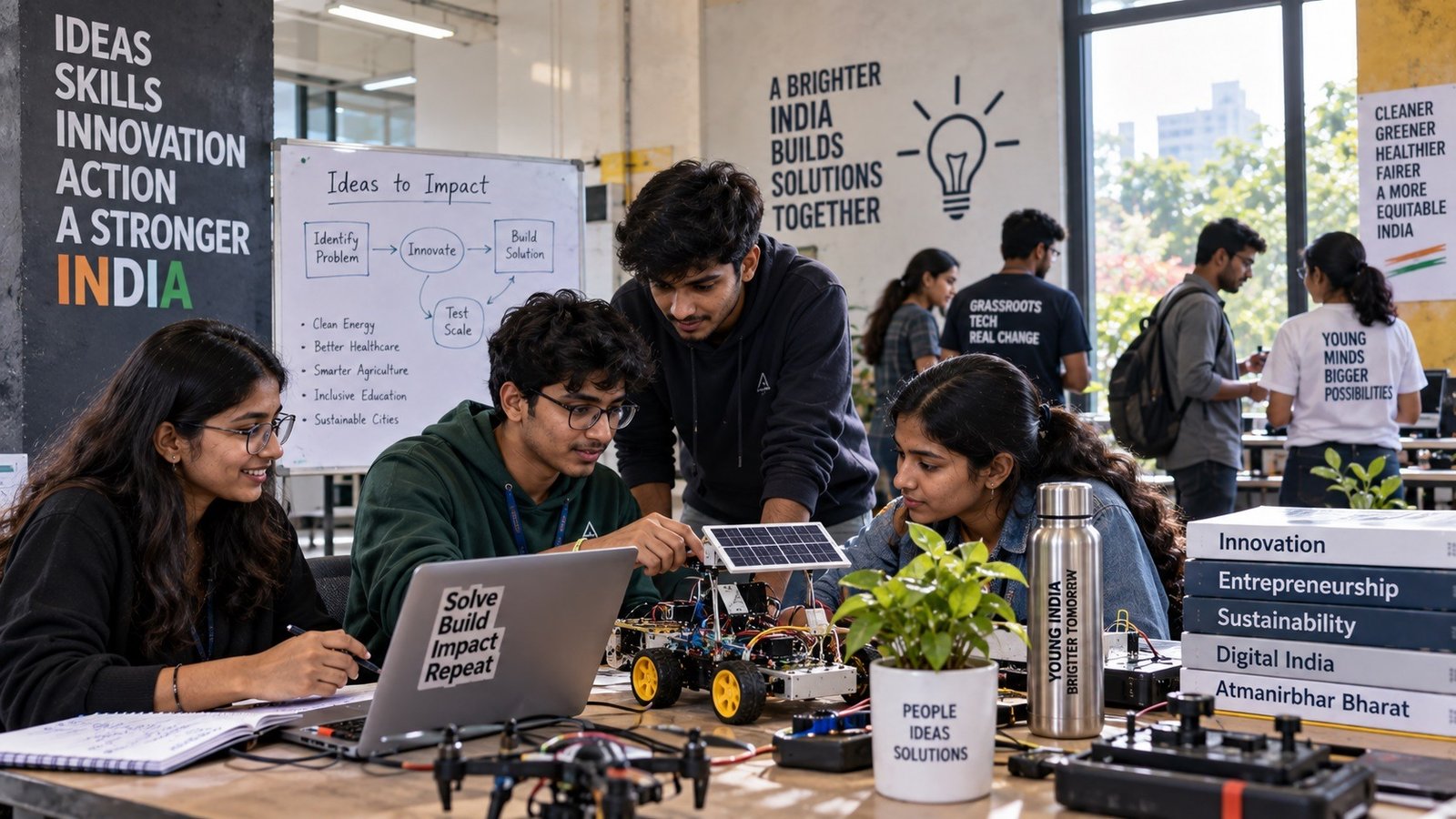
Techpedia, an initiative of SRISTI, provides a striking example. Its stated purpose is to connect problems faced by MSMEs, informal-sector workers and grassroots innovators with students who can develop technological solutions. Its current platform says it contains around 1.4 lakh technology projects created by approximately 3.5 lakh students from more than 500 colleges.
The significance is not simply the number of projects.
It is the underlying philosophy:
real-world problems become engineering assignments.
An agricultural difficulty can become an automation project.
An accessibility problem can become an assistive-device project.
A manufacturing bottleneck can become a design challenge.
Waste can become a materials problem.
Suddenly, the village workshop, small factory or informal business is not merely a recipient of technology.
It can become the source of the question.
The Student Project Is Getting a Second Life
There is an old Indian education problem hiding here.
Every year, enormous numbers of students complete projects that are submitted, graded and then quietly forgotten.
The idea may be good.
The prototype may even work.
And then the semester ends.
Techpedia was created partly to address precisely this disconnect between student projects, industry requirements and grassroots problems. Its model encourages students to see what has already been attempted and build on work rather than repeatedly starting from zero.
That sounds mundane.
It is actually a major innovation principle.
A country does not need millions of isolated ideas. It needs systems that allow good ideas to accumulate.
One student solves 40% of a problem.
Another improves the design.
A startup tests it.
An industry partner manufactures it.
A local community becomes the user.
That is how a student project becomes technology.
Young India Is Also Building Parallel Career Paths
The old career formula was comparatively straightforward:
education → degree → job → promotion → retirement.
That pathway still exists.
But the modern Indian economy has made room for more combinations.
A young person can study engineering while freelancing.
A commerce graduate can build an online business.
A software developer can work remotely while creating a startup.
A student can combine formal education with certifications, internships and online courses.
The important point is not that every young Indian is becoming an entrepreneur.
They are not.
Millions still want stable employment, and India’s employment challenge remains substantial.
The change is that young people increasingly have more than one possible route to building employability.
Government platforms are responding to this shift.
The Skill India Digital Hub (SIDH) brings training, assessment, certification, employment and entrepreneurship services onto a common digital platform. By July 2026, government data showed more than 1.5 crore candidates had been onboarded, alongside thousands of training providers, assessment agencies and employers.
That is a different approach to skills policy.
Instead of asking young people to navigate dozens of disconnected systems, the ambition is to create a digital doorway into the skills ecosystem.
Digital Public Infrastructure Changed Expectations
India’s Digital Public Infrastructure has also altered what citizens expect from services.
UPI is the obvious example.
A generation that can transfer money almost instantly increasingly finds it difficult to understand why every public or commercial service should require repeated paperwork, physical visits and mysterious waiting periods.
That does not mean every government process can become a UPI transaction.
But it changes the psychological baseline.
Fast becomes normal. Trackable becomes normal. Digital becomes normal.
And once people experience a well-designed digital service, poorly designed services become much more visible.
This creates pressure for institutions to improve.
The same logic is now extending into skilling.
SIDH is interoperable with platforms including National Career Service, e-Shram, DigiLocker and BHASHINI, creating a broader digital ecosystem around learning and employment.
Young India Is Not Only “Digital India”
There is a danger in telling this story as if every young Indian is coding from a café.
India’s youth population is enormously diverse.
A young entrepreneur in Bengaluru, a diploma student in Nagpur, an agricultural student in Punjab, an ITI trainee in Uttar Pradesh and a first-generation college student in a smaller district may have completely different opportunities.
That is why grassroots innovation matters.
Techpedia’s model explicitly connects students with problems from the informal sector, MSMEs and local communities. Its Gandhian Young Technological Innovation Awards also recognise frugal and socially relevant technologies, including medical devices, diagnostics, assistive technologies, water purification, energy and manufacturing solutions.
This is a more interesting definition of innovation than simply producing another app.
Sometimes innovation means making a machine cheaper.
Sometimes it means making it repairable.
Sometimes it means designing for someone who was never considered by the original manufacturer.
And sometimes it means asking why the original system was so complicated.
The Youth Opportunity Is Real — So Is the Pressure
India’s demographic advantage comes with a major condition:
young people need productive opportunities.
Government data describe nearly 65% of India’s population as being below 35, making youth employment, skills and entrepreneurship central to the country’s economic future. The proposed National Youth Policy 2026 identifies education, skilling and employment readiness, entrepreneurship and innovation, health, leadership and civic participation among its core areas.
But a young population is not automatically a demographic dividend.
It becomes a dividend when young people acquire useful skills and can convert those skills into productive work.
This is where the optimism needs a reality check.
India still faces mismatches between education and employment.
A certificate is not the same thing as competence.
An online course is not the same thing as experience.
An internship is not automatically a job.
And entrepreneurship is not a substitute for a healthy labour market.
Young people may be more willing to challenge old systems, but they still need systems that actually work.
From Complaining About the System to Designing Alternatives
This may be the most important shift.
Young people have always complained.
That is not new.
What is changing is the possibility of building an alternative alongside the complaint.
A student unhappy with an education system can create a learning platform.
A programmer frustrated by a government process can build a civic-tech tool.
A designer concerned about accessibility can develop an assistive device.
A farmer’s child can combine agricultural knowledge with sensors, drones or data analytics.
A young worker dissatisfied with a rigid career path can build a portfolio of skills rather than relying on one qualification.
Not all these efforts succeed.
Most startups fail.
Many student prototypes never leave the laboratory.
Some “disruptive” ideas merely reinvent something that already exists.
That is perfectly normal.
Innovation is not a collection of guaranteed success stories.
It is a process that produces enough experiments for useful ideas to survive.
The New Definition of Career Security
There is also an interesting irony here.
Older generations often associated security with one stable institution.
Young Indians may increasingly associate security with the ability to adapt.
That does not mean stability has become irrelevant.
It means the source of stability may be changing.
Knowing one software language is less valuable than knowing how to learn new ones.
Knowing one job role is less valuable than understanding how your skills transfer between industries.
Having one qualification matters.
Knowing what to do when that qualification becomes outdated may matter even more.
This is why lifelong learning has become such a central theme in India’s skills policy. The government has increasingly framed skilling as a continuing process rather than a one-time intervention.
AI Will Accelerate This Change
Artificial intelligence adds another layer.
India is already incorporating AI into the skilling ecosystem. The Skilling for AI Readiness (SOAR) initiative began with foundational AI-literacy courses and has expanded into dozens of AI and AI-application qualifications.
This could change the relationship between young workers and technology again.
AI can automate some tasks.
It can also make certain kinds of expertise accessible to people who previously lacked specialised support.
A small entrepreneur can use AI for marketing.
A student can use it as a learning assistant.
A designer can prototype faster.
A rural enterprise can potentially access digital tools that once required a large office.
But AI will not eliminate the need for judgement.
It may simply raise the value of people who know which problem is worth solving.
Young India Needs Permission to Fail — But Not an Excuse to Avoid Responsibility
There is a fashionable tendency to romanticise young entrepreneurs and innovators.
Every student with an app idea is not a founder.
Every startup is not a revolution.
Every disruption is not progress.
India needs something more useful than hype.
It needs experimentation with accountability.
Young people should be able to try, fail, learn and try again.
But products still need to work.
Businesses still need customers.
Medical technologies still need evidence.
Public platforms still need security.
And social innovations still need measurable outcomes.
The point is not to replace one generation’s unquestioned assumptions with another generation’s unquestioned assumptions.
It is to make questioning itself a normal part of progress.
DOONITED View: India’s Biggest Youth Advantage May Be Impatience
India’s young population is often described as an economic advantage because of its size.
The more interesting advantage may be psychological.
Impatience can be productive.
A young person who refuses to accept a bad process can be annoying.
They can also be the person who redesigns it.
A young engineer asking why a machine needs five manual steps may eventually automate four of them.
A student asking why a project must end with a grade may eventually turn it into a product.
A citizen asking why a public service cannot be tracked may eventually create the digital expectation that makes tracking unavoidable.
Of course, impatience without knowledge produces noise.
But impatience combined with skills, experimentation and responsibility can produce innovation.
India does not need its young people to reject everything previous generations built.
It needs them to inherit the country without inheriting every inefficiency along with it.
That is the real generational opportunity.
Learning Point
The strongest form of youth empowerment is not simply giving young people opportunities. It is giving them enough skills, access, information and institutional space to turn problems into experiments — and experiments into solutions.
India’s young population will not transform the country merely because it is young.
It will do so if millions of young Indians can move through a chain that looks something like this:
Notice a problem → understand it → build something → test it → improve it → scale it.
That is more powerful than simply complaining about what does not work.
And perhaps the most useful lesson for every generation is this:
respect the past, question the present, build the next version.


World Beyond the News
Birds Can Navigate Using Earth’s Magnetic Field
Several bird species can sense Earth’s magnetic field, helping them navigate during long-distance migration.
Fermentation Is a Global Food Tradition
People across continents have used fermentation for centuries to preserve food and create distinctive flavours.
Modern Batteries Store Energy Chemically
Rechargeable batteries repeatedly move ions between electrodes, allowing electrical energy to be stored and released.
Why Songs Become Global Hits
Streaming platforms, short-form video, playlists and international collaborations can rapidly carry music across borders.