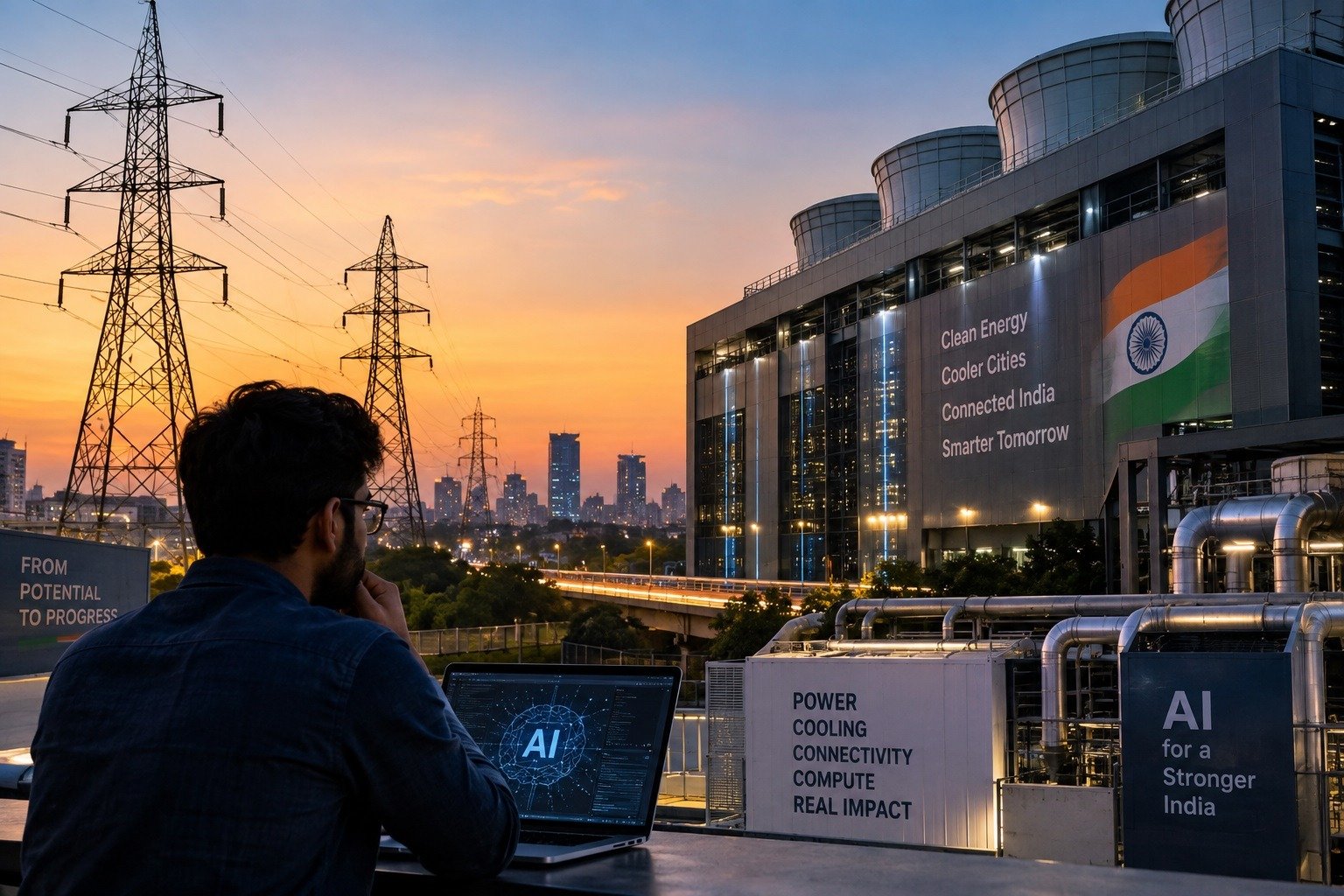
Why electricity, cooling, connectivity and real-world adoption could matter as much as GPUs in India’s artificial-intelligence push
The global artificial-intelligence race is often presented as a contest of spectacular numbers: how many GPUs a country has, how large its data centres are, how many parameters its latest model contains and how much money is being invested.
India’s AI story, however, is increasingly revealing a less glamorous reality.
The next constraint may not be the availability of another AI model. It could be electricity, transformers, cooling systems, fibre connectivity, skilled operators and the ability to put AI into everyday use.
That distinction matters because India is attempting something unusually large: not merely developing AI technology, but making it useful across a vast economy and population.
A December 2025 analysis by Observer Research Foundation’s Samir Saran described the transition as moving from a “Compute Era” to a “Diffusion Era”—from competing primarily over chips and computing infrastructure to competing over how effectively AI becomes embedded in businesses, institutions and everyday life.
That idea is becoming particularly relevant as India’s physical AI infrastructure expands.
The GPU is only the beginning
IndiaAI has significantly expanded access to computing.
Government data published in 2026 says the IndiaAI Mission had expanded shared computing capacity to more than 45,000 GPUs by June 2026. By August, 237 projects had accessed subsidised AI computing, accounting for 93.18 lakh GPU hours.
That is important because access to expensive computing has historically been a major barrier for Indian startups, researchers and smaller organisations.
But a GPU cannot operate in isolation.
It sits inside a data centre that needs electricity, networking, cooling, backup systems and increasingly sophisticated power-management equipment.
In March 2026, the government said India’s data-centre capacity had risen from approximately 375 MW in 2020 to around 1,500 MW in 2025. It also estimated that electricity demand from data centres could reach 13.56 GW by 2031–32.
The numbers reveal an important shift.
India is no longer asking only, “How many chips can we obtain?”
It increasingly has to ask, “Can the surrounding infrastructure keep those chips running reliably and economically?”

The unglamorous AI bottleneck: electricity
AI data centres are different from ordinary office buildings.
Their computing loads can be extremely concentrated and continuous. As rack densities increase, the requirements for electrical distribution, transformers, UPS systems, backup generation and cooling also rise.
The Ministry of Power has already planned transmission infrastructure for upcoming data centres, including projects in Navi Mumbai and Telangana. Government planning documents also anticipate substantial expansion of data-centre capacity and transmission infrastructure alongside renewable-energy integration.
And the wider electricity system is already under pressure from multiple directions.
Reuters reported in September 2026 that nearly one-third of India’s coal-fired power plants had critically low coal stocks as of September 9, while electricity demand had approached the country’s record peak. This does not mean AI data centres caused the shortage—the pressures on India’s power system are much broader—but it demonstrates why dependable electricity supply cannot be treated as an afterthought in an AI expansion.
There is a certain irony here.
The world’s most futuristic technology may occasionally be waiting for one of the oldest pieces of industrial infrastructure: a reliable power connection.
The AI revolution may be digital, but its electricity bill is very physical.
Then comes the water-and-heat problem
More powerful computing produces more heat.
That heat has to go somewhere.
India’s government has acknowledged that data-centre water requirements depend heavily on the cooling technology used. The industry is increasingly adopting direct-to-chip liquid cooling, adiabatic cooling and immersion cooling to reduce water consumption while supporting high-density computing.
This is particularly important for India because data-centre growth will occur alongside competing demands for water in cities and industrial regions.
The answer therefore cannot simply be: build a bigger data centre.
The better question is: Where should it be built, what power should support it, what cooling technology should it use, and what impact will it have on local infrastructure?
Location is becoming an AI infrastructure decision.
Connectivity, land, electricity, renewable-energy availability, water conditions and proximity to fibre networks can all influence where future computing capacity makes economic sense.
India’s opportunity may lie in diffusion
This is where India’s AI story becomes more distinctive.
India does not need every organisation to build its own frontier AI model.
A hospital can use AI to assist administrative workflows.
A bank can automate document processing and customer support.
A manufacturer can use predictive systems to identify equipment problems.
A farmer-facing platform can make information more accessible in regional languages.
A government department can use AI to process documents or improve service delivery.
These applications may not produce spectacular headlines about trillion-parameter models. But collectively, they can have a much larger economic footprint.
The IndiaAI Mission’s progress already reflects this emphasis on applications. Government figures state that by August 2026, IndiaAI initiatives had developed 62 AI prototypes and deployed 20 AI solutions across public-sector institutions. The programme also reports more than 14,000 datasets and 331 AI models on AI Kosh as of July 2026.
That is the less flashy side of AI—and potentially the more consequential one for an economy of India’s scale.
But adoption has its own difficult questions
Calling India an AI “user and integrator” should not become an excuse to ignore domestic technological capability.
There are still important dependencies in semiconductors, advanced computing hardware, specialised manufacturing and frontier research.
The government itself acknowledges these gaps. Its August 2026 statement on sovereign AI infrastructure explicitly identified limited domestic capabilities in areas including semiconductor manufacturing, computing infrastructure, foundational models and advanced research ecosystems as challenges requiring a multi-pronged approach.
India is therefore pursuing both tracks simultaneously: increasing access to computing and applications while developing indigenous models and semiconductor capabilities.
That is a sensible distinction.
Using global technology effectively and building domestic capability are not mutually exclusive goals.
The real test: integration
There is another infrastructure layer that is easier to overlook: software integration.
An organisation can buy access to an excellent AI model and still fail to obtain meaningful results if its data is fragmented, workflows are poorly designed, employees are not trained and governance is weak.
In September 2026, IBM India and South Asia’s managing director highlighted data quality, governance, infrastructure and AI literacy as key requirements for moving enterprise AI from pilots into scaled deployment.
That is an important lesson.
AI does not automatically improve a bad process.
Sometimes it simply allows a bad process to operate faster.
Doonited Editorial Perspective: India’s AI race needs an infrastructure mindset
The temptation is to measure technological progress through things that are easy to photograph: shiny servers, giant GPU clusters and futuristic AI demonstrations.
But India’s more difficult AI challenge is largely invisible.
It lives inside transmission lines, substations, cooling systems, fibre networks, software architecture, datasets, cybersecurity controls and the skills of the people operating them.
The country’s AI opportunity therefore has two sides.
Build enough computing capacity to participate. And build enough practical applications to make that computing economically meaningful.
The first creates infrastructure.
The second creates value.
The strongest outcome would be an India that does both—while gradually reducing critical technological dependencies rather than simply shifting dependence from one part of the technology stack to another.
The big AI story may therefore not be about who owns the largest pile of GPUs.
It may ultimately be about who can turn computing power into reliable, affordable and useful services at population scale.
And that race is only beginning.
What readers should take away
India’s AI expansion is entering a phase where energy, cooling, connectivity, computing access, data, skills and practical applications must develop together.
The country’s growing GPU pool is important. So are semiconductor investments and indigenous AI models.
But the ultimate measure of success will be what happens after the servers are switched on:
Does AI solve real problems, reduce costs, improve services and create new economic value for people and businesses?
That is where the spectacular technology meets the everyday Indian economy.