UPI Is Changing: What India’s New Merchant Charges Mean for Shops, Businesses and Consumers
The era of completely zero-MDR merchant UPI is set to change from October 15. But most everyday payments will remain free.
For years, one of India’s most powerful digital-payment propositions has been wonderfully simple: scan a QR code, enter your UPI PIN and pay.
For merchants, the other attraction was equally important. Ordinary bank-account UPI payments operated under a zero-MDR structure, helping millions of businesses accept digital payments without the percentage-based merchant charges associated with many card transactions.
That model is now changing.
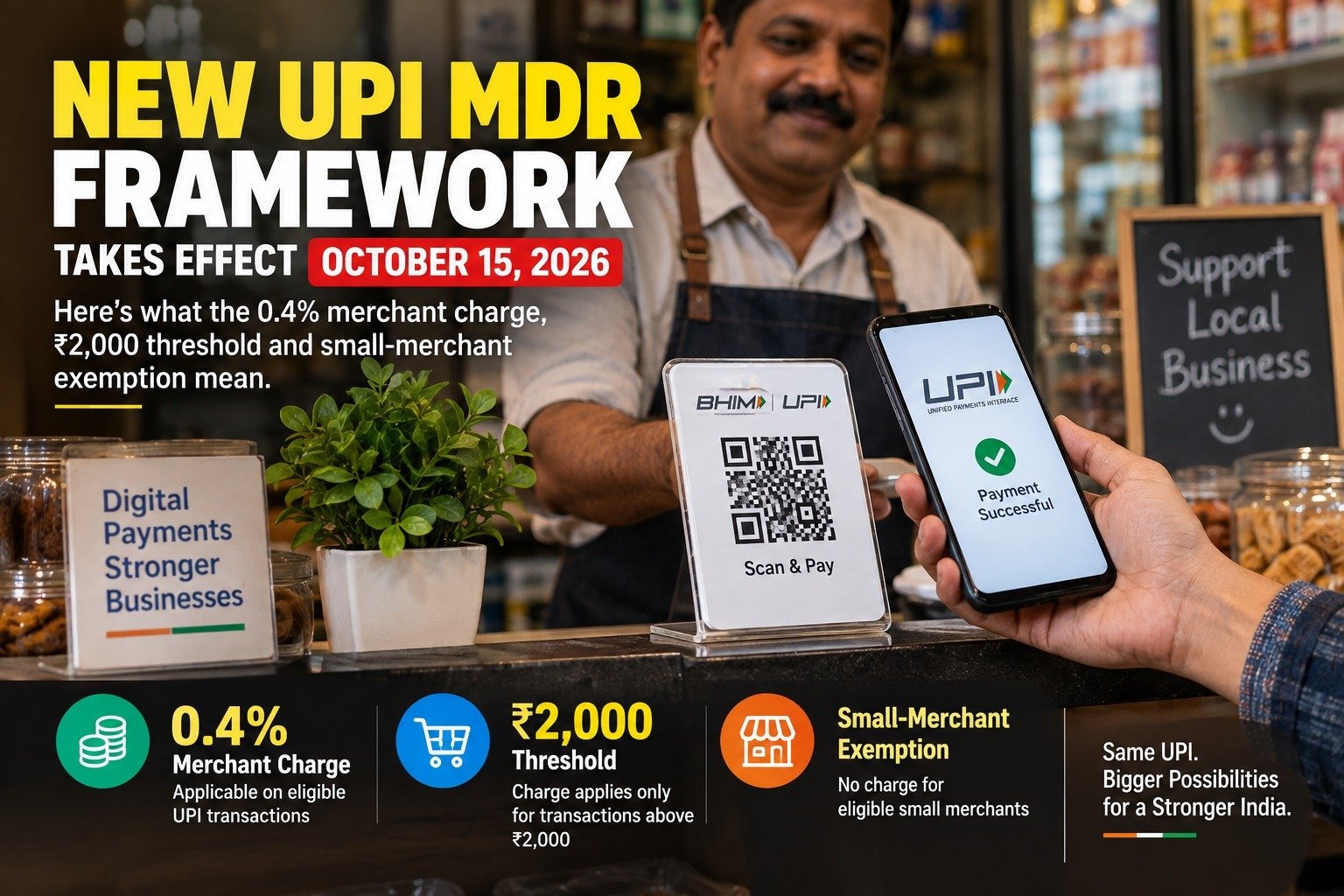
On 15 September 2026, the Ministry of Finance announced a new framework for Merchant Discount Rate (MDR) on selected UPI person-to-merchant transactions. The new provisions are scheduled to take effect from 15 October 2026.
But there is an important detail that has already been lost in some simplified social-media explanations:
UPI is not becoming a paid service for ordinary consumers.
And most everyday merchant transactions will continue without MDR.
What exactly is changing?
Under the new framework, a 0.4% MDR will apply to specified person-to-merchant (P2M) UPI transactions above ₹2,000.
For transactions of ₹75,000 or more, the MDR is capped at ₹300 per transaction.
Consider a simple example.
If an eligible merchant receives a UPI payment of:
- ₹1,000: MDR = ₹0
- ₹2,000: MDR = ₹0
- ₹3,000: 0.4% = ₹12
- ₹10,000: 0.4% = ₹40
- ₹50,000: 0.4% = ₹200
- ₹1,00,000: 0.4% would be ₹400, but the cap limits it to ₹300
The government says the charge will be borne within the merchant-payment ecosystem and cannot be passed on to customers.
So the person standing at the shop counter should still see the same ₹3,000 bill—not ₹3,012 simply because the customer chose UPI.
The ₹2,000 line matters
The most significant protection is the threshold.
UPI merchant payments up to ₹2,000 remain free of MDR, according to the government’s new framework. The Ministry says these small-value transactions represent more than 95% of P2M UPI transaction volume.
That means the everyday digital economy—tea, groceries, local transport, restaurant bills, pharmacy purchases and thousands of other routine transactions—does not suddenly acquire a UPI surcharge.
There is also a separate protection for qualifying small merchants.
Merchants operating under the P2PM framework, including small vendors receiving up to ₹1 lakh a month through UPI QR codes, continue to receive zero-MDR treatment. The government specifically mentions street vendors, neighbourhood shops and other small businesses.
In other words, the familiar roadside QR code is not being sent into retirement.

Why introduce MDR now?
The argument from policymakers is essentially about sustainability.
UPI operates on an enormous technical foundation: bank systems, payment applications, servers, telecommunications networks, fraud monitoring, cybersecurity and settlement infrastructure.
The Ministry’s FAQ says the new MDR revenue is intended to support infrastructure resilience, innovation, cybersecurity and customer service. It also argues that depending entirely on government incentives is not a permanent financing model for a system operating at this scale.
That creates an interesting economic question.
India built UPI partly around the idea that digital payments should be extremely accessible. But a payment system handling billions of transactions also has a very real cost of operation.
“Free to the user” does not necessarily mean “costless to the ecosystem.”
That distinction is becoming increasingly important.
What about small businesses?
This is where the new structure becomes more nuanced.
A large online retailer processing substantial volumes of high-value transactions is not economically identical to a vegetable seller receiving ₹300 from a customer.
The new framework recognises that distinction.
Qualifying P2PM merchants remain protected from MDR, while eligible larger merchant transactions above ₹2,000 enter the new pricing structure.
The government also says 5% of total MDR collections will be contributed to a dedicated fund intended to promote UPI acceptance among small merchants, including expansion into Tier-3 to Tier-6 centres and other targeted areas.
The detailed operational framework for that fund is still to be finalised in consultation with the RBI, according to the government FAQ.
That is an important qualification: the broad policy has been announced, but some implementation details remain to be worked out.
And what about wallets and credit cards?
This is where some existing online explanations can become confusing.
Earlier discussions about UPI charges often focused on PPI/wallet-funded UPI transactions and RuPay credit-card transactions on UPI, which operate differently from ordinary bank-account-funded UPI.
Razorpay’s current merchant guidance, for example, distinguishes between bank-account UPI, PPI-funded UPI and RuPay credit-card UPI, and separately discusses payment-gateway platform charges.
But the September 2026 government announcement changes the broader picture for eligible merchant UPI transactions.
Therefore, merchants should not simply assume that an old article saying “UPI = zero MDR” or “UPI = 1.1%” tells them what their settlement cost will be after 15 October.
The actual cost depends on:
- The type of UPI transaction
- Transaction value
- Merchant classification
- Merchant category
- Whether a payment gateway is involved
- The gateway’s own commercial/technology charges
This is precisely why merchants should examine their settlement agreement rather than rely on a headline percentage.
Some sectors get a different calculation
The new framework also creates special treatment for certain essential or thin-margin sectors.
For transactions above ₹2,000, specified categories including railways, telecommunications, insurance, fuel and agricultural inputs will attract a flat ₹5 MDR rather than the standard 0.4% rate.
Capital-market-related payments, including specified transactions involving mutual funds, securities, stockbrokers and dealers, are assigned a 0.02% MDR, subject to a ₹300 cap.
The structure is therefore more complicated than simply saying:
“UPI will now cost 0.4%.”
It won’t apply uniformly to every merchant transaction.
Consumers are still protected
Perhaps the most important message for ordinary UPI users is straightforward:
There is no new UPI payment fee for consumers.
The government’s framework keeps P2P transactions free and says consumers will not be charged MDR for making merchant payments. Banks have also been advised to ensure merchants do not pass MDR on to customers.
So if your neighbourhood shop displays a QR code, you do not need to start carrying cash again because you fear an additional “UPI tax.”
There isn’t one.
MDR is a merchant-side payment-system charge, not a government tax collected from the customer. The Ministry explicitly states that MDR is neither a tax nor a government/NPCI collection.
The bigger story: Can UPI pay for its own future?
This is perhaps the most interesting part of the change.
India’s UPI success was built around extraordinary scale and extremely low friction. That model helped digital payments move from a technology novelty to an everyday habit.
But scale creates another problem.
The bigger the system becomes, the more expensive its underlying infrastructure becomes to operate, protect and upgrade.
The government says the new framework is designed to create a more sustainable commercial model while preserving free access for consumers and protecting small merchants.
Whether that balance works efficiently will depend on implementation.
That is where the real test begins.
Doonited Editorial Perspective
There is a useful lesson hidden behind the MDR debate.
India’s digital-payment revolution has reached a stage where “free” can no longer be the only measure of success.
Reliability, cybersecurity, fraud prevention, rural connectivity, merchant support and continuous technological investment also have economic value.
At the same time, introducing a charge into a system that became successful partly because of its simplicity creates a legitimate need for transparency.
Merchants should know exactly what they are paying.
Consumers should know exactly what they are not paying.
And payment companies should clearly distinguish MDR from their own platform, technology or settlement charges.
The danger is not necessarily a small payment-system fee.
The danger would be allowing a complicated fee structure to become so confusing that a shopkeeper needs an accountant just to understand why ₹10,000 entered the business account as something slightly less.
UPI’s greatest achievement has been making digital payments feel almost effortless.
Its next challenge is to make the economics behind that simplicity equally understandable.
What this means for readers
From 15 October 2026:
| Transaction | Position under new framework |
|---|---|
| P2P UPI | Free |
| Merchant UPI up to ₹2,000 | No MDR |
| Qualifying P2PM small merchant | Zero MDR |
| Eligible P2M above ₹2,000 | 0.4% MDR |
| Eligible transaction ₹75,000+ | ₹300 maximum MDR |
| Specified essential sectors above ₹2,000 | ₹5 flat MDR |
| Specified capital-market payments | 0.02%, capped at ₹300 |
| Consumer UPI payment fee | No charge |
These provisions are scheduled to take effect on 15 October 2026.