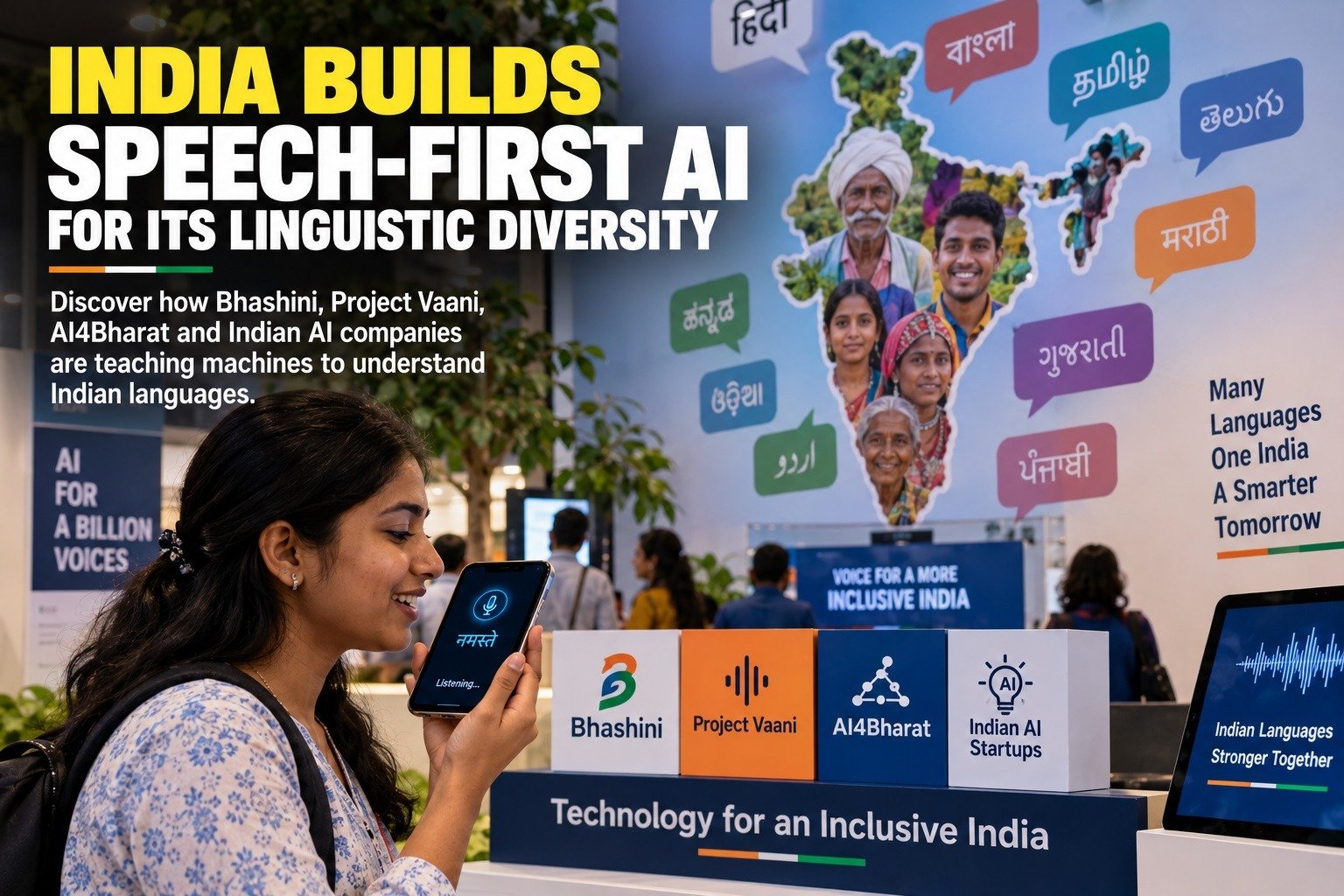
India Teaches AI to Listen: The Race to Build a Voice-First Digital India
From Hindi and Hinglish to Marathi, Tamil and dozens of less-represented languages, India is building AI that has to understand how Indians actually speak—not how textbooks say they should
By Doonited News | Technology
For decades, the internet quietly assumed that the world would eventually learn to speak its language.
That language was English.
Artificial intelligence initially inherited much of the same assumption. The largest models were trained predominantly on enormous quantities of digital text, with English enjoying a disproportionate presence online.
India presents a very different challenge.
A person may begin a sentence in Hindi, insert an English technical term, switch to Marathi with family members and use a distinctly local pronunciation—all within the same conversation.
And that is before background noise, regional accents, imperfect mobile connections and unfamiliar names enter the equation.
For AI, India’s linguistic diversity is not a minor translation problem.
It is an engineering problem.
And increasingly, Indian researchers, government programmes and technology companies are trying to solve it from the ground up.
India is not simply a multilingual country
The Constitution’s Eighth Schedule contains 22 languages. But the linguistic picture is considerably larger.
The 2011 Census identified 121 languages and 270 mother tongues with at least 10,000 speakers at the national level.
That distinction is important.
When someone speaks of “Indian languages,” they are not describing a neat list of 22 alternatives to English.
They are describing a vast linguistic ecosystem containing different scripts, accents, dialects, vocabulary, grammatical structures and speech patterns.
And increasingly, AI has to deal with the way Indians actually communicate rather than the way languages appear in school textbooks.

The voice problem is bigger than translation
Translation is only one part of the challenge.
An AI system first needs to hear the user correctly.
Automatic speech recognition—or ASR—converts spoken language into text. But Indian speech can contain:
- regional accents;
- code-switching;
- background noise;
- telephone-quality audio;
- local names and places;
- multiple scripts;
- pronunciation variations;
- incomplete or informal sentences.
The government-backed Bhashini ecosystem has been developing datasets and models specifically for these problems. Its Bhashadaan initiative, for example, invited citizens to contribute voice recordings, transcriptions and translations to help develop speech recognition, text-to-speech and machine-translation technologies.
That is a fundamentally different approach from simply taking an English-language AI system and adding a translation button.
Project Vaani: listening to India village by village
One of the most interesting efforts is Project Vaani, a collaboration involving Google, the Indian Institute of Science and Bhashini.
Google says the project has collected more than 30,000 hours of speech from more than 155,000 speakers across 109 languages. Rather than looking only at languages as abstract categories, the project uses a region-anchored approach, helping capture linguistic diversity as it exists on the ground.
That matters because language does not stop changing when it crosses a district boundary.
Pronunciation changes.
Vocabulary changes.
Expressions change.
Sometimes even the same word can carry different meanings or pronunciations in neighbouring regions.
For an AI model, these differences can determine whether a conversation feels natural—or whether the machine produces the technological equivalent of a blank stare.
AI4Bharat: building the language layer
At IIT Madras, AI4Bharat has become one of India’s prominent research efforts focused on Indian-language AI.
The lab develops open-source datasets, tools and models covering areas including transliteration, natural-language understanding, generation, translation, automatic speech recognition and speech synthesis. Its work includes multilingual systems such as IndicBERT, IndicBART and IndicTrans2.
This is significant because India’s language problem cannot be solved by speech recognition alone.
The full chain looks more like:
Voice → speech recognition → language understanding → reasoning → translation or response → speech synthesis.
A weakness anywhere in that chain can degrade the entire experience.
If an AI misunderstands the first sentence, producing a beautifully spoken answer at the end does not help very much.
Code-switching: the language AI wasn’t expecting
Consider a typical Indian conversation:
“Kal meeting hai, presentation ready hai na? Please send me the final file.”
It isn’t neatly Hindi or English.
It is both.
Such code-switching is normal in many Indian conversations. The same phenomenon can occur with regional languages and English.
Modern Indian speech systems are increasingly being designed around this reality.
Sarvam’s current speech platform, for example, supports code-mixed speech and says its latest speech-recognition systems are designed for Indian accents, noisy audio and language switching. Its Saaras family supports 22 Indian languages plus English, with outputs including transcription, transliteration, translation and code-mixed text.
Sarvam’s newest Saaras V4, announced in August 2026, adds further capabilities around dialectal variation and noisy speech and reports support for all 22 Indian languages. These are company-reported benchmark claims, so they should be understood in that context rather than treated as independent proof of universal superiority.
The larger point remains important:
Indian AI developers are designing for the way Indians actually speak.
From speech recognition to sovereign AI
Language capability is also becoming part of India’s wider AI infrastructure.
Sarvam describes its platform as an India-focused stack covering speech recognition, text-to-speech, translation, document intelligence and large language models. Its current documentation lists models supporting 22 Indian languages plus English for several capabilities, although coverage differs by model.
That distinction is important.
There is no single magical “Indian AI” that automatically understands every Indian language equally well.
Different models support different language sets.
Some systems are stronger in speech recognition.
Others focus on translation.
Some concentrate on text-to-speech.
The ecosystem is still developing.
That is precisely why open datasets, benchmarks and independent evaluation matter.
Where local-language AI could make a difference
The most important applications may not be glamorous.
Imagine a farmer speaking naturally into a phone rather than navigating an English-heavy application.
Imagine a patient communicating with a health-information system in a familiar language.
Imagine a small shopkeeper using voice commands for inventory.
Imagine a citizen interacting with a government service without first having to become comfortable with a keyboard, English terminology or complex menus.
India’s government technology ecosystem already provides examples of multilingual conversational systems. The National Informatics Centre’s VANI framework, for example, integrates multilingual voice and text services and has been used across government-facing applications. IndiaAI’s documentation says VANI recorded more than 14 crore hits during FY 2024–25 and supports multiple citizen-facing projects.
That is the more important story.
AI becomes useful when people do not have to learn how to use AI.
The technology has to learn how to communicate with them.
Low bandwidth may be as important as language
India’s AI challenge is not only linguistic.
It is also infrastructural.
A voice AI system designed for a modern high-speed broadband connection may not perform the same way in every Indian environment.
Telephony audio can be compressed and noisy. Devices can vary enormously. Connectivity can fluctuate.
Sarvam’s own developer documentation specifically highlights challenges such as 8kHz telephone audio, code-mixing, multiple scripts and regional speech when building for Indian-language applications.
This is why “AI for India” cannot simply mean translating a Silicon Valley product into Hindi.
The system has to be designed around Indian operating conditions.
The data question cannot be ignored
There is a less comfortable side to the language-AI revolution.
Better models require better data.
Speech datasets require recordings.
Recordings involve real people’s voices.
That creates questions around consent, licensing, privacy, representation and how the resulting datasets are governed.
Bhashini’s crowdsourcing framework explicitly sets out how users contribute recordings, transcriptions and translations for language-technology development.
India therefore needs not only more linguistic data, but trustworthy systems for deciding how that data is collected, documented, licensed and used.
Otherwise, the rush to make AI understand Indians could create a different problem: Indians not knowing how their voices became part of the machine.
The biggest challenge: inclusion without pretending perfection
There is a temptation to declare victory whenever a new model supports 22 languages.
But language support on a specification sheet is not the same as equal performance across every language.
Low-resource languages can have substantially less training data than Hindi, English or other heavily represented languages.
Even within a supported language, regional accents and dialects can present difficult cases.
IndiaAI’s public AI model repository illustrates the breadth of this work, including specialised speech-recognition models and datasets for individual Indian languages and challenging speech conditions.
The presence of such specialised datasets is itself revealing.
One model does not solve India’s language problem.
A continuing programme of data collection, testing and improvement is required.
Doonited Editorial Perspective
India’s language-AI opportunity is bigger than replacing English menus with Hindi menus.
The real opportunity is to make voice a universal interface for digital India.
That could be transformative.
A person should not need perfect English literacy, advanced typing skills or familiarity with a particular app’s interface to access a digital service.
They should be able to speak.
But there is an equally important principle: India’s linguistic diversity should not become a marketing slogan while the technology remains unreliable for less-represented communities.
The real measure of success will be much more demanding.
Can AI understand a farmer’s accent?
Can it recognise a local place name?
Can it follow a conversation that switches languages?
Can it function over imperfect connectivity?
Can it preserve meaning during translation?
Can people trust what happens to their voice data?
And can smaller Indian languages receive sustained technical attention after the launch-day headlines disappear?
If the answer to those questions increasingly becomes yes, India will have achieved something more significant than simply producing another language model.
It will have created an AI ecosystem that listens before it speaks.
The takeaway
India’s language-AI journey is moving simultaneously through research, government infrastructure, open datasets, startups and commercial products.
Bhashini and community data collection are expanding the underlying language resources. Project Vaani is documenting speech diversity at an unusually large scale. AI4Bharat is contributing open-source research. Indian companies such as Sarvam are building production-oriented speech and language systems.
The technology is not finished—and claims of universal language fluency should be treated carefully.
But the direction is clear.
The next generation of Indian AI may not begin with a keyboard. It may begin with a voice.
And that could bring artificial intelligence much closer to the way India actually lives, works and communicates.


World Beyond the News
Dolphins Use Individual Signature Whistles
Bottlenose dolphins develop distinctive whistles that function somewhat like individual acoustic identifiers.
The Pacific Is Earth’s Largest Ocean
The Pacific Ocean covers more area than any other ocean basin and stretches between Asia, Australia and the Americas.
Artificial Intelligence Learns Statistical Patterns
Modern machine-learning systems identify patterns in large datasets and use those patterns to generate predictions or outputs.
Why Some Stories Spread So Quickly
Emotion, novelty, visual appeal and easy sharing can make a story travel rapidly across social platforms.