India has just produced the kind of economic number governments, businesses and economists like to put in bold type.
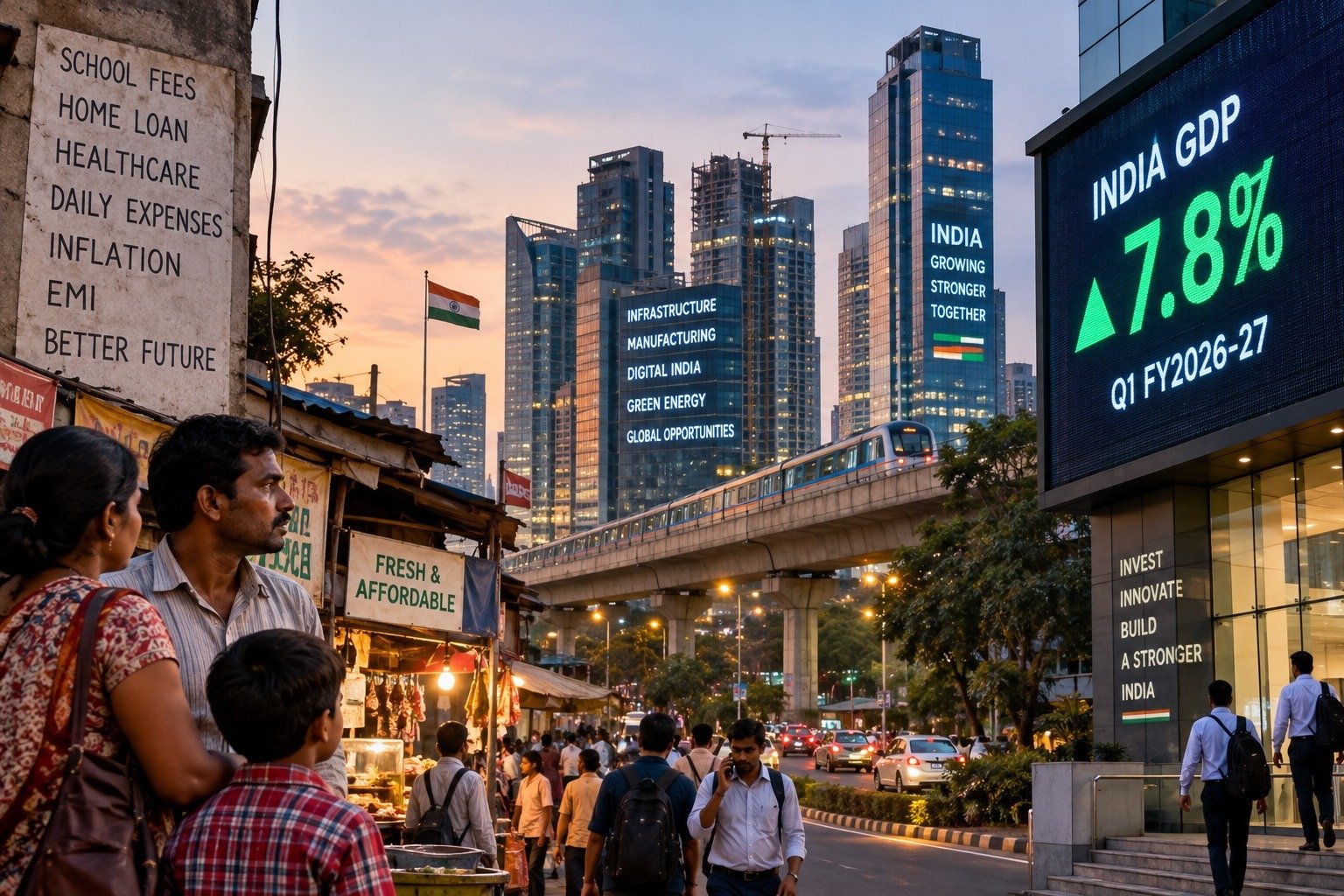
Real GDP grew 7.8% year-on-year in April–June 2026, the first quarter of FY2026–27.
Manufacturing grew 9.2%, real fixed investment rose 11.9% and private consumption increased 7.1%. Services also remained a major engine of expansion.
And yet there is a perfectly reasonable question sitting at the kitchen table:
If the economy is growing at 7.8%, why doesn’t every household feel 7.8% richer?
The short answer is that GDP is not a household salary slip.
And that distinction explains a surprisingly large part of India’s economic conversation.
GDP Is the Size of the Economy. Your Wallet Is Something Else.
Gross domestic product measures the value of goods and services produced in an economy.
It does not tell us that every worker received a 7.8% pay rise.
It does not tell us that house prices rose by 7.8%.
It does not tell us that school fees, medical bills or groceries became 7.8% cheaper.
Nor does it tell us how much of the economic expansion accrued to a particular household.
That is why two statements can comfortably coexist:
“India’s economy grew strongly.”
and
“My monthly budget is still under pressure.”
There is no contradiction.
The Growth Number Is Real — But It Is Not Evenly Distributed Across Household Experience
The April–June national accounts show a broad expansion.
Real GDP grew 7.8%, while private consumption grew 7.1% and fixed investment 11.9%. Manufacturing expanded 9.2%, while financial, real estate, IT and professional services were among the stronger service areas.
Investment growth is particularly important because it can create future productive capacity, jobs and incomes.
But there is a time gap.
A new factory does not necessarily become next month’s salary.
A highway under construction does not automatically increase the income of every shopkeeper in the country.
An investment boom can be economically valuable while its benefits reach households gradually and unevenly.
Economic growth is therefore partly a story about future capacity, while household finances are a story about today’s cash flow.
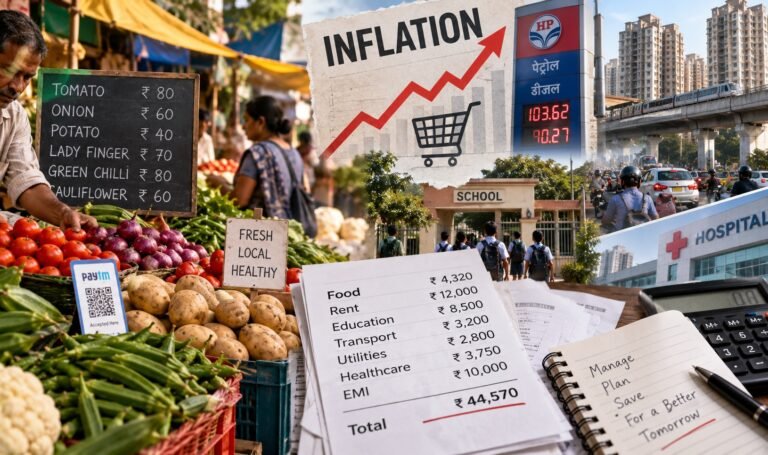
Then Comes Inflation — The Quiet Thief in the Grocery Bag
Suppose someone’s income rises.
That sounds straightforward.
Until the price of what they buy rises too.
India’s latest consumer-price data illustrate the problem. Headline CPI inflation was 4.82% in August 2026, while food inflation was substantially higher at 5.95%. Rural CPI inflation was 5.23%, compared with 4.31% in urban India.
That does not mean every household experienced 4.82% inflation.
A family spending heavily on food experiences the price environment differently from a high-income household spending proportionally more on financial services, travel or discretionary goods.
Inflation is therefore an average.
Your household has its own inflation rate.
The official CPI may say 4.82%. Your kitchen may have a different opinion.
Housing Can Make a Growing Economy Feel Surprisingly Expensive
Housing is another reason the national growth number and personal financial experience can diverge.
Rent, home-loan payments, maintenance, electricity and other housing-related costs absorb a significant share of household budgets, particularly in major cities.
The new CPI series gives housing, water, electricity, gas and other fuels a substantial place in household consumption measurement. In June 2026, official housing inflation was 2.10% year-on-year nationally.
But the consumer’s experience is not limited to the official housing index.
A person moving from a smaller city to Bengaluru, Mumbai, Delhi-NCR or another expensive urban market may encounter a completely different housing equation.
For a young professional, a salary increase can disappear remarkably efficiently into:
Rent + commute + food + EMI + subscriptions.
Modern adulthood has developed some impressive talent for finding places to put money.
Education Is an Investment — But It Is Also a Household Expense
Indian families often treat education as an investment in the next generation.
Economically, that makes sense.
Financially, however, it is still an expense that must be paid today.
School fees, coaching, university tuition, accommodation, transport, books and technology can create substantial financial commitments.
The revised CPI system separately tracks education services, reflecting the growing importance of services in household consumption. The education category recorded 3.8% year-on-year inflation in urban India in June 2026 in RBI’s presentation of the CPI series.
And education spending can be particularly difficult to reduce.
A family may postpone buying a television.
It is much harder to postpone an examination, university admission or a child’s school year.
Healthcare Works the Same Way
Healthcare creates another asymmetry.
National GDP can grow rapidly while a single hospitalisation can completely change a household’s monthly financial position.
India’s CPI data separately track health expenditure, but averages do not capture the financial shock of an unexpected surgery, chronic treatment or major medical episode for an individual family.
This is why economic security is not identical to economic growth.
A household can have a rising income and still feel financially vulnerable if it has insufficient insurance, emergency savings or predictable healthcare costs.
Employment Quality Matters More Than a Simple Employment Count
The labour market provides another piece of the puzzle.
India’s 2025 PLFS annual report shows that the share of workers in regular wage or salaried employment increased to 23.6% in 2025 from 22.4% in 2024. The unemployment rate among people aged 15 years and above with secondary or higher education fell to 6.5% from 7.0%.
But employment quality still matters enormously.
A regular salaried job with predictable income, social security and career progression is financially different from irregular casual work.
PLFS 2025 estimated average daily earnings for casual labour, outside public works, at ₹453 nationally — ₹489 for men and ₹324 for women. Average gross monthly earnings from self-employment were ₹14,861 for the combined rural-and-urban group in the survey’s measurement.
These averages cover very different kinds of workers and should not be treated as representative salaries for all Indians.
But they demonstrate an important point:
“Employment” is not one economic experience.
What About Household Debt?
Borrowing has become an increasingly important part of household finance.
Government data show household financial liabilities were equivalent to 4.9% of GDP in FY2024–25, down from 6.5% in FY2023–24, while household savings were 21.7% of GDP.
RBI’s broader financial analysis also shows that household borrowing remains significant, with consumption-related borrowing an important component of household credit.
Debt is not automatically bad.
A home loan can finance an asset.
An education loan can finance human capital.
A business loan can create income.
But borrowing becomes uncomfortable when income growth cannot keep pace with repayments and everyday expenses.
The important question is therefore not simply:
“How much debt do households have?”
It is:
“What are households borrowing for, and can their future income comfortably service it?”
Savings Tell Another Part of the Story
Savings are the financial shock absorber of a household.
RBI data show that net household financial savings improved to 7% of gross national disposable income in FY2024–25, compared with 5.8% the previous year, helped by a decline in financial liabilities.
Government data using the revised national-accounts series put total household savings at 21.7% of GDP in FY2024–25.
So the household financial story is not simply one of worsening savings.
There has actually been improvement in some aggregate measures.
But averages again conceal differences.
A household with a large emergency fund and no debt is in a very different position from one with the same income but a mortgage, education expenses and little liquid savings.
So, Why Doesn’t Everyone Feel Richer?
Because economic growth, income growth and financial security are three different things.
GDP can rise because factories produce more, businesses invest, services expand and exports grow.
Household income depends on wages, salaries, self-employment earnings, business profits, transfers and other income sources.
Household financial comfort then depends on what remains after inflation, rent, EMIs, education, healthcare, transport, food and other expenses.
And finally, financial security depends on whether the household has savings to absorb a shock.
You can think of it as a simple chain:
GDP growth → economic activity → income opportunities → household income → purchasing power → savings/security
The first link can be very strong while one of the later links remains weak.
The DOONITED View
India’s 7.8% growth rate is important.
But it should not be expected to answer a question it was never designed to answer:
“How comfortable is the average Indian household?”
That requires a different dashboard.
GDP should be read alongside real wages, employment quality, household consumption, inflation, housing costs, healthcare spending, education costs, debt and savings.
This is not an argument against GDP.
Quite the opposite.
Strong GDP growth creates the economic capacity from which higher incomes and better living standards can eventually emerge.
But the word eventually matters.
The real test of India’s economic expansion will be whether strong production and investment translate into durable household income growth, productive employment, purchasing power and financial resilience.
A country can celebrate a bigger economy.
Its citizens quite reasonably want to know whether they can afford the bigger life that comes with it.
The Learning Point
The next time India announces another impressive GDP number, don’t ask only:
“How fast is the economy growing?”
Ask five more questions:
Are household incomes rising?
Are real wages keeping up with prices?
Are jobs becoming more productive and secure?
Are essential costs consuming more or less of the household budget?
And are families able to save after paying for everything else?
That is where the macroeconomic headline meets the monthly household budget.
And somewhere between the Finance Ministry’s GDP table and the family’s grocery bill lies the real story of India’s prosperity.

World Beyond the News
Why Elephants Stay Close to Their Herd
Elephants live in highly social family groups and use calls, touch and body movements to maintain strong bonds.
Most of the Deep Ocean Remains Difficult to Explore
Extreme pressure, darkness and distance make deep-ocean exploration one of Earth’s greatest scientific challenges.
Spacecraft Can Travel Without Traditional Roads
Spacecraft use carefully calculated trajectories and gravity assists to travel enormous distances through space.
Why Movie Trailers Are Released in Stages
Major films often use teaser trailers, full trailers and final promotional spots to build awareness over time.