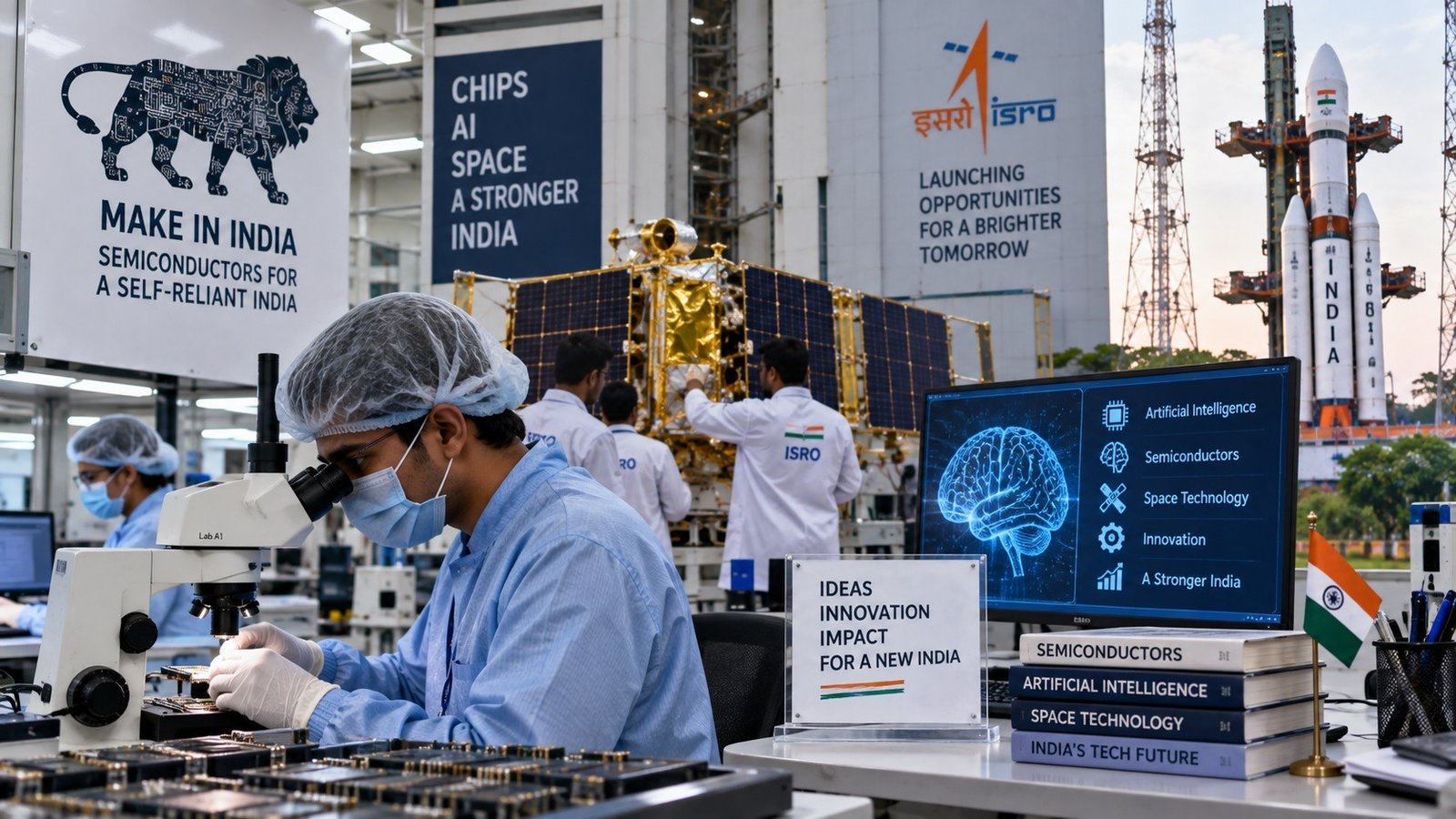
From Jugaad to Strategic Innovation: How India Is Building Its Next Technology Economy
India’s technology story is entering a different phase. The ambition is no longer simply to find clever solutions with limited resources. It is increasingly about building the chips, computing infrastructure, scientific capabilities and intellectual property that allow India to shape the technologies it depends on.
There is an old image of Indian innovation that refuses to disappear: the ingenious workaround, the improvised machine, the clever repair with whatever happens to be available.
There is truth in that image.
But India’s technological economy is becoming considerably more complicated.
A country building semiconductor fabrication facilities, training its own AI models, operating sophisticated space missions and creating private-sector space companies is no longer simply asking, “How can we make this work?”
It is increasingly asking:
“Can we build the technology ourselves — and can we become good enough to build it for the world?”
That is a much bigger question.
The Chip Is Becoming a Strategic Asset
Few technologies illustrate this transformation better than semiconductors.
India’s original Semiconductor Mission was backed by a ₹76,000 crore programme to develop a domestic semiconductor and display manufacturing ecosystem. By early 2026, the government had approved 10 projects with investment commitments of about ₹1.6 lakh crore across six states.
Since then, the programme has moved into its next phase.
In July 2026, the Union Cabinet approved Semicon 2.0 with an outlay of ₹1,27,500 crore. The programme is designed around six broad pillars: chip design, semiconductor equipment and materials, fabrication, advanced packaging, research and development, and talent development.
The numbers have also moved.
Government data now puts the programme at 12 approved semiconductor projects across six states, with investment commitments exceeding ₹1.64 lakh crore, including silicon and compound-semiconductor fabs, display fabrication and advanced packaging. Three facilities have already commenced commercial production, according to the government’s latest factsheet.
That is a significant change in the nature of the Indian semiconductor story.
It is no longer only about announcing incentives.
Factories, packaging facilities, design centres, equipment and talent are becoming part of the same industrial architecture.
Why Semiconductors Matter Beyond Electronics
A semiconductor strategy is not merely a smartphone strategy.
Chips sit inside cars, telecom equipment, medical devices, satellites, industrial machinery, defence systems, data centres and increasingly artificial-intelligence infrastructure.
One of India’s approved projects, for example, is a silicon-carbide facility whose planned applications include electric vehicles, railways, fast chargers, data centres, solar inverters and defence equipment.
This is why semiconductor capability has become a strategic economic issue.
A country may import a finished smartphone and still have a sophisticated technology economy.
But if it has little control over critical components, manufacturing processes, specialised equipment or intellectual property, its bargaining power during a global supply disruption is limited.
The lesson of recent years has been uncomfortable but straightforward:
global supply chains are efficient until something goes wrong.
Then everyone suddenly remembers geography.
India Is Not Trying to Build the Silicon Stack Alone
There is another important correction to the idea of “self-reliance.”
India’s technology strategy does not mean closing the door to international cooperation.
In February 2026, India formally joined Pax Silica, a coalition focused on strengthening cooperation around the global silicon supply chain — from critical minerals and semiconductor fabrication to advanced AI systems and deployment infrastructure.
That tells us something important about the emerging model.
Strategic autonomy does not necessarily mean technological isolation.
India wants domestic capability, but it also needs global markets, international technology partnerships, specialised equipment, foreign investment and trusted supply chains.
The objective is better described as having choices.
AI: From Users to Builders
The same transition is happening in artificial intelligence.
India launched the IndiaAI Mission with an outlay of ₹10,372 crore in 2024. By February 2026, more than 38,000 GPUs had been onboarded for the common compute facility and made available to Indian startups and academia at subsidised rates, while 12 teams had been shortlisted to develop indigenous foundational models or large language models.
This matters because AI capability is not simply about having access to ChatGPT-like applications.
It requires compute.
It requires data.
It requires researchers.
It requires engineers.
It requires model development.
It requires energy and data centres.
And increasingly, it requires access to the underlying semiconductor infrastructure.
That creates an interesting technological triangle:
chips → compute → AI.
India is attempting to build capability across all three.
But “Indigenous AI” Needs a Reality Check
There is a danger in turning this into another technology slogan.
India’s AI infrastructure still depends substantially on globally sourced GPUs. A government statement in August 2026 explicitly noted that India’s current compute ecosystem uses globally sourced GPUs procured through empanelled providers.
That is not a failure.
Advanced computing is a global industry.
The more meaningful question is whether India can progressively build capabilities around that hardware — its own models, applications, datasets, research, software, talent and eventually more elements of the hardware stack.
A sovereign technology ecosystem does not have to manufacture every transistor on Indian soil.
It needs enough capability to understand, develop, adapt and control strategically important parts of the system.
That distinction will matter enormously.
Space Is Becoming a Technology Ecosystem, Not Just an ISRO Story
India’s space programme offers another example of this evolution.
The achievements of Chandrayaan-3 and Aditya-L1 attracted global attention, but the more interesting development is what is happening around them.
Aditya-L1 is now generating a substantial scientific data resource. ISRO said in July 2026 that more than 30 terabytes of Aditya-L1 data were already in the public domain, with scientific results published in peer-reviewed journals.
That changes the nature of a space mission.
The spacecraft is not the final product.
The scientific knowledge generated from its observations is part of the product.
The same applies to SpaDeX.
The mission demonstrated rendezvous and docking technologies that are relevant to increasingly complex future operations, including spacecraft servicing, crew transfer and the planned Bharatiya Antariksh Station architecture.
Docking may sound like a technical detail.
It is not.
Once a country can reliably rendezvous and dock spacecraft, a much wider range of orbital operations becomes possible.
Space technology is increasingly about infrastructure rather than isolated spectacular missions.
The Private Sector Is Changing the Space Equation
India’s space ecosystem is also no longer confined to government institutions.
Government data show that more than 400 space startups existed by February 2026, compared with only one recognised space startup in 2014. By July 2026, IN-SPACe had granted 108 authorisations to non-government entities for activities including satellites, payloads and launch-related systems.
That is an important structural change.
The state remains central to India’s space programme.
But companies, universities and research institutions are increasingly becoming participants rather than spectators.
ISRO’s human-spaceflight programme is also opening opportunities for academic research. Its 2026 microgravity experiment programme invited India’s research community to propose experiments for the human-spaceflight ecosystem.
This is how a national mission becomes an ecosystem.
The Real Transformation Is Happening Between the Sectors
The most interesting part of India’s technology story is actually the overlap.
Semiconductors support AI.
AI needs advanced computing.
Advanced computing needs chips and data centres.
Space missions need specialised electronics.
Defence increasingly requires secure processors and sensors.
Electric vehicles need power electronics.
Medical devices need semiconductors and AI.
Telecommunications need chips, software and AI.
The technologies are no longer separate industries sitting politely in different chapters of an economic report.
They are becoming one connected technological system.
That is why India’s semiconductor programme matters to AI.
It is why AI matters to manufacturing.
And it is why space research can eventually produce technologies with applications far beyond space.
From Frugal Innovation to Deep Innovation
The famous Indian ability to innovate under constraints is not disappearing.
It is evolving.
The next stage is to combine frugality with deep technology.
That means developing products that are affordable without being technologically shallow.
It means designing for India’s enormous and diverse market while making the resulting technology exportable.
It means Indian engineers should not only optimise somebody else’s platform.
They should increasingly have opportunities to create platforms of their own.
And that requires something more difficult than government announcements:
patient investment in research, universities, laboratories, manufacturing, intellectual property and skilled people.
The Hard Part Has Barely Started
India’s technology ambitions are significant, but ambition is not the same as technological leadership.
Semiconductor fabs are extraordinarily complex.
AI compute consumes enormous quantities of capital and electricity.
Scientific research takes years to mature.
Advanced manufacturing requires precision, quality control and global customers.
And technology ecosystems cannot be created simply by approving projects.
The next test is execution.
Can factories achieve competitive yields?
Can Indian-designed chips reach commercial markets?
Can research laboratories consistently produce globally relevant science?
Can startups scale beyond government-supported pilots?
Can Indian AI models become genuinely useful and commercially sustainable?
Can universities supply the talent that all these sectors require?
These questions will determine whether today’s infrastructure becomes tomorrow’s technological power.
DOONITED View: The Biggest Shift Is Psychological
India’s technology transformation is often described through giant numbers — crores of investment, billions of dollars, thousands of GPUs and hundreds of startups.
Those numbers matter.
But the deeper transformation is psychological.
For decades, the implicit assumption was often that the world’s most advanced technologies would be designed somewhere else and India would become exceptionally good at using, adapting or servicing them.
That model created enormous value.
But the next phase is different.
India increasingly wants a seat at the design table.
Not every technology needs to be invented in India.
Not every component needs to be manufactured in India.
But India needs enough scientific, engineering and industrial capability that it can participate meaningfully when the technologies that shape the next 20 years are being created.
That is a much more ambitious definition of technological self-reliance.
And perhaps the best version of the old Indian innovation stereotype is not to abandon jugaad.
It is to give jugaad a laboratory, a semiconductor fab, a university, a patent office and a global market.
Learning Point
India’s technology story is moving from solving around constraints to building strategic capabilities.
The real measure of success will not be the number of AI models, fabs or space missions announced.
It will be whether these investments create Indian intellectual property, skilled employment, globally competitive companies, resilient supply chains and technologies that solve real problems at scale.
The transition from technology consumer to technology creator is not a single event.
It is a long industrial process.
India has started building the machinery for that transition.
Now comes the harder part:
making it work.

World Beyond the News
Birds Can Navigate Using Earth’s Magnetic Field
Several bird species can sense Earth’s magnetic field, helping them navigate during long-distance migration.
Fermentation Is a Global Food Tradition
People across continents have used fermentation for centuries to preserve food and create distinctive flavours.
Modern Batteries Store Energy Chemically
Rechargeable batteries repeatedly move ions between electrodes, allowing electrical energy to be stored and released.
Why Songs Become Global Hits
Streaming platforms, short-form video, playlists and international collaborations can rapidly carry music across borders.