Delhi-NCR’s Air Turns ‘Poor’: What GRAP Stage I Means for Residents, Schools and Commuters
Delhi’s AQI rose from 179 to 244 in a day, prompting the first stage of the winter pollution response across the National Capital Region. The immediate focus is on dust, waste burning, fuel use and transport—but the bigger test is whether agencies can enforce the rules before the air deteriorates further.
The first warning of the winter pollution season
The shift from moderate to poor air quality is not merely a change on a monitoring dashboard. It is a warning that pollution is becoming a more immediate public-health concern—and that preventive measures need to work before emergency restrictions become more disruptive.
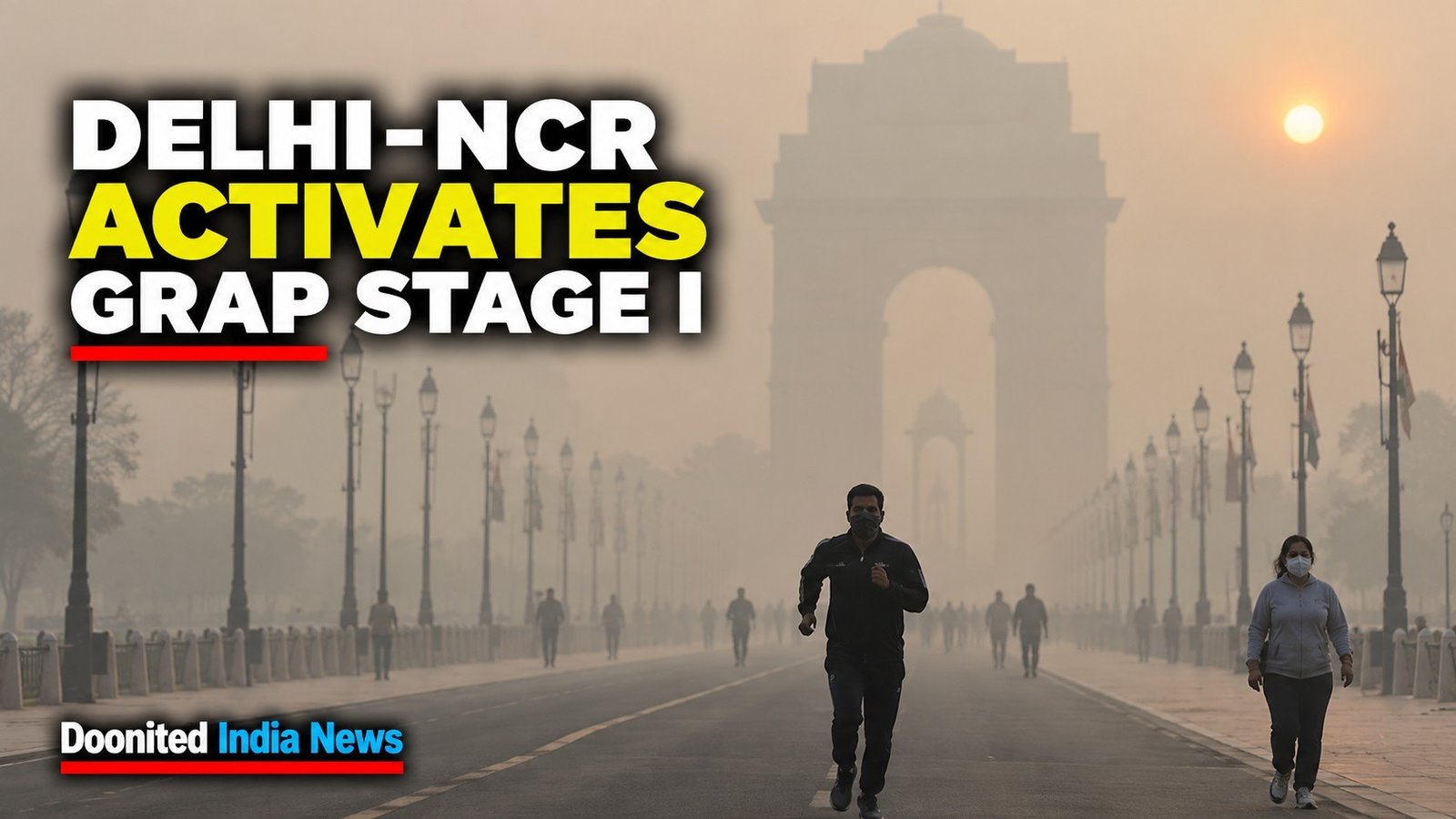
On 21 October 2026, the Commission for Air Quality Management (CAQM) activated Stage I of the Graded Response Action Plan (GRAP) across the National Capital Region (NCR), with immediate effect. Delhi’s AQI had risen from 179 on 20 October to 244 at 2 pm on 21 October, moving into the “Poor” category. Forecasts from the India Meteorological Department (IMD) and the Indian Institute of Tropical Meteorology (IITM) indicated that poor air quality could persist over the coming days.
GRAP is a staged pollution-control framework designed to trigger action as air quality worsens. Stage I applies when Delhi’s AQI is between 201 and 300. It is intended to strengthen existing pollution controls and prevent a further decline—not to shut down the city.
That distinction matters. Schools and offices do not automatically close under Stage I, and a general construction ban is not the default response at this level. Instead, the immediate emphasis is on enforcing rules already designed to reduce emissions and dust.
What Stage I means on the ground
The measures cover a range of everyday activities, from construction sites and restaurants to waste disposal and power generation.
Construction dust comes under closer scrutiny
Construction and demolition activity can release dust, particularly when materials are uncovered, debris is mishandled or trucks carry loose material onto public roads.
Under Stage I, agencies are expected to enforce dust-control requirements at construction and demolition sites, ensure materials are properly handled and covered, and act against violations. Road dust and waste on footpaths and medians also require attention.
The objective is not to halt all construction but to stop avoidable pollution from poorly managed sites. Anti-smog or misting equipment may be part of dust-control arrangements where appropriate, but installing equipment is not proof that a site is compliant. The more meaningful questions are whether dust is actually contained, debris is removed safely and inspections lead to corrective action.
For residents living near construction zones, the difference between a written rule and effective enforcement can be visible in the air outside their windows.
Restaurants must change how they use solid fuels
Stage I measures prohibit the use of coal and firewood as fuel in tandoors at hotels, restaurants and open eateries covered by the applicable directions. Establishments must use permitted cleaner alternatives, such as electricity or approved gas-based fuels.
The restriction addresses local emissions from commercial cooking. It also highlights a wider challenge in urban pollution policy: effective action has to cover not only traffic and large industrial sources but also the many smaller sources that collectively affect neighbourhood air.
Open waste burning is prohibited
Burning leaves, biomass and municipal solid waste in the open releases smoke and particulate pollution. Stage I calls for enforcement against such burning and for better waste handling.
Residents can help by reporting recurring incidents to the relevant municipal authority rather than burning garden waste or allowing rubbish to accumulate and be set alight. The long-term solution also requires reliable waste collection and disposal; enforcement works best when households and businesses have practical alternatives.
Diesel generators face tighter conditions
The Stage I framework restricts the use of diesel generator sets in accordance with the applicable rules, with exceptions for permitted essential or emergency uses. It should not be interpreted as a blanket statement that every generator is prohibited in every circumstance.
Diesel generators can be an important backup during power interruptions, particularly for essential facilities. But their emissions make compliance important during periods of deteriorating air quality.
The wider lesson is that cleaner air depends on coordinated decisions across multiple sectors, not on one conspicuous restriction.
Commuters: more Metro services, but no single transport fix
The Delhi Metro Rail Corporation announced 20 additional weekday train trips from 22 October 2026 to encourage public transport use. It also said it would intensify dust-control measures around construction sites and adjoining roads, including checking whether construction materials are covered and wheel-wash facilities are functioning.
Extra services can help make public transport more convenient, but their environmental benefit depends on whether people can realistically switch from private vehicles. Last-mile connections, crowding, service frequency, walking conditions and the cost of travel all influence that decision.
Vehicle pollution rules also require careful interpretation. Drivers should keep their vehicle documents and valid Pollution Under Control Certificate (PUCC) up to date and comply with applicable restrictions. However, the claim that Stage I itself imposes a blanket ban on all overaged petrol and diesel vehicles throughout the NCR should not be treated as a general Stage I rule. Restrictions on older vehicles can arise under separate legal directions and court orders, and their application depends on the vehicle, location and current enforceable rules.
Likewise, any proposed increase in parking fees should be distinguished from measures formally brought into force. Residents should check official notifications before assuming a new charge or restriction applies to them.
Schools and families: what should change?
Stage I does not automatically require schools to close or shift to online classes. Schools should follow official advisories and any applicable directions from education authorities.
Parents can nevertheless take sensible precautions when air quality is poor:
Check local AQI readings before outdoor sports, strenuous exercise or long periods outside.
Reduce prolonged, high-intensity outdoor activity when pollution is elevated, particularly for children with asthma or other respiratory conditions.
Pay attention to symptoms such as persistent coughing, wheezing, chest tightness or unusual breathlessness, and seek medical advice when necessary.
Keep prescribed medicines available for children who have an existing respiratory condition.
A school does not need to cancel every outdoor activity automatically to respond responsibly. It does need to consider current conditions, the vulnerability of its students and official guidance.
Health: what an AQI of 244 actually tells you
India’s National Air Quality Index classifies readings from 201 to 300 as “Poor”. The Central Pollution Control Board (CPCB) warns that this category can cause breathing discomfort to most people on prolonged exposure. People with heart or lung conditions may be particularly vulnerable.
AQI is a composite indicator based on measured pollutants. It communicates general air-quality conditions, but it does not mean every street or neighbourhood has identical exposure. Local readings can differ, and conditions may change through the day.
Practical precautions include reducing strenuous outdoor exercise when readings are poor, avoiding unnecessary exposure near heavy traffic or visible smoke, and keeping indoor spaces as free from smoke as practicable. People with asthma, chronic obstructive pulmonary disease (COPD) or cardiovascular conditions should follow their clinician’s advice and prescribed treatment plan.
A well-fitting N95 respirator can reduce inhalation of fine particles when worn correctly, but it is not a substitute for reducing exposure. Anyone with a medical condition that makes respirator use difficult should seek individual medical advice. People should not change prescribed medicines or delay urgent care because they are wearing a mask.
The most useful habit is to check the AQI before planning outdoor activity, rather than relying on whether the sky looks clear. Fine particles are not always visible.
Why the first stage matters—and why enforcement matters more
GRAP is designed to escalate as pollution worsens. Stage II corresponds to “Very Poor” air quality, while Stages III and IV involve progressively more serious conditions and stronger measures under the applicable schedule. The aim of Stage I is to intervene early enough to avoid reaching those more disruptive levels.
But a plan’s effectiveness cannot be judged simply by counting the restrictions announced. It depends on whether construction sites control dust, open burning is stopped, cleaner fuels are used where required, vehicle rules are enforced consistently and public transport offers a workable alternative to private travel.
Delhi-NCR’s pollution also cannot be solved by asking residents to change individual habits alone. Household choices matter, but authorities must coordinate across transport, construction, municipal waste, industry and energy. The regional nature of the problem makes coordination essential: pollution does not stop at a municipal boundary.
The first stage of GRAP is therefore both a response and a test. It tests whether agencies can turn an early warning into visible action before pollution becomes worse.
Where residents can check updates
Residents should use official sources for the latest information rather than relying solely on social-media posts or old advisories.
CPCB: National AQI portal
Delhi Metro: Official website
AQI figures can change during the day. Check the latest available reading for the relevant area and follow any updated instructions from local authorities.
The takeaway: prevention must begin before the emergency
Delhi’s AQI reaching 244 on 21 October has brought Stage I of GRAP into force across the NCR. The response targets everyday sources of pollution, while additional Metro trips offer commuters another reason to consider public transport.
The real measure of success will not be the number of directions issued, but whether pollution sources are controlled and air quality avoids further deterioration. Residents can reduce unnecessary exposure and follow the rules, but sustained improvement requires consistent enforcement and coordination across the region.
Clean air is not a seasonal convenience. It is a public-health requirement—and early action only works when the rules are implemented on the ground.


World Beyond the News
Dolphins Use Individual Signature Whistles
Bottlenose dolphins develop distinctive whistles that function somewhat like individual acoustic identifiers.
The Pacific Is Earth’s Largest Ocean
The Pacific Ocean covers more area than any other ocean basin and stretches between Asia, Australia and the Americas.
Artificial Intelligence Learns Statistical Patterns
Modern machine-learning systems identify patterns in large datasets and use those patterns to generate predictions or outputs.
Why Some Stories Spread So Quickly
Emotion, novelty, visual appeal and easy sharing can make a story travel rapidly across social platforms.