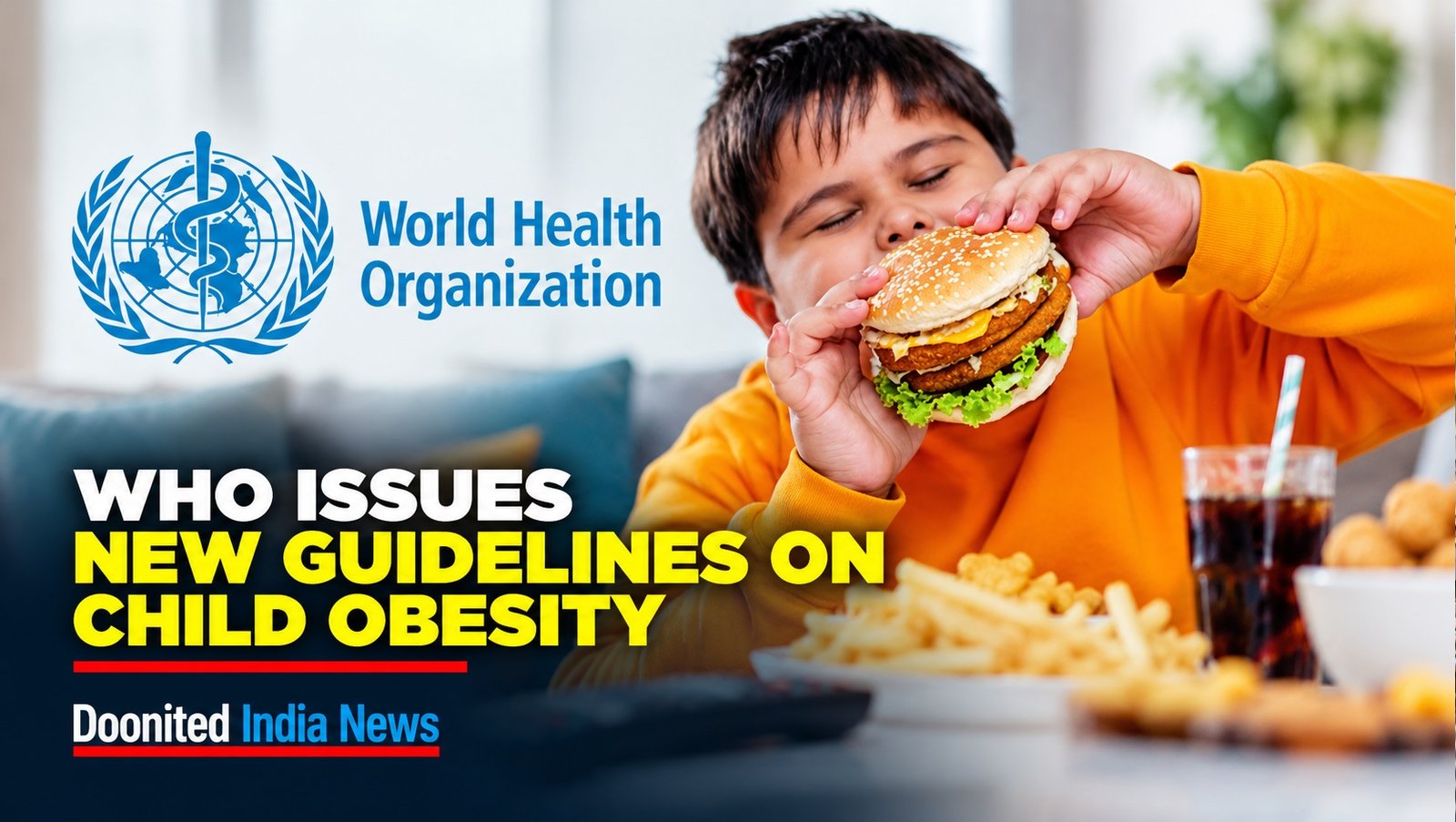
WHO’s New Childhood Obesity Guidelines: Why India Needs Healthier Homes, Schools and Food Environments
Standfirst: The World Health Organization has issued its first dedicated global guidelines for managing obesity in children and adolescents, emphasising structured care, family involvement and support free from stigma. For India, where childhood overweight is rising alongside undernutrition and micronutrient deficiencies, the challenge is not simply to tell children to eat less or exercise more. It is to make nutritious food, physical activity and appropriate medical care accessible to every child.
A child’s health cannot be measured by appearance alone. A fuller-looking child is not automatically unhealthy, just as a thin child is not necessarily well-nourished. Understanding the difference requires attention to growth, diet, activity, development and, when needed, professional medical assessment.
That distinction matters as childhood obesity becomes a growing public-health concern. On 7 October 2026, the World Health Organization (WHO) published its first dedicated global guidelines for the integrated management of obesity in children and adolescents. The guidance places structured, people-centred care at the heart of treatment, while recognising that children need support from families, healthcare professionals and the environments in which they live.
The scale of the challenge is substantial. WHO estimates that, in 2024, around 400 million children and adolescents aged 5–19 were overweight worldwide, including 170 million living with obesity. The prevalence of obesity in this age group rose from 2% in 1990 to 8% in 2024. These figures describe a global trend, not the prevalence in India alone. (WHO)
The new guidance is important not because it offers a quick solution, but because it sets out how prevention, clinical treatment and continuing support should work together.
What the new WHO guidelines actually say
WHO has issued two separate documents: one covering children aged 29 days to under 10 years, and another for adolescents aged 10–19. Both address dietary interventions, physical activity, sedentary behaviour, sleep, behaviour-change support and digital health interventions. The adolescent guidance also covers when medication and bariatric surgery may be considered. (Children’s guideline; adolescents’ guideline)
The central principle is integrated care tailored to the child’s circumstances, with parents or caregivers involved where appropriate. Obesity is recognised as a chronic disease influenced by biological, behavioural, social and environmental factors. It is not simply a failure of willpower.
The recommendations do not mean every child with a higher weight needs medication or a medical procedure. WHO says pharmacological treatment may be considered for adolescents with obesity and related complications when a structured, supervised programme combining lifestyle interventions has not achieved the intended results. Bariatric surgery may be considered for adolescents with severe obesity under strict conditions and with appropriate support.
These are clinical decisions, not options for families to pursue independently. The guidelines should not be interpreted as authorising routine weight-loss medication or surgery for younger children. Parents should seek assessment from a qualified paediatric healthcare professional rather than attempting to diagnose obesity from appearance or an adult BMI calculator.
The distinction is essential: treatment should be proportionate to clinical need, guided by evidence and monitored over time.
India faces a double challenge: too little nutrition and too much of the wrong food
India’s nutrition problem cannot be reduced to obesity alone. Millions of children continue to face stunting, wasting, inadequate dietary diversity and deficiencies in essential nutrients. At the same time, overweight and obesity are increasing.
UNICEF India reported in September 2025 that the proportion of children under five classified as overweight had risen from 1.5% in NFHS-3 (2005–06) to 3.4% in NFHS-5 (2019–21). These are national survey estimates for children under five; they should not be confused with figures for school-aged children or adolescents. (UNICEF India)
This coexistence is often described as the double or multiple burden of malnutrition. A child can consume enough calories—or even more than needed—while still lacking important vitamins, minerals, protein or dietary variety. Energy-dense foods that are high in sugar, salt or unhealthy fats can contribute to this problem when they displace more nutritious meals.
For Indian families, the answer is therefore not indiscriminate calorie restriction. Growing children need adequate energy and nutrients. Meals built around locally available foods—such as dal, beans, vegetables, fruit, whole grains, milk or suitable alternatives, eggs where consumed, and other sources of protein—can support nutritional quality without requiring expensive specialty products.
No single food is a cure, and individual needs vary. A child’s diet should be assessed in the context of age, growth, activity, health conditions and household circumstances.
Why growth charts matter more than guesswork
Parents sometimes interpret weight gain as proof that a child is thriving. Others may become alarmed by a child’s appearance and begin restricting food without medical advice. Both responses can be unhelpful.
Children grow at different rates, and body mass index (BMI) must be interpreted in relation to age and sex—not by applying adult thresholds to a child. WHO provides growth references for children and adolescents, while the Indian Academy of Pediatrics provides growth charts, including BMI charts for Indian children aged 5–18. (IAP growth charts)
A growth chart is a clinical tool, not a label to attach to a child. A paediatrician can assess the growth pattern over time and consider relevant medical, nutritional and developmental factors. That is more useful than comparing siblings, classmates or social-media images.
The language adults use matters, too. Calling a child “fat”, making weight a family joke or publicly comparing bodies can increase shame and discourage children from seeking help. WHO specifically highlights stigma, discrimination and bullying as concerns for children living with obesity.
The goal should be better health, development and well-being—not embarrassment or a particular appearance.
Healthy habits need to be a family project
The WHO approach supports structured changes in diet, physical activity and behaviour, adapted to a child’s needs and involving parents or caregivers. In practice, this means focusing on routines that can be sustained rather than short bursts of strict dieting.
For families, useful steps include:
Offer balanced, varied meals. Make nutritious foods readily available and limit frequent reliance on foods and drinks high in sugar, salt and unhealthy fats. Avoid putting children on restrictive weight-loss diets without clinical advice.
Make movement enjoyable. Outdoor play, walking, cycling, dancing, swimming and traditional games can help children be active. WHO recommends that children and adolescents aged 5–17 undertake an average of at least 60 minutes per day of moderate-to-vigorous physical activity across the week, with activities that strengthen muscles and bones on at least three days a week. (WHO physical activity guidance)
Protect sleep and recovery. Regular sleep routines support general health. Appropriate sleep duration varies by age, so families should follow age-specific guidance rather than applying one bedtime rule to every child.
Change household habits together. Children are more likely to benefit when adults also make time for movement, offer balanced meals and reduce sedentary routines. A child should not be singled out as the only person expected to change.
These are broad health principles, not a substitute for individual care. A child with a medical condition, growth concern or nutritional deficiency may need a tailored plan.
Schools must do more than hold an annual health talk
Schools are well placed to shape daily routines because children spend a significant part of their lives there. But advice about healthy choices has limited value if students have little opportunity for movement or if the most accessible food options are nutritionally poor.
Schools can support children by providing safe and inclusive physical education, ensuring access to drinking water, offering balanced meals and snacks, and teaching practical food literacy. Physical activity should not be reserved for students selected for competitive sports. Children with different abilities and fitness levels need opportunities to participate without ridicule.
Food marketing around schools also deserves attention. India’s Food Safety and Standards Authority of India (FSSAI) has regulations addressing the availability and promotion of foods high in fat, salt and sugar in school settings and restrictions on advertising such foods to children within 50 metres of school premises. However, these rules should not be misrepresented as a universal ban on every sale of packaged snacks within that radius. Implementation and compliance matter. (FSSAI guidance and regulatory material)
Schools should also take weight-based bullying seriously. Teachers and administrators can promote health without weighing students publicly, commenting on their bodies or using exercise as punishment. Confidential referral to appropriate health professionals is more constructive than public shaming.
The policy challenge: make the healthy choice realistic
Responsibility cannot rest entirely on parents. Food prices, advertising, neighbourhood safety, transport, school schedules and access to healthcare all influence children’s daily habits.
A family may understand the value of fresh food but struggle with cost, availability or time. A child may be willing to play outdoors but have no safe place nearby. A school may want to improve its food offering but lack funding, suitable kitchens or reliable suppliers.
Public policy can help close these gaps. Priorities include improving the availability and affordability of nutritious foods, strengthening school food standards, limiting harmful marketing to children, creating safe spaces for play and ensuring that paediatric services can identify and manage obesity without stigma.
India must also keep undernutrition and micronutrient deficiencies in view. Programmes supporting child nutrition should not be designed around weight alone; they need to assess dietary quality, growth and development as well.
The WHO guidelines provide a framework, but they do not automatically change national rules or guarantee that every family can access the recommended care. Countries and health systems must adapt the recommendations, train professionals and measure whether children actually receive appropriate support.
A better measure of success
The publication of global guidelines is an important step, but success will not be measured by how often adults tell children to lose weight. It will be measured by whether children can access nutritious meals, move safely, sleep adequately, receive timely medical assessment and grow up without being humiliated about their bodies.
For Indian families, the immediate lesson is straightforward: avoid diagnosing a child by appearance, do not use adult BMI thresholds, and do not start medication or restrictive diets without professional advice. If there are concerns about growth or weight, seek an assessment from a qualified paediatrician.
For schools and policymakers, the responsibility is broader. Healthy habits become easier when homes, classrooms, neighbourhoods, food systems and health services support them together.
Childhood obesity is a medical and social challenge, not a character test. The most effective response is one that protects children’s health while preserving their dignity.


World Beyond the News
Bees Communicate Where Food Is
Honeybees use movement patterns known as waggle dances to communicate information about food locations.
Street Food Reflects Local History
Many famous street foods developed from migration, trade, local ingredients and the everyday needs of working communities.
A Day on Venus Is Extremely Long
Venus rotates so slowly that one rotation relative to distant stars takes longer than its trip around the Sun.
Human Achievement Continues to Push Limits
Athletes, engineers, scientists and explorers regularly establish new benchmarks in speed, endurance, scale and precision.