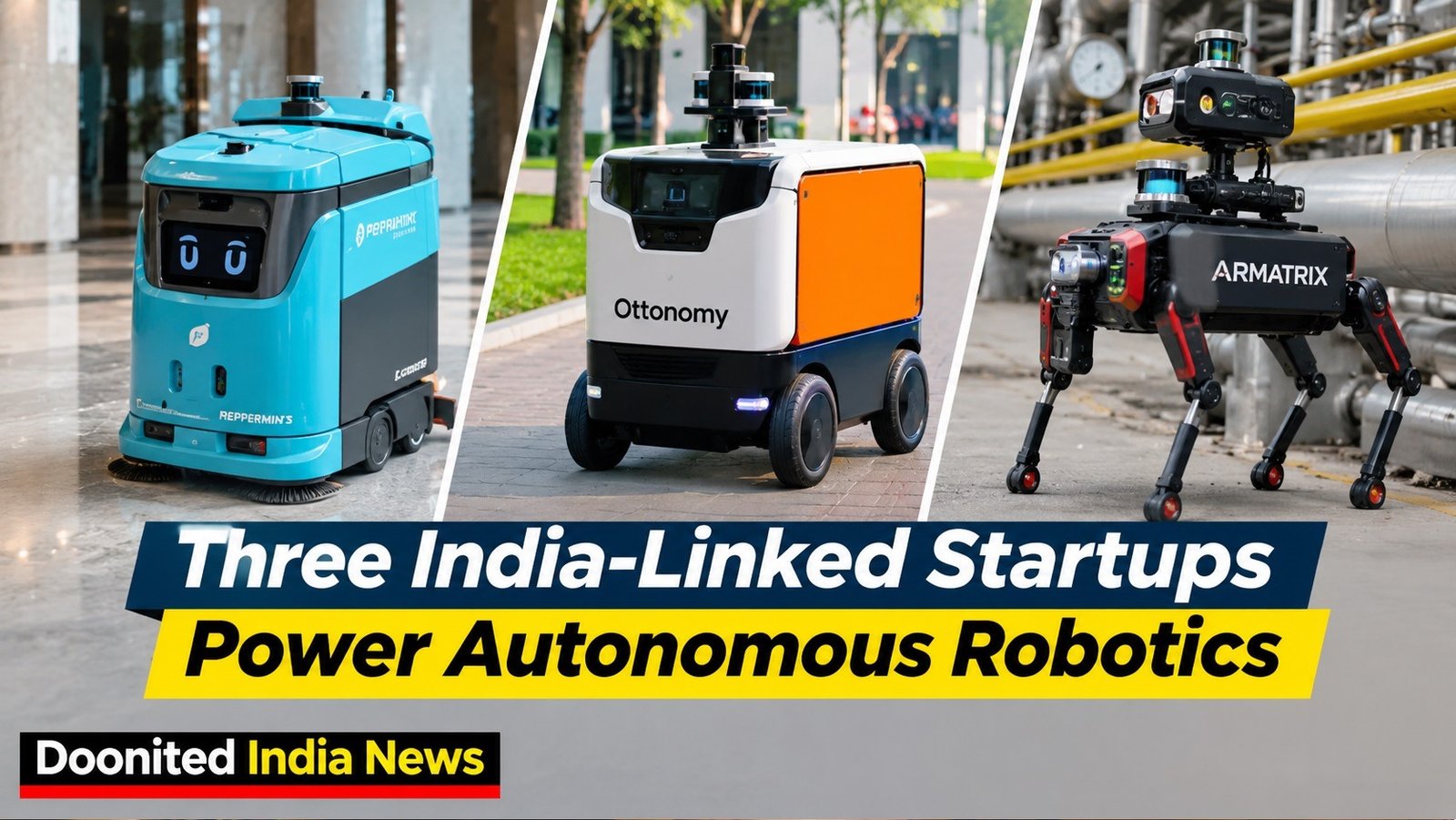
Three Indian-Linked Robotics Startups, Three Real-World Problems: Cleaning, Delivery and Industrial Safety
Peppermint Robotics, Ottonomy and Armatrix are developing autonomous machines for workplaces where repetitive, time-consuming or hazardous tasks can be handed to robots. Their November 2026 funding highlights investor interest in practical robotics—but their technologies and commercial maturity differ significantly.
By Pradeep Banerjee | Editor, DOONITED.in
Robotics is often presented through images of humanoid machines and futuristic laboratories. Yet some of the most commercially useful robots are less dramatic: a machine scrubbing a hospital floor at night, a delivery robot carrying medical supplies through corridors, or a flexible robotic arm inspecting a dangerous industrial space.
Three India-linked startups are working on precisely these problems. Pune-based Peppermint Robotics, internationally active Ottonomy, and Bengaluru-based Armatrix represent three distinct applications of autonomous systems: commercial cleaning, indoor-outdoor logistics and industrial inspection.
Their funding announcements in November 2026 have brought renewed attention to India’s deep-tech ecosystem. All three have links to pi Ventures, although their latest funding rounds have different lead investors and structures.
Peppermint Robotics: Automating the work nobody notices
Founded in 2019 by Runal Dahiwade and Miraj C Vora, Peppermint Robotics develops autonomous mobile robots for commercial floor cleaning and material movement. Incubated at IIT Bombay’s Society for Innovation and Entrepreneurship (SINE), the company has built machines designed for environments such as factories, hospitals and large commercial facilities.
Its product range includes autonomous scrubber-dryers and commercial cleaning systems. These machines combine sensors, navigation software and safety features to move through working environments while avoiding obstacles and people.
In November, Peppermint announced a ₹100 crore (approximately $10.5 million) Pre-Series B round, led by pi Ventures and Crane Venture Partners, with participation from Asiana Fund. The company said its robots were deployed across nine countries and reported nearly sixfold revenue growth between FY24 and FY26. The round includes both primary investment and secondary share transactions; the split has not been disclosed.
The funding is intended to support manufacturing, product development and international expansion, including plans for a North American assembly line.
Ottonomy: Taking autonomous delivery indoors
Ottonomy, founded in 2020, is developing robots that transport goods across indoor and outdoor environments. Its Ottobot systems use cameras, sensors and navigation technology to operate in spaces where GPS signals may be unavailable or unreliable.
The company’s applications have evolved from retail and airport deliveries towards healthcare logistics. In hospitals, autonomous machines can potentially move medicines, samples and supplies between departments, reducing routine transport work for staff.
In November 2026, Japan-based Enrission India Capital announced an investment associated with a ₹40.6 crore (approximately $4.2 million) funding round. Ottonomy’s own coverage describes the investment as a Series A, while other reporting has used the term post-seed. The public announcement does not establish a complete investor breakdown or disclose a valuation.
That distinction is important: the funding is a reported development, but it should not be presented as a round jointly led by pi Ventures without further confirmation.
Armatrix: Robotic arms for places humans cannot safely reach
Armatrix is tackling a very different challenge. Founded in 2024 by IIT Kanpur alumni Vishrant Dave, Prateesh Awasthi and Ayush Ranjan, the Bengaluru-based startup is developing flexible, snake-like robotic manipulators for inspection and maintenance in confined or hazardous industrial spaces.
Its systems are designed to reach inside complex infrastructure such as aircraft engines, industrial equipment, ship structures and oil-and-gas installations. The company describes its robotic architecture as hyper-redundant, with more than 22 degrees of freedom, allowing the arm to navigate complex paths that conventional rigid manipulators may struggle to access.
In November, Armatrix raised ₹67.28 crore in a seed round led by UK-based Crane Venture Partners. pi Ventures participated with a reported ₹15 crore investment, alongside other investors. Entrackr estimated the company’s valuation at ₹360 crore, up from ₹75 crore in its earlier round. The funding round was reported as ongoing, so the figure should not automatically be treated as the final amount raised.
Armatrix’s technology could reduce the need for workers to enter dangerous spaces, but industrial adoption will depend on reliability, inspection accuracy, maintenance costs and successful trials in real operating environments.
What connects the three companies?
The common thread is not a single type of robot. It is the effort to automate specific tasks with measurable operational value.
Peppermint targets repetitive cleaning and material movement.
Ottonomy focuses on autonomous delivery and internal logistics.
Armatrix addresses inspection and maintenance in difficult-to-access industrial spaces.
Their business models also face different tests. Cleaning robots must demonstrate productivity and durability across large facilities. Delivery robots need safe navigation, integration with building infrastructure and dependable operations. Industrial manipulators must meet demanding engineering and safety standards before customers can trust them in critical environments.
pi Ventures is a notable common investor: it co-led Peppermint’s latest round and participated in Armatrix’s reported seed financing. Its connection to Ottonomy’s November investment is not established by the funding announcements reviewed for this article. That distinction matters when describing the investment landscape.
India’s robotics opportunity is moving from demonstration to deployment
The significance of these companies lies in their focus on practical applications rather than futuristic spectacle. Robots do not need to resemble people to change how workplaces operate. A machine that cleans a large facility reliably, transports supplies through a hospital or inspects a hazardous structure can create value without attracting much public attention.
India’s opportunity is to build not only robotic products but also the supporting ecosystem: precision components, sensors, software, testing facilities, skilled technicians, manufacturing capacity and dependable after-sales service.
The next measure of success for these startups will not simply be how much capital they raise. It will be how many customers deploy their machines repeatedly, how safely the robots operate and whether the economics make sense.
The future of Indian robotics may be less about machines that look human—and more about machines that solve problems humans should not have to keep doing.


World Beyond the News
Dolphins Use Individual Signature Whistles
Bottlenose dolphins develop distinctive whistles that function somewhat like individual acoustic identifiers.
The Pacific Is Earth’s Largest Ocean
The Pacific Ocean covers more area than any other ocean basin and stretches between Asia, Australia and the Americas.
Artificial Intelligence Learns Statistical Patterns
Modern machine-learning systems identify patterns in large datasets and use those patterns to generate predictions or outputs.
Why Some Stories Spread So Quickly
Emotion, novelty, visual appeal and easy sharing can make a story travel rapidly across social platforms.