Microsoft’s October 7 Windows Event: Is the Future of AI Computing Moving Inside the PC?
Microsoft’s upcoming Windows and Surface event in San Francisco is set to put a growing question at the centre of personal computing: how much artificial intelligence should run directly on our devices, rather than in distant data centres?
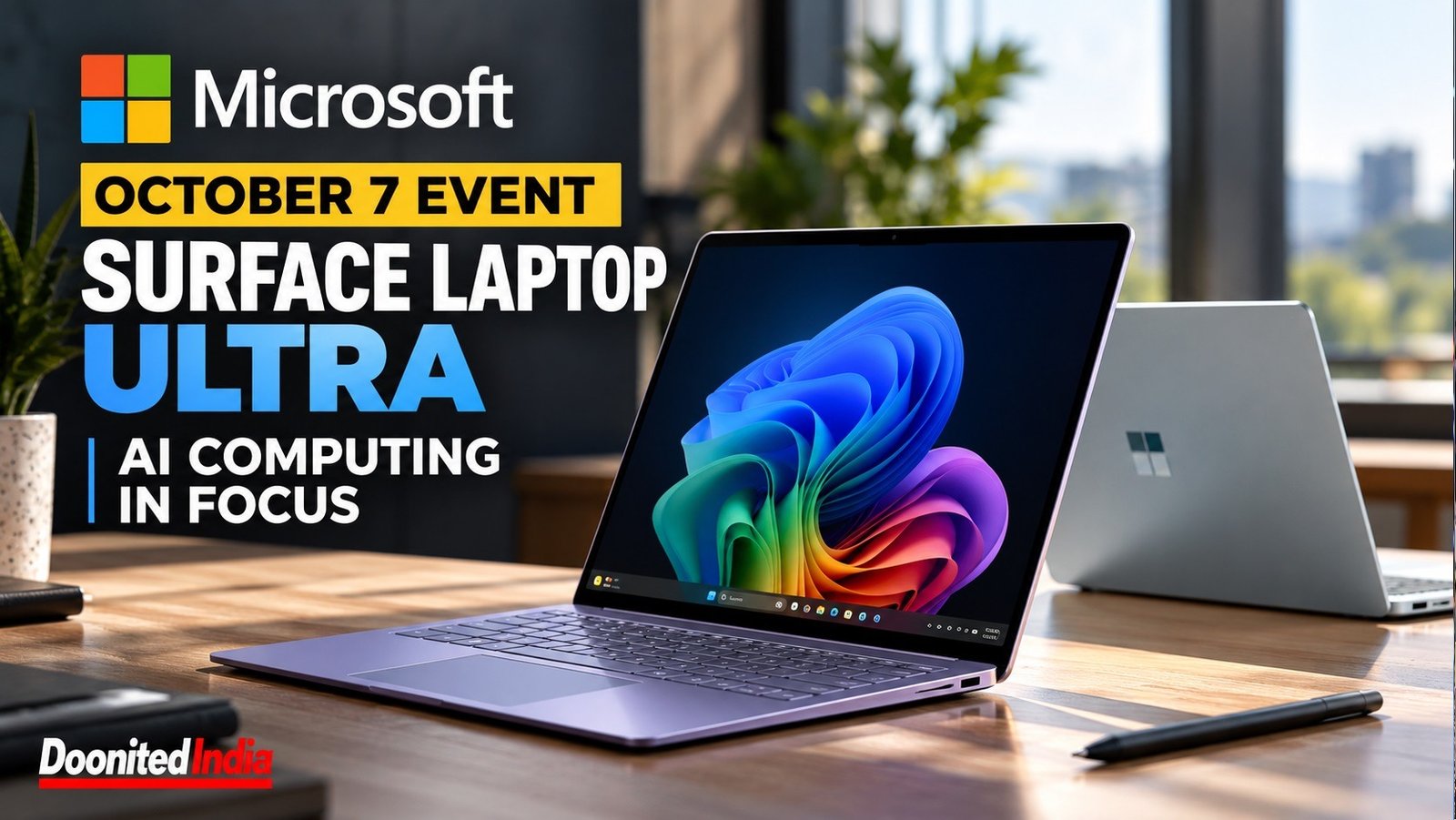
The October 7 event is expected to spotlight Windows, Surface hardware and AI computing. But some of the most significant developments are already underway. Microsoft has announced the Surface Laptop Ultra, built around NVIDIA’s RTX Spark platform, and a compact Surface RTX Spark Dev Box aimed at AI developers. Both point towards a future in which powerful AI workloads can run locally.
For Indian users, the story is about more than premium hardware. It raises questions about price, software compatibility, data privacy, electricity use and whether local AI will become genuinely useful—or remain a feature reserved for people with expensive machines.
A confirmed direction, but not every announcement is new
The event is scheduled for October 7 at 10:00 a.m. Pacific Time, which corresponds to 10:30 p.m. in India. Microsoft CEO Satya Nadella, Windows and Devices chief Pavan Davuluri, and NVIDIA CEO Jensen Huang are among the reported key attendees.
The wider context is important. Microsoft and NVIDIA have already publicly outlined their collaboration around RTX Spark-powered Windows PCs. Microsoft’s May 2026 announcements described a new generation of machines designed for developers, creators and people working with AI models locally. The October event should therefore be viewed as a potential next chapter in an existing strategy—not the starting point of the partnership.
The precise October 7 announcements, however, should be distinguished from products and specifications Microsoft has already revealed.
Surface Laptop Ultra: a powerful laptop with an AI ambition
Microsoft announced the Surface Laptop Ultra on May 31, 2026. According to the company, the machine combines an NVIDIA Blackwell RTX GPU with up to 128GB of unified memory and full CUDA support. Microsoft says it can deliver up to one petaflop of AI compute and run models with as many as 120 billion parameters locally, depending on the workload and configuration.
The announced hardware also includes a 15-inch mini-LED touchscreen with up to 2,000 nits of peak HDR brightness, alongside HDMI, USB-C, USB-A, SD card and headphone connections. Microsoft has positioned it for demanding creative and development work, including AI, 3D rendering and compiling.
These are substantial specifications, but they need context. A model’s parameter count alone does not establish how quickly or effectively it will run. Performance depends on factors such as model architecture, quantisation, memory requirements, software optimisation and the task being performed. A large model that technically loads on a machine may not deliver the same responsiveness as a smaller, more efficiently optimised one.
There is also a practical question: how many buyers need this much computing power in a laptop? For AI developers, researchers and creative professionals, local processing could be valuable. For someone who mainly browses the web, edits documents and attends video calls, much of that hardware may be unnecessary.
Microsoft says the Surface Laptop Ultra is expected to become available later in 2026. Its final specifications, regulatory approvals and availability may vary by country.
Surface RTX Spark Dev Box: a local AI workstation
The Surface RTX Spark Dev Box is another important part of Microsoft’s strategy. Microsoft introduced it in June as a compact developer system built around NVIDIA’s RTX Spark superchip and intended for local-first AI development.
Its appeal is straightforward: developers can experiment with models, build applications and test AI agents on their own hardware instead of relying entirely on remote cloud infrastructure. A system with up to 128GB of unified memory can accommodate workloads that would be difficult to run on many conventional PCs.
Local computing can offer benefits beyond performance. Sensitive material may be processed without being sent to an external service, while development teams can reduce their dependence on network connectivity and usage-based cloud charges. Those advantages are not automatic, however. Privacy still depends on software behaviour, security configuration and whether an application makes external connections.
Nor does “local” necessarily mean “free”. The hardware has an upfront cost, and users still need to account for electricity, maintenance, software licences and the time required to manage models. Cloud computing may remain more economical for occasional workloads or projects that need large amounts of computing power only intermittently.
The Dev Box is therefore best understood as a specialised development tool, rather than a replacement for every desktop computer.
Is Microsoft moving beyond the Copilot+ PC label?
A branding shift is also attracting attention. Recent reporting says Microsoft’s newer Surface devices are moving away from explicitly using the “Copilot+ PC” name, even when they meet the relevant hardware requirements.
That does not, by itself, establish that Microsoft is abandoning the underlying category or its technical capabilities. The distinction matters: a product name is a marketing decision, while hardware requirements and software features are separate matters.
Microsoft’s own May announcement said RTX Spark-powered Windows PCs would join the Copilot+ PC category. More recent reports suggest the branding is becoming less prominent on newer products. The October event may help clarify how Microsoft intends to describe its AI PCs, but a complete change in strategy should not be treated as confirmed before the company explains it.
There is a sensible reason to focus on capabilities rather than labels. Consumers need to know what a device can actually do: which AI features work offline, which require a subscription, what data leaves the machine, and how long those features will be supported. A badge cannot answer those questions on its own.
What this could mean for India
For India, the most immediate issue is likely to be accessibility—not the theoretical limits of AI performance.
Premium AI hardware could help Indian software developers, animation studios, researchers, designers and technology startups build and test applications with greater control over their computing environment. Local processing may also be useful in settings where connectivity is inconsistent or where organisations have strict requirements for handling data.
But the benefits will depend on local pricing, availability, repair support, software compatibility and the cost of upgrading. Microsoft has not yet established the India-specific pricing and configurations in the material reviewed for this article. It would be premature to suggest a rupee price or a confirmed Indian launch date.
The broader opportunity is for Indian developers and businesses to use local AI hardware to create products and services—not simply to purchase increasingly powerful machines. A capable computer is an enabler; the value comes from what people build with it.
There are also limits to the privacy argument. Running a model locally can reduce the need to send prompts and files to a cloud provider, but it does not guarantee complete privacy. Applications may still transmit telemetry, synchronise data or use online services. Buyers should examine the actual software settings and policies rather than relying on the phrase “on-device AI”.
The real test: useful AI, not just bigger specifications
Microsoft’s October event arrives as the PC industry searches for a durable reason for consumers to upgrade. Faster processors and sharper displays are familiar selling points. AI offers a new one—but only if it changes everyday work in a meaningful way.
The strongest case for local AI is not that every user should run a 120-billion-parameter model. It is that the right task can be completed faster, more privately, more reliably or at a lower ongoing cost. That might mean summarising a large collection of documents, assisting with software development, analysing media or helping a creative professional work through a demanding project.
The weakest case is a machine whose AI capability looks impressive in a keynote but remains difficult to use, poorly supported or irrelevant to the buyer’s routine.
For Microsoft, the challenge is therefore twofold: deliver the hardware performance it promises, and make the software experience clear enough that customers understand why they need it. The event will be worth watching for concrete demonstrations, product availability, pricing and details about which features work locally.
DOONITED View
The move towards local AI computing is a meaningful development in personal technology. It gives users and developers another way to balance performance, privacy, connectivity and cloud costs. But the industry should resist treating raw specifications as a substitute for practical value.
Microsoft and NVIDIA have laid out an ambitious technical direction. The next measure of success is whether that direction produces dependable tools at prices and in configurations that make sense for real users—including those in India.
Learning Point
When evaluating an AI PC, ask three questions: Which tasks can it perform locally? What are the real costs of owning and using it? And does its AI capability solve a problem you actually have? Those answers matter more than the label on the box.


World Beyond the News
Why Elephants Stay Close to Their Herd
Elephants live in highly social family groups and use calls, touch and body movements to maintain strong bonds.
Most of the Deep Ocean Remains Difficult to Explore
Extreme pressure, darkness and distance make deep-ocean exploration one of Earth’s greatest scientific challenges.
Spacecraft Can Travel Without Traditional Roads
Spacecraft use carefully calculated trajectories and gravity assists to travel enormous distances through space.
Why Movie Trailers Are Released in Stages
Major films often use teaser trailers, full trailers and final promotional spots to build awareness over time.