Lenovo Legion 5i Gen 10: What ₹2.16 Lakh Buys You in a Gaming Laptop
A gaming laptop has to do more than run the latest game at a high frame rate. It must balance graphics performance, cooling, display quality, portability and price—and, increasingly, handle demanding creative and AI-assisted workloads too.
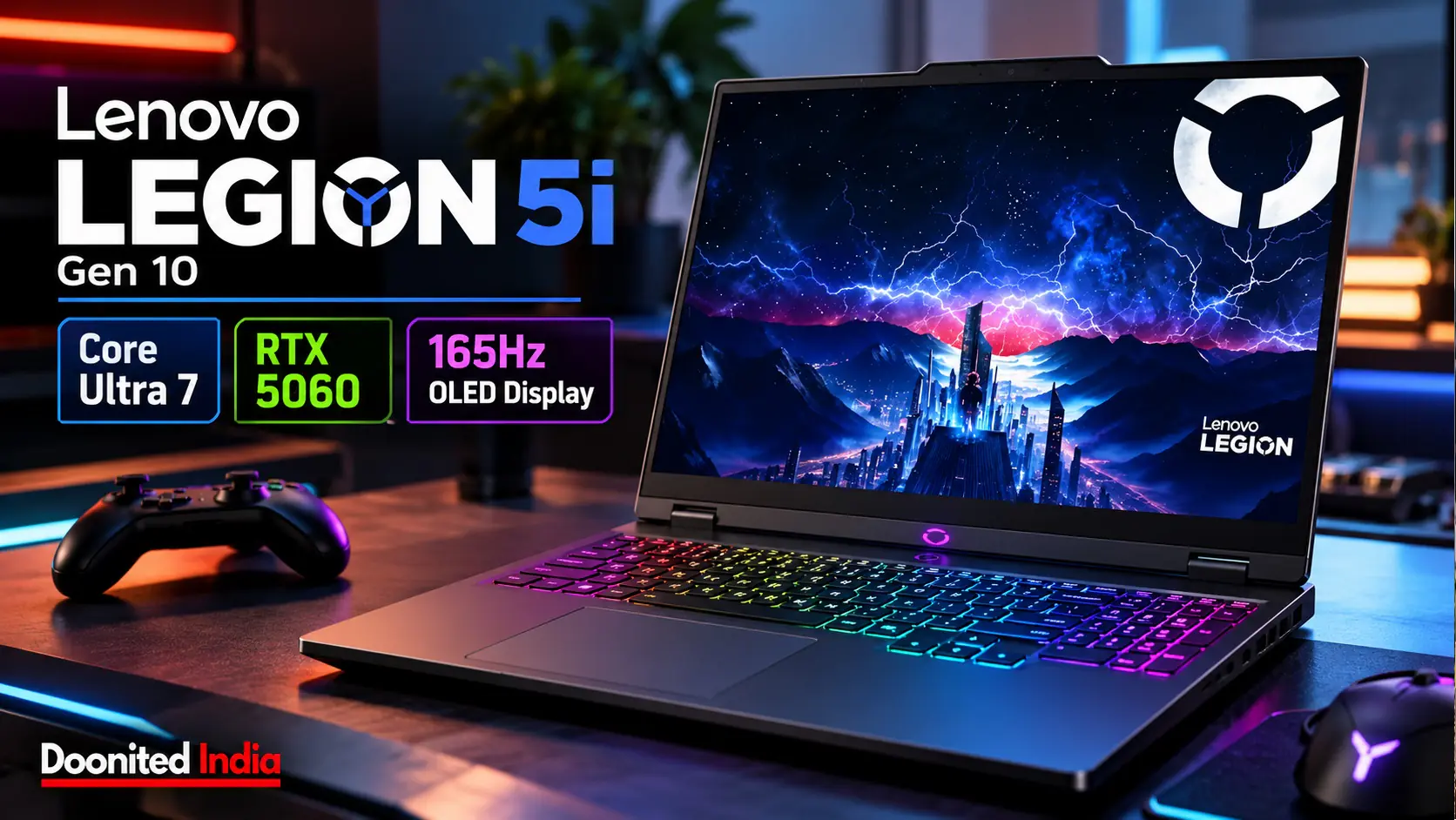
Lenovo’s Legion 5i Gen 10 brings those priorities together in a 15-inch-class laptop powered by an Intel Core Ultra 7 processor and NVIDIA GeForce RTX 5060 Laptop GPU. Lenovo India lists the configurable model at ₹2,15,818, including shipping and taxes, although prices and offers can change. The manufacturer’s product page identifies the configuration as part number 83F0CTO1WWIN2.
At this price, the question is not simply whether the laptop is powerful. It is whether its particular combination of components makes sense for the buyer—and whether the configuration is worth choosing over alternatives in Lenovo’s own Legion family.
The configuration behind the price
The Lenovo India listing for the specified Legion 5i Gen 10 configuration gives the following hardware:
-
Processor: Intel Core Ultra 7 255HX
-
Graphics: NVIDIA GeForce RTX 5060 Laptop GPU with 8GB GDDR7 memory
-
Memory: 16GB DDR5-5600
-
Storage: 512GB PCIe Gen 4 SSD
-
Display: 15.1-inch WQXGA OLED, 2560 × 1600 resolution, 165Hz refresh rate
-
Operating system: Windows 11 Home
-
Connectivity: Wi-Fi 7 and Bluetooth 5.4
-
Battery: 80Wh
-
Warranty: One-year courier or carry-in service
The OLED panel is a notable part of this specification. Lenovo lists HDR 600, 100% DCI-P3 colour coverage and up to 500 nits brightness. That combination can benefit not only gaming but also photo editing, video work and other tasks where colour and contrast matter.
These specifications apply to the cited Intel configuration. Legion 5i listings and configurable options can vary, so buyers should verify the final build summary before placing an order.
RTX 5060: gaming power with a practical limit
The RTX 5060 Laptop GPU belongs to NVIDIA’s GeForce RTX 50 Series, bringing support for modern rendering features, ray tracing and AI-assisted graphics technologies such as DLSS 4. These can improve visual quality or increase frame rates in supported games.
But a graphics processor’s name does not tell the whole performance story. Laptop GPUs operate within power and thermal limits set by the manufacturer. Actual gaming results depend on the GPU’s configured power, cooling, game settings, resolution and whether features such as frame generation are enabled.
For the Legion 5i, the 2560 × 1600 display makes that distinction important. Running a demanding game at the panel’s native resolution can place a much greater load on the GPU than playing at 1920 × 1080. Some games will benefit from upscaling or adjusted settings to maintain a high frame rate.
The 165Hz display can make supported games feel fluid, but it does not mean every title will run at 165 frames per second. Competitive games and graphically demanding cinematic titles place very different demands on hardware.
The sensible expectation is a capable gaming machine whose performance will vary by game—not a guarantee of maximum settings and maximum frame rates in every title.
Intel Core Ultra 7: more than a gaming processor
The Intel Core Ultra 7 255HX is designed for high-performance laptop workloads. Its combination with a discrete RTX GPU makes the Legion suitable for gaming alongside tasks such as video editing, 3D work, software development and intensive multitasking.
That versatility is relevant to students and professionals who want one computer for both work and entertainment. A laptop that can handle a project during the day and a demanding game in the evening may be more useful than maintaining separate systems.
The system also includes Lenovo AI Engine+, managed through Legion Space. Lenovo says the technology can adjust system settings according to the game or application, with the aim of improving performance. Such automated tuning can be convenient, though results will depend on the workload and system configuration.
AI features are a supporting benefit here, not a reason by themselves to buy the laptop. The central value remains its CPU, GPU, cooling and display combination.
Cooling: the performance you can sustain
Gaming laptops can deliver impressive short bursts of performance, but maintaining that performance during a long session is the harder engineering task. Heat from the CPU and GPU must be moved away efficiently, while fan noise and chassis temperature remain manageable.
Lenovo’s Legion Coldfront: Hyper cooling system is intended to address that challenge. The company also highlights its fan design and thermal management.
For buyers, the important distinction is between advertised cooling technology and measured real-world behaviour. Reviews that test sustained gaming, CPU-heavy workloads, fan noise and surface temperatures can help establish how the laptop behaves under pressure.
A powerful laptop that becomes uncomfortably loud or reduces performance during extended use may not deliver the experience its specifications suggest. Cooling is not a glamorous line on a product page, but it can determine how enjoyable the machine is to use.
The trade-off: 16GB RAM and 512GB storage
At around ₹2.16 lakh, the listed configuration’s 16GB of RAM and 512GB SSD deserve careful consideration.
Sixteen gigabytes can be sufficient for many games and everyday applications. However, users who keep numerous applications open, edit high-resolution video, work with large creative projects or run virtual machines may benefit from more memory.
Storage could become the more immediate limitation. Modern games can occupy substantial amounts of space, and a 512GB drive leaves less room than its headline capacity suggests once Windows, applications and files are installed.
The listed memory uses SODIMM modules, and the storage is an M.2 PCIe Gen 4 SSD. Buyers considering an upgrade should confirm the machine’s supported memory capacity, available slots, drive compatibility and warranty implications before purchasing additional components.
It is worth comparing the final cost of a higher-memory or higher-storage configuration with the base build. A discounted headline price may look attractive, but the configuration that meets your needs is the one that matters.
What about the AMD Legion 5?
Lenovo also sells the Legion 5 Gen 10 with AMD Ryzen processors. One listed configuration combines a Ryzen 7 260, RTX 5060 8GB, 16GB RAM and a 1TB SSD, with a 15.3-inch WUXGA IPS display. Lenovo’s product page has listed it at ₹1,87,991, though offers and pricing may change.
That comparison illustrates why model names alone are not enough. The Intel Legion 5i configuration offers a higher-resolution OLED display and a newer connectivity specification, while the cited AMD model provides more storage at a lower listed price.
They are not identical systems, and their gaming performance cannot be judged from the processor brand alone. But the comparison gives buyers a useful checklist: display quality, storage, CPU performance, GPU power limits, memory, ports, weight and warranty.
If OLED contrast and a high-resolution screen are priorities, the 5i’s configuration has a clear feature to consider. If the goal is to get an RTX 5060 laptop with more storage for less money, the AMD model is also worth examining.
Is ₹2.16 lakh justified?
The Legion 5i Gen 10 is positioned as a premium gaming laptop, and its OLED display, Core Ultra 7 processor, RTX 5060 graphics and Wi-Fi 7 make for a substantial specification sheet.
However, price should be evaluated against the actual configuration and competing machines available at the time of purchase. Lenovo’s listed price is not a permanent market price, and discounts, bank offers, exchange benefits and configurable upgrades can alter the final amount.
Potential buyers should also budget for the practical extras: a gaming mouse, headset, laptop stand or external monitor if needed. The 80Wh battery provides mobility, but demanding gaming workloads generally make a power adapter essential for sustained performance. At roughly this price, portability should not be confused with all-day unplugged gaming.
The most useful pre-purchase step is to check independent reviews of the exact configuration, particularly sustained gaming performance, display measurements, noise, temperatures and battery life. A review of a different Legion variant may not reflect the same GPU power limits or display.
DOONITED View
The Lenovo Legion 5i Gen 10 illustrates the modern gaming laptop’s dual identity: it is both an entertainment machine and a portable workstation. Its OLED panel and RTX 5060 graphics could appeal to gamers, creators and users who need substantial graphics performance in one device.
The main caution is configuration value. At ₹2,15,818, 16GB RAM and 512GB storage may feel restrictive for some buyers, even if the processor and display are attractive. Lenovo’s AMD-based Legion 5 is a useful internal comparison, particularly for buyers who prioritise storage and price over the 5i’s OLED display.
The right decision depends on workload, not just the Legion badge. A well-matched configuration will serve its owner better than a more expensive specification chosen for bragging rights.
Learning Point
When buying a gaming laptop, evaluate the complete configuration—not just the GPU. Check graphics power limits, display resolution, memory, storage, cooling and the final checkout price. Those details determine whether a laptop’s performance is useful in everyday life.


World Beyond the News
Octopuses Can Change Their Appearance
Octopuses can rapidly alter their skin colour and texture to communicate, camouflage themselves and respond to danger.
Some Cities Exist Across Two Continents
A small number of cities are geographically associated with two continents, creating unusual cultural and geographic identities.
Earth’s Climate Is Measured in Many Ways
Scientists track temperature, atmospheric gases, sea level, ice cover and other indicators rather than relying on a single climate number.
Streaming Changed How Audiences Discover Shows
Recommendation systems and global streaming releases allow audiences to discover programmes far beyond their original markets.