Meghalaya’s Living Food Heritage: How Indigenous Kitchens Are Bringing Northeast India to the World
From fermented soybeans and smoked fish to bamboo-cooked rice and forest-foraged ingredients, Meghalaya’s culinary traditions are finding a wider audience. The challenge is to turn growing curiosity into lasting recognition and opportunity for the communities that have preserved these flavours.
In Meghalaya, a meal can tell the story of a forest, a farming season and generations of knowledge passed down around a home hearth. Rice, pork, fermented soybeans, dried fish, black sesame, bamboo shoots and wild greens are not simply ingredients. Together, they represent a food culture shaped by the landscape and the everyday practices of Khasi, Jaintia and Garo communities.
For years, much of this culinary heritage remained relatively unfamiliar outside the Northeast. That is beginning to change. Regional chefs, food storytellers, restaurants and tourism initiatives are taking Meghalaya’s traditional preparations to audiences in other Indian cities and beyond.
But the real story is not just about introducing unfamiliar dishes to new diners. It is about recognising the people, local ingredients and traditional knowledge behind them.
A cuisine shaped by the land
Meghalaya’s varied terrain and biodiversity have influenced what grows, what communities gather and how food is prepared. Seasonal wild herbs, edible ferns, mushrooms, bamboo shoots, roots and local fruits remain part of the region’s food culture. The state’s tourism department describes foraging as a longstanding practice rooted in familiarity with local ecology.
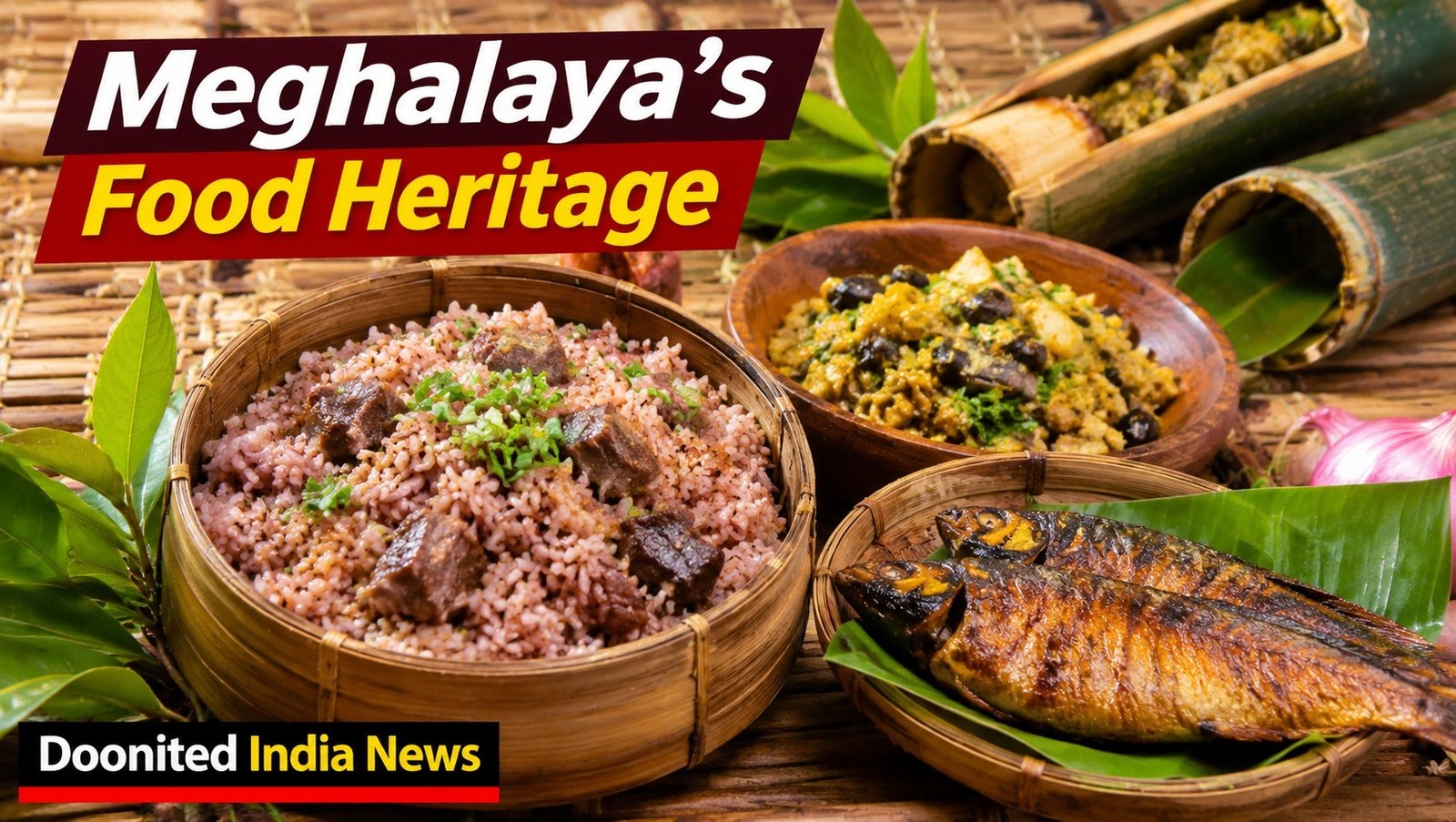
Rice is central to everyday meals, while pork features prominently in many traditional preparations. One of the best-known Khasi dishes is jadoh, rice cooked with meat, commonly pork. It is often served with dohkhleh, a pork salad, and tungrymbai, a preparation made from fermented soybeans and commonly cooked with black sesame.
Black sesame, known in Khasi cuisine as nei-iong, also gives dishes such as dohneiiong their distinctive nutty character. These preparations demonstrate how a relatively small number of local ingredients can produce complex flavours without depending on elaborate spice mixtures.
The cuisine is not uniform across the state. Jaintia food traditions include putharo, a soft rice-flour preparation, served with pork curry known as dohjem. The smoked fish preparation kharang is another regional speciality. Garo kitchens, meanwhile, are known for dishes such as do’o kappa, chicken cooked with indigenous alkaline ingredients, and nakham bitchi, a gravy made with dried fish.
Smoking, fermentation and the wisdom of preservation
Before refrigeration became commonplace, smoking and fermentation helped communities preserve food. These techniques remain important not merely as methods of storage but as defining elements of flavour.
Meat and fish smoked over a hearth acquire a deep aroma and can be used in curries, chutneys and other preparations. Fermentation gives tungrymbai its characteristic pungency and depth, while fermented or pickled bamboo shoots contribute a tangy note to regional cooking.
Garo cooking also uses potash, traditionally obtained from the ash of burnt plant material. It is used in preparations such as pork and chicken dishes, helping soften ingredients and creating a characteristic taste. The exact preparation and terminology can vary between communities and households.
Cooking in hollow bamboo tubes is another striking technique. Rice, meat, fish or vegetables are placed inside fresh bamboo, sealed and cooked over a fire. The method connects the cooking process directly to the materials available in the surrounding landscape. Meghalaya Tourism also documents the use of heated stones in traditional cooking.
These practices deserve attention as living culinary knowledge, not merely as picturesque attractions for visitors.
Nambie Marak and a new audience for regional food
One of the prominent voices introducing Meghalaya’s food traditions to a wider audience is Nambie Jessica Marak. Her journey began with documenting recipes and food memories through her Eat Your Kappa platform. She later reached the final stages of MasterChef India Season 8, finishing as first runner-up.
In 2026, Marak represented India on MasterChef Asia, giving her an international platform to introduce flavours and culinary traditions associated with Meghalaya and the wider Northeast. Her work illustrates how digital storytelling and mainstream television can help regional food cultures travel beyond their geographical origins.
YouTube+3
Her influence is part of a broader movement. Chefs, food entrepreneurs and independent dining initiatives are experimenting with traditional ingredients and contemporary presentation. The opportunity lies in making these foods accessible without stripping away the cultural context that makes them distinctive.
From local kitchens to national food showcases
The movement is also gaining institutional support. In October 2026, a 14-event culinary roadshow was announced by Meghalaya Tourism and The Meghalayan Age Limited, in collaboration with the Seeti Movement. Planned between October 2026 and February 2027, the programme is intended to showcase Khasi, Garo and Jaintia cuisine in metropolitan centres including Delhi-NCR, Mumbai, Bengaluru, Kolkata, Goa and Hyderabad.
Such events can introduce diners to dishes they may never encounter on conventional restaurant menus. They can also create opportunities for local cooks, food producers and farmers to connect with new markets.
However, visibility alone does not guarantee that communities benefit. A successful culinary initiative must build reliable links with local suppliers, ensure fair returns for producers, preserve traditional knowledge and maintain food safety without unnecessarily standardising recipes. The challenge is to make indigenous food commercially viable while respecting the people who have sustained it.
More than a tourism attraction
Meghalaya’s culinary heritage offers India an important reminder: the country’s food identity extends far beyond its most widely marketed regional cuisines. A dish such as jadoh, a bowl of nakham bitchi or a serving of tungrymbai carries knowledge about ingredients, preservation, local ecology and community life.
A 2018 study published in the Journal of Ethnic Foods, based on research involving cooks, food-stall owners and consumers from Khasi, Jaintia and Garo communities, documented traditional meat preparations and examined their cultural and socioeconomic significance. The researchers argued that better documentation, improved hygiene and packaging, and stronger market access could help prevent the loss of these food traditions while creating opportunities for local communities.
That remains a useful direction for the road ahead. Recipes should be documented with the participation of the communities that own and practise them. Local ingredients should be sourced responsibly. Young people should see value in learning traditional food skills, and tourism programmes should create tangible economic opportunities rather than treating heritage as a marketing label.
Meghalaya’s food does not need to become something else to appeal to the world. Its strength lies precisely in its distinctive ingredients, techniques and stories. The task is to give those stories the platforms, recognition and fair economic support they deserve.
For Indian readers discovering the cuisine, the invitation is simple: look beyond familiar menus. Some of the country’s most compelling food stories are still being cooked in village kitchens, over wood fires and with ingredients gathered from the surrounding hills.


World Beyond the News
Birds Can Navigate Using Earth’s Magnetic Field
Several bird species can sense Earth’s magnetic field, helping them navigate during long-distance migration.
Fermentation Is a Global Food Tradition
People across continents have used fermentation for centuries to preserve food and create distinctive flavours.
Modern Batteries Store Energy Chemically
Rechargeable batteries repeatedly move ions between electrodes, allowing electrical energy to be stored and released.
Why Songs Become Global Hits
Streaming platforms, short-form video, playlists and international collaborations can rapidly carry music across borders.