The Winter Plate of India: How Punjab and Rajasthan Turn Landscape Into Food
From Punjab’s mustard fields to Rajasthan’s dry landscapes, two very different regions developed winter foods that reveal something larger than taste: how agriculture, climate, ingredients and community shaped the Indian meal.
There is a particular moment in an Indian winter when food stops being merely food.
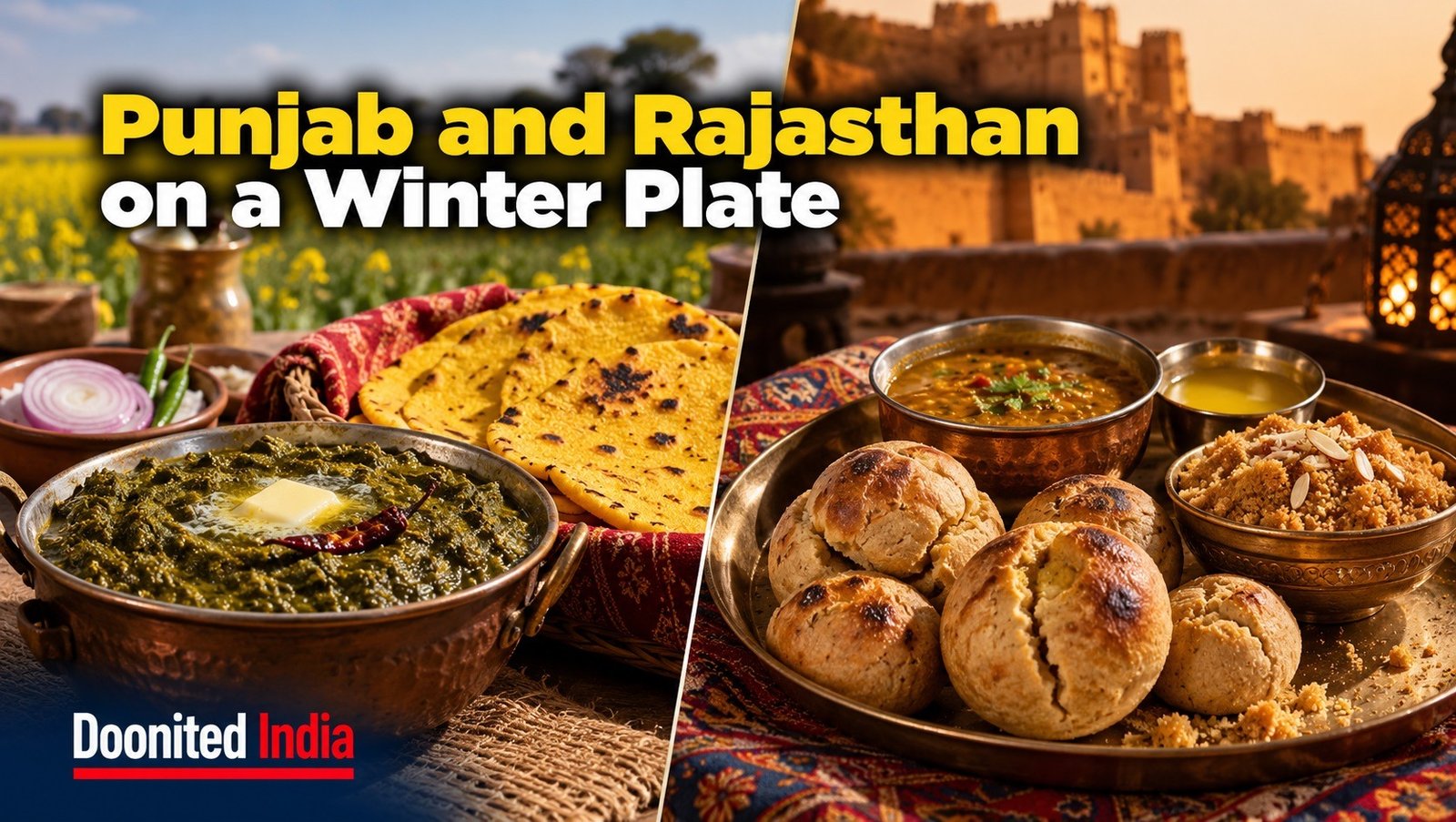
In Punjab, mustard greens arrive in the kitchen, cornmeal becomes a rustic roti and a familiar combination of Sarson ka Saag and Makki di Roti begins appearing on tables. In Rajasthan, wheat, lentils, ghee and spices come together in Dal Baati Churma, a meal whose ingredients and cooking methods have long been associated with the state’s distinctive food culture.
At first glance, the two meals could hardly look more different.
One is green, earthy and closely associated with the winter harvest. The other is built around baked wheat, lentils, ghee and a sweet finish.
But both tell the same larger story.
Indian regional cuisine is often geography made edible.
The crops that grow, the ingredients that store well, the cooking techniques available and the way communities gather all leave their mark on the plate.
That is why these dishes deserve to be understood as more than nostalgic comfort food.
Punjab: When the winter harvest reaches the table
Few dishes are more strongly associated with Punjabi winter than Sarson Ka Saag with Makki di Roti.
In official tourism material for Chandigarh, Incredible India describes the combination as a traditional Punjabi preparation and explicitly connects it with winter crops: mustard greens are cooked with spices and served with unleavened cornmeal bread. The same source describes Punjabi cuisine more broadly as reflecting the agricultural abundance of the region, with grains, spices and dairy playing important roles.
That agricultural connection is important.
Sarson — mustard greens — is not an exotic imported ingredient that happened to become fashionable. It belongs to the agricultural landscape of North India.
Makki di roti brings another crop into the picture: maize.
The classic pairing therefore has a quiet logic. Greens meet grain. The meal reflects what is available in the region and the season.
Then comes the ghee or butter.
It is easy for a contemporary diner to see the generous topping simply as indulgence. But traditional cuisines are rarely designed according to modern calorie-counting spreadsheets. Food cultures evolve around availability, taste, labour, preservation and custom.
The result is a dish that has become one of the most recognisable expressions of Punjabi food.
The roti is harder than it looks
There is also a practical lesson hidden inside Makki di Roti.
Cornmeal does not behave like wheat flour. It lacks the gluten structure that makes wheat dough relatively easy to roll and stretch.
That helps explain why preparing a good Makki di Roti can require considerable skill.
The cook is not simply making “cornbread”.
The dough must be handled differently, shaped carefully and cooked without allowing it to fall apart.
It is a small example of something often overlooked in discussions about traditional food: recipes contain technique as well as ingredients.
A written recipe can tell somebody what goes into a dish.
It cannot completely teach the judgement developed by somebody who has made it hundreds of times.
That knowledge is part of culinary heritage too.
And then there is Kanji
The winter table can also include Kanji, a fermented drink traditionally associated with North Indian foodways.
One version uses dark purple or black carrots, whose colour gives the drink its striking appearance. Fermentation produces the characteristic sourness that distinguishes it from an ordinary vegetable drink.
It is worth being cautious about the modern tendency to turn every traditional fermented food into a miracle health product.
Fermented foods are scientifically interesting, and fermentation has genuine effects on flavour, preservation and microbial activity. But claims that a particular traditional drink automatically “detoxes” the body, cures disease or produces dramatic health benefits require evidence and should not be casually attached to heritage foods.
The more interesting story is simpler.
Kanji demonstrates how older food cultures used fermentation to transform seasonal ingredients into something with a different flavour and longer culinary life.
That is already remarkable enough.
Rajasthan: A different landscape, a different answer
Travel west and the food story changes dramatically.
Rajasthan’s culinary identity has been shaped by a markedly different environment from Punjab’s fertile agricultural plains.
Traditional Rajasthani cuisine includes many preparations designed around ingredients that can be stored and used creatively, and the state’s official tourism material highlights this relationship between food and the desert environment. Rajasthan Tourism describes Dal Baati Churma as one of the state’s signature complete meals.
The structure is wonderfully straightforward:
Dal — lentils cooked with spices.
Baati — baked wheat balls.
Churma — crushed or crumbled wheat preparation enriched with ghee and sweetened in different versions.
The combination brings savoury, spicy, rich and sweet elements into one meal.
Incredible India describes Dal Baati Churma as a culinary icon of Rajasthan, with baati traditionally combined with dal and churma and ghee playing an important role in the preparation.
But the dish’s real significance goes beyond its ingredient list.
Baati is food built around the fire
The baati is the most distinctive component.
Unlike a conventional soft roti cooked rapidly on a flat griddle, baati is traditionally baked, giving it a different texture and a firm exterior.
That cooking method matters.
The Rajasthan Tourism description notes that baati is served hot, dipped in ghee and accompanied by dal, with garlic chutney adding another strong layer of flavour.
The result is a meal with extraordinary textural contrast.
The baati is dense.
The dal is soft.
The churma is crumbly.
The ghee ties the components together.
And the garlic chutney provides the sharp counterpoint that stops the plate becoming one long conversation about richness.
That balance is part of the genius of the meal.
The desert is not empty; it is selective
One of the laziest descriptions of Rajasthan is that its food developed simply because “there was little water”.
The reality is more interesting.
Rajasthan has diverse ecological zones and food traditions, and its cuisine includes an impressive range of grains, pulses, dairy products, spices, dried ingredients and hardy plants.
The official Rajasthan Tourism account of local cuisine illustrates this broader relationship between food and environment. Its description of Gatte ki Khichdi, for example, explicitly connects the dish’s development with the scarcity of green leafy vegetables in desert areas.
This is the more useful way to understand regional cuisine.
Not as a collection of dishes invented because people lacked something.
But as a history of adaptation.
When ingredients are abundant, cuisine takes one direction.
When they are seasonal, scarce, difficult to transport or easy to store, it takes another.
Why ghee appears so prominently
Modern urban food culture sometimes treats ghee as either a villain or a superfood.
Traditional cuisine is less ideological.
Ghee appears in Dal Baati Churma because it contributes flavour, texture and richness, and because dairy has historically played an important role in many Indian food traditions.
The mistake is to assume that because a food was traditional, it was necessarily designed according to modern nutritional science.
It wasn’t.
Nor should traditional food be judged solely through contemporary dietary fashion.
A better approach is to ask what role each ingredient played in the cuisine.
Ghee makes baati richer and softer when broken open.
It carries flavour.
It changes texture.
And in a celebratory meal, abundance itself can be part of hospitality.
Two regions, two agricultural stories
The contrast between Punjab and Rajasthan becomes particularly revealing when the dishes are placed side by side.
Punjab’s iconic winter meal celebrates fresh seasonal greens and grain.
Rajasthan’s Dal Baati Churma reflects a cuisine in which storage, baking, pulses, wheat and concentrated flavours became particularly important.
Neither should be reduced to climate alone.
Punjab’s cuisine is also shaped by dairy, grain cultivation, migration, religion, trade and centuries of cultural exchange.
Rajasthan’s cuisine similarly reflects different communities, local agriculture, royal kitchens, pastoral traditions and regional variation.
But geography provides the stage.
Food provides the script.
And generations of cooks keep performing it.
From village kitchen to global restaurant
Both dishes have now travelled far beyond their original settings.
Sarson Ka Saag and Makki di Roti appear on menus across India’s cities and in Indian restaurants overseas. Dal Baati Churma has similarly moved from regional food tradition to a recognisable representation of Rajasthan.
That global movement brings opportunity.
Regional dishes can support tourism, restaurants, farmers, food producers and culinary entrepreneurs.
But it also brings a risk.
Once a dish becomes a cultural symbol, it can be simplified into a stereotype.
Punjab becomes “saag and butter”.
Rajasthan becomes “dal baati”.
The enormous variety within both cuisines disappears behind two photographs.
For international readers especially, that distinction matters.
A cuisine is not a menu item.
It is a system of ingredients, techniques, rituals, agricultural knowledge and social relationships.
The winter plate is also a history book
Perhaps the most fascinating thing about these meals is how little of their history is written on the plate.
A bowl of Sarson Ka Saag does not announce the agricultural landscape that produced the mustard greens.
A Makki di Roti does not explain the technique required to handle cornmeal.
A plate of Dal Baati Churma does not tell the diner why baking, pulses, wheat, ghee and preserved ingredients became so important in Rajasthan.
Yet all that history is there.
This is why traditional food deserves serious cultural documentation.
As food becomes increasingly standardised for restaurants, packaged products and social-media presentation, there is a danger that the story of a dish becomes thinner even as its popularity grows.
The solution is not to keep traditional food frozen in the past.
It is to preserve the knowledge around it.
Who made it?
When was it eaten?
What ingredients were local?
What techniques were used?
What changed over generations?
And what remains distinctive today?
The real comfort is continuity
Punjab and Rajasthan offer two different answers to the same winter question.
What should people eat when the season changes?
Punjab answers with mustard greens, cornmeal, fermentation and the unmistakable richness of saag served with roti.
Rajasthan answers with baked wheat, lentils, ghee, sweetness and the robust combination of Dal Baati Churma.
But beneath those differences lies a shared Indian idea.
Food is not merely fuel.
It is a way of remembering a landscape.
It is a way of marking a season.
It is a way of welcoming people.
And sometimes, it is a remarkably efficient way for one generation to tell another what life once required — without saying a word.
The modern diner may encounter these dishes as “winter specials”.
Their deeper story is that they are seasonal knowledge served on a plate.
And that is why the best regional Indian food does not merely taste of a place.
It explains the place.


World Beyond the News
Bees Communicate Where Food Is
Honeybees use movement patterns known as waggle dances to communicate information about food locations.
Street Food Reflects Local History
Many famous street foods developed from migration, trade, local ingredients and the everyday needs of working communities.
A Day on Venus Is Extremely Long
Venus rotates so slowly that one rotation relative to distant stars takes longer than its trip around the Sun.
Human Achievement Continues to Push Limits
Athletes, engineers, scientists and explorers regularly establish new benchmarks in speed, endurance, scale and precision.