India’s Millet Revival: The Forgotten Grain Is Back — But Will Farmers Benefit?
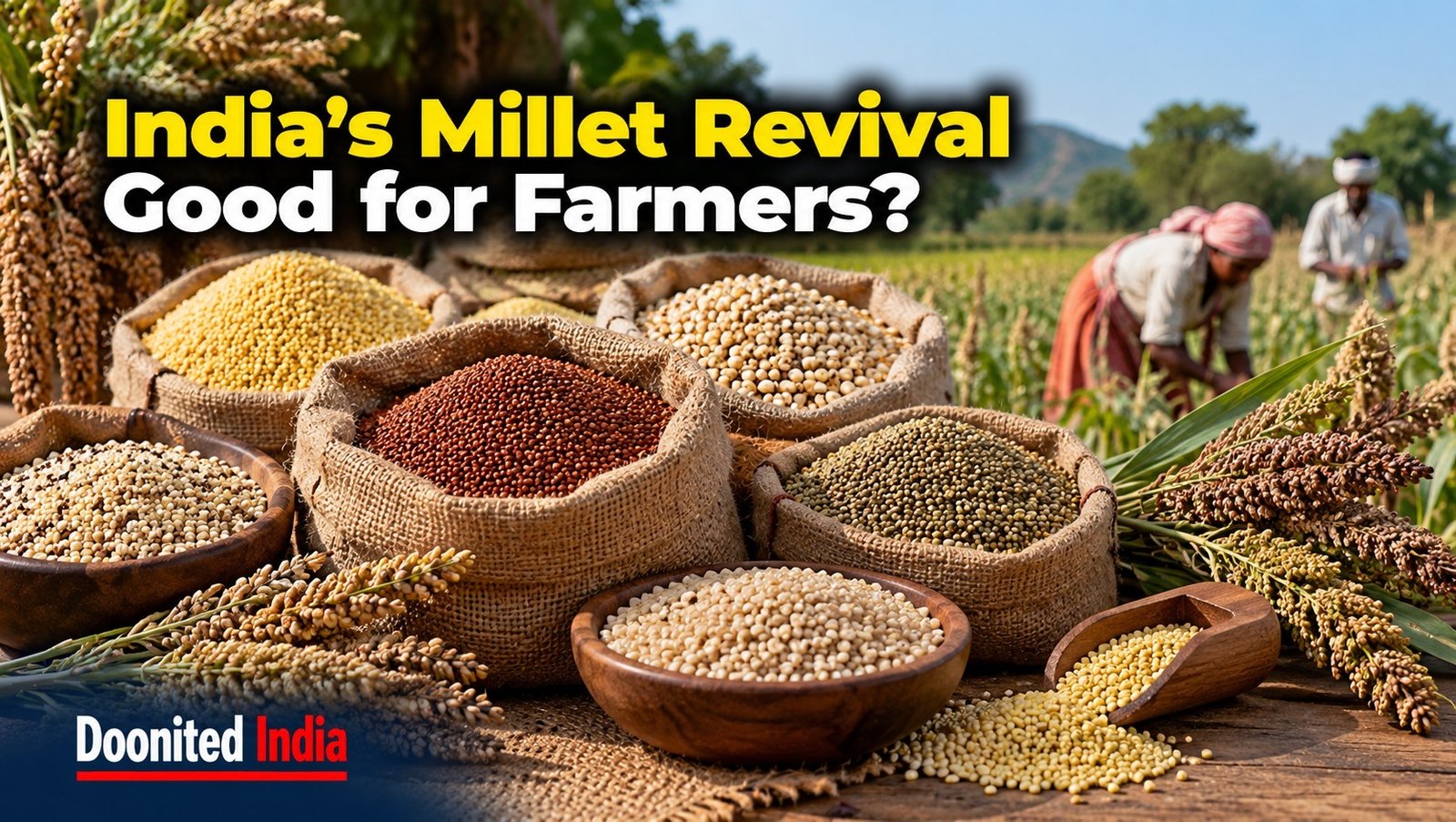
Ragi, jowar, bajra, kodo and other millets have moved from traditional kitchens into cafés, packaged foods and contemporary menus. But India’s millet revival is facing a harder test than popularity: can growing consumer interest create reliable demand and better livelihoods for the farmers who grow them?
There is an amusing contradiction at the heart of India’s millet revival.
For generations, many Indian families ate millets because they were simply the grains available to them.
Then the country modernised.
White rice and refined wheat acquired the language of aspiration. Millets were increasingly associated with older food habits, rural households or regions where agriculture had fewer choices.
Now the marketing has changed.
The same ragi that once appeared in an everyday household meal can turn up as a premium dosa, a café brownie or a packaged breakfast product.
Bajra has found its way onto restaurant menus.
Jowar is being presented as an alternative flour.
Kodo and little millet are being rediscovered by chefs and food entrepreneurs.
The language has changed too.
The “coarse grain” is now a nutri-cereal.
But beneath the fashionable packaging is a more important question:
Has India’s millet revival actually changed the economics of growing and eating these crops?
India did not really forget millets
Calling millets “forgotten” is convenient but historically imprecise.
They never disappeared completely.
Millets continued to be cultivated and eaten across many parts of India, particularly in rainfed and dryland farming systems.
The Indian Council of Agricultural Research’s Indian Institute of Millets Research describes millets as crops with a long agricultural history and is now explicitly working on improving their productivity, profitability, processing and value-added uses.
What changed was their position in the food hierarchy.
As rice and wheat became increasingly dominant in India’s food system, many traditional millet foods lost status.
That is an important distinction.
The grain did not disappear. Its prestige did.
And that may explain why today’s revival is partly a cultural reversal.
The climate argument is stronger than the wellness slogan
Millets are often promoted as a “superfood”.
That is not the most interesting reason for their revival.
Their agricultural characteristics may matter more.
The Indian government and international institutions have repeatedly highlighted millets’ suitability for dryland and climate-stressed farming. India’s Permanent Mission to the United Nations describes millets as crops capable of growing under adverse and arid conditions with relatively low water and input requirements compared with many conventional cereals.
The Food and Agriculture Organization’s India platform similarly identifies millets as climate-resilient crops suitable for diverse environments, including dryland and marginal farming systems. It lists Rajasthan, Karnataka, Maharashtra, Uttar Pradesh and Haryana among India’s leading millet-producing states.
That makes millets particularly relevant as India confronts irregular rainfall, water stress and the economic risks associated with agriculture dependent on a narrow crop mix.
But there is an important caveat.
Climate resilience does not automatically mean farmer profitability.
A crop can survive difficult conditions and still provide insufficient income.
That distinction is central to the future of millets.
The farmer’s problem begins where the Instagram story ends
A consumer sees a packet of premium millet flour.
The farmer sees seed, labour, rainfall, harvesting, cleaning, storage and transport.
Between those two ends sits the entire value chain.
India’s policy push around millets has increasingly recognised this. The government’s International Year of Millets programme explicitly included production, processing, value-chain development, branding, exports and market creation rather than focusing only on consumer awareness.
That is sensible.
Because telling people to eat more millets is only half a strategy.
Someone has to buy them.
Someone has to process them.
Someone has to package them.
Someone has to distribute them.
And the price received by the farmer must make the crop worth growing.
If urban consumers happily pay ₹150 for a beautifully packaged millet product but the producer receives only a small fraction of the value created downstream, the “millet revolution” has become primarily a branding revolution.
That would be a missed opportunity.
The restaurant has discovered the chef’s canvas
Something genuinely exciting is happening at the culinary end.
Millets are no longer restricted to traditional preparations.
The Indian Institute of Millets Research itself showcases value-added products ranging from jowar muffins and pearl millet pakoda to millet cheese balls, ragi balushahi and barnyard millet rabdi.
That is more significant than it may initially appear.
A grain becomes commercially powerful when consumers no longer need to change their entire lifestyle to consume it.
The old form might be:
“Here is millet. Learn how to cook it.”
The new form is:
“Here is a familiar food — made with millet.”
That could include breads, breakfast products, snacks, desserts, ready-to-cook mixes and restaurant dishes.
The challenge is to innovate without turning the grain into a marketing prop.
The packaged-food industry could be the turning point
The modern kitchen has one major problem that traditional food systems did not have in the same form:
time.
Many consumers may like the idea of traditional grains but do not want complicated preparation every morning.
This is where processing becomes crucial.
Cleaning, milling, flour production, ready-to-cook mixes and other forms of value addition can make millets easier to use.
India’s government explicitly identified processing and value addition as part of its millet strategy during the International Year of Millets.
The commercial opportunity is therefore not simply selling whole grains.
It is making them convenient without stripping away their nutritional and culinary value.
That is a much harder business.
And it requires investment.
The health story needs less hype
The modern millet revival is heavily driven by health-conscious consumers.
Some of the nutritional advantages are well established.
FAO’s India platform notes that millets provide protein, dietary fibre and micronutrients including calcium, iron and phosphorus, while also describing them as gluten-free.
But the marketing conversation often goes further than the evidence.
A traditional grain should not be presented as a cure for diabetes, obesity or every modern health problem.
Nor should a low-glycaemic or high-fibre food automatically be assumed to produce the same health outcome for every individual.
The sensible message is more modest:
Millets can be part of a diverse, nutritious diet.
That is strong enough.
Food journalism should resist turning every grain into a miracle.
The uncomfortable evidence: revival does not equal mass adoption
Here the story becomes more interesting.
A 2026 study indexed by FAO AGRIS examining Indian household consumption data found a substantial long-term decline in per-capita millet consumption, despite the recent policy push. The research also identified demand-side constraints, with consumption remaining more concentrated among rural and lower-income households than among urban and higher-income consumers.
That finding challenges the easy narrative that India’s urban millet revival has already transformed the food system.
It may have transformed visibility.
Visibility is not the same as consumption.
A restaurant serving a millet dessert is interesting.
A million households buying millet regularly is a structural change.
Those are very different achievements.
Why convenience may decide the future
There is a practical reason rice and wheat became dominant.
They fit established cooking habits.
Consumers know how to buy them.
They know how to store them.
They know how to cook them.
Their texture is familiar.
Their supply chains are mature.
Millets have to compete with that convenience.
This is why the future of millets may depend less on persuading consumers to become traditional-food purists and more on making millet-based foods easy, affordable and reliable.
The successful millet product may not look traditional at all.
It could be a breakfast cereal.
A dosa mix.
A ready-to-cook meal.
A snack.
A bakery product.
A school meal.
Or something that has not yet been invented.
The grain does not have to remain unchanged for the agricultural tradition to survive.
But who captures the premium?
This is where policymakers and consumers should ask a harder question.
When millet becomes fashionable, who gains?
The farmer?
The processor?
The restaurant?
The packaged-food company?
The retailer?
Ideally, the answer should be: all of them, with a meaningful share returning to the producer.
That requires transparent value chains, productivity improvements, better processing infrastructure, market linkages and stable demand.
The government’s millet programmes have increasingly focused on exactly these areas, including production, value addition, branding, market access and exports.
But policy ambition should not be confused with completed transformation.
The market still has to prove itself.
The global opportunity is real
India’s millet story also has an international dimension.
The United Nations declared 2023 the International Year of Millets following a proposal led by India. The campaign was explicitly designed to raise awareness of millets’ nutritional and agricultural value and encourage production, consumption, research and investment.
India subsequently promoted millets as “Shree Anna” and positioned itself as a global hub for the crop.
That gives India an unusual opportunity.
It is not merely exporting a food product.
It can export culinary knowledge.
Indian millet dishes can travel alongside packaged grains, flour, snacks and contemporary foods.
But the global opportunity will depend on consistency.
International consumers need reliable quality, food-safety compliance, clear labelling, appropriate processing and products that fit local cooking habits.
The ancient grain still needs a modern supply chain.
The best revival may be the least glamorous one
The most important sign of success may not be a five-star restaurant putting ragi on its menu.
It may be a farmer deciding to continue growing millet next season because the crop has a reliable buyer.
It may be a small mill investing in better processing equipment.
It may be a school kitchen using millet regularly.
It may be a family replacing one refined-grain product with a millet alternative because it is affordable and convenient.
It may be a regional food entrepreneur turning a traditional recipe into a commercially viable product without erasing its identity.
These are less photogenic developments than a beautifully plated millet dessert.
They are also more important.
From forgotten grain to ordinary grain
There is a final irony in India’s millet revival.
The ultimate success of millets may come when people stop calling them “forgotten”.
If ragi becomes ordinary breakfast food again, there is no need for a revival story.
If bajra is simply another flour on the kitchen shelf, it has won.
If jowar becomes a normal part of urban and rural diets, it no longer needs to be marketed as ancient wisdom.
And if farmers can grow these crops profitably in regions where they make agricultural sense, the climate argument becomes an economic reality rather than a slogan.
That is the real test.
India does not need to turn every traditional grain into a luxury product.
It needs to make the grain useful again at scale.
The millet revival will ultimately be judged not by how fashionable ragi becomes in a city café, but by whether the crop can reconnect farmer, food, market and consumer.
The forgotten grain does not need to become fashionable forever.
It simply needs to become normal again.


World Beyond the News
Birds Can Navigate Using Earth’s Magnetic Field
Several bird species can sense Earth’s magnetic field, helping them navigate during long-distance migration.
Fermentation Is a Global Food Tradition
People across continents have used fermentation for centuries to preserve food and create distinctive flavours.
Modern Batteries Store Energy Chemically
Rechargeable batteries repeatedly move ions between electrodes, allowing electrical energy to be stored and released.
Why Songs Become Global Hits
Streaming platforms, short-form video, playlists and international collaborations can rapidly carry music across borders.