The Northern Peaks: How Kashmir and Himachal Turn Winter Into a Culinary Tradition
From Kashmir’s overnight-cooked harissa and ceremonial Wazwan to Himachal’s Dham and ghee-rich Siddu, the mountains have developed food traditions that are about far more than surviving the cold. They preserve memory, community and a distinct sense of place.
Winter in the Himalayas is not merely a change in temperature.
It changes the rhythm of the day, the ingredients available in the kitchen, the way food is cooked and, in many communities, the way people gather around a meal.
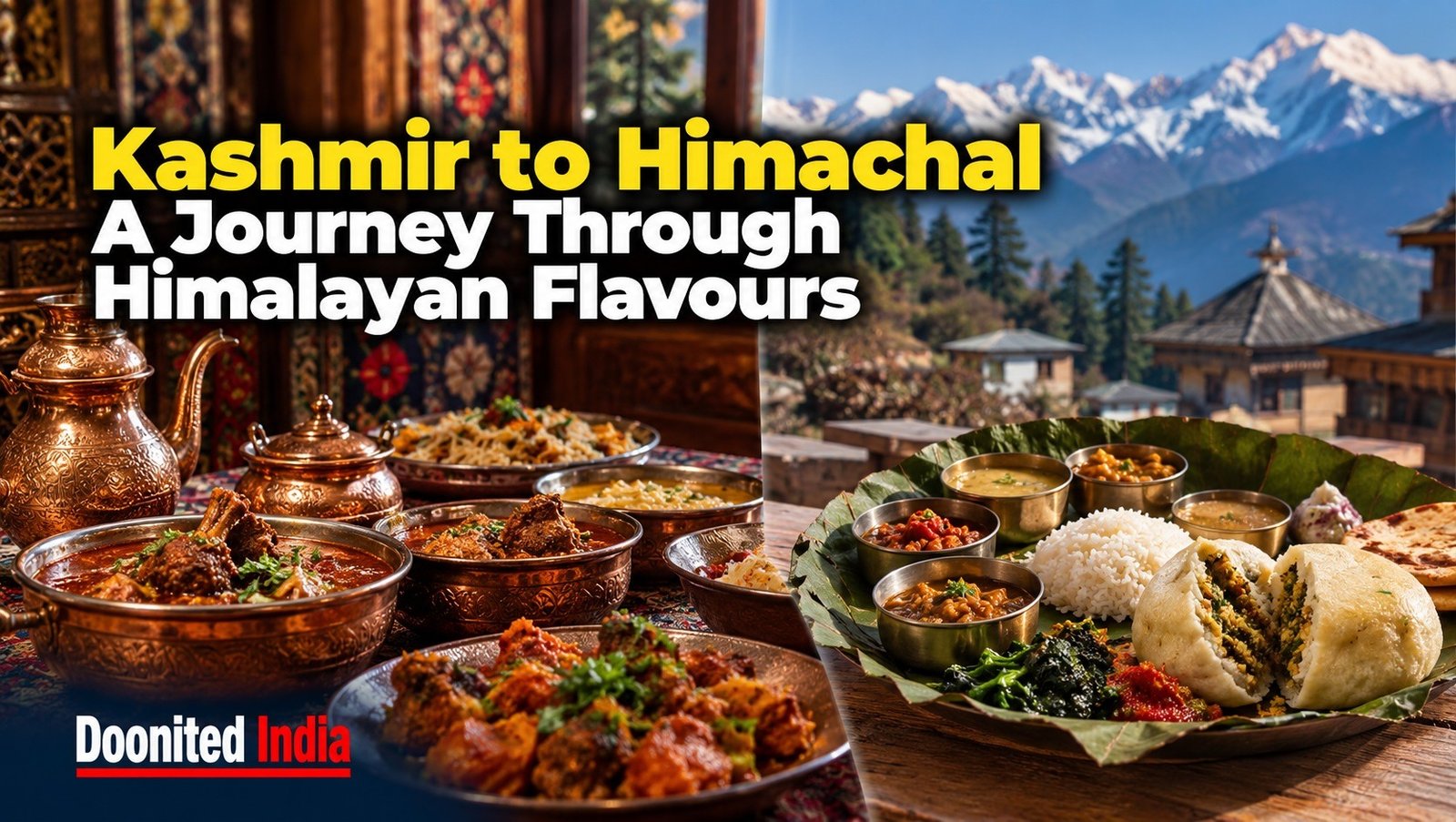
In Kashmir, an early winter morning can begin with harissa — meat and rice cooked slowly until the ingredients become a rich, almost paste-like preparation. In Himachal Pradesh, a steaming Siddu split open and finished with ghee can feel like exactly the food a cold mountain morning was waiting for.
Then there are the great communal meals.
Kashmiri Wazwan turns cooking into ceremony: a highly elaborate feast in which meat, technique and hospitality become part of a shared cultural performance. Himachali Dham takes another route, bringing together regional vegetarian preparations in a communal festive meal traditionally prepared by specialist cooks.
These foods are often described as “winter comfort food”.
That description is convenient — and incomplete.
They are also examples of how mountain societies have adapted food to geography, agriculture, climate and community life.
Kashmir: Where winter begins before breakfast
Few Indian winter foods have a stronger seasonal identity than harissa.
The dish is associated with cold-weather mornings in Kashmir, particularly Srinagar. Research published by the National Council for Hotel Management and Catering Technology lists harissa among the notable dishes of Kashmiri cuisine and describes it as a popular breakfast preparation during the cold winter months, made from minced meat, rice and spices.
Its appeal lies partly in time.
Harissa is not the sort of dish that rewards impatience. Traditionally, the meat and rice are cooked slowly until they develop a smooth consistency. The result is substantial, rich and distinctly different from the better-known Kashmiri dishes that dominate restaurant menus outside the Valley.
That distinction matters.
For international visitors, Kashmiri cuisine is often reduced to Rogan Josh, Yakhni and the spectacular Wazwan feast.
But everyday food culture is considerably broader.
Harissa belongs to a different part of that story: the seasonal morning meal shaped by winter.
It is also why food tourism should not begin and end with restaurant menus. The most interesting culinary traditions are often connected to when a dish is eaten, who prepares it and why it belongs to a particular season.
Wazwan is not simply a large meal
If harissa illustrates Kashmir’s winter food rhythm, Wazwan illustrates its ceremonial food culture.
The District Budgam administration describes Wazwan as a multi-course Kashmiri meal whose preparation is regarded as an art and a source of cultural pride. It is traditionally associated with celebrations and is largely centred on meat preparations.
The meal is communal rather than individual.
Guests traditionally sit together and share food from a large copper platter, the traem. The preparation is overseen by the vasta waza, the master chef responsible for the culinary process.
Among its best-known dishes is Gushtaba — tender meatballs served in a yoghurt-based gravy. In the traditional sequence of Wazwan, Gushtaba comes toward the end of the main course and signals that the great meat feast is approaching its conclusion.
There is something revealing about that position.
Gushtaba is not merely another item on a menu. Within Wazwan, the order of dishes, the preparation techniques and the manner of serving are part of the cultural experience.
That makes Wazwan closer to a culinary institution than a collection of recipes.
Recent reporting has also shown that the tradition is adapting. Reuters reported in September 2026 that Wazwan continues to play a central role in Kashmiri celebrations while changing with contemporary lifestyles and younger generations.
That tension — preservation without freezing a tradition in time — is one of the most important questions facing traditional cuisines everywhere.
Himachal: The feast changes from valley to valley
Travel a few hundred kilometres southeast and the culinary landscape changes again.
Himachal Pradesh does not have one single mountain cuisine.
Its valleys, altitudes, agricultural patterns and cultural influences have produced different food traditions. The state’s tourism department explicitly notes that a Mandi Dham is different from a Chamba, Kangra, Bilaspur, Shimla, Sirmaur or Kullu Dham, with individual regions retaining their own dishes and cooking styles.
This is important because the word “Dham” can easily become a generic label for an entire state’s food.
It shouldn’t.
A traditional Dham is a festive communal meal, generally vegetarian, and is especially associated with occasions such as festivals, weddings and other celebrations. Incredible India describes it as a traditional feast particularly popular in Mandi, Chamba and Kangra.
Rice forms an important base, while preparations such as Madra, dals, vegetables and sweet dishes can appear in different regional sequences.
The cooking is part of the spectacle.
Himachal Tourism notes the role of hereditary Boti cooks in preparing traditional Dhams.
In other words, the recipe is only half the story.
The other half is the institution that knows how to cook it for a community.
And then comes Siddu
If Dham represents the communal feast, Siddu represents something more intimate.
Siddu is a steamed wheat-based bread found across parts of Himachal Pradesh. Himachal Tourism describes it as one of the state’s popular dishes: a wheat-flour preparation in which yeast is used before steaming, commonly served with ghee or butter and sometimes filled with poppy-seed or walnut paste.
Incredible India similarly describes Siddu as a local Himachali bread filled with ingredients such as walnuts and poppy seeds and served with ghee or lentil soup.
The appeal is straightforward.
A warm, steamed bread with a rich filling and ghee is substantial food in a cold mountain environment.
But calling it merely “food to fight the cold” misses the deeper story.
Siddu carries information about the landscape.
Wheat provides the base. Walnuts and other locally available ingredients can become fillings. Steaming suits the preparation. Ghee adds richness. The dish can be adapted into sweet or savoury versions.
Food becomes a record of what communities grow, preserve and value.
The mountain pantry is an archive
One of the most fascinating aspects of Himalayan cuisine is its relationship with local agriculture.
Himachal Tourism notes that traditional foods draw heavily on what the land produces — including cereals, lentils, herbs, nuts, fruits, milk and milk products. In higher regions such as Lahaul-Spiti and Kinnaur, Tibetan influence becomes more pronounced, with barley, buckwheat and millet playing important roles.
That creates an important lesson for modern food culture.
A regional cuisine does not become distinctive simply because someone invents an unusual recipe.
It becomes distinctive because generations of cooks solve everyday problems with the ingredients available to them.
How do you store food?
How do you feed a family through winter?
What grows at altitude?
What can be dried?
What can be fermented?
What can be cooked slowly?
What can feed a large gathering?
Traditional cuisine is, in many ways, accumulated local knowledge.
Why outsiders sometimes misunderstand mountain food
There is also a danger in turning these cuisines into tourism stereotypes.
Kashmir should not be reduced to Wazwan.
Himachal should not be reduced to Siddu, Dham and a photograph of snow-covered mountains.
Both regions have substantial everyday food cultures beyond the dishes most frequently promoted to visitors.
Even within Himachal, food changes from valley to valley. The state’s tourism department acknowledges this diversity directly.
And within Kashmir, Wazwan is primarily a ceremonial feast, while everyday meals and seasonal foods occupy different spaces in the culinary calendar. Official Kashmiri sources and food-heritage material distinguish the elaborate Wazwan tradition from individual dishes such as Harissa and Gushtaba.
The difference matters because authenticity is not achieved by putting every famous dish on the same restaurant menu.
Sometimes authenticity means accepting that a dish belongs to a particular time, place and occasion.
A culinary tradition that can travel — without losing its address
There is growing international interest in regional Indian food, and Kashmir and Himachal have obvious potential within that movement.
But globalisation presents a curious challenge.
A dish must become accessible enough for outsiders to understand it without becoming so simplified that its original identity disappears.
That may mean explaining Wazwan as a communal ceremonial tradition rather than merely advertising it as a “36-course feast”.
It may mean presenting Siddu with its regional variations instead of treating one filling as the definitive recipe.
It may mean explaining Dham as a family of regional traditions rather than a single fixed thali.
The opportunity for Indian food tourism is not to make every mountain dish identical for international consumers.
It is to make the story behind the dish understandable without erasing its differences.
The real ingredient is continuity
Kashmiri Harissa and Wazwan, and Himachali Dham and Siddu, emerge from very different culinary settings.
Yet they share something fundamental.
Food is being used to preserve continuity.
A recipe survives because somebody continues making it.
A feast survives because somebody continues teaching the sequence.
A bread survives because a family still prepares it.
A community meal survives because people still believe gathering around it matters.
That is why Himalayan cuisine deserves to be understood as living heritage rather than simply winter tourism content.
The mountains have given these foods their ingredients, but people have given them their meaning.
And perhaps that is the most useful lesson for the modern food world: a cuisine becomes valuable not when it becomes fashionable, but when it remains meaningful to the community that created it.
The next time a steaming bowl of harissa or a ghee-covered Siddu arrives at the table, the obvious question is whether it tastes good.
The more interesting question is what had to survive for that taste to reach us.


World Beyond the News
Birds Can Navigate Using Earth’s Magnetic Field
Several bird species can sense Earth’s magnetic field, helping them navigate during long-distance migration.
Fermentation Is a Global Food Tradition
People across continents have used fermentation for centuries to preserve food and create distinctive flavours.
Modern Batteries Store Energy Chemically
Rechargeable batteries repeatedly move ions between electrodes, allowing electrical energy to be stored and released.
Why Songs Become Global Hits
Streaming platforms, short-form video, playlists and international collaborations can rapidly carry music across borders.