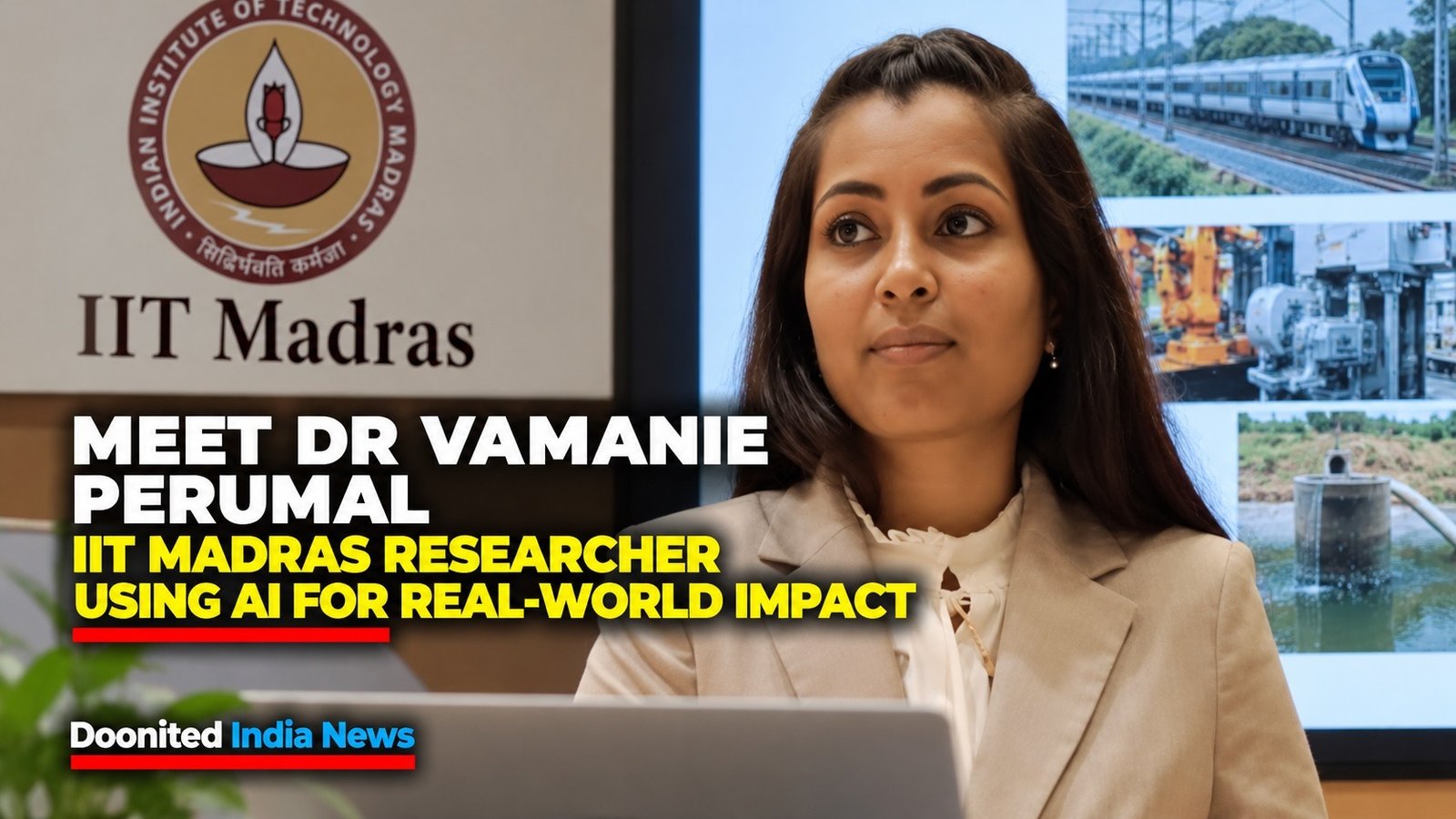
Dr. Vamanie Perumal: The IIT Madras Researcher Applying AI to India’s Railways, Industry and Environment
From analysing train-service efficiency to predicting groundwater contamination, the AI researcher combines machine learning with real-world data. As an inaugural India RISE Fellow, she also advocates keeping human judgement at the centre of AI-assisted science.
Artificial intelligence is often discussed through chatbots, futuristic robots and increasingly powerful computers. Yet some of its most consequential applications may be less visible: identifying why a train service underperforms, spotting a defect in industrial machinery or helping researchers assess environmental risks.
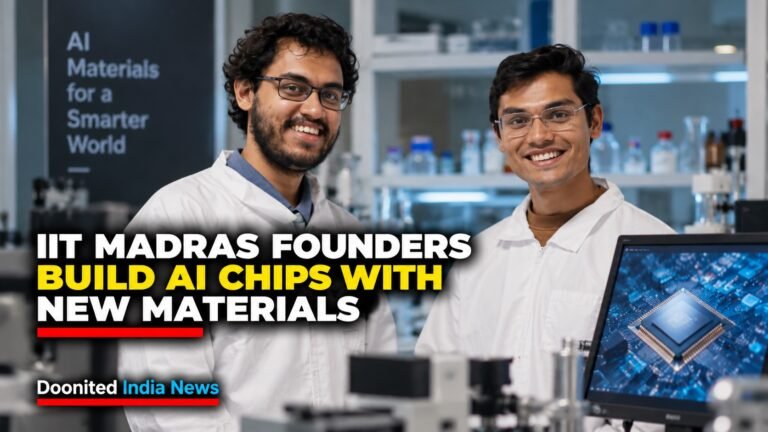
These are the kinds of practical questions explored by Dr. Vamanie Perumal, a Lead AI Researcher with the AI4NetZero group at the Indian Institute of Technology Madras. Her work combines applied machine learning, optimisation and decision sciences to investigate problems involving public infrastructure, industrial systems and environmental health.
Perumal is also a fellow in the inaugural 2026 cohort of the India RISE Fellowship, a programme designed to support early-career women researchers through research development, mentorship and leadership training.
Her career has crossed several disciplines. She studied biotechnology and materials engineering before moving into computer science, machine learning and data engineering during her doctoral work at IIT Madras. That transition is more than an unusual academic biography. It reflects a growing reality in applied AI: solving a complex problem requires understanding the system being studied, not merely knowing how to build a model.
Using AI to understand Indian Railways
Railway efficiency is not a single number. A train may have strong passenger occupancy but require substantial resources to operate. Another may serve an important route despite low demand, because its public value cannot be measured by ticket revenue alone.
Understanding such differences requires more than comparing trains by speed, punctuality or passenger numbers. Researchers need to examine multiple operational factors together.
In a study published in the journal Transport Policy in September 2026, Perumal and co-author Kandaswamy Paramasivan developed a multi-stage framework to analyse the operational efficiency of 267 train services associated with Southern Railway. The dataset covered nearly three years, from April 2022 to February 2025, and included daily occupancy and other operational information.
The researchers first used Data Envelopment Analysis (DEA), a method for comparing the relative efficiency of different operating units when they use multiple inputs to produce multiple outputs. They then applied statistical modelling, dimensionality reduction and clustering techniques to investigate patterns that a single efficiency score might conceal.
The framework combined DEA with a fractional logit model, Variational Autoencoders, Uniform Manifold Approximation and Projection, and density-based clustering. In simpler terms, the team measured relative efficiency, investigated factors associated with performance and grouped services with similar operational characteristics.
One finding was that the diversity of coaches available on a service was an important positive factor in the study’s efficiency analysis. The researchers also identified differences between routes that could support more targeted operational decisions.
The significance is not that an algorithm can decide which train should run or which route should be closed. Railway planning must also account for affordability, regional connectivity, public service obligations, safety and social needs. A route that looks inefficient under a narrow financial measure may remain essential to the people who depend on it.
The study offers a way to organise complex evidence and identify where further investigation may be useful. Operational decisions still require railway expertise, contextual judgement and an assessment of public value.
Can machine learning help identify unsafe groundwater?
Perumal’s research also reaches beyond transport and industry into environmental health.
In a study published in ACS Sustainable Resource Management, she worked with Sankar Sudhir, Tanmayaa Nayak and Thalappil Pradeep on predicting uranium concentrations in Punjab’s groundwater using routinely measured water-quality indicators.
The researchers analysed a dataset of 8,735 samples and developed machine-learning models using parameters that included common ions and other water-quality measurements. They explored approaches involving gradient boosting, random forests, XGBoost and ensemble modelling, as well as clustering to account for variations in groundwater chemistry.
The motivation is practical. Testing for uranium can require specialised equipment and expertise, and it may not be included in every routine water-quality assessment. If commonly measured indicators help identify samples or locations that warrant further investigation, machine learning could support more targeted monitoring.
The study reported strong predictive performance for one of its modelling approaches. But this must be interpreted carefully: a model that predicts contamination from existing measurements is not the same as a direct laboratory test, and predictive accuracy within a dataset does not automatically establish reliability across different aquifers or regions.
Groundwater chemistry varies with geology, agricultural practices, water extraction and local environmental conditions. Any operational use of such a model would require independent validation, appropriate sampling and confirmation through accepted testing procedures.
The potential value lies in helping researchers and public-health authorities prioritise investigation—not in replacing water testing or declaring water safe based solely on an algorithm.
When AI meets industrial diagnosis
A third strand of Perumal’s research examines whether vision-language models can help detect defects in industrial equipment.
In a paper presented through IEEE, she and her co-authors investigated needle-bearing defect detection using few-shot learning. The approach involved converting acoustic or vibration signals into spectrogram images, which represent how signal frequencies change over time, and evaluating vision-language models on the resulting diagnostic task.
Few-shot learning aims to make a model useful when only a limited number of labelled examples are available. That is relevant in industrial settings, where collecting and labelling examples of rare failures can be expensive, time-consuming or impractical.
The study examined how models including GPT-4o and Gemini performed in this setting. Such research can help clarify whether general-purpose multimodal systems have a role in specialised technical applications.
However, a promising experimental result does not establish that a model is ready to diagnose every machine reliably. Industrial deployment requires testing under realistic operating conditions, evaluating false alarms and missed faults, and ensuring that the system remains reliable as equipment, loads and environments change.
For manufacturers, the practical goal is not to use the newest model simply because it is available. It is to determine whether the model detects problems accurately enough to improve maintenance, reduce downtime or support technicians’ decisions.
A career that crosses disciplinary boundaries
Perumal’s academic journey began in biotechnology at PSG College of Technology, followed by a master’s degree in materials engineering at Amrita Vishwa Vidyapeetham. During her doctoral work in the Department of Engineering Design at IIT Madras, she moved into machine learning, computer science and data engineering.
This combination of scientific and computational training is relevant to the problems she investigates. Environmental contamination involves chemistry and geology. Railway efficiency requires an understanding of operations and demand. Industrial diagnosis depends on the physical behaviour of equipment and the signals produced when something goes wrong.
A model can detect statistical patterns, but interpreting those patterns requires knowledge of the underlying system. Without that expertise, researchers risk mistaking correlation for causation or producing predictions that look convincing but have limited practical value.
Perumal has also served as Student Secretary for Research Affairs at IIT Madras, representing research scholars and advocating for issues affecting the research community. That experience adds a dimension to her career beyond technical research: the ability to work within institutions and understand the conditions researchers need to do their jobs.
Why she wants researchers to remain at the centre of AI
In an August 2026 reflection published by India RISE, Perumal described her own experience of adopting AI tools despite not having a computer-science background at the start of her education.
She also discussed the limitations she encountered while using AI to prepare research and teaching material, including inaccurate outputs and the need for careful editing. Her central argument was that researchers must understand and verify the code and analysis they use rather than accepting outputs because they appear plausible.
That perspective is especially important in scientific work. An AI system can help draft code, explore a dataset or suggest a method, but it can also make errors, fabricate information or recommend an analysis that is inappropriate for the research question.
There are additional concerns around confidential data, bias and intellectual ownership. Uploading unpublished research or sensitive information to an external system without understanding its data practices can create risks. Similarly, a model’s answer should not replace a researcher’s responsibility to explain and defend the methods used.
AI is most useful when it expands a scientist’s ability to investigate a question while leaving the scientist accountable for the evidence and conclusions.
Perumal’s own career demonstrates this principle: the value of computational methods comes from combining them with domain knowledge and critical judgement.
The India RISE Fellowship and women’s research leadership
The India RISE Fellowship is a 12-month, part-time programme launched by the Gupta-Klinsky India Institute at Johns Hopkins University under the U.S.-India Alliance for Women’s Economic Empowerment, in collaboration with Indian research and academic partners.
The inaugural cohort began in January 2026 and runs into early 2027. Fellows continue in their existing institutional roles while participating in research training, leadership development, mentorship and professional networking.
The programme addresses a persistent challenge in STEMM: strong participation by women in higher education does not translate automatically into equal representation in research careers and senior leadership.
Technical skill alone does not guarantee access to research funding, opportunities to lead teams or the professional networks needed to establish an independent research programme. Mentorship and leadership development can help researchers navigate these demands, although fellowships cannot substitute for long-term funding, fair promotion practices and supportive institutional environments.
For Perumal, the fellowship offers a setting to exchange experiences with researchers from different fields and develop leadership skills alongside her technical work. Its longer-term value will depend on what participants are able to build after the programme—research collaborations, independent projects, stronger teams and sustained scientific contributions.
Measuring impact beyond the algorithm
Perumal’s research offers a useful perspective on how AI can serve public-interest goals. It can help researchers examine railway operations at a finer level, explore possible contamination risks using existing measurements and test new approaches to industrial fault detection.
But each application has its own limits. Railway efficiency metrics must be balanced against public-service needs. Groundwater predictions require validation anDr Vamanie Perumal: Applying AI to Railways, Industry and Environmental Healthlimitations are understood and the results improve decisions in the real world.
Dr. Vamanie Perumal’s work illustrates that applied AI is strongest when computation and domain knowledge reinforce one another. Her career also highlights why research leadership needs more than technical ability: it requires time, mentorship, collaboration and institutions willing to support scientists as they develop independent work.
For India, the opportunity is to build AI systems that do more than demonstrate technical sophistication. They should help public agencies, researchers and industry ask better questions, use evidence more effectively and make decisions that stand up to scrutiny.


World Beyond the News
Why Elephants Stay Close to Their Herd
Elephants live in highly social family groups and use calls, touch and body movements to maintain strong bonds.
Most of the Deep Ocean Remains Difficult to Explore
Extreme pressure, darkness and distance make deep-ocean exploration one of Earth’s greatest scientific challenges.
Spacecraft Can Travel Without Traditional Roads
Spacecraft use carefully calculated trajectories and gravity assists to travel enormous distances through space.
Why Movie Trailers Are Released in Stages
Major films often use teaser trailers, full trailers and final promotional spots to build awareness over time.