AI Innovation Meets a Governance Test
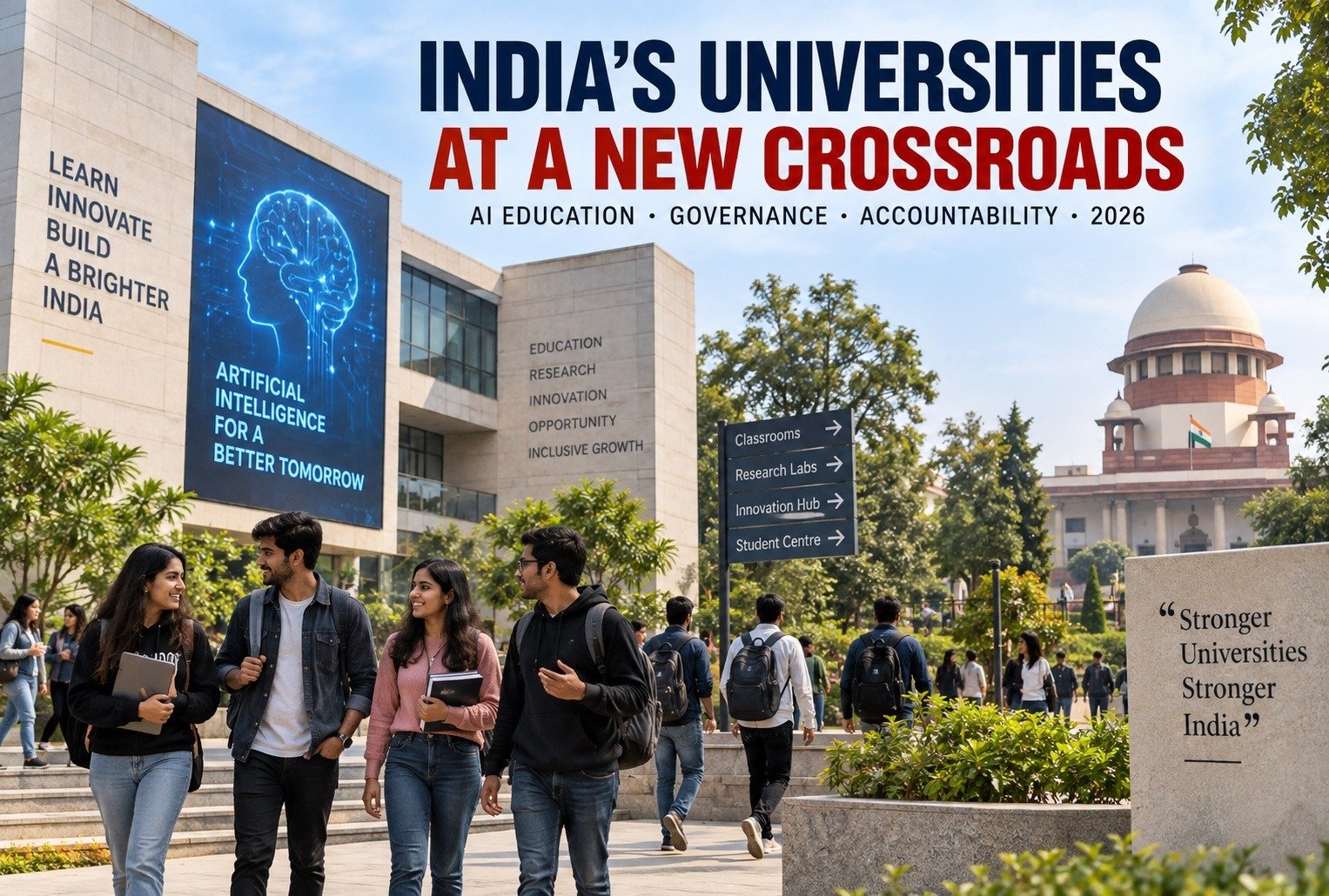
India’s universities are being asked to do two very different things at the same time.
They must prepare students for a world being transformed by artificial intelligence, advanced technology and rapidly changing employment patterns. At the same time, institutions — particularly private universities — are facing sharper questions about governance, financial transparency, student rights and regulatory oversight.
The contrast is striking.
Inside one campus, students may be learning about generative AI, machine learning and robotics. Outside the classroom, the larger education system is being asked a much older question:
Who is accountable for the institution educating them?
That question has acquired national importance following proceedings in the Supreme Court involving Amity University, Noida.
From one student’s dispute to a national examination
The Supreme Court’s proceedings arose from a petition by Ayesha Jain concerning Amity University, Noida. The case began with a dispute over the university’s handling of her request to change her name in academic records.
The Court subsequently widened the scope of the matter.
In November 2025, it sought information from the Union government, States, Union Territories and the University Grants Commission concerning the establishment, governance and regulatory framework of private and deemed universities across India. The Court asked for information including the legal basis for their creation, government benefits such as land or other concessions, and the composition and functioning of bodies responsible for running the institutions.
The proceedings continued through 2026.
In May, the Court record showed that a committee headed by former Indian Legal Service officer R.M. Sharma had received state-wise information and affidavits, with the Court asking for details about who actually governs universities and what benefits they have received from governments.
By September, the issue had moved further towards financial and operational scrutiny.
The Supreme Court directed States and Union Territories to submit audited information covering areas including university income and expenditure, fees, employee salaries, admissions, recruitment and teaching standards. The Court also stressed that private universities must serve the public purpose of education rather than operate as profit-making institutions.
This is no longer just a story about one university.
It is a story about how India wants its private higher-education system to function.
Meanwhile, universities are racing towards AI
The timing could hardly be more interesting.
Indian higher education is simultaneously entering an AI-intensive phase.
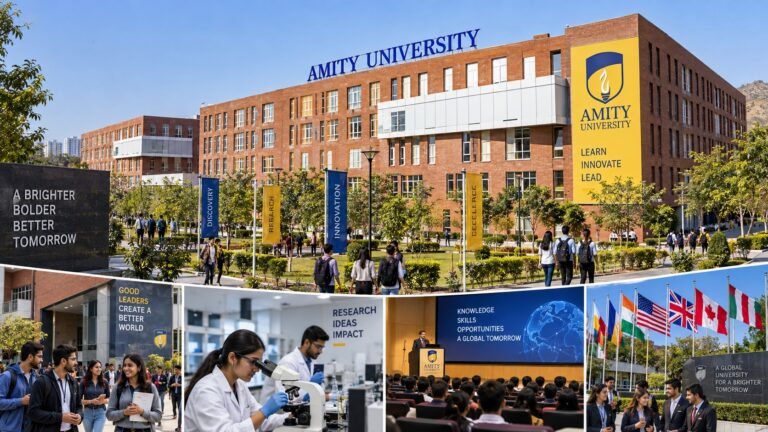
Amity’s Centre for Artificial Intelligence in Noida describes an ecosystem built around AI education, research and industry collaboration, including specialised AI computing infrastructure. The university says its centre uses NVIDIA DGX2 A100 systems and has 10-petaflop computing capacity. It also highlights being among the first institutions in India to introduce a full undergraduate Generative AI course.
Amity’s academic offerings also include a B.Sc. programme in Artificial Intelligence and Data Science at its Noida campus.
These developments reflect a much wider national trend.
Universities are no longer preparing students for a workplace where a degree followed by a stable career path is the default assumption.
Students are entering an economy where software tools change quickly, AI can automate parts of professional work, and employers increasingly expect graduates to combine domain knowledge with digital skills.
The university of the 2020s therefore has to teach both knowledge and adaptability.
But AI laboratories cannot solve everything
A sophisticated AI laboratory makes for an impressive brochure.
It does not, by itself, make a university excellent.
A university is also classrooms, teachers, examinations, laboratories, hostels, food, water, student services, grievance mechanisms, financial systems and governance.
That becomes particularly relevant when examining reports from Amity’s Panvel campus earlier this year.
Students had alleged problems with food and water quality and reported illnesses. The university rejected the allegations and said its campus dining facilities complied with FSSAI hygiene standards and that it maintained sanitation and food-safety procedures. Earlier reporting also recorded student demands for independent testing and greater oversight.
Those competing claims should not be treated as established fact on either side without appropriate independent evidence.
But the episode illustrates something important.
Institutional quality is experienced by students at ground level.
A university may advertise advanced laboratories and international partnerships, but students also judge it by whether everyday systems work properly.
The glamorous and the mundane are both part of education.
The real meaning of accountability
The Supreme Court proceedings could have a significance beyond the institutions directly involved because they focus attention on questions that students and parents routinely face.
Who owns or controls the institution?
Who makes academic and administrative decisions?
How are governing bodies constituted?
How are fees used?
What public benefits or concessions have institutions received?
What grievance mechanisms are available to students?
How are teachers recruited and paid?
What regulatory checks actually take place?
These are not merely legal questions.
They are consumer-information questions.
A family spending several lakh rupees on a university education is making a major financial decision. Students are also investing three, four or more years of their lives.
Transparency therefore matters almost as much as marketing.
A glossy campus brochure can tell a prospective student what a university wants to show.
Governance documents, audited accounts and credible grievance systems can tell them something much more useful.
India’s private university expansion needs trust
Private universities have become an important component of India’s higher-education landscape.
They have expanded capacity, introduced new courses, invested in modern campuses and, in some cases, built strong links with industry and research.
The answer to governance concerns is therefore not to dismiss the entire private sector.
It is to make the system more transparent.
Strong private institutions benefit from credible regulation because accountability can distinguish genuine educational investment from merely impressive presentation.
Students benefit.
Parents benefit.
Faculty benefit.
And universities that are doing things properly have an interest in making that visible.
The AI question is bigger than the classroom
There is another lesson here.
India’s AI education race should not be measured only by the number of universities launching AI programmes.
The more important questions are:
Are students actually learning how AI works?
Are they learning statistics, mathematics, computing and domain fundamentals?
Are universities teaching responsible AI use?
Are research opportunities available?
Can students work on real problems?
Are faculty members themselves being trained?
And, perhaps most importantly, can graduates use AI without becoming completely dependent on it?
The country needs AI-skilled graduates.
But it also needs graduates capable of questioning AI outputs, protecting data, understanding bias and making decisions when technology gets something wrong.
In other words, India’s AI education challenge is partly technological and partly intellectual.
The student’s university experience is the final test
There is a temptation to judge universities through rankings alone.
Rankings matter, but they cannot capture everything.
A university’s true reputation is also created in hostels, laboratories, classrooms, examination offices, cafeterias and student grievance cells.
This is where governance becomes tangible.
A student does not experience “institutional accountability” as a legal phrase.
They experience it when an academic record needs correction.
When a complaint is filed.
When a fee dispute arises.
When accommodation has a problem.
When a health or safety concern emerges.
When an examination decision is challenged.
The distance between the university’s official policy and the student’s lived experience is therefore an important measure of institutional maturity.
The Doonited Perspective
The most interesting part of the current university story is not the controversy alone.
It is the collision of two expectations.
India wants universities that are ambitious enough to build AI laboratories, conduct advanced research and prepare students for the global technology economy.
At the same time, it needs institutions disciplined enough to maintain transparent finances, fair procedures, student safeguards and accountable governance.
These goals are not opposites.
They should reinforce each other.
A university capable of training an AI engineer should also be capable of maintaining an efficient grievance system.
A campus investing in supercomputing should also be able to explain its institutional finances clearly.
A university seeking global recognition should have nothing to fear from credible scrutiny.
That is the deeper lesson emerging from the current debate.
Innovation may attract students, but trust sustains institutions.
What students and parents should learn
For students choosing a university in 2026, the lesson is practical.
Do not evaluate an institution only through advertisements, rankings or photographs of impressive buildings.
Look at the curriculum.
Check accreditation and approvals relevant to the programme.
Understand fees and refund policies.
Examine placement information carefully.
Look for evidence of research and faculty quality.
Understand hostel and campus policies.
Find out how student complaints are handled.
And ask what happens when something goes wrong.
The best university decision is not necessarily about choosing the institution with the most spectacular brochure.
It is about choosing an institution whose academic promise, governance systems and student experience can stand together.
India is building the universities of its AI age.
The country now has an opportunity to make them more transparent, more accountable and more student-centred at the same time.
That would be an innovation worth celebrating.
DOONITED INDIA — THE TAKEAWAY
The future university cannot be only a technology campus.
It must be a trusted institution.
AI can transform what students learn. Better governance can determine how confidently they learn it.
India needs both.


World Beyond the News
Why Elephants Stay Close to Their Herd
Elephants live in highly social family groups and use calls, touch and body movements to maintain strong bonds.
Most of the Deep Ocean Remains Difficult to Explore
Extreme pressure, darkness and distance make deep-ocean exploration one of Earth’s greatest scientific challenges.
Spacecraft Can Travel Without Traditional Roads
Spacecraft use carefully calculated trajectories and gravity assists to travel enormous distances through space.
Why Movie Trailers Are Released in Stages
Major films often use teaser trailers, full trailers and final promotional spots to build awareness over time.