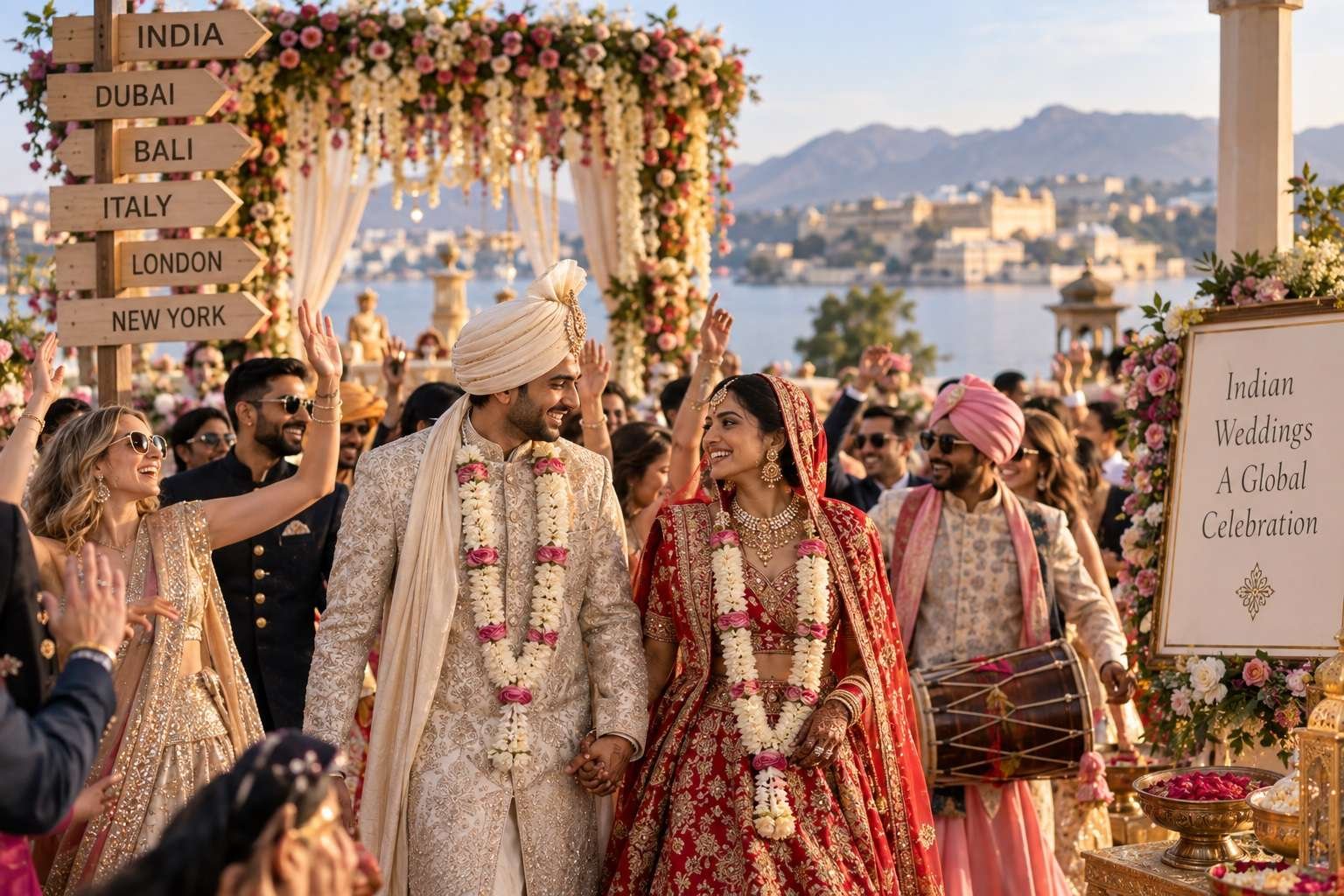
From Jaipur to Dubai: How Indian Weddings Became a Global Celebration Industry There is a useful way to explain the modern Indian wedding to someone who has never attended one. It is not simply a wedding. It is a wedding, fashion show, concert, food festival, family reunion, hospitality operation and destination holiday—sometimes all before the actual wedding ceremony has started. And increasingly, this distinctly Indian way of celebrating is travelling around the world. From Muscat and Abu Dhabi to Mauritius, Thailand, Italy, Bali and Türkiye, Indian couples are taking familiar rituals—mehendi, haldi, sangeet, pheras and elaborate receptions—and placing them against international landscapes. The result is an unusual form of cultural globalization: India is exporting not merely clothes or cuisine, but an entire celebration format. That is the fascinating part. The Indian wedding has become a global business without becoming culturally anonymous. First, let’s talk about the money The frequently quoted $100 billion figure needs some caution. India’s wedding economy is estimated at around that level, with WeddingWire India’s 2024–25 survey describing the Indian wedding industry as a $100 billion market and reporting an average wedding expenditure of ₹29.6 lakh among its surveyed couples. India House Foundation similarly describes India’s wedding


World Beyond the News
Octopuses Can Change Their Appearance
Octopuses can rapidly alter their skin colour and texture to communicate, camouflage themselves and respond to danger.
Some Cities Exist Across Two Continents
A small number of cities are geographically associated with two continents, creating unusual cultural and geographic identities.
Earth’s Climate Is Measured in Many Ways
Scientists track temperature, atmospheric gases, sea level, ice cover and other indicators rather than relying on a single climate number.
Streaming Changed How Audiences Discover Shows
Recommendation systems and global streaming releases allow audiences to discover programmes far beyond their original markets.