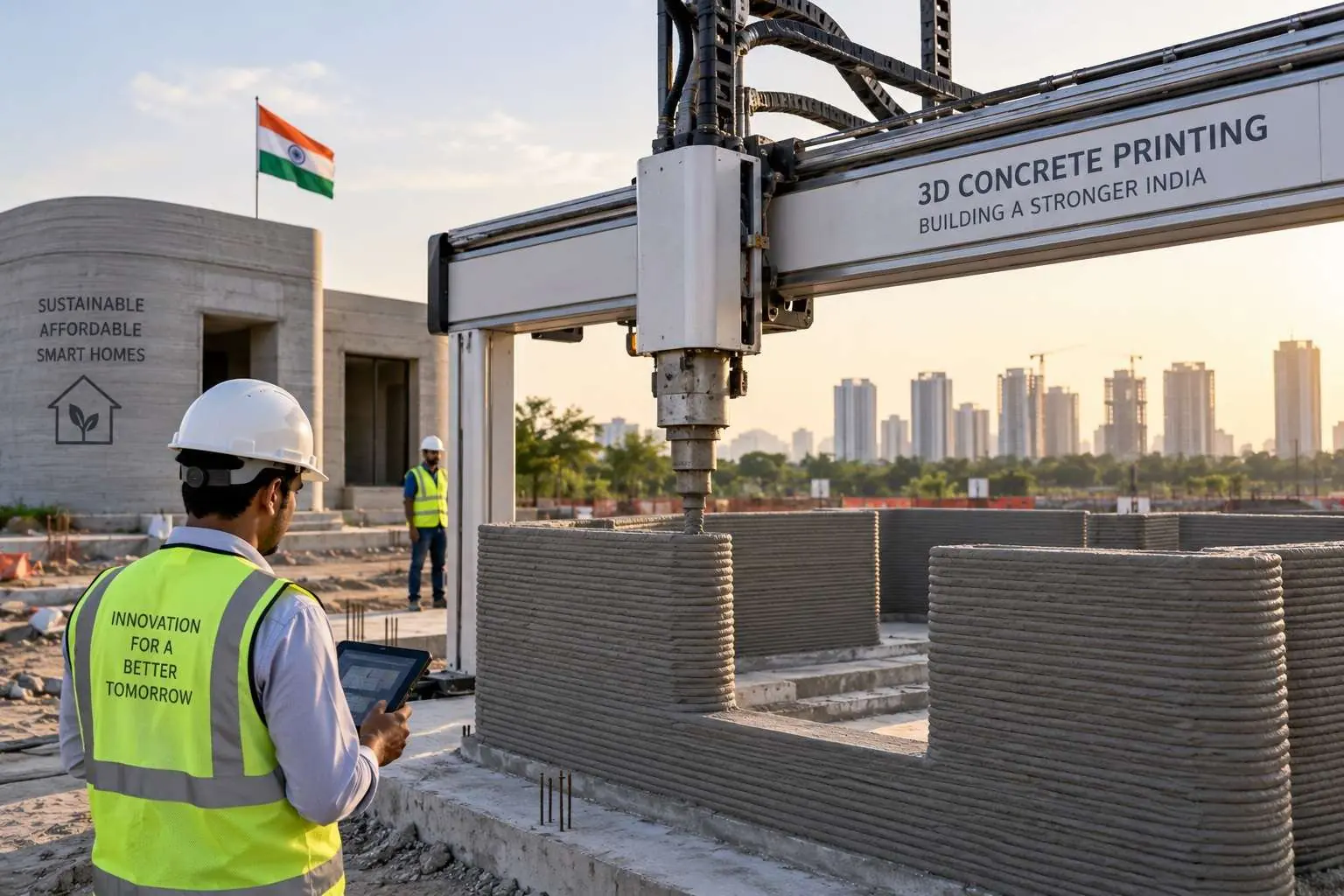
Can a House Really Be Built in Three Days? Imagine replacing a construction site full of bricks, shuttering, scaffolding and dozens of workers with a giant robotic printer. Instead of ink, it extrudes specially formulated concrete. Instead of paper, it follows a digital CAD design. Layer by layer, a building begins to appear. This is no longer science fiction. India has already demonstrated that 3D Concrete Printing (3DCP) can move from laboratory experiments into real construction projects. One of the most striking examples came from AJAX Engineering, which unveiled its APX 1.0 3D concrete printer and demonstrated the technology by constructing a 350-square-metre structure in three days. Conventional construction of a comparable building can take considerably longer, although direct comparisons depend on what stages of construction are included. The headline is impressive. But the real story is bigger than three days. What exactly is a 3D-printed building? The basic idea is surprisingly simple. A computer model tells a robotic printing system where to place concrete. A specialised mixture is pumped through a nozzle, which deposits material in controlled layers. The printer essentially turns a digital building design into physical walls. There is no need to imagine a robot carefully laying


World Beyond the News
Octopuses Can Change Their Appearance
Octopuses can rapidly alter their skin colour and texture to communicate, camouflage themselves and respond to danger.
Some Cities Exist Across Two Continents
A small number of cities are geographically associated with two continents, creating unusual cultural and geographic identities.
Earth’s Climate Is Measured in Many Ways
Scientists track temperature, atmospheric gases, sea level, ice cover and other indicators rather than relying on a single climate number.
Streaming Changed How Audiences Discover Shows
Recommendation systems and global streaming releases allow audiences to discover programmes far beyond their original markets.