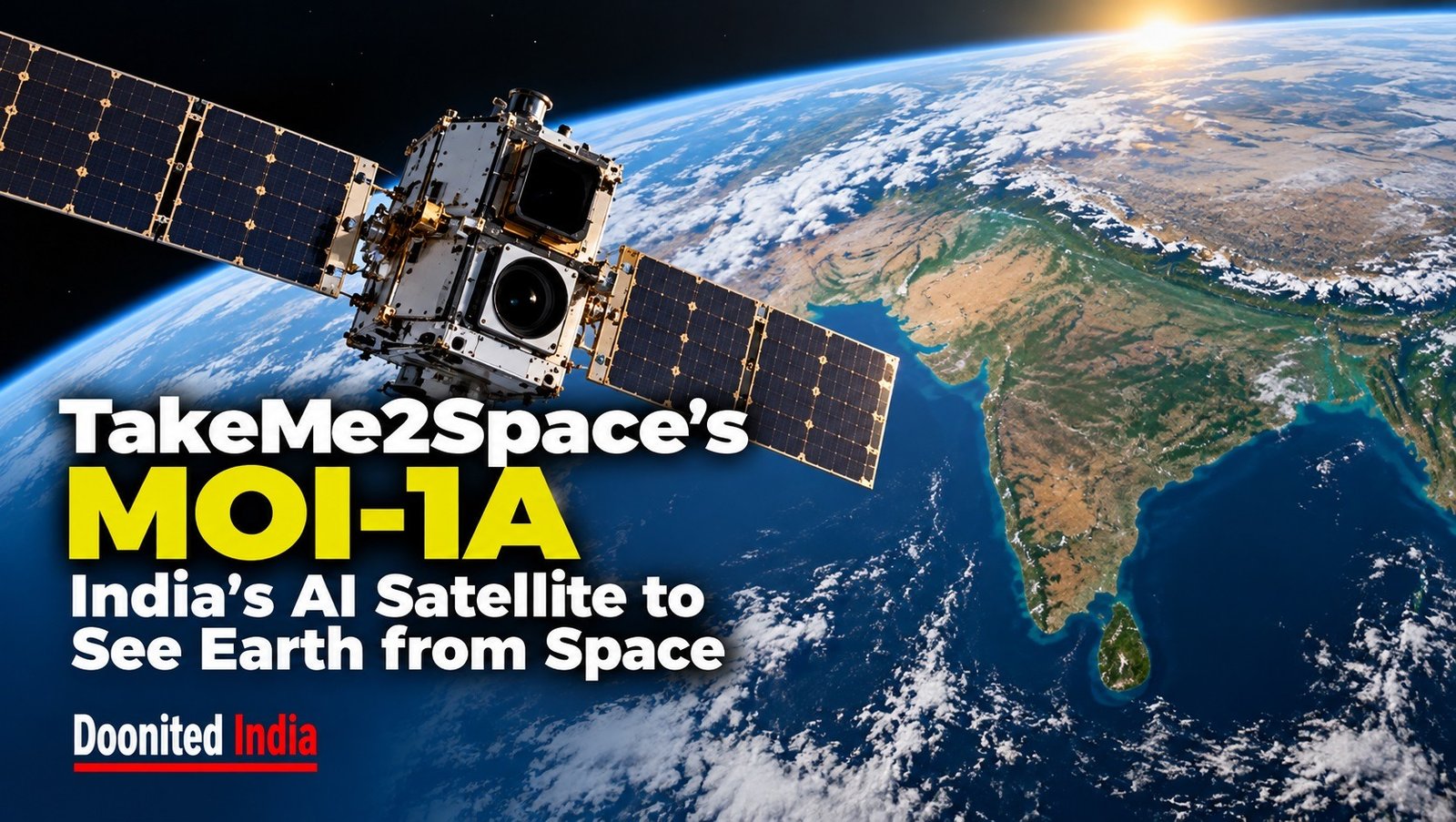
TakeMe2Space’s MOI-1A: Can India Put Artificial Intelligence to Work in Orbit?
India’s next space-tech milestone may not be about taking a satellite farther into space. It may be about making the satellite do more with the data it already collects.
Hyderabad-based startup TakeMe2Space is preparing to launch MOI-1A, an orbital computing satellite scheduled to fly on SpaceX’s Transporter-18 rideshare mission on October 1, 2026. The spacecraft is designed to process Earth-observation data in orbit using onboard computing and artificial intelligence, transmitting selected results to Earth instead of routinely sending down all the raw data.
SpaceX currently lists October 1 as the target launch date, with a backup opportunity on October 2. As with any launch, the schedule remains subject to change.
The idea is straightforward but consequential: rather than treating a satellite as a camera that sends everything home for analysis, make it a computing platform that can decide what information is worth sending.
If the approach works reliably and economically, it could change how some satellite-data services operate. But MOI-1A is still a mission to demonstrate and develop a commercial capability—not proof that every promise of orbital computing has already been achieved.
MOI-1A: A Small Satellite with a Different Job

The company says its onboard computing system can deliver up to 117 trillion operations per second (TOPS). That is substantial processing capability for a compact satellite, although raw computing performance alone does not determine how well an AI application will perform in orbit. The available electrical power, thermal management, radiation effects, software and quality of the incoming imagery all matter.
|
Feature |
MOI-1A |
|---|---|
|
Satellite platform |
6U CubeSat |
|
Approximate mass |
14 kg |
|
Onboard processor |
Nvidia Jetson Orin NX |
|
Claimed computing capacity |
117 TOPS |
|
Storage |
2 TB |
|
Imaging |
Nine-band multispectral |
|
Planned launch |
October 1, 2026 |
|
Launch mission |
SpaceX Transporter-18 |
The company’s specifications are its own published figures. Actual performance will need to be assessed through in-orbit operation and demonstrated customer results.
Why Process Data in Space?
Earth-observation satellites can generate large volumes of imagery. Traditionally, that data must be transmitted to ground stations, processed and analysed before it becomes useful to a customer.
This creates a bottleneck. Satellite passes over a ground station are limited, communications capacity is finite, and transferring large datasets can cost time and money.
MOI-1A is designed to move part of the computing process into orbit.
A customer could upload an AI model to the satellite. When the spacecraft observes a target region, the model could analyse the data onboard and identify information of interest. Instead of transmitting every image, the satellite could send back a smaller result—such as a detected change, a classification or an alert.
For example, an agricultural analytics company might be interested in identifying a particular crop condition across a region. A mining or mapping business might need to detect changes at a site. In such cases, a targeted output could be more useful than receiving a large collection of images and processing everything on the ground.
The benefit depends on the task. Some applications need the original imagery for detailed analysis, auditability or later reprocessing. Others may be able to work effectively with a concise result.
Orbital computing is therefore not a replacement for ground-based data processing. It is another stage in the data pipeline.
From Demonstration to Commercial Mission
MOI-1A follows TakeMe2Space’s earlier MOI-TD technology demonstrator, which the company says validated onboard computing and AI processing in orbit.
The company’s journey has also included a setback. Its MOI-1 spacecraft was lost in the January 12, 2026 PSLV-C62 launch failure. The loss illustrates a fundamental reality of space technology: a satellite can be carefully engineered and still be lost because of a launch-vehicle failure.
MOI-1A is consequently more than a new product announcement. It is an opportunity to resume the mission and test the company’s orbital-computing approach with a new spacecraft.
TakeMe2Space has reported 23 customers signed up for the MOI-1A mission, across areas including geographic information systems, agriculture, mining, supply-chain management and insurance. US-based space-data analytics company Little Place Labs is among the named customers.
That is an encouraging sign of commercial interest, but customer sign-ups should not be confused with recurring revenue, completed service delivery or proven demand at scale. Those will require evidence from actual operations.
The International Opportunity: Data Is the Product
The potential market for orbital computing is not limited to India.
Earth-observation data is used internationally for agriculture, infrastructure, environmental monitoring, logistics, insurance and resource management. A satellite that can deliver useful information faster—or reduce the amount of data that must be transmitted—could appeal to customers in multiple countries.
TakeMe2Space’s reported customer base already includes an overseas company. The broader opportunity is to build services that can operate across borders, with reliable data quality, clear pricing and compliance with the relevant national rules governing satellite data and its use.
There is also a strategic dimension. India has been expanding the role of private companies in its space ecosystem. Developing satellite platforms, onboard software and data services domestically can help Indian firms participate in more of the value chain.
However, the satellite’s use of an Nvidia processor also highlights the global nature of the supply chain. TakeMe2Space says it designs and manufactures many satellite subsystems in India while sourcing certain key components externally. Indigenous capability does not require every component to be domestically produced, but it does require a clear understanding of where critical dependencies remain.
The Hard Problems Above the Clouds
Orbital computing sounds like a data-centre story, but a satellite is not a data centre with a better view.
A spacecraft has a constrained power budget. Its electronics must operate through temperature swings and radiation exposure. Hardware faults can be difficult or impossible to repair, and communications windows are not continuously available.
AI models also need to be adapted to the actual computing environment. A model that performs well on a powerful ground server may need optimisation to run within a satellite’s limits. And if the system sends back only a conclusion rather than the original data, customers must be confident that the result is accurate enough for their purpose.
The business case needs similar scrutiny. Orbital processing may reduce the cost of transmitting raw imagery, but the customer must still pay for satellite access, operations, computing time and data delivery. The economics will vary by application.
A further question concerns security. If customers upload models and process commercially sensitive imagery, the service will need robust controls for access, data handling, software integrity and communications. These are essential requirements, especially for applications involving critical infrastructure or sensitive sectors.
The Road Ahead: From One Satellite to a Network
TakeMe2Space has outlined plans to expand its orbital-computing capabilities with larger and networked satellites beginning in 2027. Its website describes a future constellation intended to provide more frequent access to orbital computing.
A network could improve the service by increasing the number of opportunities to collect data, process it and return results. But building a constellation also multiplies the engineering, launch, operational and financing challenges.
The next milestones are therefore practical ones: successful deployment, commissioning, stable onboard computing, useful imagery, dependable data delivery and customers willing to pay for the service over time.
The October launch is an important step in that sequence. It is not the finish line.
DOONITED View: The Value Is in the Answer, Not the Satellite
India’s space ambitions are often measured through launches, spacecraft and technical firsts. MOI-1A points towards another measure: how effectively space technology solves a customer’s problem.
If the satellite can reliably turn imagery into timely, useful information, it may help create a new category of space-based services. That would matter not only for TakeMe2Space, but for India’s wider private space ecosystem.
Still, the phrase “data centre in space” should be understood as a long-term business direction, not a literal description of what a 14-kilogram satellite can do today. MOI-1A is an edge-computing spacecraft with a focused mission. Larger orbital infrastructure would require a different scale of power, storage, networking and operations.
The most meaningful success story will be a customer using the service to make a better-informed decision—not merely a satellite reaching orbit.
Learning Point
The next stage of satellite innovation may be about sending less data, but delivering more meaning.
MOI-1A will test whether a small Indian satellite can perform useful AI processing in orbit and turn that capability into a commercially valuable service. Its launch is scheduled for October 1, 2026; the results of its mission will determine how far that promise can go.


World Beyond the News
Octopuses Can Change Their Appearance
Octopuses can rapidly alter their skin colour and texture to communicate, camouflage themselves and respond to danger.
Some Cities Exist Across Two Continents
A small number of cities are geographically associated with two continents, creating unusual cultural and geographic identities.
Earth’s Climate Is Measured in Many Ways
Scientists track temperature, atmospheric gases, sea level, ice cover and other indicators rather than relying on a single climate number.
Streaming Changed How Audiences Discover Shows
Recommendation systems and global streaming releases allow audiences to discover programmes far beyond their original markets.