From IIT Madras to AI Materials Discovery: How Akash Ramdas Wants to Help Build Cooler, More Efficient Chips
Discovered Materials has raised US$9 million to develop AI agents that search for promising semiconductor materials. The opportunity is substantial, but turning a computer-generated candidate into a reliable industrial material still requires physics, laboratory experiments and years of engineering work.
The next leap in artificial intelligence may depend on something that rarely appears in a technology headline: the materials inside a computer chip.
As AI models grow and data centres handle more demanding workloads, semiconductor manufacturers face a difficult combination of rising computing requirements, power consumption and heat. Better processors are part of the answer, but progress also depends on the materials that carry electrical signals, connect components and move heat away from sensitive parts.
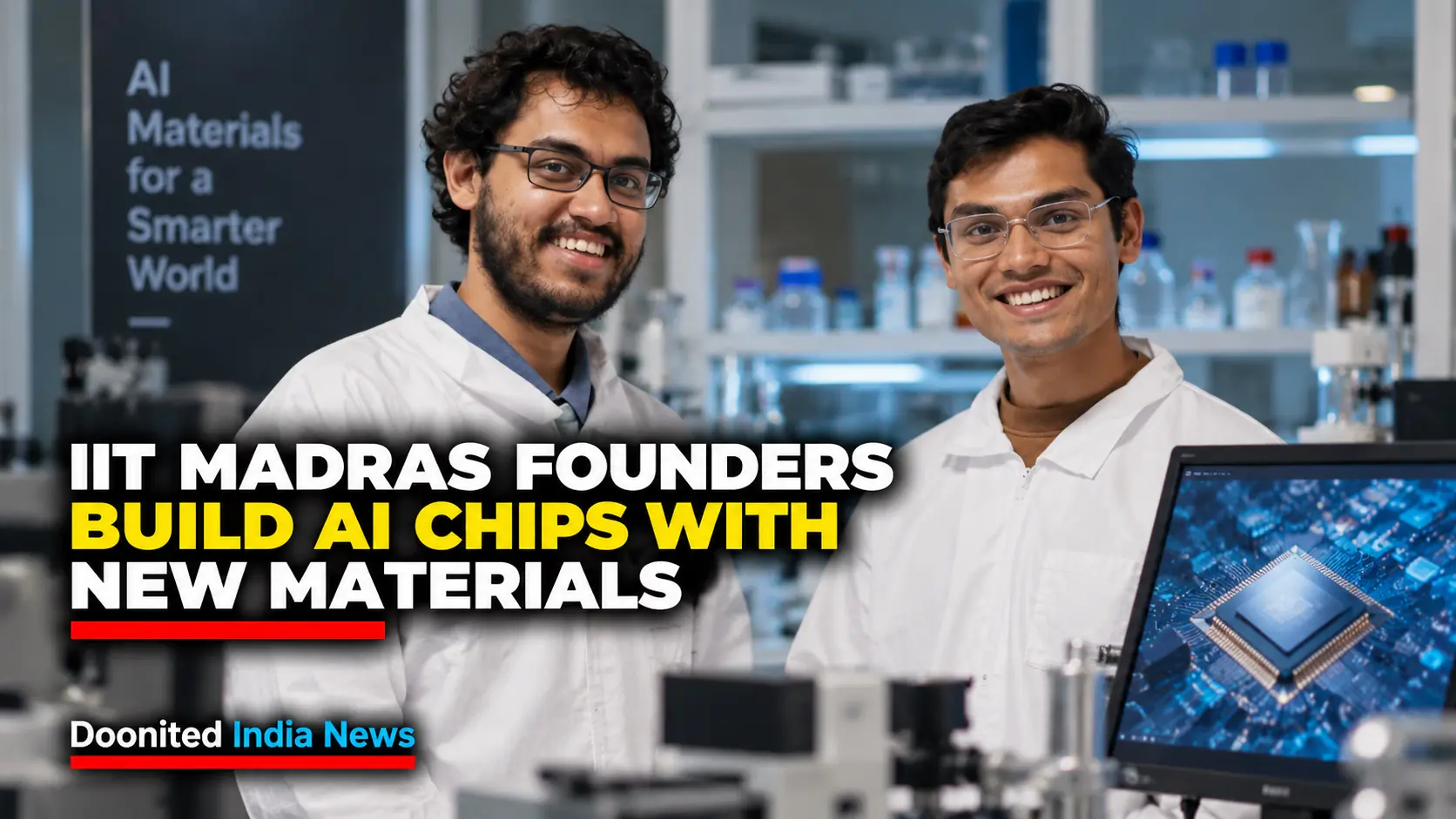
This is the scientific challenge being tackled by Discovered Materials, a startup founded by Akash Ramdas and Advaith Sridhar. The company uses AI agents and physics-based simulations to identify potential new materials for semiconductor applications, with particular attention to thermal management.
In August 2026, the company announced a US$9 million seed funding round led by Lightspeed India Partners, with participation from Y Combinator, Peak XV Partners and angel investors including Paul Graham, Gokul Rajaram and Thariq Shihipar. It also released hundreds of AI-generated material candidates and introduced an open-source benchmark called Material Discovery Bench to evaluate AI systems on semiconductor materials problems.
The funding gives the young company resources to expand its team, laboratory work and research systems. But the more interesting question is scientific: can AI meaningfully shorten the long journey from a promising material predicted by a computer to one that can be manufactured and used in a commercial chip?
Who is Akash Ramdas?
Ramdas’s path connects Indian engineering education with advanced research in materials science. He studied Metallurgical and Materials Engineering at the Indian Institute of Technology Madras before pursuing graduate research at Stanford University, where his work focused on computational materials discovery for electronic applications.
His research has involved using physical theory, computational methods and machine learning to identify materials that could prove useful in next-generation electronic devices. This background is relevant to semiconductor development because many of the industry’s constraints are not simply software problems. They involve the behaviour of matter at extremely small scales.
His co-founder, Advaith Sridhar, brings a complementary background in artificial intelligence. According to the company, Sridhar studied electrical engineering at IIT Madras and AI at Carnegie Mellon University, then worked on AI systems and agents at Persona AI and Luma Labs.
The founders met at IIT Madras more than a decade ago. Their combination of materials-science expertise and AI engineering underpins the company’s approach: use AI to explore possible materials, then apply scientific methods to determine which candidates deserve further investigation.
That combination matters because materials discovery is not simply a matter of asking a chatbot for a new chemical formula. A useful candidate must have the right physical properties, remain stable under relevant conditions and be feasible to synthesise and manufacture.
Why AI chips have a materials problem
AI computing relies on large numbers of transistors operating at high speeds. As processors become more powerful and systems pack more computing capacity into limited space, managing the heat they generate becomes increasingly important.
Heat can affect performance, reliability and the lifespan of electronic components. Data centres must remove it through cooling systems, which consume additional electricity and may require water depending on the cooling design.
The materials used in a chip and its packaging influence how effectively heat moves through the system. They also affect electrical resistance, structural reliability, manufacturing compatibility and cost.
One possible route to better performance is therefore to discover materials that conduct heat more effectively or support improved chip architectures. Other materials could help reduce electrical losses or enable more advanced packaging techniques.
However, a material that looks promising in a simulation is not automatically suitable for a real device. It may be difficult to manufacture, unstable at operating temperatures, incompatible with neighbouring materials or too expensive to use at scale.
The semiconductor industry must evaluate all these properties together. A breakthrough in one metric can be of limited value if it creates a problem elsewhere.
How Discovered Materials uses AI agents
Traditional materials research can require scientists to review existing literature, formulate hypotheses, run calculations, select candidates, synthesise samples and measure their properties. Each stage can take time, and experimental results often force researchers to revise earlier assumptions.
Discovered Materials aims to accelerate this process with AI agents that can explore research directions and coordinate parts of the discovery workflow.
The broad approach involves generating candidate materials, using computational methods to evaluate their properties and directing promising options towards synthesis and physical testing. In principle, this allows researchers to investigate a much larger pool of possibilities than they could examine manually.
The company says that during its Y Combinator programme it simulated, synthesised and tested thermal-interface materials that it reports matched the performance of established commercial products. That is a company-reported claim, and detailed independent validation would be needed to assess the specific materials, testing conditions and reproducibility.
The distinction between generating candidates and validating them is crucial. AI can help identify possibilities that researchers might otherwise overlook, but scientific value comes from evidence that the proposed material behaves as predicted.
The company’s Material Discovery Bench is intended to help measure AI systems’ performance on real-world semiconductor materials tasks. The benchmark is important because a model’s ability to produce plausible-looking answers does not necessarily demonstrate that it can consistently identify scientifically useful materials.
Why the laboratory still matters
There is a temptation to describe AI materials discovery as the automation of science. A more accurate description is that it can automate or accelerate parts of the scientific search.
Computer simulations rely on assumptions, models and available data. Their predictions can be wrong, especially when a candidate material behaves differently from the systems used to train or evaluate a model. Physical experiments are needed to determine whether a material can actually be made and whether its measured properties match expectations.
Even a successful laboratory sample is only one stage of the journey. Semiconductor manufacturers must consider purity, reliability, compatibility with existing processes, production yields, cost and performance over time. Moving from a laboratory result to a material used in a commercial fabrication facility can take years.
This is a familiar challenge across deep technology: the distance between an exciting research result and a commercially useful product is often much greater than the distance between a startup announcement and its first prototype.
Discovered Materials acknowledges this gap in its own description of the industry. Its ambition is to make materials discovery faster, not to eliminate the need for synthesis, measurement or manufacturing validation.
For investors, that means the company’s progress should be judged through evidence of reproducible results, successful testing and adoption—not merely the number of candidates generated by AI.
What the startup’s funding means
The US$9 million seed round is a vote of confidence in the possibility that AI can improve an important part of semiconductor research. It also reflects the strategic significance of materials science at a time when the world is investing heavily in computing infrastructure.
The funding is intended to help the company expand its team and laboratory capabilities and scale its AI research agents. Its open-source benchmark could also contribute to a broader effort to measure how effectively AI systems solve specialised scientific problems.
Yet a seed round is not proof of a commercial breakthrough. The company must show that its approach consistently produces candidates worth testing, that physical validation supports its predictions and that the resulting materials can compete with established alternatives.
The economics will matter as well. Semiconductor companies operate within demanding manufacturing environments, where a material must deliver measurable benefits without compromising reliability or making production prohibitively expensive.
If AI can narrow the search to a smaller set of genuinely promising candidates, it could help reduce wasted experimental effort. If it generates large numbers of candidates that fail during testing, the apparent speed advantage may be less valuable than expected.
India’s opportunity in deep technology
Ramdas’s educational journey highlights how Indian engineering institutions can connect with global scientific research and entrepreneurship. IIT Madras provided the early technical foundation; Stanford research contributed to his specialisation in materials discovery; and the startup now operates in an international semiconductor ecosystem.
Discovered Materials is based in San Francisco, so its funding should not be confused with the establishment of a manufacturing operation in India. Nevertheless, the story is relevant to India’s wider ambitions in semiconductors, advanced computing and scientific research.
India’s opportunity is not limited to assembling electronic products. Building stronger capabilities in materials research, simulation, chip design, fabrication processes and testing can help develop expertise deeper in the technology supply chain.
That requires sustained investment in laboratories, research institutions, specialised talent and collaboration between universities and industry. It also requires patience: advanced materials research cannot be evaluated on the same timetable as a consumer application that can launch a new software feature in weeks.
For students and entrepreneurs, the lesson is that important AI applications may emerge far from familiar consumer products. Some of the most consequential uses of AI could involve helping scientists discover, test and improve the physical materials on which future technologies depend.
The next milestone is proof
Discovered Materials is pursuing a difficult but potentially valuable goal: using AI to make the search for better semiconductor materials more efficient.
Its founders bring relevant scientific and technical backgrounds, and the company has secured early investment to develop its approach. The release of Material Discovery Bench is also a useful step towards evaluating AI systems against concrete research tasks rather than relying solely on broad claims about artificial intelligence.
But the decisive evidence will come from reproducible experiments, independent assessment and eventual industrial adoption. A promising simulation is a starting point, not the finish line.
The future of AI computing will depend on algorithms, processors, power systems and cooling infrastructure. It may also depend on materials that have not yet been discovered. If AI helps researchers find those materials faster—and laboratories can demonstrate that they work—the impact could extend well beyond one startup, influencing how efficiently the next generation of chips is built and operated.


World Beyond the News
Bees Communicate Where Food Is
Honeybees use movement patterns known as waggle dances to communicate information about food locations.
Street Food Reflects Local History
Many famous street foods developed from migration, trade, local ingredients and the everyday needs of working communities.
A Day on Venus Is Extremely Long
Venus rotates so slowly that one rotation relative to distant stars takes longer than its trip around the Sun.
Human Achievement Continues to Push Limits
Athletes, engineers, scientists and explorers regularly establish new benchmarks in speed, endurance, scale and precision.