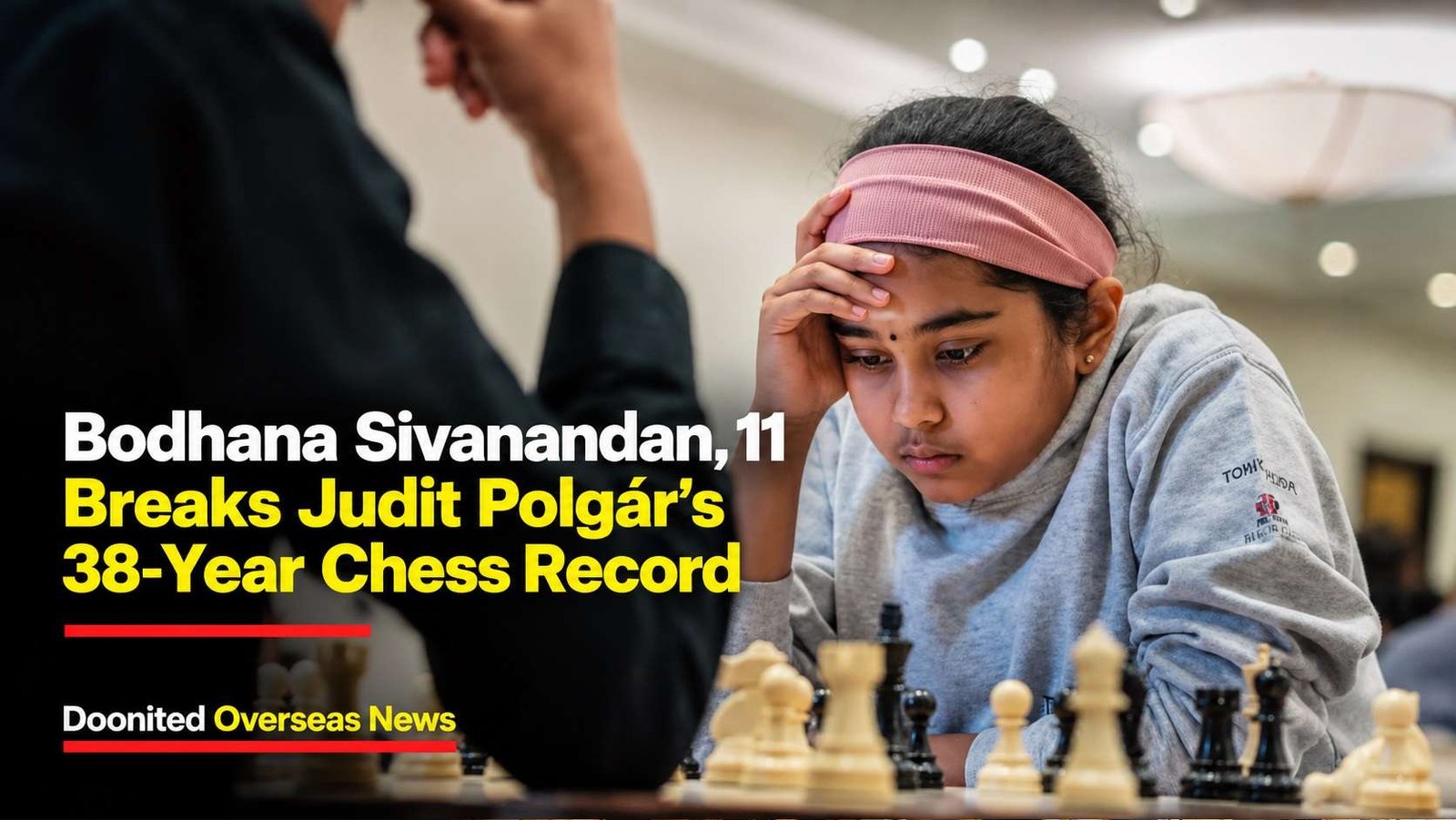
Bodhana Sivanandan: British-Indian Chess Prodigy Breaks Judit Polgár’s 38-Year Record
At just 11, the Harrow-born chess sensation has completed the requirements for the International Master title, surpassing a record held by Judit Polgár since 1988. Her rise highlights a remarkable British-Indian sporting story—and the discipline behind exceptional young talent.
At an age when most children are still discovering their interests, Bodhana Sivanandan is already rewriting the history of international chess.
On 23 October 2026, the 11-year-old from Harrow, north-west London, completed the requirements for the International Master (IM) title after defeating Sweden’s Viktoria Johansson in the final round of the European Women’s Chess Club Cup in Budva, Montenegro.
The victory took Sivanandan to her third and final IM norm, making her the youngest female player in history to fulfil the requirements for the title. At 11 years, seven months and 16 days, she surpassed the record established by Hungarian chess legend Judit Polgár in 1988.
The achievement is another milestone in the rapid rise of a British chess talent whose Tamil Indian heritage also makes her story significant to the wider Indian diaspora.
Importantly, completing the requirements is distinct from formal confirmation of the title by the international governing body. Sivanandan’s record-breaking performance, however, has already established her place in chess history.
A decisive victory in Montenegro
Sivanandan secured the milestone while representing the English women’s team She Plays To Win Lionesses A at the European Women’s Chess Club Cup.
Playing with the black pieces against Johansson, she won her final-round game to finish with 5.5 points from seven rounds on her team’s top board. The result earned her the third IM norm needed to complete the title requirements.
International Master is one of chess’s highest competitive titles, below Grandmaster. Achieving it requires sustained performance against strong opposition under specific tournament conditions, together with the required rating threshold.
For Sivanandan, the achievement was not an isolated result. Her progress has been marked by a series of performances against experienced international players, demonstrating an ability to compete beyond what might be expected of someone her age.
The English Chess Federation described her as a generational talent following the record-breaking performance. The next challenge will be sustaining that progress against increasingly strong opposition.
From lockdown discovery to international competition
Sivanandan’s chess journey began during the COVID-19 pandemic, when she was around five years old. According to published accounts, her father, Siva, brought home a chess set, introducing her to a game that would soon become a serious pursuit.
Her early development was followed by increasingly significant competitive achievements.
In 2025, she attracted international attention after defeating Grandmaster Peter Wells at the British Chess Championships. The victory was reported as a record for the youngest girl to defeat a grandmaster in a classical game.
In August 2026, she won the British Women’s Chess Championship, adding a national title to her growing list of accomplishments.
Then, in September, she completed the requirements for the Woman Grandmaster (WGM) title at the 46th Chess Olympiad in Samarkand, Uzbekistan, where she represented England. Her performance also brought her closer to the International Master title.
The October milestone followed within weeks.
These achievements matter because they reflect different dimensions of competitive chess: individual tournament performance, consistency across multiple rounds and the ability to meet demanding international standards.
Why Judit Polgár’s record matters
The record Sivanandan surpassed belonged to Judit Polgár, widely regarded as one of the greatest female chess players in history.
Polgár earned the International Master title at 12, becoming a symbol of how far women could progress in a sport historically dominated by men. She later became the strongest-rated female player in chess history and competed successfully against elite players across the open circuit.
Sivanandan’s achievement does not diminish Polgár’s legacy. Instead, it marks a new generation reaching a milestone earlier.
The distinction between the International Master and Woman International Master titles is also important. The IM title is open to players of any gender, while the Woman International Master title belongs to a separate title category. Sivanandan’s achievement concerns the former, making the age record particularly notable.
Her next ambition is to progress towards the Grandmaster title, a substantially more demanding objective. The IM milestone should therefore be understood as a major step in a developing career, not a guarantee of future titles.
A British sporting achievement with Indian roots
Born in Harrow and representing England, Sivanandan is part of Britain’s Indian-origin community. Her Tamil heritage adds a diaspora dimension to a story that is fundamentally about sporting achievement.
For overseas Indian families, her progress offers an example of how young people with Indian roots can develop talent and compete at the highest international level within their countries of residence.
It also illustrates why diaspora success should not be viewed through a single national lens. Sivanandan’s achievement belongs to British chess, while her family background connects her story to a broader community with cultural roots in India.
That distinction matters in an increasingly international sporting world, where identity, nationality and representation can overlap without being interchangeable.
Her success may inspire young players in Britain, India and elsewhere, but it should not obscure the individual work involved: sustained practice, tournament experience, coaching and the ability to manage pressure.
The challenge beyond the record
Exceptional achievement at 11 brings opportunities as well as responsibilities. Competitive chess demands time, travel, preparation and emotional resilience. Maintaining progress over several years can be more difficult than producing a single historic result.
Sivanandan’s development will depend on continued access to strong competition, appropriate coaching and support that allows her to progress without losing the benefits of a balanced childhood and education.
The challenge facing British chess is equally important: turning an exceptional individual talent into a wider opportunity for young players. Visibility can encourage participation, but lasting progress requires accessible clubs, coaching and pathways for children from different backgrounds.
For now, Sivanandan has achieved something extraordinary. By completing the requirements for the International Master title before her twelfth birthday, she has surpassed a record that stood for 38 years.
Her story is not simply about how young a chess player can become an International Master. It is about what sustained talent can achieve—and how a new generation is reshaping expectations in a game where every move must be earned.
Originally published on Doonited Overseas: Read the original article


World Beyond the News
Dolphins Use Individual Signature Whistles
Bottlenose dolphins develop distinctive whistles that function somewhat like individual acoustic identifiers.
The Pacific Is Earth’s Largest Ocean
The Pacific Ocean covers more area than any other ocean basin and stretches between Asia, Australia and the Americas.
Artificial Intelligence Learns Statistical Patterns
Modern machine-learning systems identify patterns in large datasets and use those patterns to generate predictions or outputs.
Why Some Stories Spread So Quickly
Emotion, novelty, visual appeal and easy sharing can make a story travel rapidly across social platforms.