India’s Factory Revolution: When Machines Learn Before They Manufacture
Digital twins, robotics, AI and simulation are changing how Indian factories are designed and operated—but the real challenge is taking smart manufacturing from demonstration centres to thousands of ordinary industrial plants
India’s next manufacturing transformation may not begin with a new factory floor.
It may begin with a virtual one.
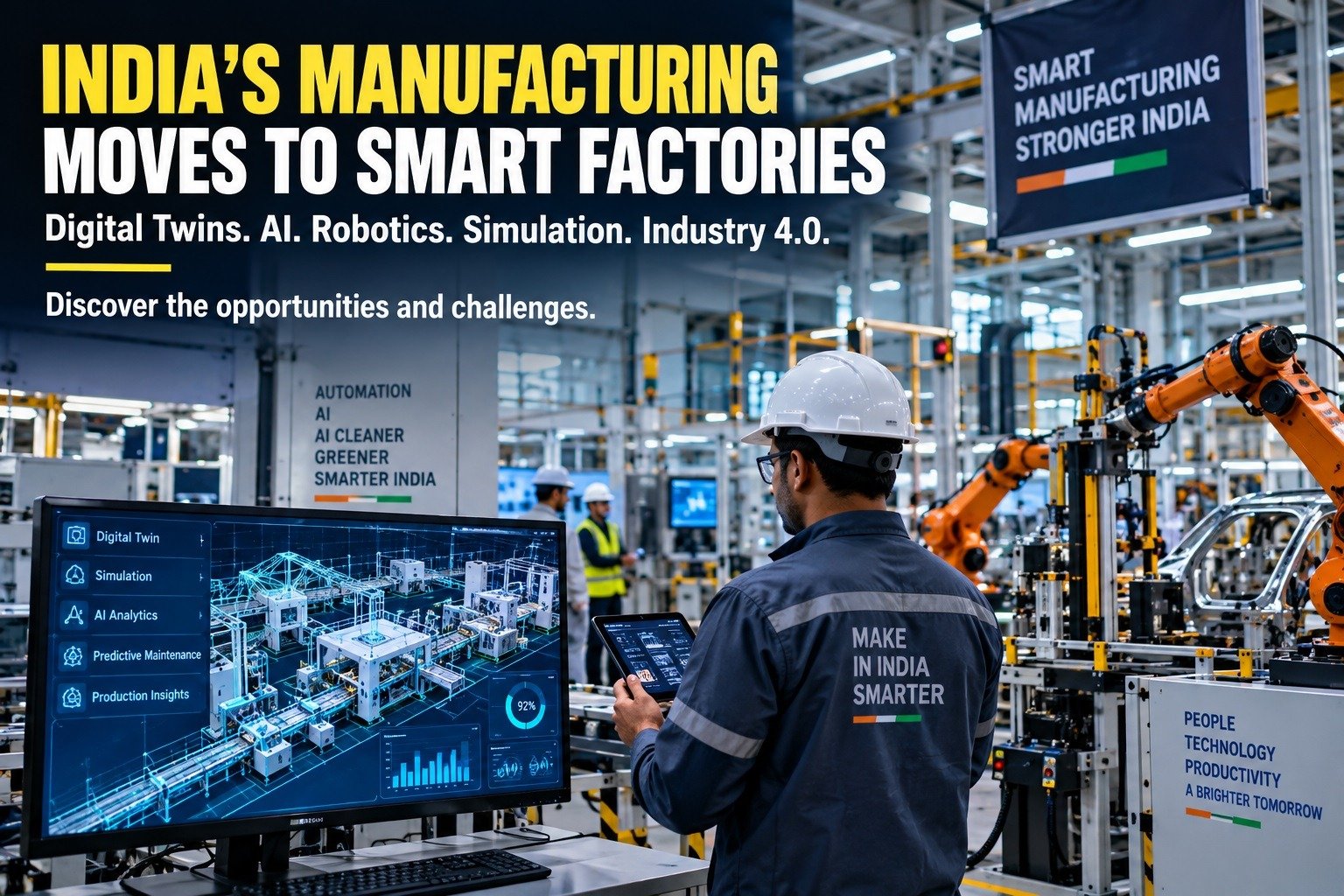
Before a production line is rearranged, engineers can increasingly create a digital representation of the plant, simulate machines and workflows, test alternative layouts and examine how an automated system might behave before making expensive physical changes.
This is the promise of the digital twin—and it is becoming an important component of India’s Industry 4.0 journey.
The technology is now being combined with industrial robotics, artificial intelligence, sensors, simulation and autonomous systems. The ambition is bigger than simply replacing a worker with a robot.
It is to create factories that can observe, analyse, predict and increasingly optimise themselves.
But India’s manufacturing revolution comes with an important reality check: the technology exists, demonstration facilities are expanding, and industrial adoption is progressing—but the transition across India’s enormous MSME manufacturing base is far from complete.
From automation to intelligent automation
Traditional industrial automation follows instructions.
A machine performs a programmed task. A sensor detects a condition. A controller responds.
The emerging model adds another layer: intelligence.
Data from machines, sensors and production systems can be combined with simulation and AI to help manufacturers understand what is happening and determine what might happen next.
Wipro’s description of physical AI and its Industry DOT framework illustrates this direction. Its approach combines digital twins, simulation, robotics and AI to model production environments and explore “what-if” scenarios before deploying changes in the physical world.
That could mean testing a production-line modification digitally before shutting down the real factory.
Or training a robot in a simulated environment before placing it beside workers.
Or examining how a change in production scheduling could affect throughput.
The factory becomes not just a physical asset but a physical-and-digital system.

The digital twin: a factory’s rehearsal room
Think of a digital twin as a virtual representation of a physical machine, production line or facility that can incorporate data from the real system.
Its value is not simply producing a pretty 3D model.
The useful part is the ability to simulate behaviour and test alternatives.
For example, a manufacturer considering a new robotic assembly station could potentially test:
- where the robot should be positioned;
- how materials move through the line;
- whether another machine becomes a bottleneck;
- how production changes under different workloads;
- how a maintenance intervention could affect output.
The physical factory does not have to be the first place where the experiment takes place.
That can reduce the risk associated with trial and error.
The Ministry of Heavy Industries is supporting this broader ecosystem through SAMARTH Udyog Bharat 4.0, which includes Industry 4.0 centres and common engineering facilities designed to help Indian manufacturers experience, test and adopt smart manufacturing technologies.
One such initiative is a Digital Twinning for Emerging Automotive Applications facility being established through ARAI and an industry partner, with a hub in Pune and spokes in Bengaluru and Guwahati. The stated objective includes helping MSMEs and startups experiment with digital twins, simulation, validation and related technologies.
That is significant because India’s manufacturing challenge is not simply about large automobile or electronics companies.
It is about thousands of smaller suppliers.
The “lights-out” factory arrives as a demonstration
The phrase lights-out manufacturing sounds like something designed by a science-fiction screenwriter.
In industrial terms, it describes production environments where autonomous systems can operate with minimal human intervention.
In September 2026, Tata Consultancy Services announced its Industrial Autonomy & Engineering Lab – Lights-Out Factory at its Sahyadri Park campus in Pune.
TCS says the facility combines digital twins, robotics, industrial AI, factory-control systems and real-time operational intelligence. Its demonstration setup includes a fully robotic battery-pack assembly line.
The significance is not that India has suddenly converted its manufacturing sector into unmanned factories.
It has not.
The significance is that such facilities provide manufacturers with a controlled environment in which they can test integrated industrial AI and automation before attempting deployment in production environments. TCS specifically describes the lab as a way to prototype, validate and scale AI-first production systems while reducing deployment risk.
That distinction matters.
A demonstration factory is a laboratory for the future—not proof that the future has already arrived everywhere.
Robots are becoming teammates, not just machines
Industrial robotics is also changing character.
Traditional industrial robots are generally associated with highly structured, repetitive operations.
The newer generation combines robotics with computer vision, sensors, AI and simulation.
Collaborative robots—or cobots—are designed for applications in which humans and robotic systems can work in closer proximity, subject to appropriate safety engineering and operating conditions.
Autonomous mobile robots can move materials around industrial environments.
Meanwhile, simulation platforms can help manufacturers train and test robotic behaviour before physical deployment.
Wipro’s current Industry DOT offering, for example, describes simulation-first deployment for robotic arms, autonomous mobile robots and other autonomous systems, alongside synthetic data and vision-AI applications.
The important shift is therefore from:
“Robot performs task.”
to:
“Robot senses, software interprets, AI decides, and the industrial system responds.”
That is a considerably more complicated proposition.
And considerably more powerful when it works correctly.
India’s biggest opportunity—and biggest problem—is the MSME sector
Large manufacturers can afford sophisticated automation programmes.
A small component manufacturer may not.
This is one of the biggest realities in India’s Industry 4.0 journey.
The Ministry of Heavy Industries’ own documentation identifies challenges including the cost of imported hardware and software, limited affordable indigenous solutions and the difficulty of finding customised solutions suitable for MSMEs.
That means India’s smart-manufacturing story cannot be judged only by impressive laboratories in Pune, Bengaluru or large corporate factories.
The real test will be what happens in smaller industrial clusters.
Can a mid-sized engineering company afford sensors?
Can a small auto-component manufacturer justify a digital twin?
Can an MSME connect an old machine to modern industrial software?
Can workers be trained to operate and maintain the new systems?
And perhaps most importantly:
Will the productivity improvement be large enough to justify the investment?
Those questions are less glamorous than a robot arm moving at impressive speed—but much more important economically.
The human worker isn’t disappearing overnight
One common misunderstanding about smart factories is that automation necessarily means an empty factory.
The more realistic transformation is likely to involve different kinds of human work.
Machine operators may increasingly supervise automated systems.
Maintenance technicians may work with predictive analytics.
Engineers may spend more time modelling and optimising processes.
Workers may need skills in robotics, sensors, industrial software and data interpretation.
TCS itself describes its industrial-autonomy approach as a Human + AI model rather than simply removing people from the production system.
That may prove particularly important for India, where manufacturing employment, skills development and industrial productivity need to advance together.
A robot does not eliminate the need for engineering.
It often changes what the engineer needs to know.
There is still a long road ahead
The technology can be impressive, but smart manufacturing has its own vulnerabilities.
Factories become increasingly dependent on software, connectivity and data.
That introduces cybersecurity risks.
Poor-quality sensor data can undermine AI decisions.
Legacy machinery may be difficult to integrate.
Imported technology can raise costs and create dependency.
And a highly automated factory can potentially create a new kind of operational fragility if a critical digital system fails.
The Ministry’s own smart-manufacturing programme explicitly includes evaluating the limitations and security aspects of automated systems.
So the intelligent factory should not be confused with the infallible factory.
Automation removes some problems. It also creates new ones.
Doonited Editorial Perspective
India’s manufacturing opportunity is not simply to build factories filled with robots.
It is to build an industrial ecosystem in which machines, software, engineers, workers, suppliers and data work together more intelligently.
The digital twin may eventually become as ordinary to a factory engineer as a blueprint once was to an architect.
But India’s success will depend on making the technology economically accessible beyond showcase facilities.
A ₹100-crore smart factory is interesting.
A practical Industry 4.0 solution that helps 10,000 smaller manufacturers improve productivity could be transformational.
That is the more meaningful benchmark.
The future factory may have fewer people pressing buttons and more people interpreting data, supervising autonomous systems and solving problems machines cannot yet solve.
And there is a small irony here.
The factory of the future may be called “lights-out”—but India’s industrial ambitions will still need plenty of human brains switched on.
The takeaway for Indian industry
The next phase of manufacturing is moving from automation to intelligence.
Digital twins can allow factories to test before they build.
Robotics can automate repetitive and hazardous work.
AI can analyse production data.
Simulation can reduce the risk of physical experimentation.
And Industry 4.0 centres can help businesses—particularly MSMEs—understand how these technologies can be applied.
But technology alone will not create competitive manufacturing.
Affordable deployment, skilled people, reliable infrastructure, cybersecurity and measurable business value will decide whether India’s smart-factory ambitions scale.
That is where the real industrial revolution will be won: not in the demonstration video, but on the ordinary factory floor.