Apple Pay Is Coming to India — But Can Apple Find Space in a UPI Nation?
Apple’s reported India launch puts its iconic wallet into one of the world’s most mature digital-payment markets, where scanning a QR code has become almost as ordinary as handing over cash
For years, there has been one conspicuous absence from India’s digital-payment landscape.
Apple Pay.
The service has become a familiar part of the Apple ecosystem in many countries, allowing iPhone and Apple Watch users to make contactless payments using tokenised card credentials stored in Apple Wallet.
India, however, has remained different.
Here, a shopkeeper can put a small QR sticker on a counter and receive a payment almost instantly from a customer’s bank account.
No card machine.
No wallet login.
No complicated checkout.
Just scan, enter the PIN and go.
Now Apple appears ready to enter that environment.
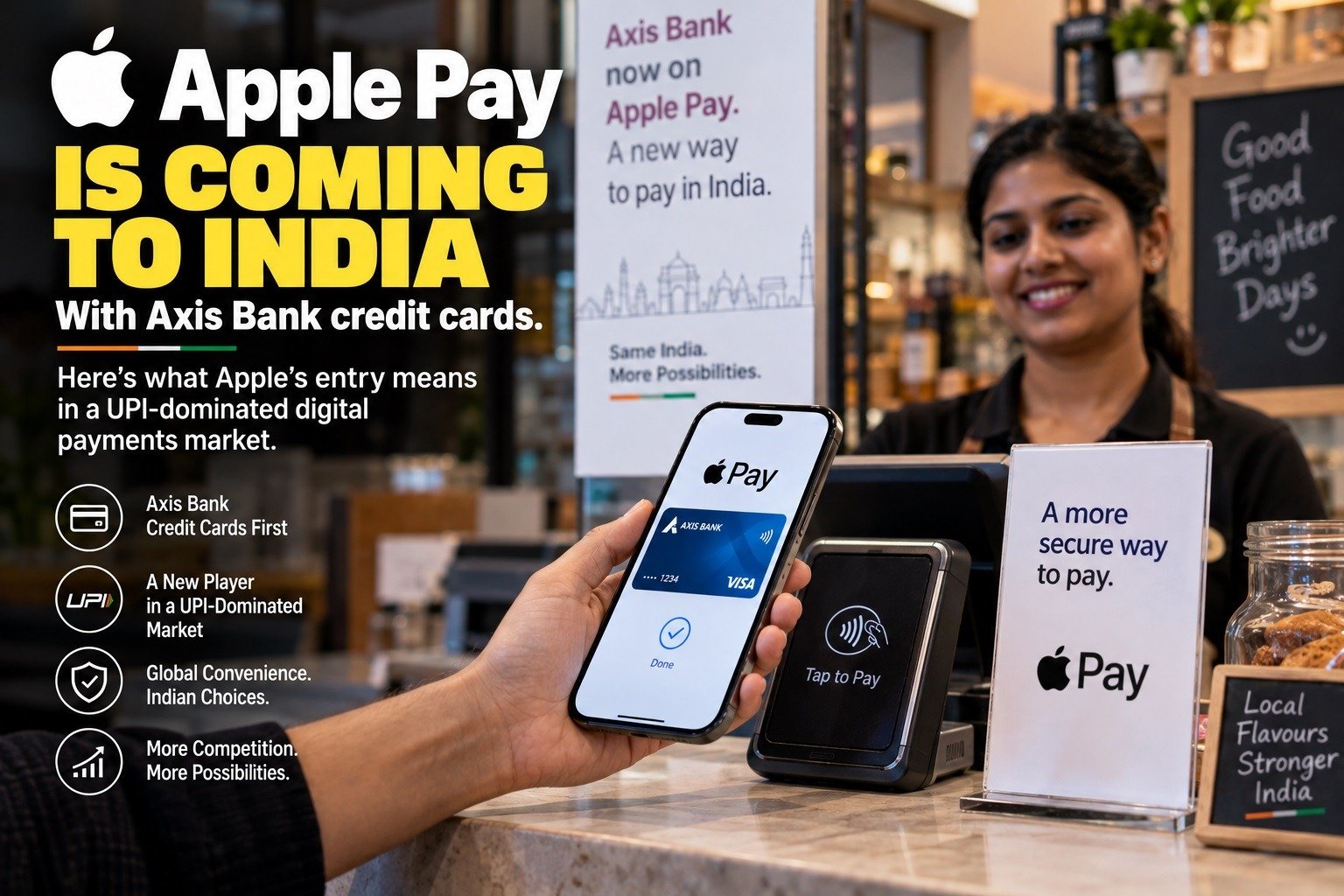
Reuters reported on 18 September 2026 that Apple is preparing to launch Apple Pay in India as soon as October, initially with Axis Bank credit cards. Apple has also held discussions with HDFC Bank and ICICI Bank, although commercial terms with those banks have not yet been finalised.
That makes the story considerably more interesting than simply “Apple Pay finally comes to India.”
The real question is:
What exactly is Apple Pay bringing to a market that already has a remarkably successful digital-payment system?
India doesn’t need another way to scan a QR code
The biggest challenge for Apple Pay is that India isn’t waiting for digital payments to arrive.
They are already everywhere.
UPI has become the country’s dominant digital-payment rail. Reuters reports that UPI accounted for approximately 84% of India’s digital transaction volume and processed 24.5 billion transactions in August 2026, worth ₹29.823 trillion.
That scale changes the competitive equation.
In many countries, the pitch for a digital wallet is simple:
Put your card in your phone and leave the plastic at home.
In India, millions of people have already gone one step further.
They often don’t need the card at all.
A QR code can connect the customer directly to a bank account through UPI.
So Apple Pay’s Indian proposition is unlikely to be about replacing UPI.
It is more likely to be about bringing Apple’s particular contactless-card experience to Indian iPhone users.
Apple Pay and UPI are not the same thing
This distinction is crucial.
Apple Pay primarily stores tokenised payment-card credentials in Apple Wallet and allows compatible devices to make contactless payments. Reuters describes the Indian plan in precisely those terms.
UPI, by contrast, is fundamentally a bank-account-based instant-payment system.
That means Apple Pay and UPI can coexist without necessarily being direct substitutes.
Imagine two different checkout experiences.
One customer taps an iPhone or Apple Watch against a compatible contactless terminal and pays with a supported card through Apple Pay.
Another scans the merchant’s UPI QR code and authorises a bank-account payment.
Both are digital.
But the underlying payment architecture is different.
This distinction could become particularly relevant for Apple’s Indian strategy.
Why Axis Bank first matters
Reuters reports that Axis Bank will be Apple’s initial banking partner for the launch. Axis was India’s fourth-largest credit-card issuer, with around 16.26 million active cards in July, according to Reserve Bank of India data cited by Reuters.
But Apple is not stopping there.
The company has reportedly been in discussions with HDFC Bank and ICICI Bank, two major private-sector card issuers.
However, Reuters says those discussions have not yet resulted in final commercial agreements.
That means the initial launch should not be interpreted as Apple Pay suddenly becoming available to every Indian iPhone owner with a bank card.
The rollout is expected to be phased, with additional banks potentially joining through separate agreements.
That is consistent with how Apple Pay has expanded in other markets.
The timing is particularly interesting
Apple’s reported arrival comes at a moment when India’s payment economics are themselves changing.
From 15 October 2026, a new MDR framework is scheduled to introduce a 0.4% merchant discount rate on specified P2M UPI transactions above ₹2,000, with exemptions and lower rates for certain categories. Person-to-person UPI payments remain free.
That does not mean Apple Pay and UPI are suddenly competing under identical economics.
They aren’t.
But it does mean India’s digital-payment market is entering a new phase after years in which UPI operated under a predominantly zero-MDR merchant model.
For banks, card networks, payment companies and technology platforms, the economics of digital payments are becoming more important.
Apple is entering at an interesting moment.
Apple’s real advantage is the device
The most obvious thing Apple brings to India is not another payment network.
It brings hardware integration.
Apple Pay is built into the company’s devices and operating systems.
That means payment can become part of the same ecosystem as:
- iPhone;
- Apple Watch;
- Apple Wallet;
- biometric authentication;
- supported bank cards;
- Apple’s broader services ecosystem.
Apple has long positioned this integration as a security and convenience advantage.
Its payment system uses tokenisation rather than sharing the actual card number with merchants during transactions.
The result is intended to make payment feel almost invisible.
And that is very much an Apple philosophy:
The best technology is the technology the user barely notices.
But India has already made payment almost invisible
Here comes the irony.
Apple is arriving with an exceptionally polished payment experience.
India has already developed one of its own.
For many consumers, paying at a shop has become:
Scan → PIN → done.
A roadside tea seller, a large supermarket and an online merchant can all participate in the same broader UPI ecosystem.
That creates a very different competitive environment from markets where contactless card payments were the primary digital-payment habit.
Apple therefore doesn’t simply have to demonstrate that Apple Pay works.
It has to demonstrate why an Indian iPhone user should choose it in situations where UPI already works extremely well.
That is a harder question.
The merchant side may decide the story
For Apple Pay to become genuinely useful at physical stores, compatible contactless acceptance matters.
A customer cannot simply tap an iPhone against any arbitrary payment terminal and expect Apple Pay to work.
The merchant infrastructure has to support the appropriate contactless technology and payment network.
India already has a massive QR-payment acceptance ecosystem.
That creates a practical difference.
A tiny shop may have a ₹20 QR sticker but no contactless terminal.
A premium retail outlet may have both.
This could naturally make Apple Pay more relevant initially in environments where card acceptance and contactless terminals are already common.
That does not make the service irrelevant elsewhere.
It simply means adoption will depend partly on India’s physical payment infrastructure.
What Apple Pay could bring to Indian consumers
For eligible iPhone users, the appeal could be straightforward.
Instead of physically carrying a supported credit card, the user can potentially keep it securely in Apple Wallet and authenticate payments through the device.
For frequent travellers, there is another potential advantage.
An Indian consumer who already uses Apple Pay abroad would have a more consistent experience if domestic card support becomes available.
And for Apple’s growing Indian user base, the service would finally connect another major part of the Apple ecosystem to the domestic market.
Reuters says Apple’s share of India’s smartphone market has risen to 8% since 2022, giving the company a significantly larger installed base than it had previously.
That installed base matters.
Payment products work better when the hardware is already in people’s pockets.
What Apple Pay will not automatically solve
Apple Pay does not make India’s payment ecosystem simpler simply by arriving.
It will still depend on:
Bank partnerships.
Card eligibility.
Merchant acceptance.
Contactless infrastructure.
Commercial agreements.
Regulatory compliance.
And India’s enormous UPI ecosystem will continue operating alongside it.
There is also a question of consumer habit.
If someone has spent years paying everything through a familiar UPI application, Apple has to provide a meaningful reason to change the behaviour.
Convenience alone may not be enough if the existing method is already extremely convenient.
Doonited Editorial Perspective
Apple’s arrival in India is interesting precisely because India is not a blank market.
Apple is not introducing digital payments to people who have never experienced them.
It is entering a country that has already leapfrogged several traditional payment habits.
That makes India a fascinating test for Apple.
In some markets, Apple Pay helped introduce consumers to contactless digital payments.
In India, Apple may have to persuade consumers who are already digitally comfortable that another payment method is worth having.
And that is a much tougher sales pitch.
The likely outcome is not necessarily a battle in which one system replaces another.
India is perfectly capable of carrying several payment methods at once.
UPI can remain the everyday bank-account payment rail.
Cards can remain important for credit and rewards.
Apple Pay can become a secure device-based interface for supported cards.
The interesting competition may therefore happen above the payment rails, at the level of user experience.
Who makes paying feel easiest?
Who integrates the payment experience most naturally with the device?
Who offers the best combination of security, rewards and convenience?
And who can do all of that without making the customer think about the plumbing underneath?
For Apple, that is the real Indian challenge.
India does not need Apple Pay.
But Indian iPhone users may decide that they would like to have it.
And those are two very different propositions.
The takeaway for Indian consumers
If the reported rollout proceeds as expected, Apple Pay’s Indian launch should initially be viewed as an additional card-payment option, not as a replacement for UPI.
The first phase is expected to centre on Axis Bank credit cards, while talks with HDFC Bank and ICICI Bank continue.
The bigger story will unfold after launch:
Will Indian iPhone owners actually change their payment habits?
The answer will tell us something important about India’s digital economy.
India may have built one of the world’s most successful payment infrastructures—but convenience is never permanently won.
There is always another tap, scan or innovation waiting at the checkout counter.

World Beyond the News
Bees Communicate Where Food Is
Honeybees use movement patterns known as waggle dances to communicate information about food locations.
Street Food Reflects Local History
Many famous street foods developed from migration, trade, local ingredients and the everyday needs of working communities.
A Day on Venus Is Extremely Long
Venus rotates so slowly that one rotation relative to distant stars takes longer than its trip around the Sun.
Human Achievement Continues to Push Limits
Athletes, engineers, scientists and explorers regularly establish new benchmarks in speed, endurance, scale and precision.