iPhone 18 Pro India Launch: Why the Queue Still Matters in the Age of Online Shopping
At a time when almost anything can be delivered to an Indian doorstep with a few taps, thousands of people still chose to do something remarkably old-fashioned on September 18:
They stood in a queue.
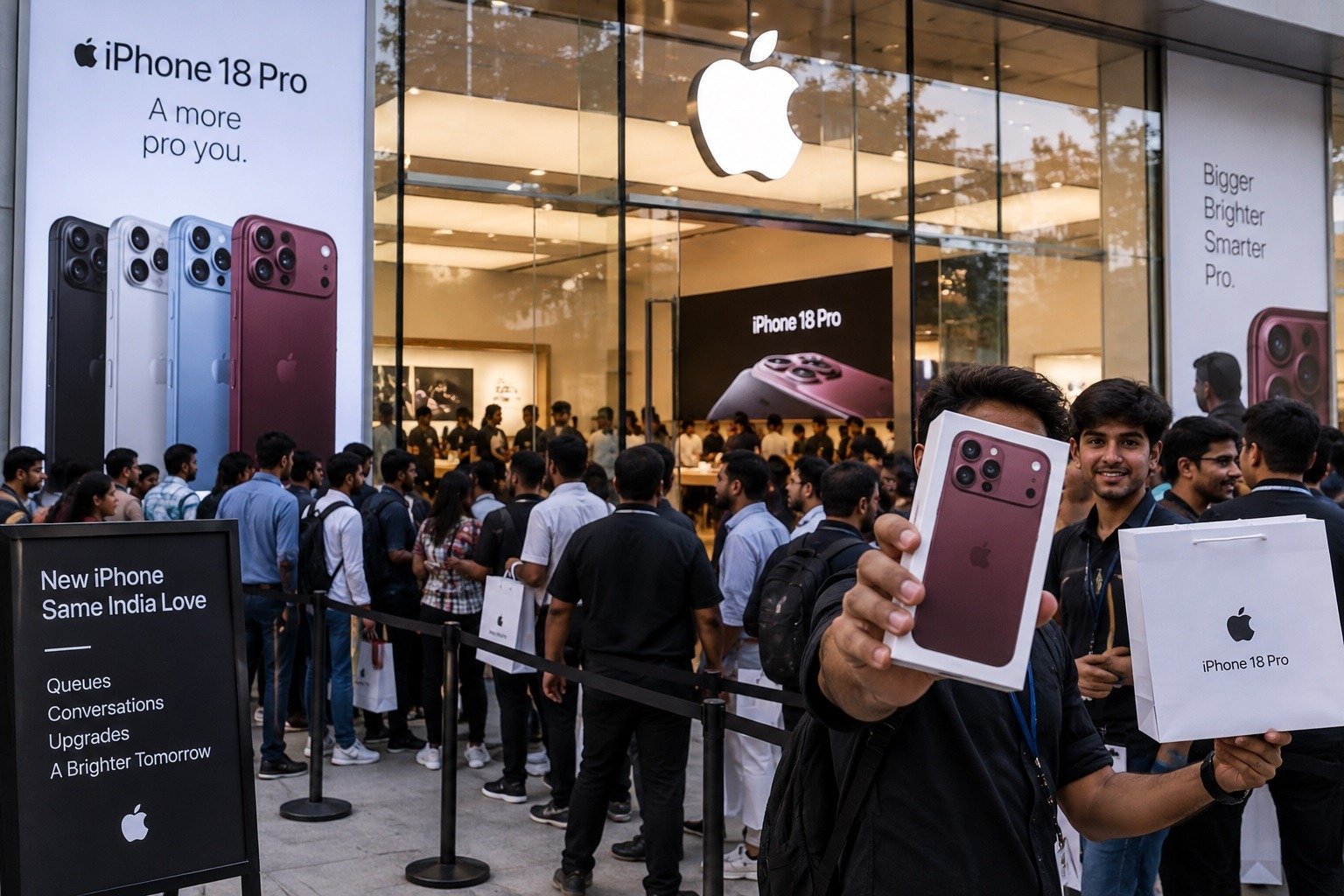
The occasion was the India launch of Apple’s iPhone 18 Pro and iPhone 18 Pro Max, which went on sale across the country on Friday morning.
Outside Apple Stores in Mumbai, Delhi, Bengaluru, Noida and other cities, customers arrived hours — and in some cases overnight — before opening time. The scenes included long queues, excited buyers, social-media creators and consumers determined to get their new iPhone on day one.
There is something almost amusing about it.
The smartphone was designed to eliminate queues for everything from banking to food delivery.
Yet the smartphone itself can still create one.
But beneath the spectacle is a much more interesting Indian consumer story.
The iPhone 18 Pro launch shows how technology, aspiration, premium consumption, financing, retail experience and brand loyalty are increasingly meeting in the same shopping decision.
A ₹1.65 Lakh Starting Point
The iPhone 18 Pro starts at ₹1,64,900 in India, while the iPhone 18 Pro Max starts at ₹1,79,900.
Both begin with 256GB storage, with 512GB, 1TB and 2TB options available. The highest-storage iPhone 18 Pro Max reaches ₹3,29,900, according to current Indian pricing reports.
That places these devices firmly in India’s premium consumer-electronics segment.
And yet the launch-day crowds demonstrate that price alone does not explain demand.
For some consumers, the purchase is about replacing an ageing device.
For others, it is about camera capabilities.
For creators, the hardware can be part of their professional toolkit.
For technology enthusiasts, it is about owning the newest generation.
And for some buyers, the iPhone has acquired a role that goes beyond specifications.
It has become a consumer identity marker.
The Burgundy Effect
Every iPhone generation has its specification sheet.
But consumers often remember the colour first.
Apple’s new Pro models arrive in black, silver, glacier and an all-new burgundy finish. Apple itself prominently features burgundy in its launch material.
Indian launch reporting and early retail checks indicate particularly strong interest in burgundy, with reports of the colour and higher-storage configurations contributing to early demand.
Business Standard reported preliminary estimates suggesting that Indian demand for the iPhone 18 Pro series was 15–28% higher than the iPhone 17 Pro range at launch, with retailers and analysts pointing to strong interest in the new colour and Pro Max.
That is an interesting reminder that consumer electronics are not entirely about technology.
A phone can be a piece of engineering.
It can also be a fashion accessory.
And burgundy appears to have understood the assignment.
What Actually Changed?
The iPhone 18 Pro is not merely a colour refresh.
Apple’s new Pro models introduce a 48MP Fusion Main camera with variable aperture, giving users more control over depth of field and exposure. Apple says the system uses six laser-cut blades to move between aperture settings, while a new sensor is intended to improve image quality and low-light performance.
The phones also use Apple’s A20 Pro chip and a next-generation vapor chamber, with Apple claiming its highest sustained performance in an iPhone to date.
The Pro Max also gets a particularly large battery-life improvement, according to Apple.
Then there is Apple’s expanding AI strategy.
The new models run iOS 27 and support Apple Intelligence and Siri AI, although feature availability varies by language and region. Apple’s current Apple Intelligence language list does not include Hindi, an important limitation to keep in mind when discussing AI capabilities for the Indian market.
That last detail is easily lost in the excitement.
For Indian consumers, “AI available on the phone” and “AI available in the language I naturally use” are not necessarily the same thing.
Why Are Indians Still Queuing?
This is perhaps the most interesting part of the story.
An iPhone can be ordered online.
It can be delivered.
It can be reserved.
It can be purchased through multiple retail channels.
So why stand outside a shop?
Partly, it is about certainty.
Day-one buyers want to know that they have secured a particular model, storage capacity or colour.
But the physical store also offers something that an online checkout cannot completely reproduce:
the launch experience.
The queue becomes a social event.
People meet other Apple fans.
Content creators film the atmosphere.
Friends take photographs.
Retail employees applaud early buyers.
The first unboxing becomes part of the ritual.
In other words, the product launch is no longer only a retail transaction.
It is live consumer theatre.
The Indian Premium Consumer Is Changing
The iPhone launch also tells us something about India’s premium consumption market.
India has a rapidly expanding group of consumers willing to spend significantly on smartphones, automobiles, travel, fashion, entertainment and experiences.
That does not mean the average Indian can casually spend ₹1.6 lakh on a phone.
Quite the opposite.
The very high price means the iPhone 18 Pro remains a premium product.
But there is clearly a sufficiently large market willing to pay for it.
Early industry estimates suggesting stronger Pro demand than last year reinforce that point.
The premium smartphone market therefore cannot be understood simply through India’s average income.
It has to be understood through urban affluence, financing, trade-ins, professional use, aspirational consumption and brand loyalty.
EMI Has Changed the Meaning of “Affordable”
There is another important part of the Indian retail ecosystem: financing.
Apple’s premium prices are high enough that retailers and banks have strong incentives to make the purchase easier through no-cost EMI, cashback and exchange offers.
Retailers including Croma have announced launch promotions combining cashback and exchange benefits. Economic Times reported an effective price of ₹1,24,900 for the 256GB iPhone 18 Pro after specified offers at Croma, although such effective prices depend on eligibility and the particular offer.
This is an important distinction.
A ₹1.65 lakh phone does not suddenly become a ₹1.25 lakh phone for everyone.
It becomes a ₹1.25 lakh effective price under particular promotional conditions.
That difference matters when consumers compare advertised prices.
Financing can widen access to premium technology, but it also changes the psychology of purchasing.
A very expensive product can appear less expensive when translated into a monthly payment.
That makes financial literacy part of technology shopping.
The Upgrade Loop
Another striking feature of launch-day queues is that some customers are not moving from old feature phones to smartphones.
They are upgrading from recent premium iPhones.
That creates what can be called the upgrade loop:
new model → early adoption → trade-in → new model → repeat.
The technology industry depends heavily on this cycle.
Camera improvements, processing power, battery life, AI capabilities, colours and design changes provide reasons to upgrade.
But consumers also have to decide whether the improvement is meaningful enough to justify the expense.
The newest phone is automatically newer.
It is not automatically necessary.
That distinction is worth remembering when the marketing machine is running at full volume.
India Is No Longer Just a Smartphone Market
Apple’s growing retail presence in India also reflects a broader shift.
The company has established official Apple Stores in major Indian cities, including Mumbai and Delhi, while expanding its direct retail and online presence.
That changes the relationship between Apple and Indian consumers.
Previously, much of the premium smartphone experience depended on third-party retail.
Now the company can directly control more of the launch experience — store design, customer service, demonstrations, accessories, trade-ins and product education.
The physical store therefore becomes part of the brand.
That helps explain why a launch queue can have marketing value even when online ordering is available.
The queue itself becomes evidence of demand.
But the Queue Does Not Represent Everyone
There is an important caveat.
Images of hundreds of people outside an Apple Store can create the impression that India as a whole is rushing to buy a ₹1.65 lakh smartphone.
It isn’t.
The people standing in launch-day queues are a self-selected group of highly motivated consumers.
They are not representative of India’s entire smartphone-buying population.
India remains an extremely diverse smartphone market, with consumers buying across enormous price ranges.
The launch-day crowd therefore tells us something specific:
there is strong enthusiasm among a segment of India’s premium smartphone market.
It does not mean every Indian consumer is ready to spend this amount on a phone.
That distinction is important for understanding the market honestly.
When a Phone Becomes a Status Object
There is also a cultural dimension.
Premium smartphones have increasingly become visible social objects.
The phone is held in public.
It appears in photographs.
It is used at meetings.
It is carried into restaurants, airports, offices and college campuses.
The design is visible.
The camera can influence social-media creation.
The brand can become part of a person’s public identity.
This is why the iPhone can function simultaneously as:
a communication device, a camera, a creative tool, a status symbol and a fashion accessory.
The technology may be inside the device.
The social meaning is outside it.
India’s Retail Opportunity Is Bigger Than the Phone
For Apple and its retail partners, a major product launch generates an ecosystem of commercial activity.
There are cases, chargers and accessories.
There are trade-ins.
There are financing products.
There are repairs and support services.
There are telecom connections and data plans.
There are insurance and protection products.
There are also millions of pieces of social-media content generated around the launch.
The smartphone is therefore only one part of the economic chain.
The launch itself becomes a commercial event.
The Bigger Question: Do We Need to Upgrade?
This is where technology journalism should become slightly less excited and slightly more useful.
The iPhone 18 Pro contains substantial hardware changes, particularly around the camera, performance and AI capabilities. Apple has also increased recycled material use, with the company saying the devices contain 40% recycled content overall, including 100% recycled cobalt in the battery and 85% recycled aluminium in the enclosure.
But whether those changes justify an upgrade depends entirely on the user.
Someone shooting professional video may value the camera improvements enormously.
A heavy mobile gamer may care about sustained performance.
A creator may value the new camera controls.
Someone whose current phone handles calls, messaging, banking and photographs perfectly well may see considerably less practical benefit.
Technology should improve our lives.
It should not automatically create a new monthly EMI.
The Queue Is the Story
The iPhone 18 Pro launch in India is therefore not merely a story about a new smartphone.
It is a story about India’s premium consumer culture.
It shows the power of global technology brands in an increasingly important market.
It shows how physical retail can remain relevant in an online-first economy.
It shows how financing and trade-ins reshape premium purchasing.
It shows how colours can become demand drivers.
And it demonstrates that technology launches can become cultural events.
Most importantly, the queues reveal something very human.
People do not always buy technology because they need it.
Sometimes they buy it because they love technology.
Sometimes because they create with it.
Sometimes because they want to be first.
Sometimes because the new burgundy phone simply looks very good.
And sometimes, apparently, because waiting outside an Apple Store at midnight sounds like a perfectly reasonable Friday night.
DOONITED Editorial Perspective
The iPhone 18 Pro launch illustrates the difference between technology adoption and technology aspiration.
The device is undoubtedly technologically advanced, but the extraordinary launch-day attention cannot be explained by specifications alone.
Apple has built an ecosystem in which hardware, software, retail, financing, photography, fashion and social identity reinforce one another.
That is why the queue matters.
The queue is not proof that every Indian wants an iPhone.
It is proof that premium technology has become a cultural experience for a significant segment of Indian consumers.
The sensible question for buyers is therefore not simply, “Can I get the new iPhone?”
It is:
“What will the new iPhone actually change in my life?”
That is the more useful upgrade test.
Meaningful Learning for Readers
A premium smartphone purchase is no longer just a comparison of processors and cameras.
Consumers should consider:
- whether the new features solve a real need;
- the total price rather than only the EMI;
- exchange and cashback conditions;
- storage requirements;
- software and language availability;
- how long they expect to keep the device;
- and whether their existing phone already performs the tasks they need.
The most expensive phone is not necessarily the most useful phone.
The smartest upgrade is the one whose benefits continue after the excitement of unboxing has disappeared.

World Beyond the News
Why Elephants Stay Close to Their Herd
Elephants live in highly social family groups and use calls, touch and body movements to maintain strong bonds.
Most of the Deep Ocean Remains Difficult to Explore
Extreme pressure, darkness and distance make deep-ocean exploration one of Earth’s greatest scientific challenges.
Spacecraft Can Travel Without Traditional Roads
Spacecraft use carefully calculated trajectories and gravity assists to travel enormous distances through space.
Why Movie Trailers Are Released in Stages
Major films often use teaser trailers, full trailers and final promotional spots to build awareness over time.