India’s Health Reset: For much of India’s modern healthcare story, the starting point has been familiar:
Something hurts. Find a doctor.
The next steps usually involve a consultation, diagnostic test, medicine and, if necessary, a hospital.
That model will always remain necessary. Acute illness cannot be prevented simply by downloading another health app.
But India is increasingly confronting a different kind of healthcare challenge — diseases that can develop silently for years before they demand attention.
Diabetes. Hypertension. Cardiovascular disease. Obesity. Certain cancers. Chronic respiratory conditions.
The result is a gradual change in the country’s health conversation:
What if we find the risk before we have to treat the disease?
That is the idea behind India’s emerging preventive-health economy.
The Disease Burden Is Changing the Question
India’s health system is dealing with a substantial non-communicable disease burden.
WHO’s India data have reported that NCDs accounted for 63% of deaths in the cited 2016 dataset, with cardiovascular diseases responsible for 27% of total deaths. WHO also identifies raised blood pressure, elevated glucose and lipids, overweight and obesity among important cardiovascular risk factors.
More recent ICMR research reinforces the scale of metabolic risk.
The ICMR-INDIAB study, covering 30 states and Union Territories and 113,106 participants, reported a weighted diabetes prevalence of 9.6%, while earlier published national data showed substantial burdens of prediabetes, hypertension, obesity and abnormal lipid levels.
This changes the healthcare equation.
A patient with an emergency is a treatment problem.
A population with millions of people developing risk factors over decades is a prevention problem.
And prevention is usually far less dramatic.
There is no ambulance siren.
No hospital drama.
Just a blood-pressure reading, a glucose test, a walk and perhaps a conversation with a doctor.
Healthcare’s least cinematic moments can sometimes be its most valuable.
India Is Also Getting Older
There is another structural reason prevention is becoming more important: India’s population is ageing.
The UNFPA’s India Ageing Report 2023 projects that people aged 60 and above will account for more than 20% of India’s population by 2050. The report also highlights the growing health, social and economic needs associated with demographic ageing.
Ageing does not automatically mean disease.
But the probability of living with chronic conditions generally rises with age, making long-term management, functional ability and preventive care increasingly important.
India therefore faces a dual challenge:
remain healthy enough to benefit from its economic development while preparing for a much larger older population.
That requires more than building additional hospitals.
It requires strengthening what happens before hospitalisation becomes necessary.
Prevention Is Moving Closer to Primary Healthcare
The preventive-health shift is not restricted to wealthy urban consumers ordering elaborate health packages.
India has been expanding NCD screening and management through primary healthcare.
The National Programme for Prevention and Control of Non-Communicable Diseases uses primary-care facilities for awareness, screening, diagnosis, treatment and referral.
That matters enormously.
If prevention exists only in premium clinics, it remains a lifestyle product.
If blood-pressure, diabetes and other appropriate screenings become accessible through primary care, prevention becomes public health.
That is a much more important transition.
The Diagnostic Test Has Become a Consumer Product
There is nevertheless another transformation happening in parallel.
Health diagnostics are becoming easier to order.
Large diagnostic networks now offer home sample collection, online booking, preventive packages and digital reports. Redcliffe Labs, for example, currently markets age-specific and preventive health packages and offers home collection across a large network.
That convenience can encourage people to pay attention to their health earlier.
But there is an important warning.
More testing is not automatically better healthcare.
A test should answer a useful clinical question.
An abnormal result can require interpretation, repeat testing or further investigation.
And a normal result is not a guarantee that a person will remain healthy.
The preventive-health revolution should therefore not become the “full-body-checkup-everything” revolution.
The best screening strategy is usually the one appropriate to a person’s age, sex, medical history, family history and risk profile.
India’s Metabolic Conversation Is Becoming More Sophisticated
The old health conversation often focused heavily on body weight.
The newer conversation looks at a wider group of risk factors.
Blood pressure.
Blood glucose.
HbA1c.
Cholesterol and triglycerides.
Waist circumference.
Physical activity.
Diet.
Sleep.
Smoking and alcohol use.
Family history.
These measures can reveal risk that is not always obvious from appearance.
ICMR’s national diabetes research has documented substantial variation in diabetes, obesity, hypertension and lipid abnormalities across Indian states and between urban and rural populations.
That matters because there is no single “Indian patient”.
A software professional in Bengaluru, a farmer in Maharashtra, a homemaker in Lucknow and a factory worker in Surat can have completely different risk profiles.
Prevention therefore has to become more personalised without becoming unnecessarily expensive.
Wearables Can Help — But They Are Not Doctors
The next layer is technology.
Smartwatches and fitness trackers can encourage people to monitor physical activity, heart rate and sleep-related patterns.
Digital health records can make information easier to carry between healthcare encounters.
India’s broader digital-health infrastructure is making it increasingly possible to connect citizens with health information and services.
But technology introduces a paradox.
The more numbers we receive, the easier it becomes to become obsessed with numbers.
A wearable says your sleep score was 71.
Your resting heart rate changed.
Your recovery score fell.
Your watch thinks you should stand up.
Suddenly the device has become the most demanding relative in the house.
The useful principle is simpler:
Technology should help people understand health, not make them anxious about every fluctuation.
A consumer device can identify a pattern.
A qualified healthcare professional determines whether that pattern matters.
Exercise Remains the Original Health Technology
For all the excitement surrounding artificial intelligence and digital diagnostics, one preventive technology remains remarkably low-tech.
Walking.
Regular physical activity is an established component of reducing chronic-disease risk.
Strength training can help maintain muscle and functional capacity.
Aerobic activity supports cardiovascular fitness.
Mobility and balance become increasingly important with age.
The terminology may have become more sophisticated — Zone 2, VO₂ max, functional fitness, metabolic conditioning — but the underlying message is wonderfully uncomplicated:
The human body benefits from regular movement.
And unlike some wellness gadgets, exercise does not require a software update.
Food Matters, But Prevention Should Not Become Food Fear
Nutrition is another major part of prevention.
The sensible direction is toward diets built around adequate nutrition, vegetables, fruits, pulses, whole grains and appropriate protein, while limiting excessive consumption of highly processed foods, added sugars, salt and unhealthy fats.
But the preventive-health market has created a second problem: fear.
One week carbohydrates are the villain.
The next week it is seed oils.
Then dairy.
Then gluten.
Then a mysterious ingredient that apparently has been hiding in Indian kitchens for centuries waiting to ruin everyone’s metabolism.
The evidence-based approach is considerably less exciting.
Dietary needs vary.
Total dietary pattern matters.
Medical conditions matter.
Portion sizes matter.
And qualified nutritional advice is preferable to whichever food rule happens to be trending on social media.
Sleep Is Health Infrastructure
Sleep is also moving into the mainstream health conversation.
Poor sleep can affect mood, concentration, appetite and daily functioning. Persistent sleep problems can also be associated with broader health concerns.
But once again, the preventive-health industry needs to distinguish useful information from marketing.
A smartwatch’s sleep estimate is not the same thing as a clinical sleep assessment.
Someone with persistent insomnia, significant daytime sleepiness or symptoms suggestive of sleep apnoea should not attempt to diagnose themselves from an app.
The objective is not to achieve a perfect sleep score.
It is to sleep well enough to support health — and seek medical help when there is a genuine problem.
Where Yoga and Ayurveda Fit
India has another resource that many countries would envy: deeply embedded traditions of yoga, meditation and other wellness practices.
These can have a place in a broader preventive-health lifestyle.
But integration needs intellectual honesty.
Traditional practices should not automatically be treated as medical cures simply because they are traditional.
Equally, modern medicine should not dismiss practices that may contribute to physical activity, relaxation, stress management or wellbeing when appropriately used.
The sensible Indian model is neither blind rejection nor blind acceptance.
It is integration with evidence, safety and appropriate medical supervision.
The Real Preventive Revolution May Be Boring
The biggest mistake would be to define preventive healthcare as an expensive collection of tests, supplements, wearables and wellness retreats.
Prevention is actually much more ordinary.
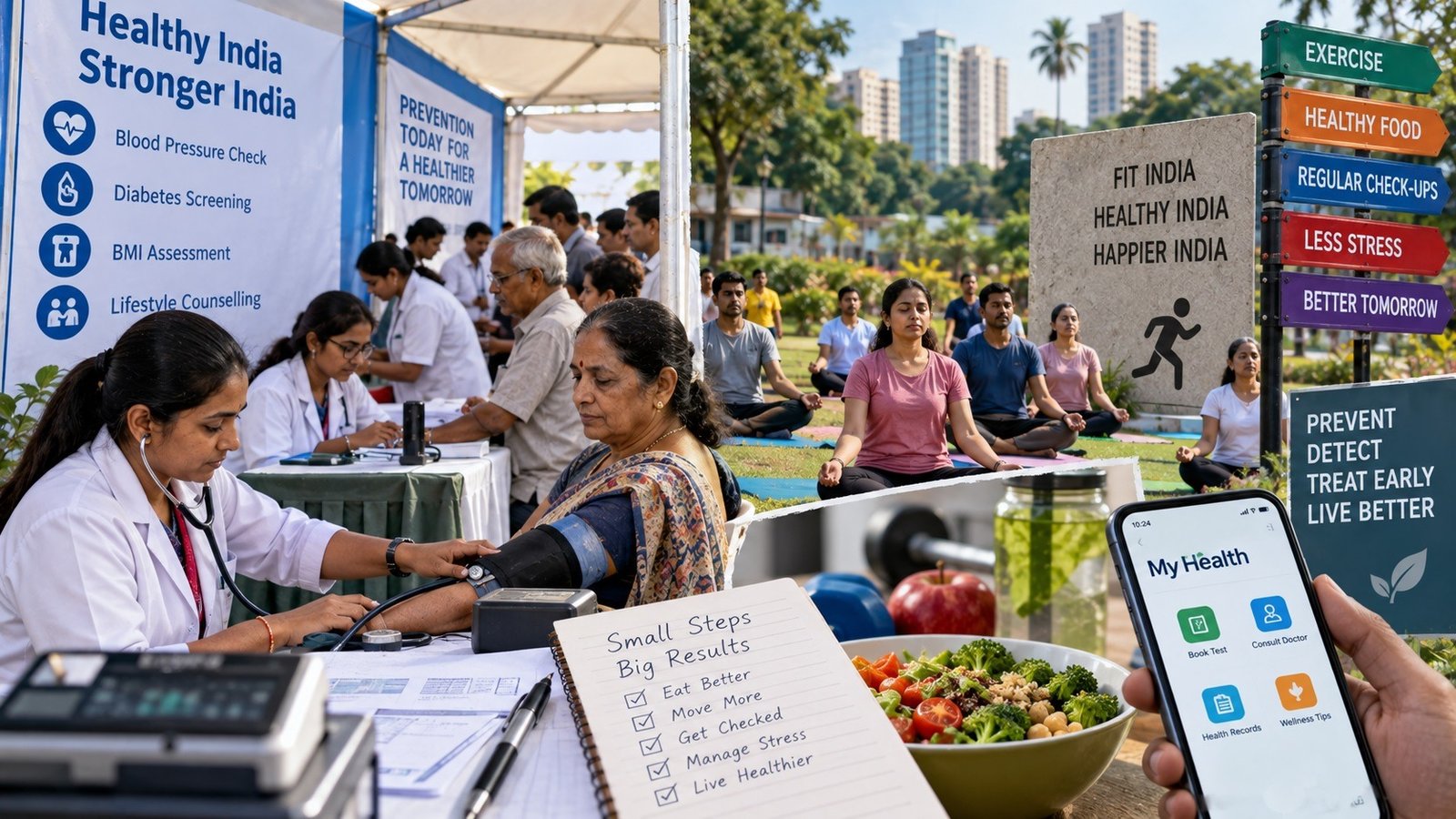
Know your blood pressure.
Understand your diabetes risk.
Get appropriate screening.
Move regularly.
Eat sensibly.
Sleep adequately.
Avoid tobacco.
Use alcohol responsibly.
Maintain a healthy weight where appropriate.
Take prescribed medicines correctly.
Seek medical attention when something is wrong.
And don’t wait for a serious diagnosis before beginning to care about your health.
That may sound less glamorous than personalised longevity medicine.
It is also considerably more scalable.
The DOONITED View
India’s healthcare reset should not mean replacing hospitals with wellness centres.
It should mean moving the starting point of healthcare earlier.
The country’s NCD burden makes that shift increasingly necessary. Its ageing population makes it increasingly urgent. Digital health and diagnostics can make prevention easier to deliver, but they cannot substitute for strong primary care.
The real measure of India’s preventive-health revolution will therefore not be how many people own smartwatches or purchase comprehensive health packages.
It will be whether more Indians discover hypertension before a stroke, diabetes before severe complications, cardiovascular risk before a heart attack, and functional decline before independence is lost.
That is a much tougher metric.
It is also the one that matters.
The Learning Point
Preventive healthcare does not mean trying to predict every disease.
It means reducing avoidable risk, identifying important problems early and acting before a manageable condition becomes a major one.
For individuals, that means taking sensible ownership of everyday health.
For healthcare providers, it means making screening and interpretation accessible.
For government, it means investing in primary care and population-level prevention.
For technology companies, it means building tools that inform rather than frighten.
And for India’s rapidly growing wellness industry, perhaps the biggest lesson is this:
A healthy India will not be created by selling more health products. It will be created by helping more people build healthier lives.

World Beyond the News
Birds Can Navigate Using Earth’s Magnetic Field
Several bird species can sense Earth’s magnetic field, helping them navigate during long-distance migration.
Fermentation Is a Global Food Tradition
People across continents have used fermentation for centuries to preserve food and create distinctive flavours.
Modern Batteries Store Energy Chemically
Rechargeable batteries repeatedly move ions between electrodes, allowing electrical energy to be stored and released.
Why Songs Become Global Hits
Streaming platforms, short-form video, playlists and international collaborations can rapidly carry music across borders.