Delhi Becomes an Open-Air Gallery: Inside India’s Art, Architecture & Design Biennale 2026
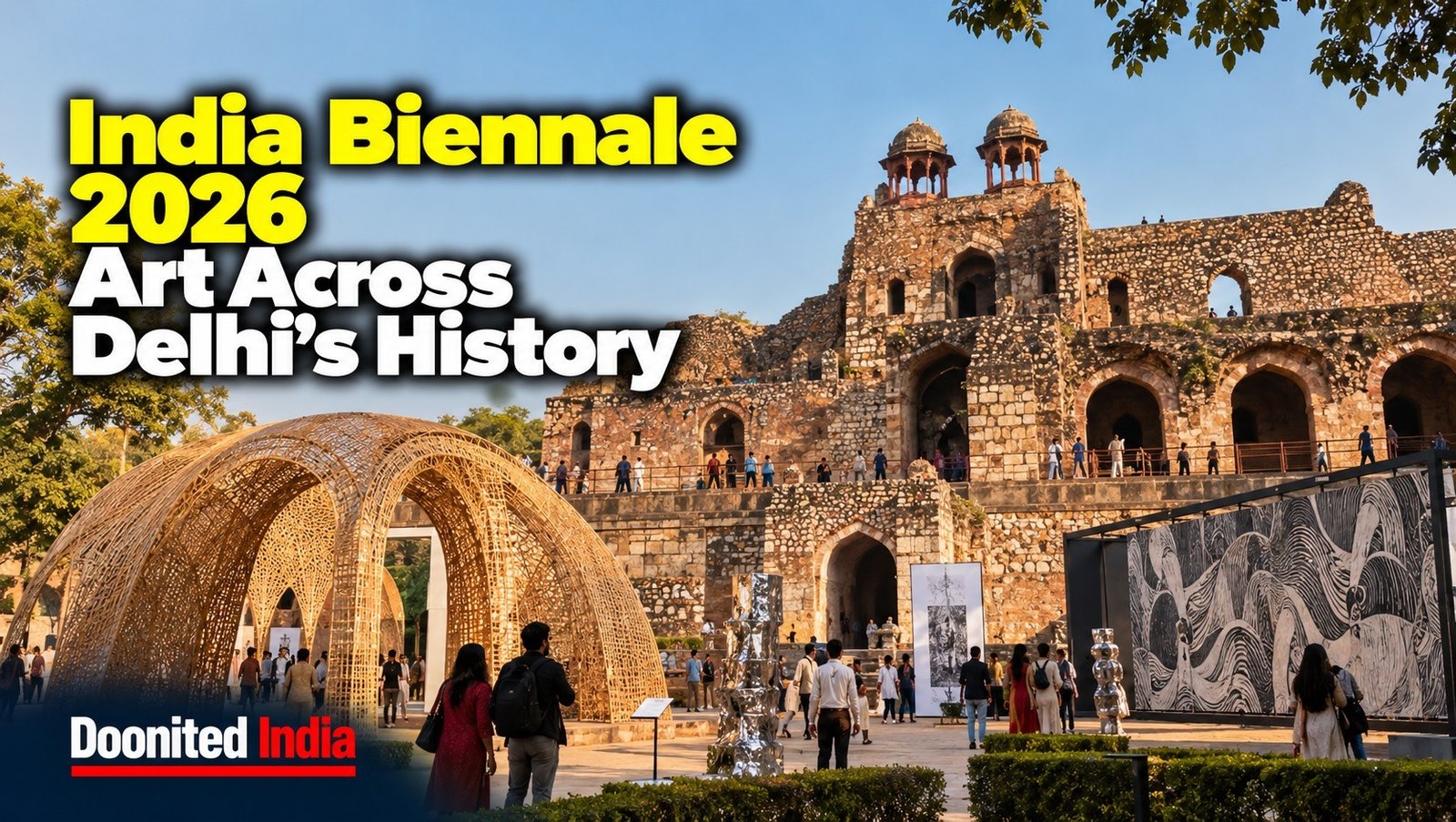
From Purana Qila and the Red Fort to museums, gardens and historic neighbourhoods, the second India Art, Architecture & Design Biennale turns Delhi into a citywide cultural canvas from December 4, 2026 to March 21, 2027. Its bigger experiment is not simply what contemporary art can say—but what happens when art is asked to listen to history.
Delhi has always been a city that refuses to exist in one time period.
A Mughal fort can stand beside a colonial boulevard. A medieval tomb can sit within a modern neighbourhood. A museum can hold objects thousands of years old while smartphones outside it record the newest version of urban life.
In December 2026, that collision of time will become the central experience of one of India’s largest contemporary cultural events.
The second India Art, Architecture & Design Biennale (IAADB 2026) opens on December 4, 2026, and runs until March 21, 2027. Instead of concentrating the event inside one exhibition complex, the Ministry of Culture is opening Delhi itself as its venue, connecting monuments, institutions, historical precincts and cultural spaces into what it describes as “one interconnected cultural canvas.”
The ambition is considerable.
And the question it raises is even more interesting:
What happens when contemporary art stops entering a neutral gallery and instead has to negotiate with architecture that already carries centuries of memory?
A Biennale without a single building
The conventional art biennale has a recognisable formula.
Visitors enter a museum, gallery or purpose-built pavilion. Artworks are displayed in controlled spaces. Architecture generally provides the background.
IAADB 2026 reverses that relationship.
The Ministry of Culture’s official programme allows artists, architects, designers, curators, galleries, institutions and other participants to select heritage and cultural venues across Delhi and develop presentations in relation to those spaces. The official list includes Purana Qila, Red Fort, Qutub Minar Complex, Humayun’s Tomb, Safdarjung Tomb, Jantar Mantar, Mehrauli Archaeological Park, Jamali Kamali, Agrasen ki Baoli and Sunder Nursery, among others.
Institutional venues include the National Gallery of Modern Art, IGNCA, Lalit Kala Akademi, National School of Drama and National Archives of India, while historical precincts such as Hauz Khas, Chandni Chowk, Shahpur Jat and Tughlaqabad also form part of the potential citywide framework.
This matters because a visitor will not experience the Biennale as a single sequence of galleries.
They will experience it while moving through Delhi.
The city becomes the exhibition map.
“Tat Tvam Asi”: an ancient idea for a distracted city
The intellectual centre of the Biennale is the Sanskrit phrase “Tat Tvam Asi” — “You Are That.”
The phrase comes from the Upanishadic tradition and is being used by the Biennale as a proposition about connection: between the individual and the world, people and communities, and human beings and the built and natural environments they inherit.
The official theme is “Reconnecting in an Age of Distraction.”
The choice is revealing.
Modern urban life is increasingly defined by speed, notifications, screens and fragmented attention.
The Biennale’s response is almost counterintuitive.
Slow down.
Look.
Touch.
Listen.
Smell.
Taste.
In other words, experience the city physically again.
The official curatorial framework uses five senses as a shared lens: Sight and Time; Touch and the Body; Taste and Material; Hearing and Reflection; and Smell and Space.
That makes the Biennale less about looking at art from a safe distance and more about considering how art changes our relationship with a place.
Four ideas hold the citywide programme together
The programme is organised around four broad threads:
Reflection considers the individual and the self, particularly contemporary life in conversation with inherited traditions.
Rejuvenation focuses on recovering attention in an era of constant connectivity.
Renewal considers communities and the possibility of reading traditions differently through contemporary practice.
Resilience examines human presence in dialogue with the built and natural environment.
Together, they suggest that the Biennale is not simply asking artists to make beautiful objects.
It is asking them to consider how people inhabit the world.
That distinction becomes especially important when the “world” is a historic monument.
When a monument stops being a backdrop
Imagine encountering a contemporary installation inside a Mughal-era complex.
The first reaction may be visual.
Does the artwork contrast with the stone?
Does it echo the geometry?
Does it disrupt the symmetry?
But the more interesting relationship develops after that initial reaction.
The monument carries its own history.
It has witnessed political changes, social transformations, architectural fashions and generations of people.
A contemporary artwork placed inside that environment cannot arrive without context.
Even an abstract sculpture becomes part of a conversation with the building around it.
This is why site-specific art can be so powerful.
The artwork is no longer only an object.
The space becomes part of the work.
The IAADB’s official curatorial language explicitly describes its venues not merely as backdrops but as mirrors—places where contemporary visitors can encounter themselves through the history and environment around them.
That is a substantially more ambitious proposition than decorating heritage.
Delhi itself becomes the artwork
The most radical element of the Biennale may therefore have little to do with any individual artist.
It is the decision to connect multiple parts of Delhi into one cultural experience.
A visitor could potentially encounter contemporary art at a monument, move into an institutional exhibition, walk through a historic neighbourhood and encounter public programming elsewhere.
The boundaries between museum visitor, tourist and ordinary Delhi resident become less rigid.
This is important for Indian cultural policy because major cultural events can easily become elite experiences.
A conventional gallery exhibition often attracts people who already understand the art world.
A citywide programme has the potential to reach people who did not intend to visit an exhibition at all.
A person visiting a monument for its history may encounter contemporary architecture.
A student may discover an installation.
A tourist may encounter a public performance.
A local resident may walk into a neighbourhood event.
The city itself becomes the invitation.
From heritage preservation to heritage activation
There is another important distinction here.
Heritage conservation traditionally focuses on protecting buildings from damage.
The Biennale introduces another idea: activation.
The Ministry explicitly includes “monument activation,” public art, heritage walks, workshops, performances, a Student Biennale and market linkages among the programme components.
Used intelligently, such programming can make heritage feel relevant rather than remote.
A teenager who might never read an architectural history book may nevertheless become fascinated by a contemporary installation inside a historic structure.
An architect may look at an old building differently after seeing how a contemporary designer responds to it.
A visitor may understand that heritage is not merely something behind glass or behind a ticket counter.
But activation also carries risks.
Historic structures have conservation requirements. Visitor pressure can damage fragile environments. Temporary installations require careful planning, engineering and removal. Light, sound, footfall and equipment can affect heritage sites.
The success of IAADB will therefore depend partly on a discipline that audiences rarely notice:
knowing when contemporary intervention should speak—and when it should step back.
The danger of making history decorative
There is an obvious temptation in an event of this scale.
Put spectacular contemporary art against spectacular historic architecture and the photographs will almost take themselves.
But beautiful photographs are not necessarily meaningful cultural encounters.
If a monument becomes merely an exotic background for an installation, the relationship works in only one direction.
The contemporary artwork gains historical drama.
The monument gains little in return.
The more interesting possibility is dialogue.
A successful intervention should make visitors notice something about the monument that they might otherwise have missed—and make them see the contemporary work differently because of its location.
That is a much higher curatorial standard.
And it is precisely why IAADB 2026 is worth watching.
Digital art meets ancient stone
The Biennale is also deliberately refusing the simplistic idea that heritage belongs to the past while technology belongs to the future.
Its official curatorial framework welcomes digital and new-media art, including immersive forms, while presenting technology as something that can potentially restore attention rather than merely fragment it.
This creates an intriguing possibility.
Imagine a digital artwork inside a centuries-old structure.
At first glance, the two may appear incompatible.
But both can be understood as technologies of human imagination.
The monument records what earlier societies could build.
The digital installation records what contemporary societies can now simulate, project and interact with.
The conversation between them is not necessarily about old versus new.
It is about how humans use technology to make meaning.
The student question may be the most important one
Among the Biennale’s programme components is a Student Biennale, involving institutions including the National School of Drama and Lalit Kala Akademi, with a national open call for young artists and design students and provisions for curatorial mentorship and limited grants.
That could prove more consequential than some of the headline exhibitions.
India’s next generation of artists and designers will inherit a complicated cultural landscape.
They will work with artificial intelligence, immersive technology, digital fabrication and global visual culture while simultaneously negotiating ancient craft, vernacular architecture and historical memory.
A platform that places young creators inside that contradiction is valuable.
The question is not whether they can reproduce the past.
It is whether they can have a conversation with it.
Delhi as a global cultural proposition
For international visitors, the Biennale offers another advantage.
Delhi is usually consumed through a list of famous monuments.
Red Fort.
Qutub Minar.
Humayun’s Tomb.
Jantar Mantar.
The Biennale potentially changes the sequence.
Instead of seeing these places as isolated tourist attractions, visitors can encounter them as parts of an evolving cultural landscape.
That makes the event relevant beyond India’s art community.
International biennales have long demonstrated how cultural events can transform the way cities are perceived.
IAADB 2026 has an opportunity to develop an Indian version of that model—not by copying Venice, Basel or other established art destinations, but by exploiting something Delhi possesses in abundance:
layers of history living on top of one another.
The real test: can the city remain itself?
There is, however, a final question.
If Delhi becomes an open-air gallery, does it remain a city?
It must.
The success of the Biennale should not be measured only by visitor numbers, Instagram photographs or the international names attached to exhibitions.
A stronger measure would be whether people leave with a different understanding of Delhi.
Whether a monument feels newly relevant.
Whether a young visitor becomes curious about architecture.
Whether an artist finds a new relationship with heritage.
Whether an ordinary resident feels that the cultural programme belongs to the city rather than being imposed upon it.
That is the difficult balance between cultural spectacle and cultural value.
One city, many times
The first India Art, Architecture & Design Biennale took place at the Red Fort in December 2023, establishing the Ministry of Culture’s Biennale as a new platform for the country’s creative sectors. The 2026 edition expands the proposition dramatically by making Delhi itself the venue.
That expansion is more than a logistical decision.
It is a statement about how India wants to present its cultural landscape.
Not as a collection of isolated monuments.
Not as a museum of the past.
But as a living environment in which old buildings, contemporary art, new technology, design, public life and memory continue to interact.
Perhaps that is the most interesting meaning of “Tat Tvam Asi.”
The visitor is not separate from the city.
The monument is not separate from contemporary life.
The past is not completely separate from the future.
And art, at its most useful, may be the thing that makes us notice the connection.
From December 4, 2026 to March 21, 2027, Delhi will offer that experiment at an unusually large scale.
The city will not simply host the Biennale.
For four months, Delhi itself will become its canvas.


World Beyond the News
Dolphins Use Individual Signature Whistles
Bottlenose dolphins develop distinctive whistles that function somewhat like individual acoustic identifiers.
The Pacific Is Earth’s Largest Ocean
The Pacific Ocean covers more area than any other ocean basin and stretches between Asia, Australia and the Americas.
Artificial Intelligence Learns Statistical Patterns
Modern machine-learning systems identify patterns in large datasets and use those patterns to generate predictions or outputs.
Why Some Stories Spread So Quickly
Emotion, novelty, visual appeal and easy sharing can make a story travel rapidly across social platforms.