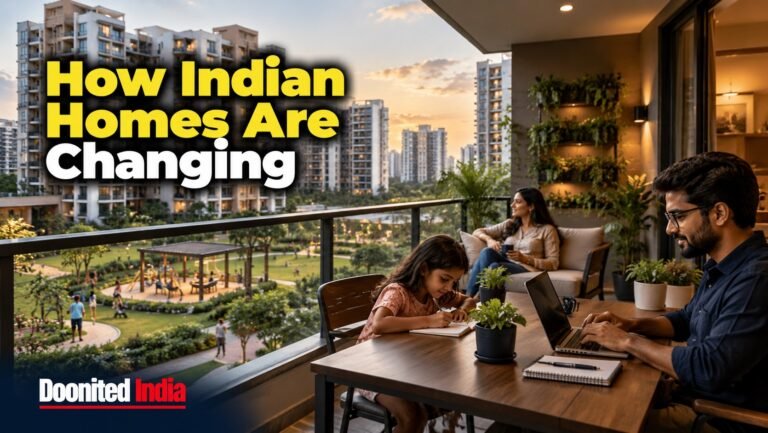
As Indian cities become hotter, denser and more expensive, the next generation of homes may be defined less by marble and chandeliers and more by shade, ventilation, water efficiency, accessibility and spaces that can change with the family.
A beautiful home used to be relatively easy to describe.
Large windows. Imported marble. A dramatic kitchen. Designer lighting. Perhaps a generous balcony and a living room impressive enough to make guests forget how much the apartment cost.
But India’s housing conversation is becoming more complicated.
The home now has to deal with hotter summers, rising cooling demand, tighter urban space, ageing family members, hybrid work, water stress and increasingly expensive construction. A room may need to be a workplace in the morning, a family space in the evening and a guest room on weekends.
That changes the job of architecture.
And as ACETECH Bengaluru returns to the Bangalore International Exhibition Centre from October 9 to 11, 2026, the event’s wide spread of building, architecture and design categories provides a useful snapshot of where the industry is looking: glazing and façades, roofing, water technologies, automation, kitchens, lighting, safety, materials and more. ACETECH itself describes its exhibition as spanning 22 product segments across the building and design ecosystem.
The more interesting question, however, is what these technologies mean once the exhibition lights go off and people actually live in the homes.
The glass-box dream is facing an Indian climate test
For years, large glazed façades became shorthand for contemporary architecture.
They also created an obvious problem in a hot climate: sunlight entering through glass can increase heat gain, making cooling more demanding.
India’s Bureau of Energy Efficiency has increasingly pushed the residential sector toward building-envelope performance rather than treating energy efficiency as an appliance problem. Its Eco-Niwas Samhita framework addresses heat gain, heat loss, natural ventilation and daylighting in residential buildings. BEE’s current residential guidance also recommends measures such as external shading, high-performance glazing, roof treatments and better fenestration.
That does not mean glass is disappearing.
It means the better question is becoming:
Where should the glass be, how much should there be, and how should the building control the sun reaching it?
This is where an old Indian architectural idea becomes unexpectedly contemporary.
The jaali—a perforated screen used to filter light and air—was not invented as a decorative Instagram background. Properly designed shading devices can reduce direct solar exposure while retaining daylight and ventilation.
Modern terracotta screens, fins, external shades and engineered façades are essentially updating that logic with contemporary materials and performance requirements.
The future Indian home may therefore look modern without behaving like a greenhouse.
Cool roofs may matter more than another luxury finish
The roof is easy to ignore because residents rarely stare at it.
The building does not.
BEE’s energy-efficiency material explains the role of cool roofs in reflecting solar radiation and reducing heat gain. Its newer residential retrofit guidance also recommends reflective roof treatments, vegetation where appropriate, high-performance glazing and external shading as part of a broader efficiency strategy.
This is important as air-conditioning becomes increasingly central to household comfort.
BEE notes that residential buildings account for a substantial share of building-sector electricity use and identifies the growth of room air-conditioning as an important driver of rising residential electricity consumption.
The implication is straightforward.
A home should not first become unbearably hot and then ask an air-conditioner to rescue it.
The building envelope should do some of the work before the compressor starts.
That is less glamorous than installing another smart appliance, but potentially much more fundamental.
The shrinking-home paradox
Indian homes are not moving uniformly toward smaller spaces.
In fact, recent housing data show two simultaneous trends.
Premium housing is becoming larger in several major markets, with JLL reporting strong growth in homes priced above ₹1 crore and describing demand for spacious, technology-enabled residences.
At the same time, affordability pressures can push developers toward smaller configurations.
In Bengaluru, one 2026 analysis based on NoBroker data reported an average apartment-size decline from 1,094 sq ft in 2024 to 1,008 sq ft in 2025, with 2BHK and 3BHK carpet areas also shrinking.
The apparent contradiction tells us something important.
There is no single Indian housing trend.
A wealthy buyer may be asking for more bedrooms, larger living areas and premium amenities. A middle-income buyer may be trying to fit a family into less carpet area without increasing the ticket price.
That makes spatial flexibility increasingly valuable.
A sliding partition that creates a temporary study may be more useful than a decorative wall. A bedroom that can accommodate an elderly parent later may have greater long-term value than a room designed for one very specific purpose.
The smartest square foot may be the one capable of doing three jobs.
The Indian kitchen refuses to become a showroom
There is another area where international design ideas often collide with Indian reality: the kitchen.
The minimalist open kitchen looks wonderful in photographs.
Then someone starts frying onions.
Indian cooking can involve high heat, oil, tempering, grinding, spices and substantial steam. The kitchen therefore has to function as a working environment, not merely a visual extension of the living room.
This helps explain the appeal of hybrid wet-dry layouts.
The concept is simple: keep a cleaner, more social preparation and dining zone while allowing heavier cooking to happen in a more contained area with appropriate extraction, surfaces and storage.
That is not a rejection of modern design.
It is modern design adapting to actual behaviour.
The best architecture does not ask residents to change their cooking habits merely because the brochure preferred a cleaner photograph.
Smart homes should become quieter, not louder
Home automation is another area where the industry can easily confuse novelty with usefulness.
A house containing 37 connected devices is not necessarily a smart house.
A genuinely useful system might be much less visible: a pump that responds intelligently to water levels, a leak alert, lighting that responds to occupancy, automated shading or controls that can still be operated manually when technology misbehaves.
ACETECH’s product categories include home and office automation as well as water technologies, reflecting how these systems are increasingly being treated as part of the building ecosystem rather than isolated gadgets.
The principle should be automation where it removes friction.
If residents need a tutorial to turn on a light, the house may have become cleverer than its occupants.
Accessibility should stop being treated as a specialist requirement
Indian homes are also likely to become more important as families age.
That makes accessibility a design question, not merely a compliance question.
The Bureau of Indian Standards’ IS 4963:2024, titled Accessibility in Built Environment for Older Adults and Persons with Disabilities, sets out requirements for barrier-free access and movement and explicitly discusses the needs associated with ageing. Its scope includes public buildings and public housing, while individual private residences are outside its direct scope.
That last distinction matters.
A private homeowner does not necessarily have the same regulatory obligation as a public building.
But families can still benefit from the principles.
Fewer unnecessary level changes. Better bathroom safety. Wider circulation where practical. Good lighting. Sensible handrails. Slip-resistant surfaces. Controls that are easy to understand.
These features do not make a house less luxurious.
They make it usable for more of the people who may live there.
The real luxury may be resilience
India’s residential design market is becoming sophisticated.
But sophistication should not be measured by the number of imported finishes displayed in a showroom.
A better home might be one that remains reasonably comfortable when the temperature rises, uses daylight without excessive glare, manages water intelligently, accommodates changing family needs and does not become dangerous when somebody’s mobility changes.
BEE’s residential efficiency work is already moving in this direction: its current resources include the Energy Conservation & Sustainable Building Code 2024, residential energy-efficiency guidance, retrofit manuals and tools for designers and homeowners.
This is the larger shift behind the design conversation.
India’s next housing story is unlikely to be simply about modern versus traditional.
It is about performing versus merely looking modern.
The house of the future may borrow from the past
There is an appealing irony in this transition.
Some of the most useful ideas for the future Indian home are not entirely new.
Shading, courtyards, cross-ventilation, verandahs, filtered daylight, thick walls and climate-responsive orientation have deep roots in Indian architecture. Contemporary technology can refine these principles rather than erase them.
The result need not look like a heritage building.
It can be a modern apartment or house with efficient glazing, sensors, contemporary materials, concealed services and elegant interiors.
But underneath the styling, it should understand the place where it stands.
That may be the most important lesson from the current architecture-and-building conversation.
India does not need homes that merely resemble international design trends. It needs homes that perform intelligently in Indian conditions.
The next generation of Indian housing will be judged not only by how impressive it looks on possession day, but by how well it behaves ten years later.
That is a much tougher design brief.
And perhaps a much better one.


World Beyond the News
Bees Communicate Where Food Is
Honeybees use movement patterns known as waggle dances to communicate information about food locations.
Street Food Reflects Local History
Many famous street foods developed from migration, trade, local ingredients and the everyday needs of working communities.
A Day on Venus Is Extremely Long
Venus rotates so slowly that one rotation relative to distant stars takes longer than its trip around the Sun.
Human Achievement Continues to Push Limits
Athletes, engineers, scientists and explorers regularly establish new benchmarks in speed, endurance, scale and precision.