IRCON’s ₹862 Crore Railway Contract: Why More Tracks Matter for India’s Freight Economy
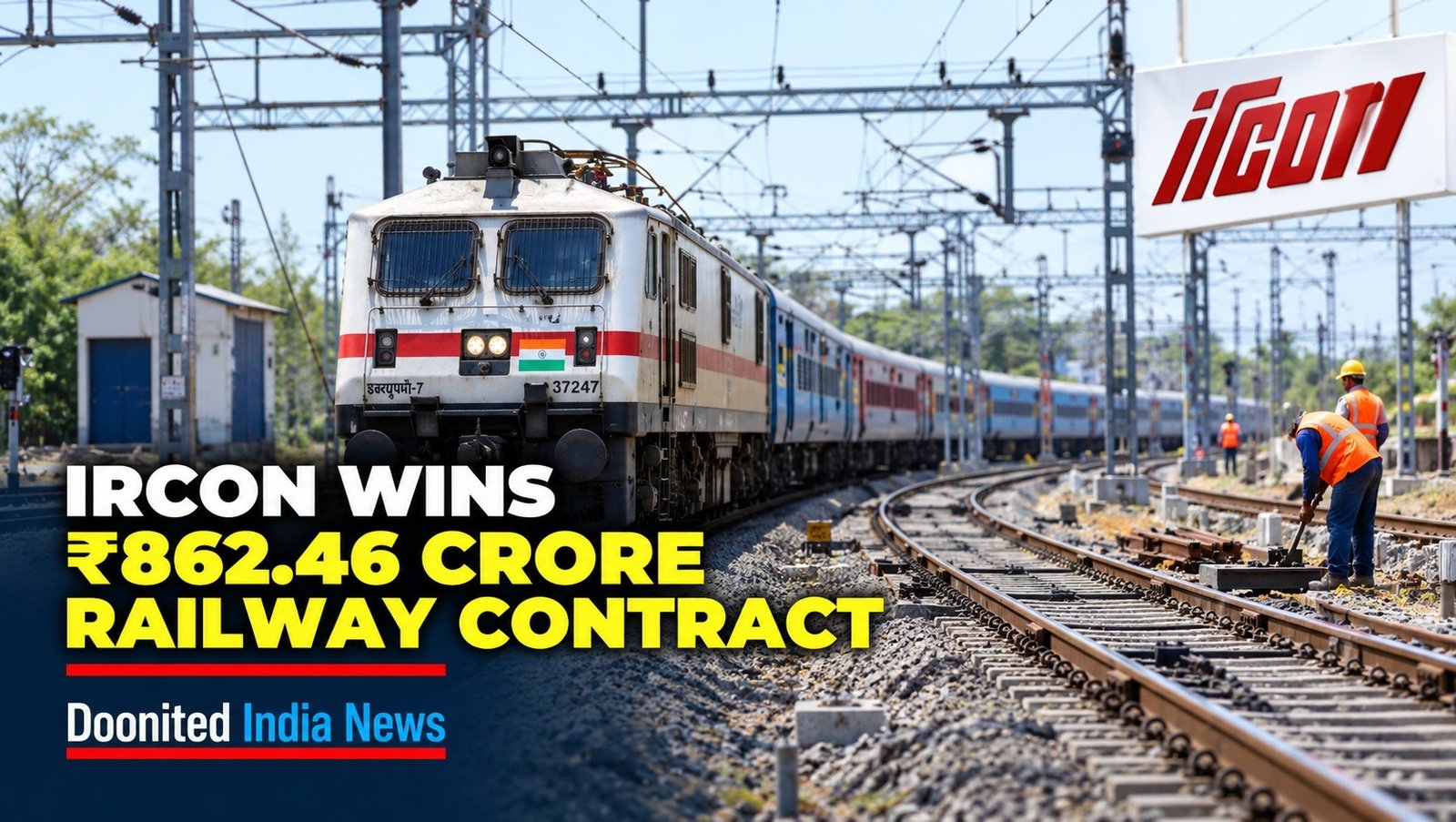
IRCON International has secured an ₹862.46 crore contract from East Central Railway for track works linked to the Son Nagar–Andal third- and fourth-line project. The work covers sections in Jharkhand and Bihar and includes infrastructure designed for a 32.5-tonne axle load. Its larger significance lies in a central challenge for Indian logistics: expanding rail capacity so freight can move more reliably without competing for scarce track space with passenger services.
A freight train carrying coal, minerals or industrial materials can travel hundreds of kilometres, yet its journey may still be slowed by a basic constraint: there is not enough track capacity to accommodate every train when it needs to run.
That is one reason additional railway lines matter. They do not automatically eliminate delays, but they can give railway planners more room to schedule freight and passenger services, manage maintenance and handle growing demand.
IRCON International’s latest contract brings that infrastructure challenge into focus. The state-owned engineering and construction company has received a Letter of Acceptance from East Central Railway for an engineering, procurement and construction (EPC) contract valued at ₹862.46 crore. Disclosed on 12 October 2026, the domestic contract is scheduled for completion within 365 days. It covers track works and material supplies associated with the construction of the third and fourth lines under the Son Nagar–Andal project.
The assignment is not simply about laying more rails. It is part of a wider effort to increase the capacity of railway routes that support industrial freight movement across eastern India.
What the ₹862.46 crore contract covers
According to the reported contract details, IRCON’s responsibilities include supplying ballast and permanent-way materials, laying and linking tracks, and carrying out associated works. Permanent way refers to the track structure, including rails, sleepers, ballast and related components.
The work covers two sections under East Central Railway:
Gomoh–Koderma: Railway kilometres 300.15 to 393.68, under the Dhanbad Division.
Gaya–Son Nagar: Railway kilometres 475.200 to 542.075, under the Deen Dayal Upadhyaya Division.
The contract also includes supplying permanent-way materials at Gaya. The work is specified for a 32.5-tonne axle load, a design requirement associated with heavy freight operations.
An EPC arrangement places responsibility for the specified package of engineering, procurement and construction activities with the contractor. The one-year completion period makes execution, material availability, coordination with railway operations and quality control important factors.
However, a contract award is not the same as a completed railway line. The practical benefits will depend on the work being delivered to specification and the wider corridor becoming operational as planned.
Why eastern India’s freight routes matter
Eastern India has a major role in the movement of coal, minerals, steel inputs and other bulk commodities. These flows connect mining and industrial areas with power stations, factories, ports and distribution centres.
Railways are particularly suited to transporting large volumes of heavy cargo over long distances. But freight trains need reliable paths through a network that also carries passenger services. When routes become congested, trains may have to wait for available slots, and delays can ripple through terminals and connecting lines.
Additional tracks can provide more flexibility. Depending on the final operating plan and infrastructure configuration, railway authorities may be able to allocate capacity more effectively between different services, reduce conflicts between train movements and accommodate traffic growth.
That does not mean the new lines will automatically separate all passenger and freight services or guarantee faster journeys. Such outcomes depend on the route layout, signalling, junction capacity, timetables, terminal facilities and how the additional infrastructure is used.
The economic case is nevertheless clear: freight reliability matters to businesses. A delay can affect inventory planning, industrial production, wagon availability and the timing of deliveries. Better railway capacity can help reduce these uncertainties, although the scale of the benefit can only be assessed after the infrastructure is commissioned and operating data becomes available.
What a 32.5-tonne axle load means
An axle load is the weight transmitted to the track through a vehicle’s axle. A higher permitted axle load can allow suitably designed freight wagons to carry more cargo, subject to wagon capacity, train configuration and the operating limits of the route.
The distinction matters because heavier loading is not achieved simply by putting more material into a wagon. Track, bridges, formations, rolling stock and other infrastructure must be suitable for the intended loads. Maintenance standards and operational controls remain essential.
Indian Railways has been pursuing higher-capacity freight operations, including through its Dedicated Freight Corridors. Its published annual reporting describes the Eastern and Western Dedicated Freight Corridors as infrastructure intended to improve freight speeds, increase carrying capacity and relieve congestion on existing railway routes. The Dedicated Freight Corridors and the Son Nagar–Andal project are distinct infrastructure initiatives, but they reflect the same broad objective: moving more freight with greater efficiency.
A 32.5-tonne axle-load specification for the IRCON package is therefore significant as an engineering requirement. It should not, by itself, be interpreted as proof that every train using the wider route will immediately carry more cargo or that all connecting sections already support the same standard.
IRCON’s role—and the execution test
IRCON, established in 1976 and operating under the Ministry of Railways, undertakes railway and other infrastructure projects in India and overseas. Its experience in track construction and large engineering assignments places it within the supply chain required to expand railway capacity.
For the company, the ₹862.46 crore order adds a substantial domestic project to its portfolio. For the railway, the value of the contract will ultimately be measured by the infrastructure delivered, not the announcement itself.
Track works involve multiple dependencies. Materials must arrive on time, construction must be coordinated with existing railway operations, and the finished work must meet engineering and safety requirements. A short execution schedule can put pressure on project management, but rushing work at the expense of quality would defeat the purpose of the investment.
The wider programme also needs coordination beyond the contractor’s package. Additional lines create useful capacity only when their connections, signalling, stations, yards and adjoining sections can handle the traffic expected to use them. Bottlenecks at a junction or freight terminal can limit the gains achieved by upgrading a particular stretch.
This is the less visible side of railway expansion: capacity is a network outcome, not merely a count of tracks laid.
Can rail expansion improve India’s logistics performance?
India’s freight system depends on a combination of railways, roads, ports, warehouses and industrial facilities. Rail can be efficient for bulk cargo and long-distance movements, while road transport offers flexibility for shorter journeys and door-to-door delivery. The strongest logistics system uses each mode where it works best and connects them effectively.
If added railway capacity allows more freight to move reliably by rail, businesses could benefit from better scheduling and reduced uncertainty. It may also help relieve pressure on road corridors. But any claim of lower costs or reduced emissions needs to be assessed against actual train utilisation, route distances, energy use, the cargo being moved and the road transport displaced.
The environmental case is strongest when new capacity attracts additional freight to rail or improves the efficiency of existing movements. Construction itself consumes materials and energy, while underused infrastructure delivers fewer benefits than a well-utilised corridor.
For policymakers, the important question is therefore not only how much is spent on railway construction, but how much usable capacity the investment adds—and whether freight operators and industries can make effective use of it.
What to watch after the announcement
Three milestones will determine the project’s significance.
First, IRCON must execute the awarded works within the stated timeline while meeting the required standards. Second, East Central Railway must integrate the new infrastructure with the operating network and associated works. Third, the additional capacity must translate into measurable improvements in train handling, freight reliability or network flexibility.
These results should be assessed through operational indicators rather than share-price movements or contract value alone. Completion, commissioning, utilisation and the performance of connecting sections will provide a clearer picture of the project’s contribution.
The ₹862.46 crore award is a meaningful infrastructure development, but its full economic value will emerge only when the track works become part of a functioning railway system.
India’s freight ambitions depend on more than adding lines on a map. They require coordinated planning, disciplined construction and an operating network that can turn new steel and ballast into reliable journeys for goods. IRCON’s latest assignment is one piece of that larger task.


World Beyond the News
Birds Can Navigate Using Earth’s Magnetic Field
Several bird species can sense Earth’s magnetic field, helping them navigate during long-distance migration.
Fermentation Is a Global Food Tradition
People across continents have used fermentation for centuries to preserve food and create distinctive flavours.
Modern Batteries Store Energy Chemically
Rechargeable batteries repeatedly move ions between electrodes, allowing electrical energy to be stored and released.
Why Songs Become Global Hits
Streaming platforms, short-form video, playlists and international collaborations can rapidly carry music across borders.