Can Waste Strengthen NH-44 Without Creating a New Environmental Problem?
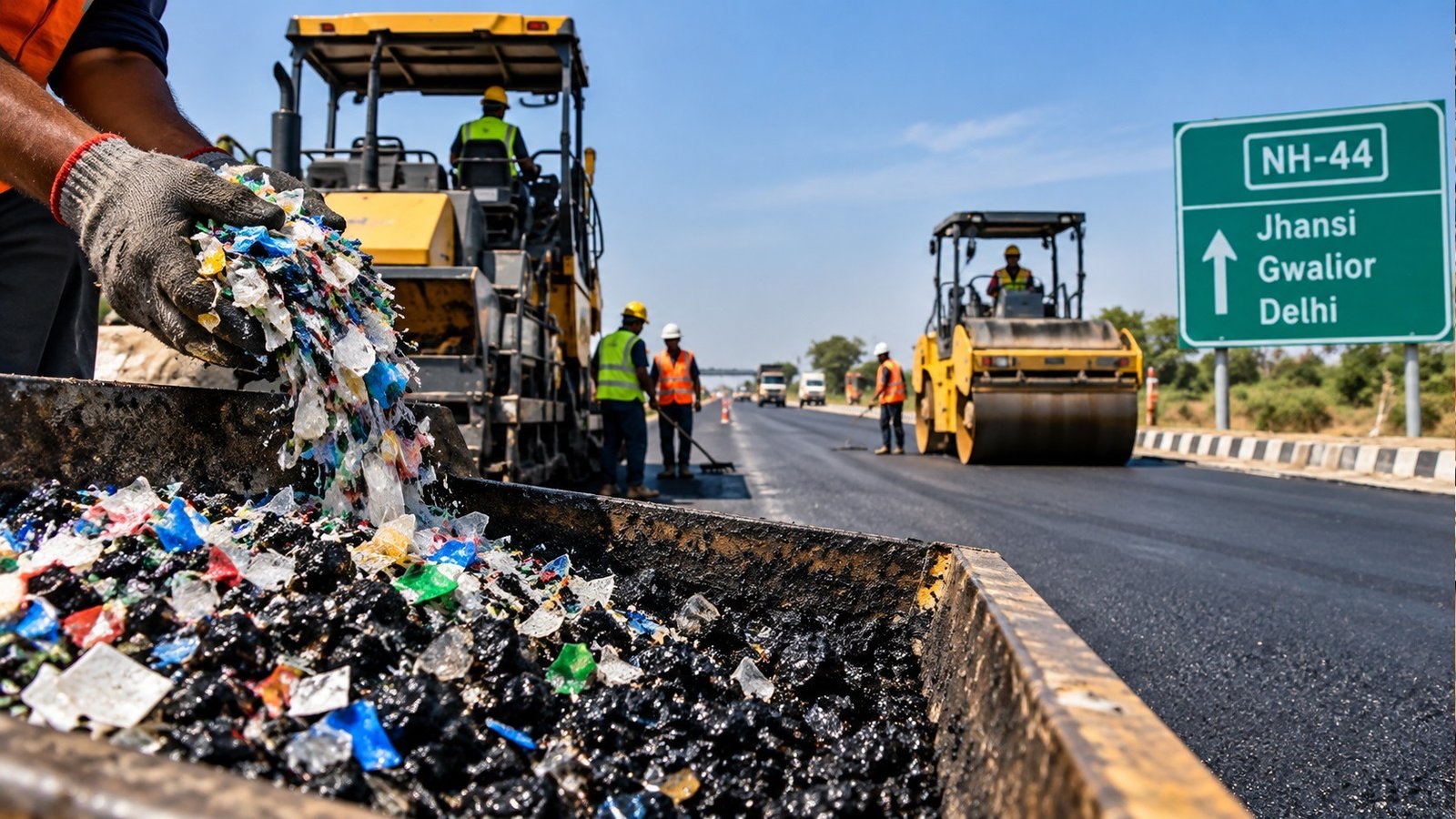
India’s roads may soon have another ingredient in their construction mix: processed plastic waste, blended directly into bitumen. A pilot section on National Highway 44 near Jhansi is testing whether discarded plastic can help create a more durable road surface while reducing the quantity of conventional bitumen required.
The experiment is significant, but its promise needs to be understood precisely. India has used waste plastic in road construction for years. What makes this trial different is the wet process, in which processed plastic is mixed directly with bitumen before the material is laid. Earlier Indian applications have primarily used a dry process, adding suitable plastic to hot aggregates during the production of bituminous mixes.
The new method could offer engineering and waste-management benefits. It also raises questions about long-term durability, emissions, microplastic release and whether a consistent supply of suitable plastic can be secured. The NH-44 trial is therefore not a final verdict on plastic roads. It is a real-world test of whether a promising material innovation can meet the demands of India’s highways.
What is being tested on NH-44?
The pilot section was laid on the main carriageway of NH-44 in Jhansi in late September 2026. The technology, known as Waste Plastic Modified Bitumen, or W-PMB 76-10, was developed by the Indian Institute of Technology (BHU), Varanasi, under a research programme funded by the Ministry of Road Transport and Highways.
The process uses processed low-density polyethylene (LDPE)—a flexible plastic commonly found in discarded irrigation pipes, files and plastic folders. Local recyclers and micro, small and medium enterprises have supported the processing of the material.
According to officials associated with the project, laboratory evaluations indicate that the modified bitumen offers better resistance to rutting at high temperatures and improved resistance to moisture damage. Rutting is the formation of permanent wheel-path depressions in a road surface, a problem that can become more pronounced under heavy traffic and hot weather.
Officials have also indicated that the technology could reduce conventional bitumen consumption by around 4%, with the modified material potentially costing about 20% less than conventional bitumen.
Those figures are projected benefits, not yet demonstrated savings from a large-scale highway rollout. The pilot’s performance will be monitored by IIT (BHU) to assess long-term engineering behaviour and suitability under actual field conditions.
That distinction matters. A promising laboratory sample has not yet endured years of monsoon rain, summer heat, heavy trucks, repeated braking and the everyday punishment of Indian highway traffic.
India’s plastic-road story did not begin this week
The NH-44 project is a new chapter in an existing policy and engineering effort.
The Indian Roads Congress has issued guidance for using waste plastic in hot bituminous mixes through its IRC:SP:98 framework. The established dry process incorporates suitable processed plastic into hot aggregates before the bituminous mix is laid. The Ministry of Road Transport and Highways has also issued guidelines for the use of waste plastic in bituminous concrete wearing courses.
The government has previously reported the use of plastic-waste technology in rural roads under the Pradhan Mantri Gram Sadak Yojana. In a parliamentary reply published in 2025, the Ministry of Rural Development stated that 43,700 kilometres of roads using waste-plastic technology had been completed under PMGSY by July 2025.
That is an important measure of existing deployment, but it should not be confused with 43,700 kilometres built using the new wet-process technology. The reported figure relates to waste-plastic road technology under the rural-road programme, not the specific NH-44 formulation.
The distinction is more than technical housekeeping. Different plastic types, processing methods and road designs can produce different results. A successful dry-process road does not automatically validate every wet-process formulation.
Why bitumen matters to India’s infrastructure bill
Bitumen is a key binder in conventional flexible roads. It holds aggregates together and helps the pavement withstand traffic and weather. India relies substantially on imported bitumen to meet domestic demand, making the material’s cost and availability relevant to infrastructure expenditure.
If waste plastic can replace a small portion of conventional bitumen without compromising road performance, the benefits could extend beyond waste disposal. Reduced binder consumption could ease some material demand, while improved resistance to deformation could potentially reduce maintenance needs.
But the scale of the impact needs to be kept in perspective. A projected 4% reduction in bitumen use within a particular formulation is not a 4% reduction in India’s overall bitumen imports. The national impact would depend on how widely the material is adopted, how much bitumen it actually replaces, and whether the claimed performance and cost advantages hold up in practice.
Nor does using plastic in roads eliminate dependence on fossil fuels. Bitumen itself is a petroleum-derived material, and the plastic used in this pilot is also derived from petroleum. The more defensible claim is that the process may reduce demand for conventional bitumen while giving selected plastic waste a productive use.
That is still worthwhile—but it is not the same as making highway construction fossil-fuel independent.
The environmental question: Where does the plastic go next?
The attraction of plastic roads is easy to understand. India faces a substantial plastic-waste management challenge, and converting suitable waste into a useful construction material can divert it from uncontrolled disposal.
The Central Pollution Control Board’s published assessment estimated plastic-waste generation in India at approximately 25,940 tonnes per day, based on extrapolation from data collected in 60 major cities. This is an older estimate, not a current daily measurement, but it illustrates the scale of the challenge.
However, placing plastic inside a road does not make its environmental footprint disappear. It changes where the material is used and how it may behave over time.
Researchers have identified several issues that require attention in plastic-modified asphalt: emissions during high-temperature processing, the possibility of microplastic particles being released through wear and weathering, chemical leaching, and the compatibility of different plastic types with bitumen.
These risks vary with the polymer, its additives, the processing temperature, the degree of mixing and the pavement’s exposure to traffic and weather. They should not be treated as proof that the NH-44 pilot is unsafe. Equally, they should not be dismissed simply because laboratory tests show better road performance.
The Indian Roads Congress’ established guidance also makes material selection and temperature control important. Certain plastics, including PVC, are unsuitable for the specified process because of hazardous emissions concerns. The lesson is clear: plastic waste cannot be treated as one uniform raw material.
A reliable system must identify suitable polymers, remove contamination, control processing conditions and ensure that the finished material meets engineering specifications.
Can the supply chain keep up?
A highway technology cannot scale on laboratory performance alone. It needs a dependable supply of correctly sorted and processed plastic, consistent quality control, transport arrangements and contractors capable of following the required procedures.
The involvement of local recyclers and MSMEs in the Jhansi pilot is potentially important. It suggests a route by which infrastructure demand could support local waste-processing businesses. But a pilot supply chain is not the same as a nationwide one.
Plastic waste is mixed, variable and often contaminated. Collection systems must separate useful material from unsuitable waste, while processing facilities must produce a consistent feedstock. If quality varies from batch to batch, the engineering performance of the road mix may vary as well.
There is also a policy question: how will the material be priced, tested and procured? A lower projected cost is meaningful only if it includes the expenses of collection, sorting, cleaning, processing, transport, quality assurance and environmental safeguards.
Otherwise, a saving in one part of the construction budget could simply reappear as a cost somewhere else.
What the pilot must prove
The NH-44 section now needs time and transparent evaluation. Its performance should be compared with a suitable conventional pavement under similar traffic and environmental conditions.
Key questions include whether the road maintains its resistance to rutting and moisture damage; how it behaves through seasonal temperature changes; whether cracking or other distress develops; and how its maintenance requirements compare over time.
Environmental monitoring is equally important. Measurements of processing emissions, road-wear particles and potential chemical release would help establish whether the material’s benefits outweigh its risks. The ability to recycle or safely manage the pavement material at the end of its service life should also be part of the assessment.
Publishing the results—including any disappointing findings—would strengthen the project. Infrastructure innovation is not weakened by honest evaluation. It is weakened when early promise is mistaken for final proof.
DOONITED View
The NH-44 experiment represents a practical approach to two real challenges: the demand for durable roads and the need to manage plastic waste more effectively. If the technology performs as intended, it could help reduce conventional bitumen use, create a market for selected waste plastics and support better road performance.
But the responsible route to adoption is evidence-led, not slogan-led. A road containing recycled plastic is not automatically sustainable, just as a conventional road is not automatically the better environmental choice. The comparison must include durability, cost, emissions, material sourcing and what happens over the pavement’s full life cycle.
India has already demonstrated that plastic can be incorporated into road construction. The next task is to establish where the newer wet process works, under what conditions, and with what safeguards.
A highway is expected to carry millions of journeys. This pilot must carry the burden of proof.
Learning Point
A circular-economy solution must be judged across its entire life cycle. Turning waste plastic into a road material can be useful, but success depends on the right plastic, controlled processing, reliable engineering performance and environmental monitoring. The NH-44 trial is a promising test—not yet a nationwide verdict.


World Beyond the News
Why Elephants Stay Close to Their Herd
Elephants live in highly social family groups and use calls, touch and body movements to maintain strong bonds.
Most of the Deep Ocean Remains Difficult to Explore
Extreme pressure, darkness and distance make deep-ocean exploration one of Earth’s greatest scientific challenges.
Spacecraft Can Travel Without Traditional Roads
Spacecraft use carefully calculated trajectories and gravity assists to travel enormous distances through space.
Why Movie Trailers Are Released in Stages
Major films often use teaser trailers, full trailers and final promotional spots to build awareness over time.