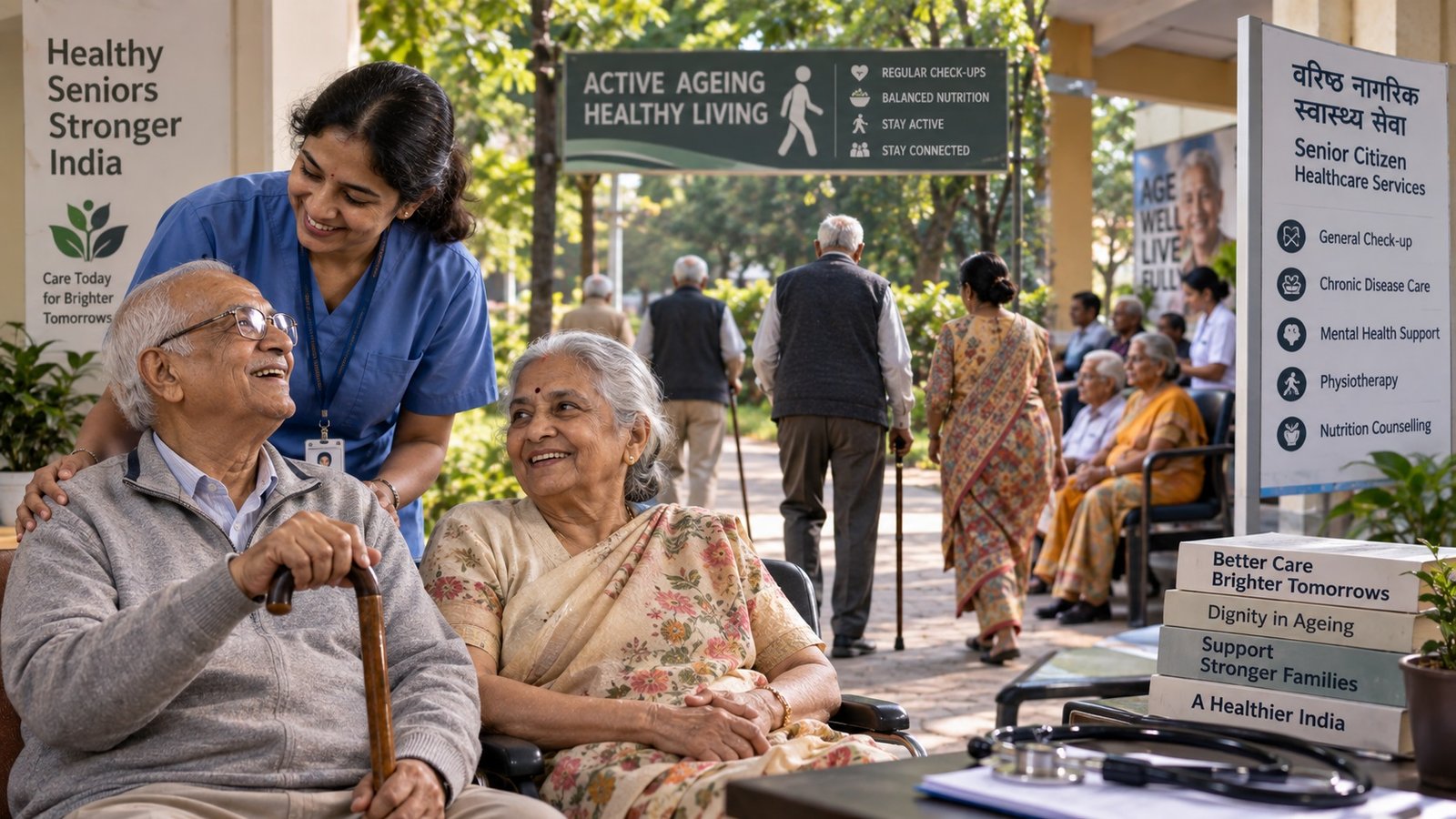
India Is Ageing Fast: Why Elderly Healthcare Can No Longer Be an Afterthought
India’s demographic story is changing. The country is still young, but its elderly population is growing so rapidly that healthcare, family structures, housing, pensions and even the way cities are designed will have to adapt.
For decades, India’s healthcare conversation was dominated by maternal and child health, infectious diseases and acute illnesses. Those priorities remain important. But another transformation is quietly gathering speed: India is becoming an ageing society.
UNFPA estimates that India had about 153 million people aged 60 and above in 2022, and projects that the number could reach 347 million by 2050. By then, people aged 60-plus are expected to account for around one-fifth of the population. UNFPA has also projected that India’s elderly population could surpass the population of children by around 2046.
That is not simply a population statistic. It is a warning about how India must redesign care.
The Family Can No Longer Be the Entire Healthcare System
India has traditionally relied heavily on families to look after older parents and relatives.
A son, daughter, spouse or other relative often becomes the informal nurse, appointment manager, pharmacist, emergency contact and financial coordinator — usually without a job description, salary or training manual.
But family structures are changing.
Lower fertility, migration for education and employment, urbanisation and the growth of smaller households mean that the traditional model of several generations living close together cannot be assumed everywhere.
UNFPA’s India Ageing Report has highlighted the “ruralisation” and “feminisation” of ageing as major policy concerns. More than 40% of elderly Indians were in the poorest wealth quintile in the report’s analysis, while about 18.7% were reported to be living without an income. Older women can face additional vulnerability because they tend to live longer and are more likely to experience widowhood and financial dependence.
The result is a difficult question: who provides care when the family caregiver is living 1,000 kilometres away?
The answer cannot always be “video call and hope for the best.”
Ageing Is Not Just About Hospitals
Older patients often need a different model of healthcare.
A person in their seventies may simultaneously need management for hypertension or diabetes, medication review, physiotherapy, vision or hearing support, mental-health care, fall prevention, rehabilitation and assistance with daily activities.
That means elderly healthcare cannot be reduced to a hospital bed after something goes wrong.
India already has a policy framework for this. The National Programme for Health Care of the Elderly (NPHCE) was launched by the Ministry of Health and Family Welfare in 2010 and is designed around preventive, curative and rehabilitative care, including services through primary and secondary healthcare facilities, regional geriatric centres and home-based care where required.
The challenge is not the absence of a policy idea.
The harder challenge is scale, consistency and accessibility.
The government itself acknowledges the need for dedicated geriatric services, trained personnel and stronger primary-level care. NPHCE’s design includes domiciliary visits, training of healthcare workers and dedicated geriatric facilities.
Rural India May Carry the Heavier Burden
India’s ageing story is not exclusively an urban story.
UNFPA has repeatedly highlighted the vulnerability of older people living in rural areas, where income insecurity, healthcare access and social support can be more difficult. The 2023 India Ageing Report also identified substantial interstate differences in the pace and scale of ageing. Southern states and some northern states are already considerably older demographically than younger states such as Bihar and Uttar Pradesh.
This creates an unusual policy challenge.
India does not have one ageing problem.
Kerala’s ageing challenge is not identical to Bihar’s. A metropolitan senior living alone in Bengaluru faces different constraints from an elderly farmer in a remote village. A widowed woman without independent income faces different risks from a financially secure retired professional.
A national policy therefore needs national standards — but flexible local delivery.
The Missing Link: Long-Term Care
Modern medicine has become increasingly good at keeping people alive after serious illness. But surviving an illness and living independently are not the same thing.
This is where long-term care becomes important.
NITI Aayog’s 2024 position paper on senior-care reforms identified gaps including the burden of non-communicable diseases, inadequate long-term senior-care planning, infrastructure deficiencies, affordability problems and regional inequalities. It called for a broader senior-care ecosystem covering health, social, economic and digital needs.
The report also argued for stronger rehabilitation, palliative care, mental-health services, caregiver capacity-building and long-term healthcare.
This is an important distinction for Indian families.
A hospital treats an episode. Ageing often requires a continuum.
That continuum might include a doctor, nurse, physiotherapist, pharmacist, caregiver, telemedicine service, home-health worker and family member working together.
Technology Can Help — But It Cannot Replace Care
Telemedicine can reduce the distance between an elderly patient and a specialist. Digital health records can make medical histories easier to access. Remote monitoring can potentially help families keep track of patients living independently.
But technology has its own accessibility problem.
A smartphone app is not automatically senior-friendly. Small text, complicated authentication, unfamiliar interfaces and digital payments can turn a supposedly convenient healthcare service into another obstacle.
NITI Aayog has specifically recommended expanding tele-consultation for seniors through outreach, home-based care, mobile medical units and other accessible platforms, while also recognising the need for technology support and health navigators.
The lesson is simple: digital healthcare for seniors should be designed around the user, not around the software.
India Also Needs a Caregiver Economy
One of the less discussed consequences of ageing will be the growth of demand for trained caregivers.
Home nursing, rehabilitation, assisted living, dementia support, emergency response, physiotherapy and palliative care could become increasingly important services.
But this sector cannot be allowed to grow without standards.
NITI Aayog has proposed recognising senior care as a sector requiring appropriate regulation, standards, policy support and governance. It has also highlighted the need to build the capabilities of medical professionals and caregivers.
That creates an opportunity as well as a responsibility.
India could create thousands of meaningful jobs in elder care — but only if caregiving is treated as skilled work rather than as an informal extension of domestic labour.
The Insurance Question Is Even Bigger
Healthcare financing is another fault line.
Acute hospitalisation can sometimes be covered by health insurance, but ageing frequently involves repeated consultations, rehabilitation, home assistance, assistive devices and long-term support.
These expenses do not fit neatly into a traditional hospital-centric insurance model.
NITI Aayog has specifically called for stronger financial-security mechanisms and incentives for geriatric insurance products tailored to seniors’ needs.
For millions of families, the difference between “medical insurance” and “care financing” could become increasingly important.
India Has Already Started Building the Architecture
The picture is not entirely bleak.
India has a dedicated national programme for elderly healthcare, regional geriatric centres, National Centres for Ageing and the Longitudinal Ageing Study in India, which provides a major evidence base on older people’s health, healthcare financing, social networks and economic circumstances.
NPHCE is explicitly intended to integrate elderly healthcare into the wider public health system rather than treating geriatric medicine as a completely separate island.
The problem is that demographic change is moving faster than many traditional systems were designed for.
DOONITED View: India Must Stop Treating Ageing as a Future Problem
India’s elderly population is not waiting until 2050 to become a policy issue.
They are already today’s parents, grandparents, workers, pensioners, patients and caregivers.
The intelligent response is not to build an elderly-only healthcare system. It is to build a healthcare system that understands the entire life course.
Primary care should detect problems earlier. Hospitals should be better equipped for geriatric patients. Telemedicine should bridge distance without creating digital barriers. Caregivers should receive training and legal protection. Insurance should evolve beyond the hospital bill. Cities and homes should become safer for people with limited mobility.
And perhaps most importantly, ageing should not automatically be equated with dependency.
People live longer because societies have become healthier and medical care has improved. The policy objective should therefore be more than simply adding years to life.
It should be about adding health, independence, dignity and participation to those years.
India’s demographic dividend gave the country a large working-age population.
Its next demographic test will be whether that generation can grow old with security.
Learning Point
A country is not truly prepared for ageing when it has more hospitals. It is prepared when an older person can access a doctor, medicines, income, mobility, companionship and long-term care without having to depend entirely on one exhausted family member.
India has time to prepare — but demographic time is not unlimited.
The smartest investment in elderly healthcare may ultimately be an investment in every Indian’s future self.


World Beyond the News
Dolphins Use Individual Signature Whistles
Bottlenose dolphins develop distinctive whistles that function somewhat like individual acoustic identifiers.
The Pacific Is Earth’s Largest Ocean
The Pacific Ocean covers more area than any other ocean basin and stretches between Asia, Australia and the Americas.
Artificial Intelligence Learns Statistical Patterns
Modern machine-learning systems identify patterns in large datasets and use those patterns to generate predictions or outputs.
Why Some Stories Spread So Quickly
Emotion, novelty, visual appeal and easy sharing can make a story travel rapidly across social platforms.