Musk vs Ambani: The Starlink India Row Raises Bigger Questions About Competition, Security and Internet Access
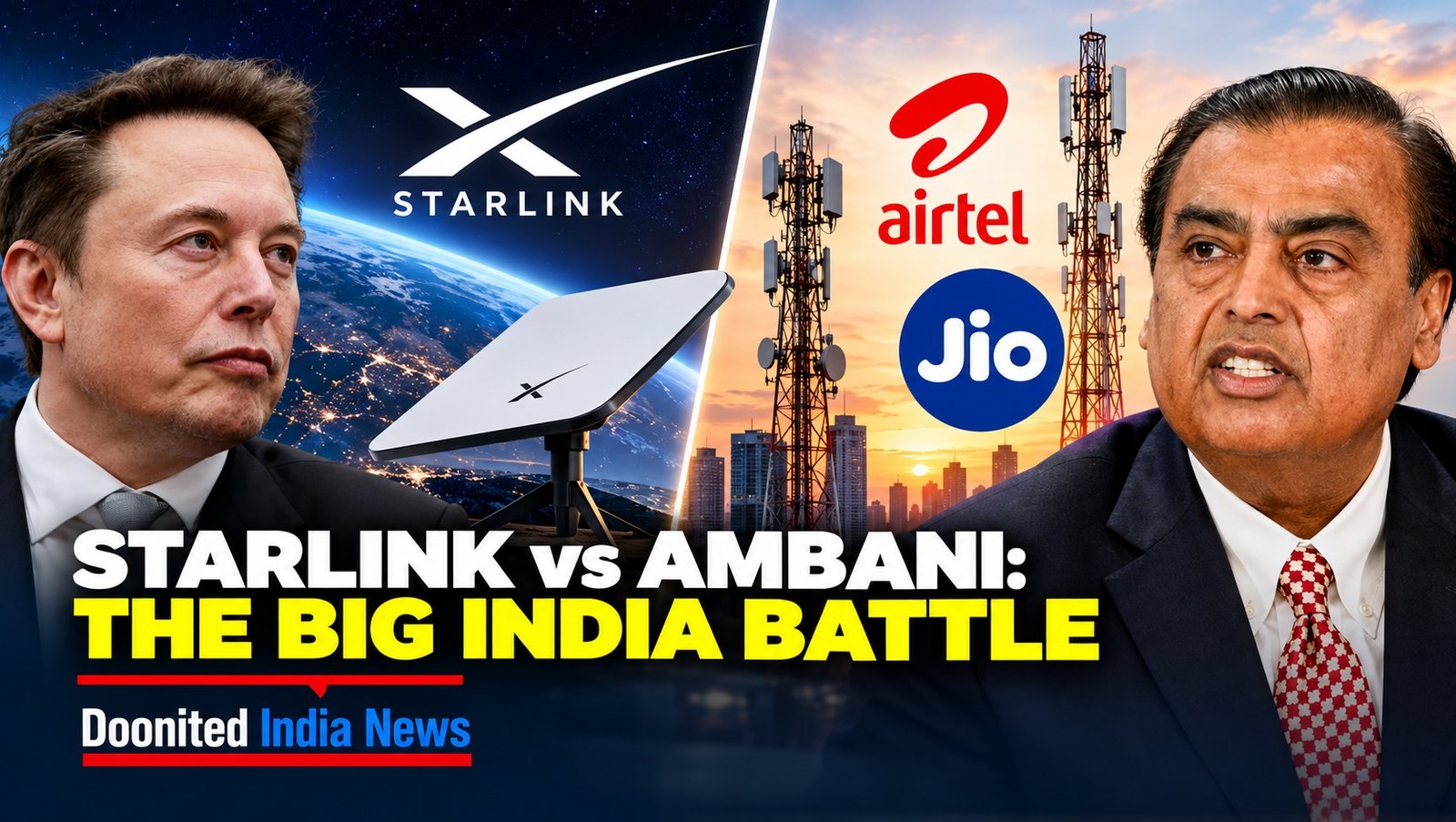
Elon Musk’s public criticism of Mukesh Ambani over Starlink’s delayed launch in India has turned a regulatory dispute into a high-profile test of the country’s telecom policy. With Reliance Jio preparing for a major public listing and satellite internet promising connectivity in underserved regions, the central question is whether India can encourage new technology, enforce national-security safeguards and ensure fair competition—without allowing accusations from either side to replace evidence.
India’s internet market has an unusual combination of strengths and limitations. Mobile data is among the world’s most affordable, and millions of people have gained access to digital payments, online education, entertainment and business services. Yet reliable connectivity remains difficult in some remote, mountainous and sparsely populated areas, where extending conventional mobile and fibre networks can be expensive.
That gap is one reason Elon Musk’s Starlink wants to enter India. It is also the backdrop to Musk’s increasingly public confrontation with Reliance Industries chairman Mukesh Ambani over delays in launching the satellite internet service.
In October 2026, Musk accused unnamed powerful business interests of obstructing Starlink’s entry to protect existing telecom market positions. He subsequently directed pointed remarks at Ambani, suggesting that the Reliance chairman wielded undue influence over decisions affecting Starlink. The allegations have not been substantiated with public evidence. India’s government has rejected the suggestion that its satellite-communications framework is discriminatory and says operators must meet regulatory and security requirements.
The dispute matters beyond two prominent billionaires. It raises questions about how India regulates a new communications technology, how much transparency companies should expect from government, and whether satellite internet will offer a practical alternative to the country’s established mobile networks.
What sparked the confrontation?
Starlink, operated by SpaceX, uses a constellation of low-Earth-orbit satellites to provide internet access through specialised user terminals. Unlike conventional mobile broadband, it does not require every customer to be within reach of a nearby terrestrial cell tower or a fibre connection.
Musk’s criticism intensified in early October, when he argued on X that powerful interests were preventing Starlink from competing in India. He subsequently used sarcasm directed at Ambani to question whether business influence was shaping the country’s regulatory decisions.
India’s Ministry of Communications pushed back. Telecom Minister Jyotiraditya Scindia rejected the suggestion that India permits monopolies, while officials said the regulatory framework was fair and non-discriminatory. Reporting by Reuters and other outlets indicated that Starlink and competing satellite operators still had to satisfy outstanding requirements, including security-related conditions and spectrum arrangements, before commercial services could begin.
The distinction is important. A delay in market entry is a fact; a claim that a rival caused the delay through political influence is an allegation requiring evidence. The two should not be treated as interchangeable.
At the same time, regulators should recognise that lengthy or poorly explained approval processes can create uncertainty for investors. A government can reject an accusation of favouritism while still being expected to communicate clearly about the status, requirements and timelines of applications.
Starlink and Jio are not selling exactly the same service
The public argument can make Starlink and Jio appear to be direct substitutes. In reality, their services address overlapping but different connectivity needs.
Jio’s strength is its extensive terrestrial mobile network and the economics of delivering large volumes of data over that infrastructure. Its business serves consumers and enterprises through mobile connectivity and other digital services. Starlink’s model depends on satellites, ground infrastructure and customer terminals that communicate with satellites overhead.
For a household in a city with reliable fibre or inexpensive mobile broadband, satellite internet may be difficult to justify if the total monthly cost and equipment expense are substantially higher. In a remote village, a mountain community, an island or a location where terrestrial networks are unreliable, the calculation may be different.
Satellite internet could also be valuable for businesses operating in isolated locations, emergency communications and sites where conventional infrastructure is expensive to extend. These are potential use cases, not a guarantee that satellite service will be affordable or suitable everywhere.
India’s price-sensitive market is a particular test. Starlink will need to make the service commercially attractive without assuming that its global pricing model can simply be transplanted into India. Equipment costs, taxes, capacity constraints, local distribution and the cost of operating the network will influence the final price.
Musk’s promise to make the service affordable is therefore a business commitment to be judged against actual Indian prices and service quality—not an established outcome.
The irony: Jio and Airtel have already explored partnerships with Starlink
The conflict is more complicated than a simple fight between rival companies. In March 2025, both Reliance Jio and Bharti Airtel announced agreements with SpaceX that could allow them to distribute Starlink equipment and services in India, subject to regulatory approvals.
Such partnerships can make commercial sense even when companies compete in other parts of the market. A telecom operator can potentially use satellite connectivity to serve customers or locations that are difficult to reach with its existing network, while the satellite provider gains access to distribution, local relationships and customer support.
These agreements did not themselves authorise Starlink to launch commercial services. They also do not establish that Jio or Airtel has abandoned its own satellite ambitions.
The episode illustrates a familiar feature of the technology industry: competitors can cooperate in one part of the value chain and compete in another. It is possible for a company to seek commercial benefits from Starlink while also questioning how a new satellite service should be regulated.
The agreements also make it harder to reduce the entire dispute to a straightforward claim that Jio wants to keep Starlink out. The relevant questions are whether commercial and regulatory arrangements are transparent, whether competitors receive equivalent treatment, and whether the resulting market serves consumers.
Why national security cannot be dismissed
Satellite internet creates opportunities, but it also raises regulatory questions that governments cannot ignore.
Authorities need to establish how services comply with lawful interception requirements, protect user data, respond to security incidents and support legitimate investigations under applicable law. Satellite systems also involve gateways, network control systems and infrastructure that may cross national borders. Security agencies need to understand how these elements operate and what safeguards are available.
India’s Department of Telecommunications lists Starlink Satellite Communication Private Limited, Jio Satellite Communications Limited and OneWeb India Communications Private Limited among licensees with the relevant satellite-communications authorisation. However, a licence does not automatically mean a company can begin commercial operations: additional security conditions and spectrum-related requirements may apply.
That distinction is central to the current dispute. The government’s position is that the operators are subject to the same framework. The publicly available explanation does not, by itself, establish that every outstanding technical requirement has been met, nor does it prove Musk’s allegation of discriminatory treatment.
A credible regulatory process should do two things at once. It should protect national security and explain, to the extent possible without disclosing sensitive information, what approvals remain outstanding and what criteria govern them.
Security cannot be treated as a convenient excuse for unexplained delay. Equally, commercial urgency cannot be used to demand that sensitive safeguards be waived.
Jio’s IPO adds another layer to the story
The timing has intensified attention on the dispute. Reliance Jio Platforms is preparing for a major initial public offering, with media reports placing the expected subscription window in October 2026. The listing could bring fresh scrutiny of the company’s growth prospects, competitive position and long-term technology investments.
But the proximity of the IPO does not prove that Starlink’s delayed entry is connected to Jio’s listing plans. No public evidence cited here establishes such a link.
For investors, the more meaningful question is how satellite broadband could affect the telecom market over time. The answer depends on whether it remains a specialised service for difficult-to-connect locations or becomes a larger component of consumer and enterprise connectivity.
Jio also has its own satellite ambitions. Its partnership with SES has provided a route into satellite-based connectivity, while the company has publicly discussed developing indigenous satellite broadband technology. Those efforts demonstrate that satellite communications are not solely a foreign entrant’s opportunity.
Still, plans, licences and partnerships should not be confused with a fully operational constellation or a commercially successful service. Building and operating satellite infrastructure requires substantial investment, technical capability, spectrum coordination and long-term customer demand.
For Jio, Starlink’s arrival could become a competitive challenge in certain segments. It could also create opportunities for distribution or complementary services. Which outcome dominates will depend on pricing, coverage, reliability and the regulatory terms under which providers operate.
What a fair outcome would look like for India
India does not need to choose between welcoming satellite internet and protecting its national interests. It needs a system that does both.
First, regulators should apply consistent standards to comparable applicants and make the process as transparent as security considerations allow. Companies should be able to understand the conditions they must meet, the status of their applications and the steps required before commercial launch.
Second, satellite operators should be judged on more than promises of universal connectivity. Their actual prices, equipment costs, service reliability, coverage, data policies and performance in Indian conditions should be examined once services become available.
Third, competition policy should focus on evidence. If a company believes that a rival has received preferential treatment or that a regulatory decision has been improperly influenced, it should present verifiable evidence through appropriate channels. Public criticism may draw attention to a problem, but it cannot substitute for proof.
Finally, the consumer must remain central. More competition is valuable when it produces better services, wider coverage, fair prices and meaningful choice. The arrival of a new global brand is not, by itself, a measure of success.
Beyond the billionaires’ argument
Musk’s confrontation with Ambani has brought an important policy issue into public view: who gets to provide the next generation of connectivity, and under what conditions?
But India’s digital future will not be determined by the sharpest post on X or the size of a corporate valuation. It will depend on whether regulators can explain and enforce their rules, whether companies can build reliable services, and whether ordinary users gain access to connectivity that meets their needs at a price they can afford.
Starlink could help reach places where terrestrial networks struggle. Jio and Airtel will remain important to India’s mobile connectivity, while their satellite partnerships and investments may reshape parts of the market. These possibilities can coexist.
The right test is not whether Musk or Ambani wins the public argument. It is whether India develops a transparent, secure and competitive communications market in which technology companies must earn their position—and consumers receive the benefits.


World Beyond the News
Bees Communicate Where Food Is
Honeybees use movement patterns known as waggle dances to communicate information about food locations.
Street Food Reflects Local History
Many famous street foods developed from migration, trade, local ingredients and the everyday needs of working communities.
A Day on Venus Is Extremely Long
Venus rotates so slowly that one rotation relative to distant stars takes longer than its trip around the Sun.
Human Achievement Continues to Push Limits
Athletes, engineers, scientists and explorers regularly establish new benchmarks in speed, endurance, scale and precision.