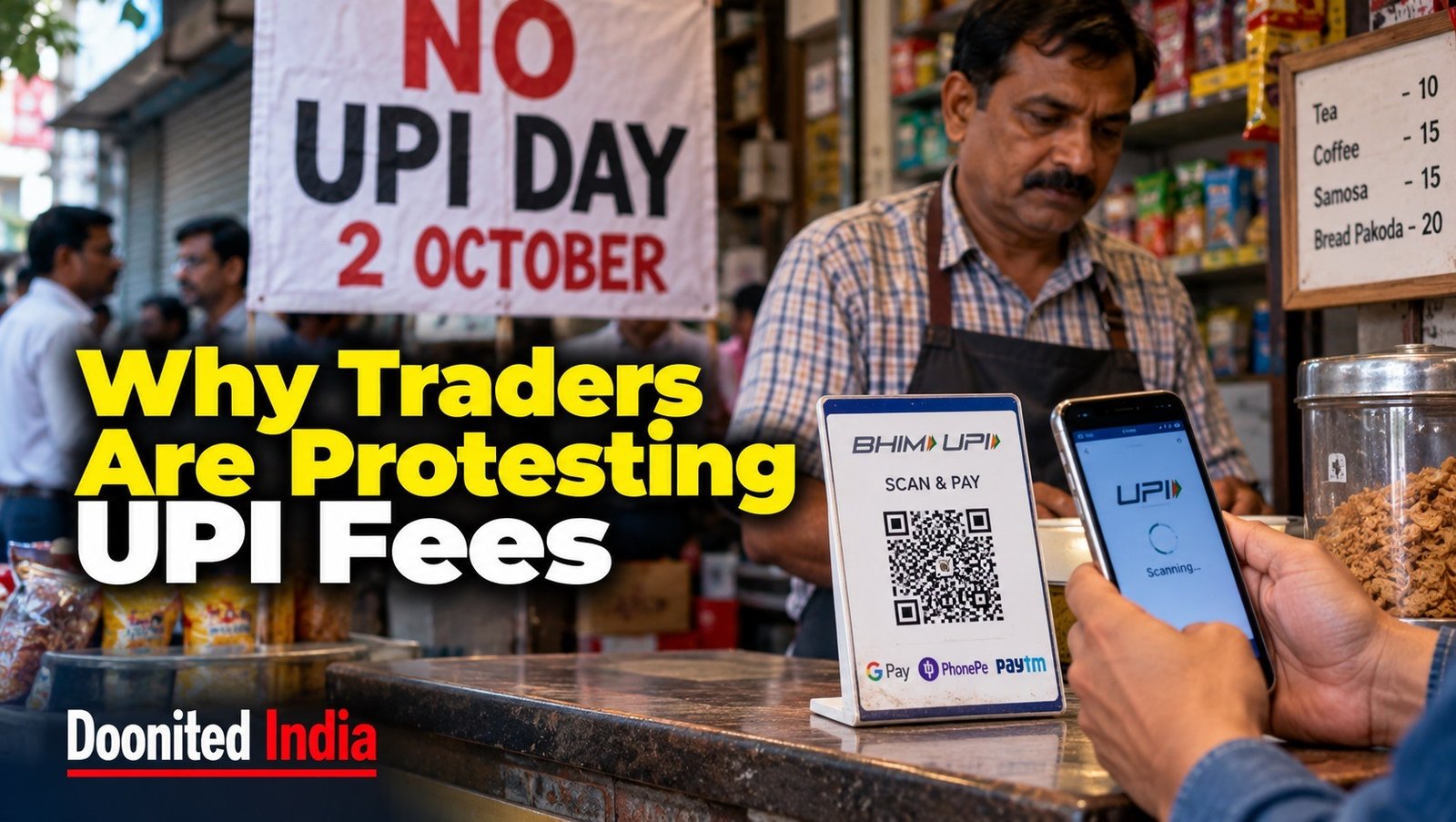
No UPI Day: The Price of Keeping India’s Digital Payments Free
A proposed fee on certain high-value UPI payments has exposed a difficult question: who should pay for the infrastructure behind India’s favourite digital payment system? While national trader bodies have withdrawn their October 2 protest, some Gujarat associations have continued to signal opposition. The debate is about more than a QR code—it is about trust, small-business margins and the future cost of digital convenience.
The article
A black cloth over a QR code is a small gesture with a large message. For a customer accustomed to scanning, paying and walking away, it turns an almost invisible part of daily life into a point of public debate.
That was the symbolism behind the proposed “No UPI Day” on October 2, Gandhi Jayanti. Traders opposing a planned Merchant Discount Rate (MDR) on certain UPI payments called for shops to cover QR codes and payment soundboxes, asking customers to use cash or cards instead.
But the story changed in the days before the protest. Two prominent national trade bodies—All India Mobile Retailers Association (AIMRA) and the All India Consumer Products Distributors Federation (AICPDF)—withdrew from the planned action after meeting Finance Minister Nirmala Sitharaman. In Gujarat, however, trader associations continued to signal a symbolic statewide protest. The result is a more complicated picture than the idea of a single nationwide shutdown.
What is changing—and what is not
The dispute centres on a proposed MDR framework scheduled to take effect on October 15, 2026. Under the reported framework, a 0.4% fee applies to specified person-to-merchant UPI transactions above ₹2,000, subject to exemptions and caps. It is a charge associated with accepting a payment as a merchant—not a general fee on every UPI transfer.
That distinction is important. Person-to-person transfers are not the target, and ordinary low-value merchant payments below the threshold are not covered by the reported charge. Small merchants meeting the stated eligibility conditions are also exempt. The fee is therefore not equivalent to making every UPI payment chargeable.
For a covered transaction of ₹10,000, a 0.4% MDR would amount to ₹40 before any applicable tax on the fee. That may look modest beside the purchase price. But merchants judge costs not only by the rupee amount, but by the margin left after rent, salaries, inventory, taxes and other expenses.
A retailer selling a phone, appliance or expensive garment may process a large digital payment while earning a relatively narrow margin. A charge calculated on the transaction value can therefore take a meaningful bite out of the profit on that sale.
The government’s stated position, as reported, is that the fee is to be borne by merchants rather than directly passed on to customers. Traders’ concern is that a cost formally assigned to the seller can still influence business decisions: prices, payment preferences, discounts or the willingness to accept UPI for larger purchases.
That is an economic concern, not proof that every merchant will raise prices. The actual effect will depend on the fee’s final application, the merchant’s margins, competitive pressure and the alternatives available to customers.
The small-business arithmetic
For a large chain, payment processing is one operating expense among many. For a small retailer, a series of small costs can become a serious calculation.
Consider a merchant who accepts several high-value UPI payments each day. Even if each individual charge is manageable, the cumulative monthly amount may matter. A business operating on thin margins may respond by absorbing the fee, adjusting prices, encouraging another payment method or revisiting which transactions it accepts digitally.
None of those responses is inevitable. Competition may make it difficult to increase prices, while the convenience of UPI may persuade many merchants to keep accepting it. But the possibility of selective resistance is precisely why payment policy cannot be judged only by the headline percentage.
The exemption rules also matter. Reports say merchants with monthly QR-based UPI receipts up to ₹1 lakh are exempt, while the fee on covered transactions is subject to caps. These conditions mean the policy’s impact will not be uniform across the retail economy. A shop’s eligibility and transaction profile will determine whether the change affects it at all.
This is where clear communication becomes essential. A shopkeeper should be able to establish quickly whether the rule applies to their business, which transactions qualify, how the fee is calculated and what the customer may be told. If the framework is difficult to explain at the counter, confusion itself becomes an additional operating cost.
Who pays for a digital public utility?
UPI feels effortless to users because the complexity sits elsewhere. Banks, payment apps, technology providers and the wider financial system must maintain the infrastructure, manage fraud and disputes, keep services available and invest in security.
That infrastructure is not costless. Yet India’s experience has been shaped by the expectation that UPI payments should be free at the point of use. The system’s popularity has made that expectation feel less like a policy choice and more like a basic feature of modern commerce.
The policy challenge is to reconcile two legitimate interests: keeping digital payments accessible while ensuring that the ecosystem supporting them can be funded sustainably.
A fee on selected merchant transactions is one possible approach. But its design matters. A system that raises revenue while discouraging merchants from accepting digital payments could undermine some of the convenience and formalisation it is meant to support. Conversely, requiring providers to absorb every cost indefinitely may leave important questions about investment and long-term sustainability unanswered.
There is no magic solution in which infrastructure is maintained, security is strengthened, merchants pay nothing and public finances face no cost. The real debate is about how the burden should be shared—and whether the rules are predictable, proportionate and easy to administer.
The protest—and the importance of getting the facts right
The changing status of “No UPI Day” shows how quickly a policy dispute can become a confusing public message. National trade bodies withdrew their planned action after discussions with the Finance Minister, while reports from Gujarat described a continuing symbolic protest by local associations. These developments are not necessarily contradictory: different organisations can make different decisions.
Nor should the protest be mistaken for a nationwide interruption of UPI services. Customers planning to shop on October 2 should check with individual retailers rather than assume that all QR payments will fail—or that every merchant will refuse them.
The disagreement also remains a live policy issue. On September 28, the Supreme Court declined to grant an interim stay on the proposed MDR framework while seeking responses from relevant authorities. That did not amount to a final ruling on the merits of the challenge; it meant the framework was not halted by that interim request.
The distinction between a proposed protest, a merchant’s choice and the status of the payment network is more than a technicality. In a country where people increasingly rely on digital payments for routine purchases, inaccurate claims can create needless uncertainty.
The real test is trust
UPI’s success rests partly on a simple promise: paying digitally should be easy. Merchants need a similarly simple promise—that the costs and rules of accepting those payments will be transparent, stable and workable.
The government and payment ecosystem will need to explain the framework clearly, including who qualifies for exemptions, how fees are capped and how merchants can resolve disputes. Traders, in turn, should make their concerns specific: which categories face the greatest pressure, how the fee affects their margins and what alternative arrangements would preserve digital acceptance.
The goal should not be to romanticise cash or treat every fee as an attack on digital progress. Nor should the convenience of UPI be used to dismiss the economics of the businesses that accept it.
A QR code is only the visible end of a much larger system. Keeping that system useful requires more than technical reliability; it requires confidence among the people who pay, the businesses that receive payments and the institutions that keep the network running.
The lasting lesson of “No UPI Day” is therefore not that India must choose between free payments and digital progress. It is that the cost of digital convenience must be designed and communicated carefully—because once trust at the counter is lost, restoring it can be harder than covering a QR code with black cloth.


World Beyond the News
Bees Communicate Where Food Is
Honeybees use movement patterns known as waggle dances to communicate information about food locations.
Street Food Reflects Local History
Many famous street foods developed from migration, trade, local ingredients and the everyday needs of working communities.
A Day on Venus Is Extremely Long
Venus rotates so slowly that one rotation relative to distant stars takes longer than its trip around the Sun.
Human Achievement Continues to Push Limits
Athletes, engineers, scientists and explorers regularly establish new benchmarks in speed, endurance, scale and precision.