Ayurveda in Modern India: Can Ancient Knowledge Meet Modern Evidence?
In India, Ayurveda has never really disappeared.
It has lived in kitchens, homes, temples, clinics and family traditions — in the morning glass of something herbal that grandmother insisted was essential, and in the occasional debate over whether the remedy actually worked.
But something more significant is happening now.
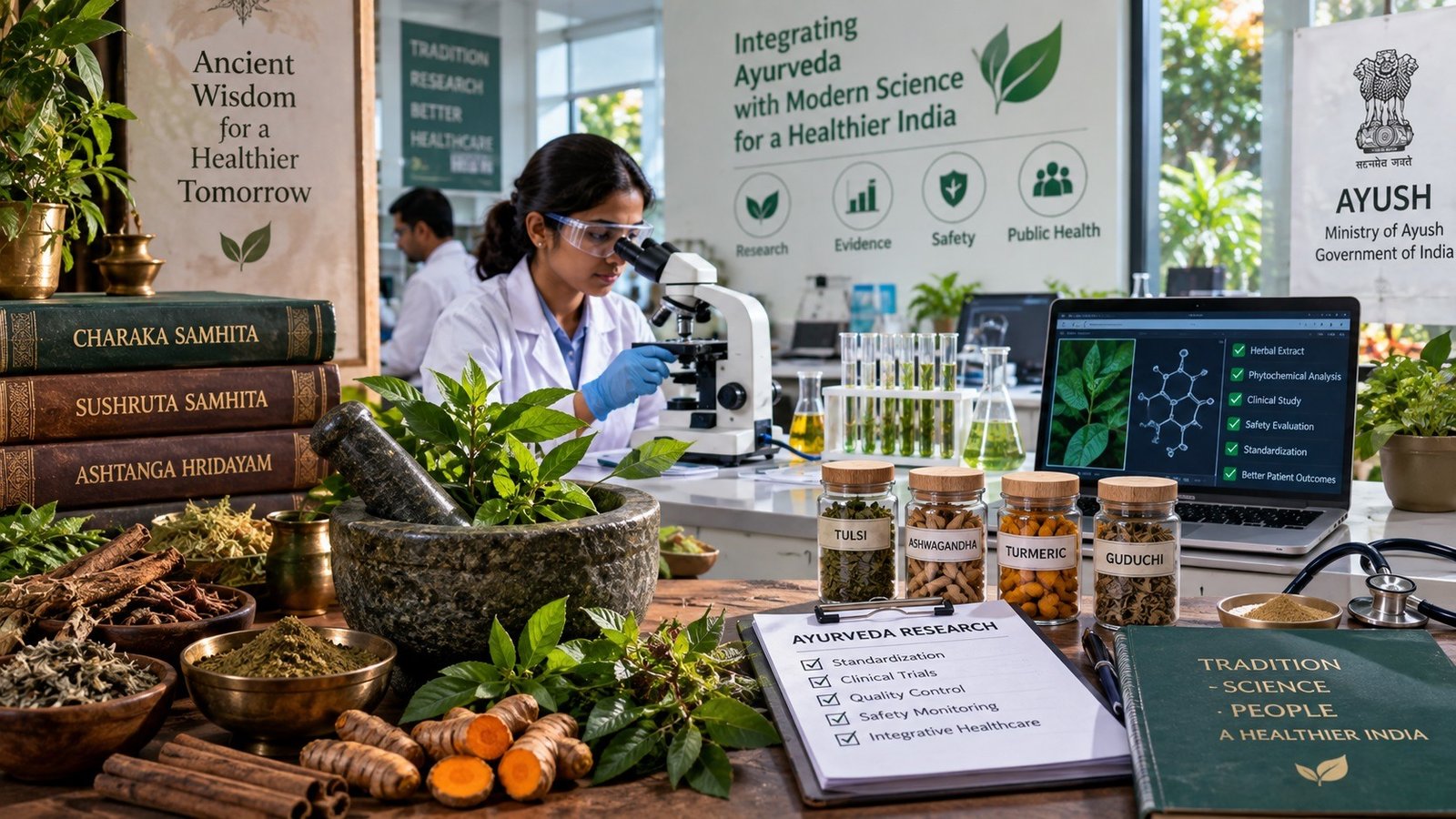
Ayurveda is entering a new phase in which its traditional knowledge is increasingly being placed alongside clinical research, pharmaceutical standardisation, safety monitoring, modern diagnostics and contemporary healthcare systems.
The interesting question is no longer whether Ayurveda belongs in modern India.
It clearly does.
The harder question is:
How should ancient medical knowledge be tested, regulated and integrated into a healthcare system that demands evidence?
That is where India’s Ayurveda story becomes much more interesting.
From Tradition to a Regulated Medical System
Ayurveda is one of the recognised systems of Indian medicine, and its education and professional standards are now overseen through the National Commission for Indian System of Medicine (NCISM).
The commission’s current regulations for undergraduate Ayurveda education explicitly require students to learn classical Ayurveda alongside contemporary advances in science and technology.
That is an important development.
It means the modern Ayurveda practitioner is not supposed to exist in a scientific vacuum.
The formal education framework itself recognises that today’s practitioner operates in a world of laboratory diagnostics, imaging, pharmacology, epidemiology, digital health and evidence-based clinical research.
In other words, the modern question is increasingly not “Ayurveda or science?”
It is:
“How can Ayurveda be studied scientifically without losing what makes the system distinctive?”
Ayurveda’s Personalised Tradition
One reason Ayurveda continues to attract interest is its emphasis on the individual.
Classical Ayurveda uses concepts such as Prakriti, Agni, Dosha and Nidana to describe constitution, physiological processes, imbalance and the causes or context of illness.
These concepts belong to Ayurveda’s own theoretical framework.
Modern researchers are investigating whether some aspects of personalised Ayurvedic assessment can be studied using contemporary biological methods.
But an important line must be maintained.
Finding a correlation between an Ayurvedic classification and a biological marker does not automatically prove that the traditional concept and the modern biological concept are identical.
That distinction may sound academic.
It is actually crucial.
Scientific research should investigate traditional concepts rather than simply rename them and declare the mystery solved.
The Laboratory Is Becoming Part of the Ayurveda Story
India’s Central Council for Research in Ayurvedic Sciences (CCRAS) is conducting research across clinical, pharmaceutical and pharmacological areas.
Its current clinical-research framework includes observational studies, cohort and case-control research, randomised controlled trials, pragmatic real-world trials, community interventions, systematic reviews and meta-analyses. It also includes pharmacovigilance and safety monitoring.
That is significant because evidence does not come in only one form.
An early observational study can generate a hypothesis.
A controlled clinical trial can test efficacy and safety more rigorously.
A systematic review can assess the overall evidence.
A pharmacovigilance system can identify adverse effects that may not be obvious from individual studies.
The research process is therefore not:
Ancient text → modern approval.
It is much more demanding:
Traditional claim → hypothesis → study → evidence → replication → safety assessment → appropriate clinical use.
That is how medical knowledge earns confidence.
Standardisation Is One of the Biggest Challenges
A medicinal plant is not automatically a standardised medicine.
The chemical composition of a plant can vary according to species, cultivation, soil, harvesting, processing and storage.
Then there is dosage.
Then formulation.
Then contamination.
Then interactions with other medicines.
This is why pharmaceutical research and quality control are so important.
CCRAS currently lists projects involving pharmaceutical standardisation, phytochemical profiling, stability studies and safety-related investigations of Ayurvedic formulations. It also maintains work around pharmacovigilance of Ayurvedic medicines.
WHO’s benchmarks for the practice of Ayurveda likewise emphasise minimum standards relating to quality and safety of practice.
For Ayurveda to expand internationally, this may ultimately be as important as proving that people are interested in it.
A global healthcare system needs to know:
What exactly is in the product?
How is it manufactured?
What dose is being used?
What are the possible adverse effects?
Who should not take it?
These are not Western questions.
They are simply good medical questions.
Panchakarma and the Problem of the Word “Detox”
Few Ayurvedic concepts have entered global wellness culture as successfully as Panchakarma.
It is commonly marketed internationally as a “detox”.
That translation can be misleading.
Panchakarma is a classical Ayurvedic therapeutic framework involving procedures intended for specific clinical contexts. Modern wellness marketing can sometimes reduce a complex traditional practice to a generic cleansing treatment.
The scientific question is therefore not whether the word “detox” sounds attractive.
It is whether a particular Panchakarma intervention, for a particular condition and patient group, produces a measurable benefit with an acceptable safety profile.
CCRAS’s current research programme illustrates the direction of travel: its clinical research includes studies of specific Ayurvedic procedures, including prospective monitoring of adverse events associated with therapies such as Nasya and Vasti.
That is precisely the kind of evidence-building that modern healthcare requires.
Ayurveda Is Also Entering Research Hospitals
The integration story becomes even more interesting when Ayurvedic research takes place alongside mainstream biomedical institutions.
CCRAS centres list collaborative projects with institutions including AIIMS New Delhi, Safdarjung Hospital and the Institute of Liver and Biliary Sciences, among others.
This does not mean that Ayurveda has suddenly been scientifically validated in its entirety.
It means researchers are increasingly willing to investigate specific Ayurvedic interventions using contemporary research methods.
That is a much more meaningful development.
Medicine advances one question at a time.
Prevention May Be Ayurveda’s Natural Meeting Point With Modern Healthcare
There is another area where Ayurveda and modern preventive-health thinking increasingly intersect: lifestyle.
Diet.
Physical activity.
Sleep.
Stress management.
Daily routines.
Weight management.
Behavioural habits.
Modern medicine increasingly recognises that these factors influence the risk of chronic diseases.
Ayurveda has long placed considerable emphasis on daily routines and lifestyle practices.
But again, the sensible approach is not to claim that an ancient text has already answered every modern medical question.
Instead, researchers can ask:
Which traditional practices are useful?
For whom?
Under what conditions?
How large is the effect?
How safe are they?
Can the benefit be reproduced?
Those are questions Ayurveda can answer through research.
The Global Opportunity — and the Global Test
Interest in traditional and complementary medicine is expanding internationally.
WHO’s global work on traditional, complementary and integrative medicine increasingly focuses on policy, regulation, practitioner standards, education, safety and evidence.
That creates an opportunity for India.
India possesses an enormous traditional knowledge base, a large pharmaceutical industry, established research institutions and a growing international wellness market.
But global credibility cannot be built on heritage alone.
A bottle labelled “Ayurvedic” needs the same basic questions asked of any health product:
Is it safe?
Is it of consistent quality?
What evidence supports the claim?
What is the appropriate use?
What does the evidence not show?
That last question is often forgotten.
It may be the most important one.
Where Ayurveda Must Be Careful
There is a temptation in both directions.
Some enthusiasts treat Ayurveda as though every traditional claim has already been scientifically proven.
Some critics treat the entire system as though anything traditional must automatically be unscientific.
Neither position helps patients.
The useful middle ground is evidence-based curiosity.
A traditional treatment may prove useful.
Another may not.
One formulation may have good evidence.
Another may have little.
One practice may be relatively low-risk.
Another may require substantial clinical caution.
The answer should come from evidence, not loyalty to a cultural camp.
The DOONITED View
India has an unusual opportunity to demonstrate what responsible integration of traditional medicine can look like.
The goal should not be to force Ayurveda to become a copy of modern biomedicine.
Nor should it be to place Ayurveda beyond scientific scrutiny because it is ancient.
Instead, India can preserve the traditional knowledge system while applying modern standards of research, manufacturing, safety, clinical evaluation and regulation to specific interventions.
That would allow the strongest ideas to survive scrutiny.
It would also allow weaker claims to be corrected without turning scientific criticism into cultural rejection.
In that sense, research is not the enemy of tradition.
Good research is how useful tradition earns a place in the future.
The Learning Point
Ayurveda’s future in modern India will probably not be decided by advertisements promising miraculous cures.
It will be decided in laboratories, clinical trials, hospitals, pharmacies, universities and regulatory systems.
The winning formula is not:
Ancient versus modern.
It is:
Knowledge + evidence + safety + standardisation + responsible practice.
India does not need to choose between respecting its medical heritage and demanding scientific evidence.
It can do both.
And if it succeeds, Ayurveda could offer something valuable to the modern world — not simply as an ancient tradition preserved in a museum, and not merely as a wellness brand, but as a body of knowledge whose useful practices are carefully identified, tested, standardised and responsibly integrated into contemporary healthcare.
That is a much more ambitious future than simply selling another herbal product.


World Beyond the News
Dolphins Use Individual Signature Whistles
Bottlenose dolphins develop distinctive whistles that function somewhat like individual acoustic identifiers.
The Pacific Is Earth’s Largest Ocean
The Pacific Ocean covers more area than any other ocean basin and stretches between Asia, Australia and the Americas.
Artificial Intelligence Learns Statistical Patterns
Modern machine-learning systems identify patterns in large datasets and use those patterns to generate predictions or outputs.
Why Some Stories Spread So Quickly
Emotion, novelty, visual appeal and easy sharing can make a story travel rapidly across social platforms.