Bengaluru Metro Pink Line Opens: Six New Stations Bring Relief to South Bengaluru Commuters
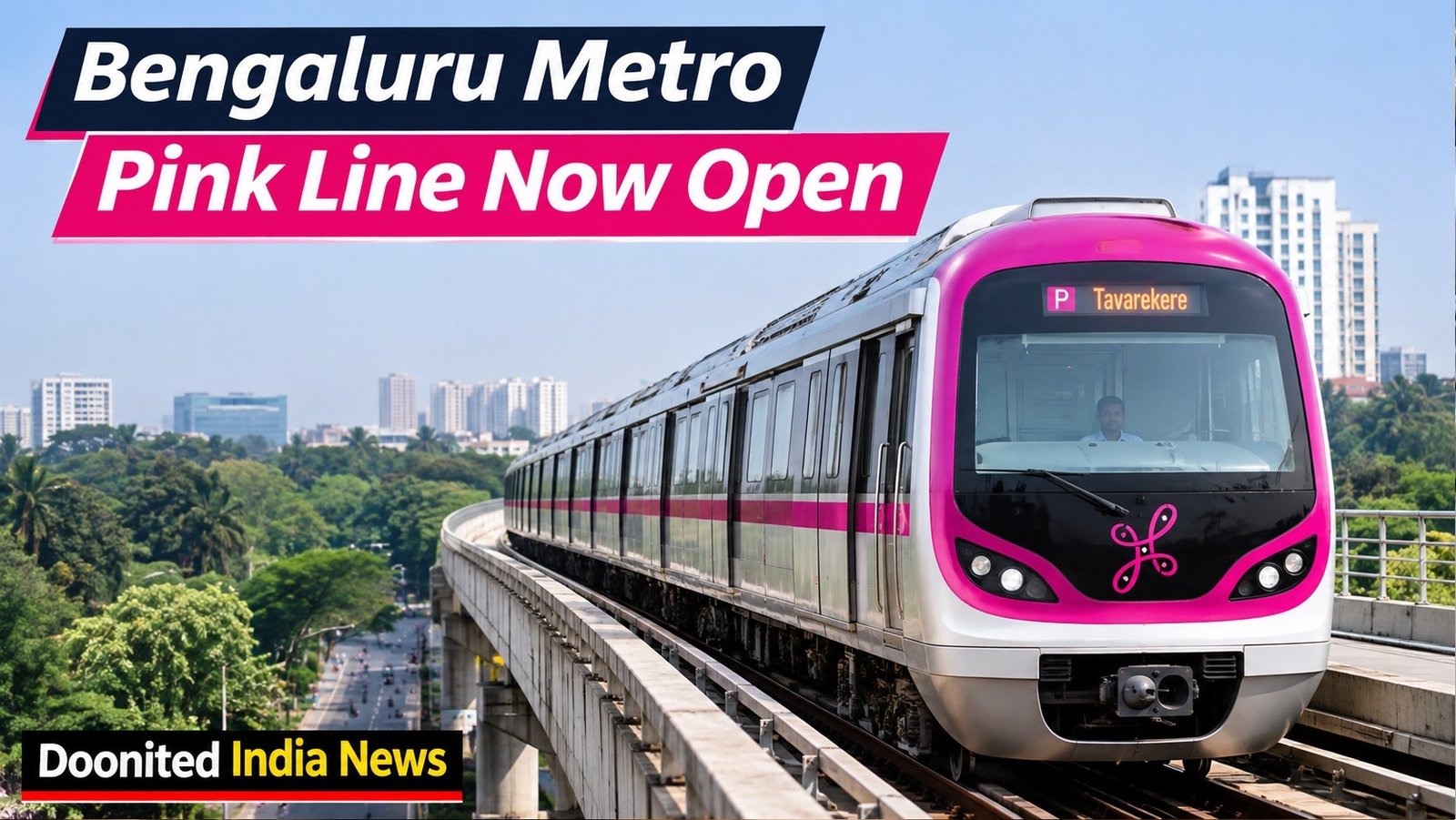
The first operational 7.5-km elevated section of Namma Metro’s Pink Line began passenger services on November 14, connecting Kalena Agrahara with Tavarekere along Bannerghatta Road. Its Yellow Line interchange at Jayadeva Hospital adds a valuable new travel option, although the full north–south corridor remains under construction.
By Pradeep Banerjee | Editor, DOONITED.in
For people travelling daily along Bengaluru’s Bannerghatta Road, time spent in traffic has become a familiar part of urban life. Journeys between residential neighbourhoods, educational institutions, hospitals and workplaces can be unpredictable, particularly during peak hours.
The opening of the elevated section of Namma Metro’s Pink Line offers a new alternative. Commercial passenger services began at 6 am on November 14, 2026, on the 7.5-kilometre stretch between Kalena Agrahara and Tavarekere, also known as Suddagunte Palya (SG Palya).
The section was inaugurated a day earlier by Prime Minister Narendra Modi. Developed by Bangalore Metro Rail Corporation Limited (BMRCL), it is the first operational part of the larger Pink Line project, designed to connect South Bengaluru with Nagawara in the north.
Six stations along the Bannerghatta Road corridor
The newly opened section has six stations, running south to north:
-
Kalena Agrahara
-
Hulimavu
-
IIM Bangalore (IIMB)
-
JP Nagar 4th Phase
-
Jayadeva Hospital
-
Tavarekere (SG Palya)
For commuters, the value is not limited to the new stations themselves. The corridor brings rail connectivity closer to residential areas and major destinations around Hulimavu, Bilekahalli, IIM Bangalore and JP Nagar.
The Jayadeva Hospital station is particularly important because it connects the Pink Line with the operational Yellow Line. Passengers can change trains there to travel towards Silk Board, Electronic City and Bommasandra, extending the usefulness of the new corridor beyond its six stations.
A practical alternative to road congestion
The Pink Line runs along a busy urban corridor where road traffic can be especially demanding during morning and evening commutes. Its elevated alignment allows metro trains to bypass much of the congestion affecting surface roads.
Early passenger responses suggest that the service is already making a difference to some daily journeys. In its first-day coverage, The New Indian Express reported commuters describing shorter travel times and relief from traffic. One resident of Hulimavu, who regularly travels towards Madiwala, welcomed the new connection. These are individual commuter experiences, not a measured citywide reduction in journey times.
The corridor could be particularly useful for students, faculty and visitors travelling to IIM Bangalore, patients and hospital staff accessing the Jayadeva area, and residents of southern neighbourhoods heading towards the Yellow Line network.
Train frequency, fares and operating arrangements
Initial reports indicated that trains would operate at approximately eight-minute intervals, with four train sets deployed for regular service and one kept on standby. The frequency may be adjusted as passenger demand and operational performance are assessed.
Published fare information reported by The Economic Times gives a distance-based range of ₹10 to ₹30 for the newly opened section. Commuters should check the latest BMRCL fare information before travelling, particularly if their journey involves an interchange or a different ticketing arrangement.
The Pink Line’s infrastructure is also part of a wider public investment. The 7.5-km section was built at an estimated cost of around ₹3,470 crore. Japan International Cooperation Agency (JICA) has supported Bengaluru Metro Phase 2 through an official development assistance loan, including assistance for signalling, train-control systems, rolling stock and consultancy services.
The missing underground link
The new service is a significant step, but it is not yet the complete Pink Line.
The full corridor is planned to extend approximately 21.26 kilometres, with 18 stations. The remaining underground section, comprising 12 stations between Tavarekere and Nagawara, is expected to connect areas including Dairy Circle, Langford Town, MG Road, Shivaji Nagar, Cantonment and Nagawara. Reports have indicated a 2027 target, but the remaining stretch is not yet operational.
This limitation matters for commuters travelling towards central and northern Bengaluru. They cannot yet use the Pink Line for a continuous journey from Kalena Agrahara to Nagawara. Depending on their destination, they will still need to change to another metro line, use buses or complete part of the journey by road.
The full corridor’s eventual interchange with the Purple Line at MG Road is expected to make the network more useful for cross-city travel.
Why the opening matters beyond six stations
Bengaluru’s transport challenge cannot be solved by one metro extension. Better public transport requires reliable feeder buses, convenient station access, safe pedestrian routes, parking arrangements and sensible integration between different modes of travel.
For the Pink Line, the next priority should be making the stations easy to reach from nearby neighbourhoods. A metro station is most useful when passengers can get to it without first negotiating another traffic bottleneck.
The new elevated stretch is nevertheless a meaningful addition to the city’s transport network. It gives South Bengaluru commuters another option, links the Bannerghatta Road corridor with the Yellow Line and brings the larger north–south metro project closer to completion.
The Pink Line has begun its journey, but Bengaluru’s real transport gains will emerge when the entire corridor works as one connected system—not simply as a collection of newly opened stations.


World Beyond the News
Why Elephants Stay Close to Their Herd
Elephants live in highly social family groups and use calls, touch and body movements to maintain strong bonds.
Most of the Deep Ocean Remains Difficult to Explore
Extreme pressure, darkness and distance make deep-ocean exploration one of Earth’s greatest scientific challenges.
Spacecraft Can Travel Without Traditional Roads
Spacecraft use carefully calculated trajectories and gravity assists to travel enormous distances through space.
Why Movie Trailers Are Released in Stages
Major films often use teaser trailers, full trailers and final promotional spots to build awareness over time.