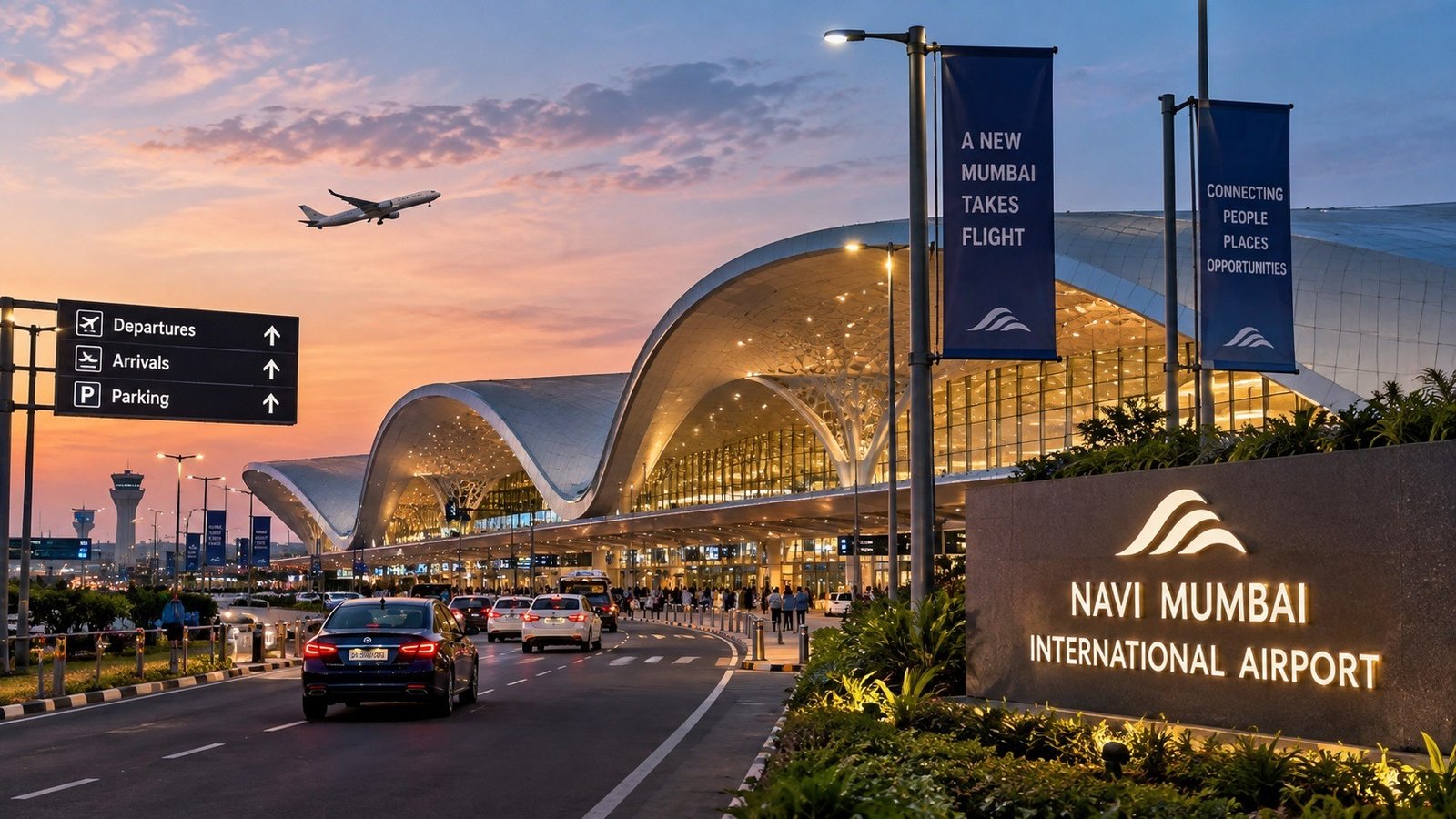
Navi Mumbai International Airport For decades, Navi Mumbai International Airport was one of those projects that seemed to exist simultaneously in two places: on government plans and in real-estate brochures.
The airport eventually became real in October 2025.
Phase 1 was inaugurated on 8 October 2025, commercial operations began on 25 December 2025, and by 2026 Navi Mumbai International Airport had moved from infrastructure promise to operating airport.
That changes the question.
The question is no longer:
“Will Navi Mumbai airport transform the region?”
It is:
“How much of the region will actually change because the airport is now there?”
The answer could extend far beyond aviation.
Navi Mumbai International Airport sits within a much larger infrastructure network involving Panvel, Ulwe, JNPT, the Mumbai Trans Harbour Link, highways, railways, metro plans, logistics parks, warehousing and real estate.
If those pieces connect effectively, the airport could help turn what was once Mumbai’s eastern and southern fringe into a much more integrated economic corridor.
The airport itself is only one part of the story.
The network around it may be the bigger one.
A Second Airport Changes Mumbai’s Geography
Mumbai has long been constrained by geography.
The Arabian Sea limits expansion on one side, while dense development makes new large-scale infrastructure in the established city extremely difficult and expensive.
Navi Mumbai was planned partly as an alternative urban centre.
The new airport adds another major economic anchor to that strategy.
The government’s stated vision is for Navi Mumbai International Airport to operate alongside Chhatrapati Shivaji Maharaj International Airport, creating a two-airport system for the Mumbai Metropolitan Region. The airport is spread across approximately 1,160 hectares and is designed to ultimately handle 90 million passengers annually and about 3.25 million metric tonnes of cargo.
But those are long-term numbers.
The first phase is much smaller.
The airport’s operator currently describes the launch-phase capacity at about 20 million passengers per annum, with cargo capacity being developed progressively.
That distinction matters.
An airport capable of eventually handling 90 million passengers does not create 90 million passengers overnight.
Infrastructure creates capacity first.
The surrounding economy then has to grow into it.

Panvel Moves Closer to the Centre of the Map
For Panvel, the airport represents a particularly important change.
The city has long been positioned at the intersection of Mumbai, Pune, Raigad and the wider Konkan region.
Now it sits beside a major international aviation asset.
The airport’s location near Ulwe and Panvel creates potential for employment, hotels, offices, retail, housing and logistics.
But the effect will not necessarily be uniform.
Some areas will benefit from airport access.
Others may benefit from employment generated by the airport.
Still others could gain because they become convenient locations for businesses serving passengers, cargo operators or airport employees.
This is how infrastructure changes cities.
Not through one dramatic transformation.
Through thousands of smaller decisions about where people live, where companies locate, where warehouses are built and where roads become commercially valuable.
Atal Setu Turns the Airport Into a Regional Project
The airport would be far less consequential if reaching it remained difficult.
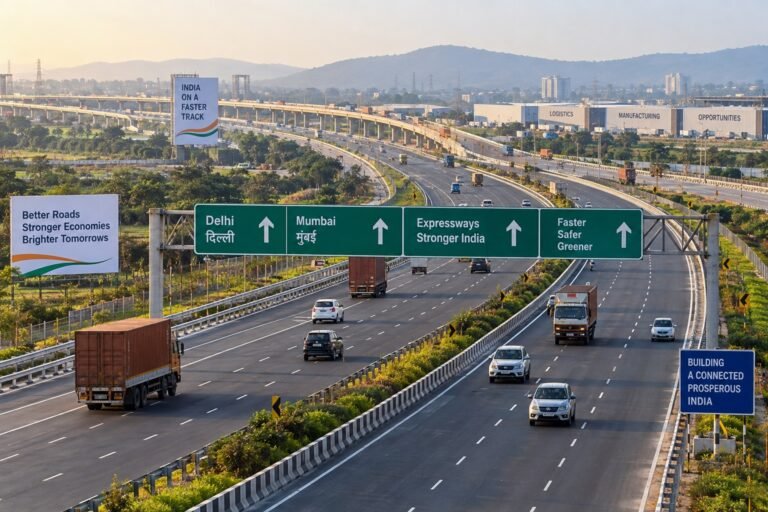
That is where the Mumbai Trans Harbour Link, or Atal Setu, becomes important.
MMRDA describes the 21.8-kilometre, six-lane bridge as a project intended to improve connectivity between Mumbai’s island city and Navi Mumbai and specifically to provide faster connectivity toward Navi Mumbai International Airport.
The significance goes beyond saving travel time.
Atal Setu changes the mental map of Mumbai.
South Mumbai and Navi Mumbai are no longer separated by the same physical barrier they once were.
For businesses, that can influence location decisions.
For residents, it can influence where they are willing to live.
For logistics companies, it can influence routing.
For an airport, it expands the potential catchment area.
An airport does not serve only the neighbourhood surrounding its terminal.
It serves the region that can reach the terminal reliably.
JNPT Gives the Airport a Different Kind of Advantage
Then there is Jawaharlal Nehru Port, better known as JNPT.
This is where Navi Mumbai’s airport story becomes particularly interesting from a logistics perspective.
The port already gives the region a major maritime freight connection.
The airport adds an air-cargo gateway.
That creates the possibility of sea-air logistics, in which cargo can move through maritime and aviation networks depending on urgency, value and destination.
NMIA’s cargo strategy explicitly identifies its strategic location near industrial hubs and the Mumbai Metropolitan Region and describes opportunities for multimodal transshipment and sea-to-air connectivity. Its cargo infrastructure is planned to expand from approximately 0.5 million metric tonnes initially to 2.6 million tonnes across its development phases.
That could matter for sectors such as pharmaceuticals, perishables, electronics, high-value manufacturing and express logistics.
The advantage is not simply having another airport.
It is having port + airport + highway + rail + industrial infrastructure in the same broad geography.
That is the kind of combination that can attract logistics businesses.
Warehousing Could Be One of the Quiet Winners
Passengers receive the publicity.
Cargo may create some of the less visible economic consequences.
An airport capable of handling substantial cargo requires an ecosystem around it:
- warehouses;
- cold-chain facilities;
- freight forwarders;
- customs services;
- trucking;
- packaging;
- distribution centres;
- maintenance;
- security;
- and specialised logistics operators.
NMIA says its cargo terminal will eventually handle domestic, international, express and transit cargo, including specialised requirements such as pharmaceuticals, perishables, cold storage, hazardous cargo and valuable goods.
That creates opportunities beyond the airport boundary.
Warehousing companies generally want access to multiple transport modes rather than proximity to an airport simply for its own sake.
That makes the broader Navi Mumbai–Panvel–JNPT geography important.
The strongest logistics development is therefore likely to occur where airport access intersects with highway, port and industrial connectivity.
The Metro Question Is Important — But Don’t Get Ahead of the Track
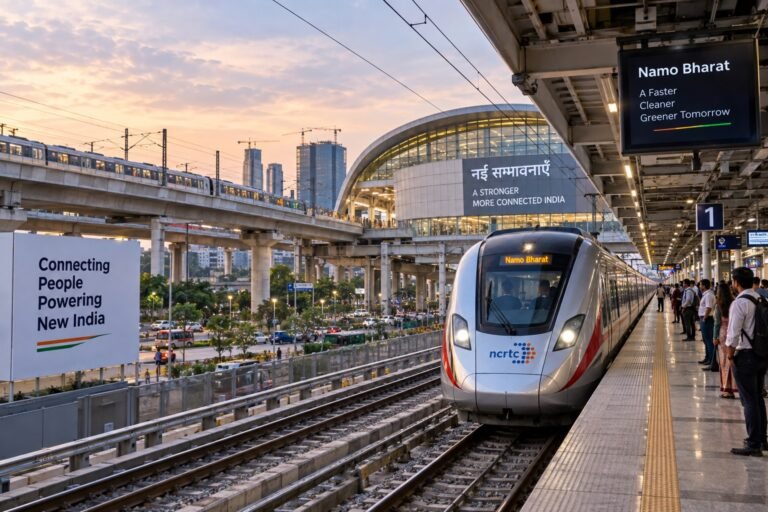
Rail connectivity will ultimately determine how accessible the airport is to people who do not want to drive.
MMRDA lists Metro Line 8 as the planned 35-kilometre airport corridor connecting Chhatrapati Shivaji Maharaj International Airport and Navi Mumbai International Airport.
That is strategically significant.
But planned connectivity should not be confused with operational connectivity.
The airport already has road and other transport links, while the wider metro network continues to develop.
MMRDA’s own project information shows several corridors at different stages, and its August 2026 data for Metro Line 12, for example, records construction progress rather than completed operations.
This is an important lesson for anyone studying infrastructure-led development:
A line on a map is not the same thing as a train carrying passengers.
The eventual success of the airport’s multimodal strategy will depend on these connections actually being completed, integrated and reliable.
Commercial Property Will Follow People — Not Headlines
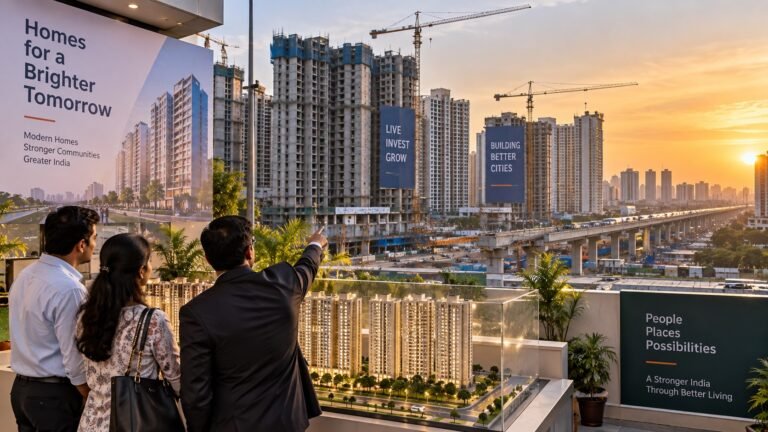
Real estate is already one of the most visible areas where the airport story is being felt.
JLL’s August 2026 analysis identifies a broad corridor stretching from the airport toward Ulwe, Panvel, Kharghar, Taloja, Karanjade, New Panvel and Dronagiri, with airport and transport infrastructure helping integrate previously separated markets.
But there is an important distinction between airport-linked property and property that merely uses the airport in its marketing.
A hotel near an airport has an obvious relationship.
A logistics warehouse near major freight routes has an obvious relationship.
An office building may benefit if businesses and employees move into the corridor.
A residential development may benefit if airport workers, logistics employees or other new residents create sustained demand.
But a property several kilometres away does not automatically become valuable simply because a billboard says:
“Near International Airport.”
The airport may be an advantage.
It is not a magic wand.
Residential Development Is Already Part of the Story
The residential effect is more complicated.
Ulwe, Panvel and neighbouring areas have seen strong development for years, influenced by infrastructure expectations, planned urbanisation and improving connectivity.
The airport adds another demand driver.
JLL reported that Navi Mumbai’s average residential prices had risen by about 27% over five years, while airport-proximate pockets such as Ulwe and Panvel experienced sharper growth.
But causation should be treated carefully.
Property prices do not move because of one project alone.
Roads, metro connectivity, employment, schools, commercial development, land supply, financing conditions and investor expectations all influence prices.
And there is another important point:
Much of the airport premium can be priced into property before the airport actually changes everyday economic activity.
That means future buyers need to distinguish between genuine new demand and prices that already reflect years of anticipation.
Navi Mumbai Could Become More Than a Satellite
This may be the most important long-term possibility.
Navi Mumbai was originally conceived as a counter-magnet to Mumbai.
The airport gives it another role.
It can potentially become a major metropolitan gateway in its own right.
That matters because successful global metropolitan regions often operate through multiple economic centres rather than one dominant downtown.
Mumbai already has several business districts.
Navi Mumbai adds another major infrastructure anchor.
The airport could reinforce the growth of commercial areas, logistics clusters, hospitality and residential communities around that network.
Instead of people thinking:
Mumbai → Navi Mumbai
the region may increasingly function as:
Mumbai ↔ Navi Mumbai
That is a subtle but important difference.
The Airport Could Also Change the Logistics Map of Western India
The airport’s full significance extends beyond Mumbai.
Its operator positions NMIA as a gateway serving Maharashtra and western India, with connectivity toward areas including Thane, Pune, Raigad and the Konkan region.
If cargo operations scale successfully, businesses do not necessarily need to be immediately adjacent to the terminal.
They need dependable access to the airport.
That creates the possibility of a wider logistics belt stretching across parts of Navi Mumbai and Raigad.
For Maharashtra, this could strengthen the connection between manufacturing, ports, airports and consumption centres.
For Indian businesses, the value is straightforward:
time is money in logistics.
Every hour saved moving a high-value product can influence where a company chooses to manufacture, store or distribute it.
There Is a Less Glamorous Side
Infrastructure stories often concentrate on ribbon-cuttings.
Cities experience the consequences long afterwards.
More traffic can accompany economic growth.
Land values can rise faster than incomes.
Construction can put pressure on local infrastructure.
Wetlands, waterways and ecological systems require careful management.
The airport operator highlights sustainability measures including planned solar capacity, EV charging infrastructure and environmental programmes, while the project’s large physical footprint makes environmental management an ongoing responsibility.
There is also the question of whether public transport keeps pace with private development.
If new housing and warehouses appear faster than roads, buses and rail capacity, the same infrastructure intended to improve connectivity can eventually generate congestion.
The measure of success therefore cannot simply be:
“How many buildings came up?”
It has to include:
“Can people and goods move efficiently after those buildings come up?”
The Real Estate Brochure Test
There is a useful test for anyone watching Navi Mumbai’s development.
Whenever somebody says:
“This property will benefit from the airport,”
ask five questions:
How far is it really?
What transport connection actually exists today?
What employment or commercial activity will generate demand?
Is the claimed future infrastructure funded and progressing?
And how much of the expected airport benefit is already reflected in the price?
Those questions are more useful than a glossy photograph of an aeroplane.
The airport is real.
The future benefits are not all equally certain.
A New Mumbai Is Not Built by an Airport Alone
Navi Mumbai International Airport is unquestionably a major infrastructure asset.
But its long-term importance will be determined by what develops around it.
Airport + Atal Setu + JNPT + highways + rail + metro + logistics + commercial development + housing
is a much more powerful equation than an airport considered by itself.
The airport provides the gateway.
Infrastructure provides access.
Businesses provide jobs.
Housing provides residents.
Logistics provides movement.
And urban planning determines whether all of those pieces can function together.
That is how a project becomes a city-making project.
The Bigger Mumbai Story
For decades, Mumbai’s biggest problem has been that economic opportunity and physical space have not always grown at the same speed.
Navi Mumbai was one response to that problem.
Navi Mumbai International Airport represents another.
The airport does not make Mumbai larger in the literal sense.
It makes the Mumbai Metropolitan Region more distributed.
That could ultimately be its most important contribution.
The future Mumbai may not be a single centre surrounded by suburbs.
It may increasingly be a network of connected economic centres — Mumbai, Navi Mumbai, Panvel and other emerging nodes — linked by roads, rail, metro, ports and airports.
And that is why the airport matters.
Not because every neighbourhood will suddenly become a property hotspot.
Not because every warehouse will become a logistics goldmine.
And certainly not because an aeroplane landing automatically creates an economy.
It matters because infrastructure changes the choices people and businesses can make.
The next decade will show how far those choices travel.
DOONITED Editorial Perspective
The most intelligent way to understand Navi Mumbai International Airport is not as a standalone airport project.
It is as a regional infrastructure experiment.
Its real success will be measured by whether Mumbai, Navi Mumbai, Panvel, JNPT and the surrounding economic corridors become more efficiently connected.
The airport can create capacity.
But capacity alone does not create prosperity.
The harder job is making sure roads, metro, rail, logistics, housing, employment and urban services grow together.
That is where the difference between infrastructure development and genuine urban development will be decided.
Meaningful Learning for Readers
Large infrastructure projects rarely transform a city overnight.
Their impact usually appears through thousands of secondary effects:
where companies locate, where warehouses are built, where people choose homes, where hotels open, how commuters travel and how quickly goods move.
For Navi Mumbai, the airport has already moved beyond the “future project” stage.
The next question is whether the surrounding region can turn that physical asset into a well-connected economic ecosystem.
That will be the real test of Mumbai’s next chapter.

World Beyond the News
Why Elephants Stay Close to Their Herd
Elephants live in highly social family groups and use calls, touch and body movements to maintain strong bonds.
Most of the Deep Ocean Remains Difficult to Explore
Extreme pressure, darkness and distance make deep-ocean exploration one of Earth’s greatest scientific challenges.
Spacecraft Can Travel Without Traditional Roads
Spacecraft use carefully calculated trajectories and gravity assists to travel enormous distances through space.
Why Movie Trailers Are Released in Stages
Major films often use teaser trailers, full trailers and final promotional spots to build awareness over time.