Wildlife Tourism in India: Where the Journey Is About More Than Seeing a Tiger
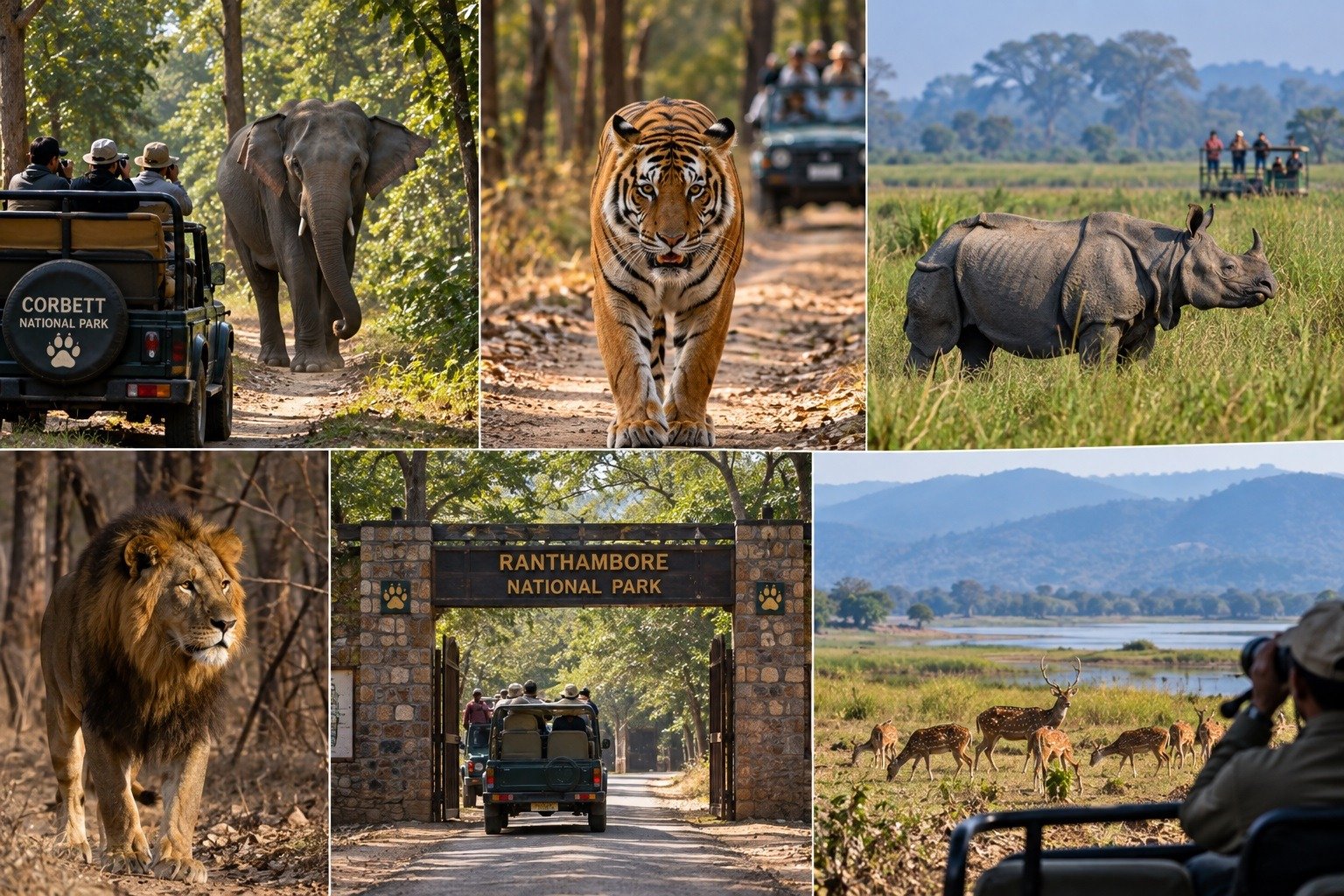
There is a particular kind of excitement in sitting quietly in an open jeep at six in the morning, surrounded by forest, waiting for something to move.
Sometimes it is a tiger.
Sometimes an elephant.
Sometimes a rhinoceros walks past as if it has somewhere considerably more important to be.
And sometimes, after three hours of careful searching, the biggest wildlife sighting is a very confident langur sitting on a branch judging everybody in the safari vehicle.
That uncertainty is precisely what makes wildlife tourism different from ordinary sightseeing.
India’s wildlife destinations offer travellers the opportunity to see some of the country’s most important species in their natural habitats — but the bigger story is increasingly about conservation, local livelihoods, landscape protection and responsible tourism.
India’s protected-area network currently comprises 106 National Parks, 564 Wildlife Sanctuaries, 99 Conservation Reserves and 218 Community Reserves. The country also has 58 tiger reserves, covering nearly 2.5% of India’s geographical area.
The safari, therefore, is only the visible part of a much larger conservation story.
Corbett: India’s classic wildlife gateway
For generations of Indian travellers, Jim Corbett National Park has been one of the country’s most recognisable wildlife destinations.
Located in the Himalayan foothills of Uttarakhand, the wider Corbett Tiger Reserve covers about 1,288 sq km when Corbett National Park, Sonanadi Wildlife Sanctuary and adjoining reserve forests are considered together. The landscape supports Bengal tigers, Asian elephants and hundreds of bird species.
Corbett is particularly attractive because wildlife is only one part of the experience.
The forests, Ramganga landscape, Himalayan foothills and birdlife create an ecosystem in which the visitor is never entirely sure what the forest will reveal.
The important practical point is timing. Corbett’s tourism zones have different operating schedules and seasonal restrictions, so travellers should check the current forest-department rules before planning a safari rather than relying blindly on an old travel blog.
That is a good rule for every wildlife destination in India.
The forest timetable wins over the tourist timetable.
Kaziranga: where the rhinoceros changes the conversation
If Corbett is strongly associated with the tiger, Kaziranga National Park changes the conversation almost immediately.
The great Indian one-horned rhinoceros is its signature species.
Assam Tourism describes Kaziranga as one of Northeast India’s most important wildlife tourism destinations. The park’s grasslands, wetlands and riverine environment support rhinoceroses, elephants, tigers, wild buffalo, swamp deer and large numbers of birds. Kaziranga is also a UNESCO World Heritage Site.
Jeep safaris are a principal way of exploring the park, while elephant safaris are also offered in the tourism ecosystem.
Kaziranga’s season is strongly influenced by the monsoon and flooding. Assam Tourism identifies November to April as the principal visiting period, with late February to early April particularly favourable for wildlife viewing.
The landscape is also a reminder that wildlife conservation is not about freezing nature in place.
Floods are part of the Brahmaputra ecosystem.
The challenge is enabling wildlife, local communities and tourism to coexist with that natural cycle.
Ranthambore: where wildlife meets history
Ranthambore offers something many wildlife destinations cannot replicate quite so easily: a tiger landscape with a major historical monument inside it.
The reserve’s forests, lakes and hills are associated with Bengal tigers, while Ranthambore Fort and historic ruins add an entirely different layer to the journey. Incredible India highlights the fort, Jogi Mahal, ancient temples and Rajbagh ruins alongside the park’s wildlife landscape.
That combination has helped make Ranthambore one of India’s most recognisable wildlife-tourism destinations.
But its popularity also illustrates a fundamental problem.
The more famous a tiger reserve becomes, the more visitors it can attract.
And the more visitors arrive, the greater the need for careful management of safari vehicles, routes, noise, waste and visitor behaviour.
A wildlife reserve cannot be operated like a theme park where the customer expects the main attraction to appear on schedule.
The tiger, fortunately, has not signed that contract.
Gir: India’s lion country
In Gujarat, the story changes again.
Gir National Park and Wildlife Sanctuary is the last wild refuge of the Asiatic lion.
Gujarat Tourism describes the protected landscape as a forested, hilly ecosystem of roughly 1,412 sq km and notes that safari access requires advance permits. The sanctuary also supports leopards, chital, sambar, nilgai, chinkara, crocodiles and many other species.
Gir’s significance goes well beyond tourism.
The Asiatic lion is one of India’s most important conservation success stories, while its restricted wild distribution also demonstrates why maintaining suitable habitat and ecological connectivity matters.
Gujarat Tourism currently lists November to March as the preferred winter visiting period and notes that the Gir Jungle Safari closes annually from June 16 to October 15.
Again, the lesson is simple: check the current official calendar before booking.
Wildlife tourism runs according to seasons, weather and conservation rules, not airline-style consumer expectations.
Bandhavgarh: the tiger, the fort and the forest
Madhya Pradesh’s Bandhavgarh National Park combines wildlife with an unusually deep historical landscape.
The park takes its name from Bandhavgarh Fort, and the surrounding landscape carries archaeological, religious and royal associations alongside its wildlife.
Incredible India describes Bandhavgarh as renowned for its tiger density and highlights its forests, fort, caves, temples and birdlife. Tiger safaris operate in core zones including Tala, Magdhi and Khitauli, along with buffer areas.
The destination demonstrates why wildlife tourism in India is increasingly difficult to place inside a single category.
It is simultaneously:
wildlife tourism + heritage tourism + nature tourism + rural tourism.
That combination can be economically valuable for the surrounding region.
Wildlife tourism is bigger than the safari vehicle
The obvious expenditure is the safari.
But the economic chain extends much further.
Hotels employ people.
Drivers earn livelihoods.
Guides develop specialist knowledge.
Restaurants purchase local supplies.
Handicraft sellers serve visitors.
Transport operators connect towns with parks.
Homestays can bring tourism revenue directly into communities.
And conservation itself requires trained staff, monitoring, patrolling and infrastructure.
The Ministry of Tourism’s national data show the enormous scale of domestic travel in India, although its tourism statistics do not provide a single national figure specifically for wildlife-tourism visits. The ministry’s tourism data system therefore needs to be interpreted carefully rather than turning every visitor number into a wildlife statistic.
That distinction matters.
A busy tourist destination does not automatically mean a healthy wildlife economy.
The quality of the economic relationship matters more than the raw number of visitors.
The conservation dividend
There is a more profound reason wildlife tourism matters.
People are generally more willing to value landscapes they have experienced.
A tiger reserve can therefore become both a conservation institution and an economic asset — provided tourism remains subordinate to ecological limits.
The Ministry of Environment, Forest and Climate Change explicitly supports protected areas, wildlife protection outside protected areas and measures addressing human-wildlife conflict. It also gives priority to areas adjoining protected areas and wildlife corridors.
That last point is particularly important.
A tiger does not understand the boundary of a tourism map.
Neither does an elephant.
Neither does a leopard.
Wildlife moves through landscapes that can include forests, farms, villages and infrastructure.
Conservation therefore cannot stop at the park gate.
The uncomfortable side of wildlife tourism
There is a temptation in travel marketing to promise the perfect safari:
Tiger guaranteed.
Rhino guaranteed.
Lion guaranteed.
Sunrise guaranteed.
Only the weather and the animals have not received the brochure.
Responsible wildlife tourism should resist that mentality.
A sighting is a privilege, not a contractual obligation.
Too many vehicles concentrating around an animal, loud behaviour, feeding wildlife, leaving designated routes or treating forests as photography studios can undermine the very ecosystem tourists have come to see.
India’s conservation system also has to manage human-wildlife conflict outside protected areas. The central wildlife programme specifically recognises this as a conservation priority.
That means the future of wildlife tourism cannot be measured only by hotel occupancy or safari bookings.
It must also be measured by whether wildlife populations remain viable and communities living alongside protected landscapes have reasons to support conservation.
India’s wildlife map is far larger than five parks
Corbett, Kaziranga, Ranthambore, Gir and Bandhavgarh are excellent gateways into India’s wildlife geography.
But they are only the beginning.
Assam alone promotes wildlife experiences across Kaziranga, Manas, Nameri, Dibru-Saikhowa and Raimona, with jeep safaris, birdwatching, river experiences and other activities.
Across India, travellers can explore landscapes associated with elephants, rhinos, lions, tigers, leopards, gaur, deer, wild buffalo, Himalayan species, marine life and extraordinary bird diversity.
The more interesting future may therefore be one in which tourism moves beyond the obsession with a single “Big Five” checklist.
A forest is not successful because a tourist saw a tiger.
A forest is successful when the entire ecological system continues to function.
The DOONITED View
India should not try to turn every protected forest into a tourism destination.
That would defeat the purpose.
The opportunity is to develop responsible wildlife tourism around carefully selected landscapes, with strong conservation rules, trained guides, local participation, good visitor management and transparent ecological limits.
For travellers, the smartest mindset is equally simple.
Go to see wildlife.
But don’t measure the trip only by whether an animal appeared in front of your camera.
Notice the forest.
Listen to the birds.
Watch the landscape.
Learn why the habitat matters.
Spend locally where possible.
Follow the rules.
And remember that the tiger was there before the safari jeep arrived — and, ideally, should still be there long after it leaves.
The Learning Point
The greatest wildlife-tourism experience is not simply seeing a rare animal; it is understanding the landscape that made that animal possible.
India’s forests are not outdoor television studios.
They are living ecosystems.
Tourism can help finance their protection and sustain local livelihoods — but only if visitors, businesses and authorities remember one simple principle:
The wildlife comes first. The tourist comes second.


World Beyond the News
Why Elephants Stay Close to Their Herd
Elephants live in highly social family groups and use calls, touch and body movements to maintain strong bonds.
Most of the Deep Ocean Remains Difficult to Explore
Extreme pressure, darkness and distance make deep-ocean exploration one of Earth’s greatest scientific challenges.
Spacecraft Can Travel Without Traditional Roads
Spacecraft use carefully calculated trajectories and gravity assists to travel enormous distances through space.
Why Movie Trailers Are Released in Stages
Major films often use teaser trailers, full trailers and final promotional spots to build awareness over time.