Spiritual India: The Journeys That Take Travellers Beyond Tourism
There are holidays in which the biggest question is, “What did we see?”
And then there are journeys in which the question quietly changes to, “What did we experience?”
India has been answering that question for centuries.
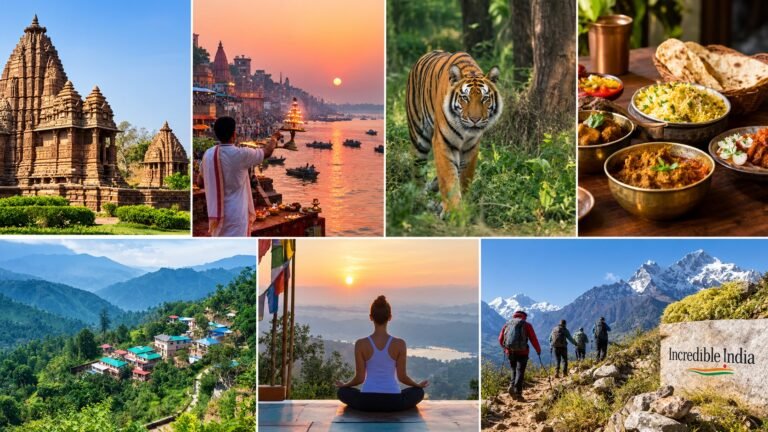
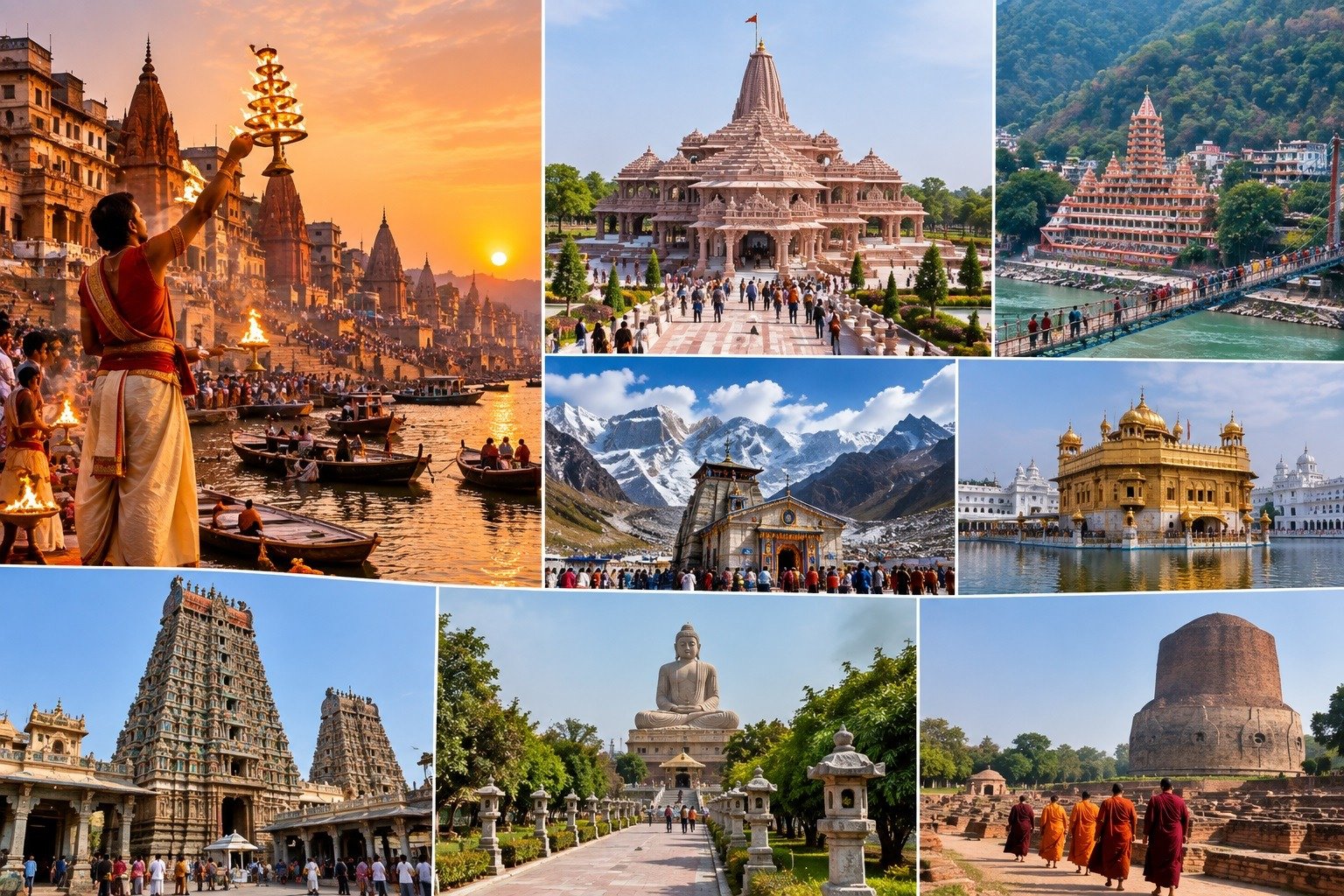
From the lamps of Varanasi reflected on the Ganga to the bells of Himalayan temples, from the langar at Amritsar to meditation beside the river in Rishikesh, spiritual travel in India is not one destination, one religion or even one kind of traveller.
It is an enormous landscape of pilgrimage, prayer, meditation, heritage, service, philosophy and personal reflection.
And increasingly, it is becoming a distinctive form of Indian travel in its own right.
India does not have one spiritual route
The easiest mistake would be to create a checklist.
Varanasi. Tick.
Ayodhya. Tick.
Rishikesh. Tick.
Char Dham. Tick.
Golden Temple. Tick.
India’s spiritual geography does not work quite like that.
Each destination has its own rhythm, tradition and meaning.
In Varanasi, spirituality is inseparable from the Ganga and the city’s extraordinary coexistence of ritual, everyday life, death, music, food, craft and scholarship. Dashashwamedh Ghat is associated with the evening Ganga Aarti, while Kashi Vishwanath remains one of the city’s central pilgrimage destinations. Sarnath, meanwhile, brings a Buddhist dimension into the same wider cultural landscape.
The result is not a conventional sightseeing itinerary.
It is a city that asks visitors to slow down enough to observe.
Varanasi and Ayodhya: two very different journeys
A Varanasi–Ayodhya journey is increasingly attractive because the two cities offer different expressions of Hindu sacred geography.
Varanasi is a living river city whose spiritual character is woven into its historic ghats and neighbourhoods.
Ayodhya is centred around the sacred landscape of the Sarayu and traditions associated with Lord Rama. Its contemporary pilgrimage environment includes the Shri Ram Janmabhoomi Mandir, Hanuman Garhi, Kanak Bhawan and the ghats along the Sarayu.
But the interesting part is what happens outside the main temple.
Ayodhya’s spiritual experience also includes riverfronts, smaller shrines, local food, traditional rituals and cultural performances.
That is an important lesson for India’s tourism industry.
A pilgrimage destination is more than its headline temple.
The surrounding city is part of the experience.
Rishikesh: where pilgrimage meets wellness
Travel a few hundred kilometres north and the character changes again.
Rishikesh has become internationally associated with yoga, meditation and wellness while retaining its religious importance along the Ganga.
The Ministry of Tourism’s Incredible India platform describes it as the “Yoga Capital of the World” and highlights its ashrams, spiritual practices and relationship with the Ganga.
Parmarth Niketan, for example, combines accommodation, yoga classes, spiritual learning and the annual International Yoga Festival. Evening Ganga Aarti is another part of the city’s distinctive experience.
This is where India’s spiritual tourism story becomes particularly interesting.
Not everyone arriving in Rishikesh is necessarily undertaking a conventional pilgrimage.
Some are looking for yoga.
Some want meditation.
Some want a retreat from digital overload.
Some are curious about Indian philosophy.
And some simply want to spend a few days beside a river without hearing an airport announcement.
The destination accommodates all of these motivations, although visitors should distinguish genuine spiritual and wellness programmes from commercial packages that simply borrow spiritual vocabulary.
The Char Dham is a journey, not a weekend attraction
Then there is Uttarakhand’s Char Dham Yatra — Yamunotri, Gangotri, Kedarnath and Badrinath.
This is not the sort of itinerary that rewards rushing.
The official Uttarakhand Tourism itinerary covers Haridwar, Yamunotri, Gangotri, Kedarnath and Badrinath and describes a journey of roughly 1,500 kilometres, with trekking forming an important part of the experience.
The terrain itself becomes part of the pilgrimage.
At Yamunotri, for example, road access ends before the shrine and the final approach involves trekking or traditional modes of assisted travel.
Kedarnath similarly requires a substantial trek from Gaurikund under the conventional route described by Uttarakhand Tourism.
This is precisely why the Char Dham experience should not be marketed like a luxury city break.
Altitude, weather, terrain, congestion and physical exertion are genuine considerations.
Uttarakhand’s own tourism planning documents identify peak-season congestion as a challenge for the Char Dham circuit.
Spiritual tourism, in other words, still requires practical tourism management.
Faith does not cancel geography.
The Golden Temple offers a different lesson
Amritsar’s Golden Temple introduces another dimension: seva.
Sri Harmandir Sahib is not simply a monument to photograph.
Its langar represents a continuing tradition of community service in which visitors can participate in a shared meal. Incredible India describes the langar as open to visitors irrespective of caste, creed or gender and identifies service and equality as central values expressed through the practice.
This changes the traveller’s role.
You are not merely looking at something.
You are participating in something.
That distinction matters because some of India’s most memorable spiritual experiences are not necessarily the grandest architectural ones.
Sometimes they are the simplest.
Sit.
Eat.
Listen.
Observe.
Help.
South India’s temple trails tell another story
Spiritual travel also stretches far beyond the North.
Rameswaram, for example, combines pilgrimage, architecture, landscape and coastal geography. The Ramanathaswamy Temple is one of India’s important Hindu pilgrimage sites and Rameswaram is traditionally recognised as one of the Char Dham destinations.
A broader South Indian temple journey can connect destinations such as Madurai, Rameswaram and Tirupati with very different architectural and ritual traditions.
Here, the temple itself becomes a lesson in history.
Massive gateways, sculptural programmes, ritual spaces and centuries-old traditions demonstrate that India’s spiritual heritage is also an architectural and cultural archive.
The traveller who looks only at the deity may miss half the story.
The Buddhist circuit: travelling through ideas
India’s spiritual tourism map becomes even more diverse when the Buddhist circuit is considered.
Bodh Gaya, Sarnath and Kushinagar are associated with important episodes in the life of Gautama Buddha, while Sarnath sits remarkably close to Varanasi.
That makes northern India capable of producing a journey across different religious traditions without requiring enormous geographical distances.
And this is one of the great strengths of Indian spiritual travel.
The country’s sacred geography overlaps.
A traveller can move from Hindu traditions to Buddhist heritage, from yoga to Sikh seva, from temple architecture to meditation practice — while remaining within the broader cultural landscape of India.
The real spiritual-tourism economy is local
There is another reason this form of travel matters.
Pilgrims and spiritual travellers spend money far beyond temple gates.
They need transport, accommodation, food, guides, local handicrafts, flowers, religious articles, clothing, photography, cultural experiences and sometimes longer stays.
That creates livelihoods across a large informal and formal tourism ecosystem.
The Ministry of Tourism’s domestic tourism statistics underline the scale of travel within India: domestic tourist visits reached nearly 2.95 billion in 2024. The ministry cautions, however, that these are visits rather than unique individuals, and that pilgrimage trips are included within the overall domestic-tourism series.
That distinction is important.
One Indian traveller can make several tourism visits in a year.
Still, the scale tells us something unmistakable: domestic travel has become a huge part of India’s tourism economy.
But more visitors are not automatically better
This is where the spiritual-tourism story needs an honest paragraph.
Sacred destinations can become victims of their own popularity.
Crowding, traffic, waste, water pressure, construction, noise and environmental damage can undermine precisely the qualities visitors came seeking.
Uttarakhand’s tourism master plan itself identifies peak-season traffic congestion as a constraint on the Char Dham experience.
The solution cannot simply be to build more hotels and encourage more visitors.
Sometimes the intelligent tourism strategy is better managed tourism.
Timed access.
Improved public transport.
Waste management.
Local employment.
Carrying-capacity planning.
Protection of heritage structures.
Responsible behaviour by visitors.
And enough quiet spaces to allow a spiritual destination to remain, well, spiritual.
Because if the search for inner peace requires two hours of honking outside the temple gate, the universe may have a complaint department.
The DOONITED View
India’s spiritual tourism opportunity is not about turning faith into a product.
It is about making it possible for people to encounter India’s living traditions responsibly.
The strongest journeys will combine pilgrimage with heritage, local food, architecture, nature, community and reflection.
They will also respect the difference between a sacred site and a tourist attraction.
A temple is not a theme park.
An ashram is not automatically a wellness resort.
A pilgrimage is not necessarily a sightseeing checklist.
And a spiritual journey cannot be measured entirely by the number of photographs uploaded afterwards.
India’s greatest advantage is that its spiritual heritage is still alive.
The rituals are performed.
The kitchens still cook.
The bells still ring.
The rivers still flow.
The pilgrims still walk.
The question for modern tourism is whether India can welcome more travellers without turning those living traditions into something artificial.
The Learning Point
The real value of spiritual travel in India is not how many sacred places a traveller can cover, but how deeply they can experience one.
In an age of hurried holidays and algorithm-generated itineraries, India’s oldest form of travel may offer a surprisingly modern lesson:
Slow down. Look around. Listen. And leave the place at least as worthy of reverence as you found it.


World Beyond the News
Why Elephants Stay Close to Their Herd
Elephants live in highly social family groups and use calls, touch and body movements to maintain strong bonds.
Most of the Deep Ocean Remains Difficult to Explore
Extreme pressure, darkness and distance make deep-ocean exploration one of Earth’s greatest scientific challenges.
Spacecraft Can Travel Without Traditional Roads
Spacecraft use carefully calculated trajectories and gravity assists to travel enormous distances through space.
Why Movie Trailers Are Released in Stages
Major films often use teaser trailers, full trailers and final promotional spots to build awareness over time.