Pushkar Beyond the Camel Fair: The Sacred Town Becoming a Global Travel Experience
Pushkar is internationally famous for its camels, desert fair and bohemian travel culture. But behind the annual spectacle is something more enduring: a living pilgrimage town that has learned to accommodate global travellers without surrendering its sacred identity.
For much of the outside world, Pushkar begins with camels.
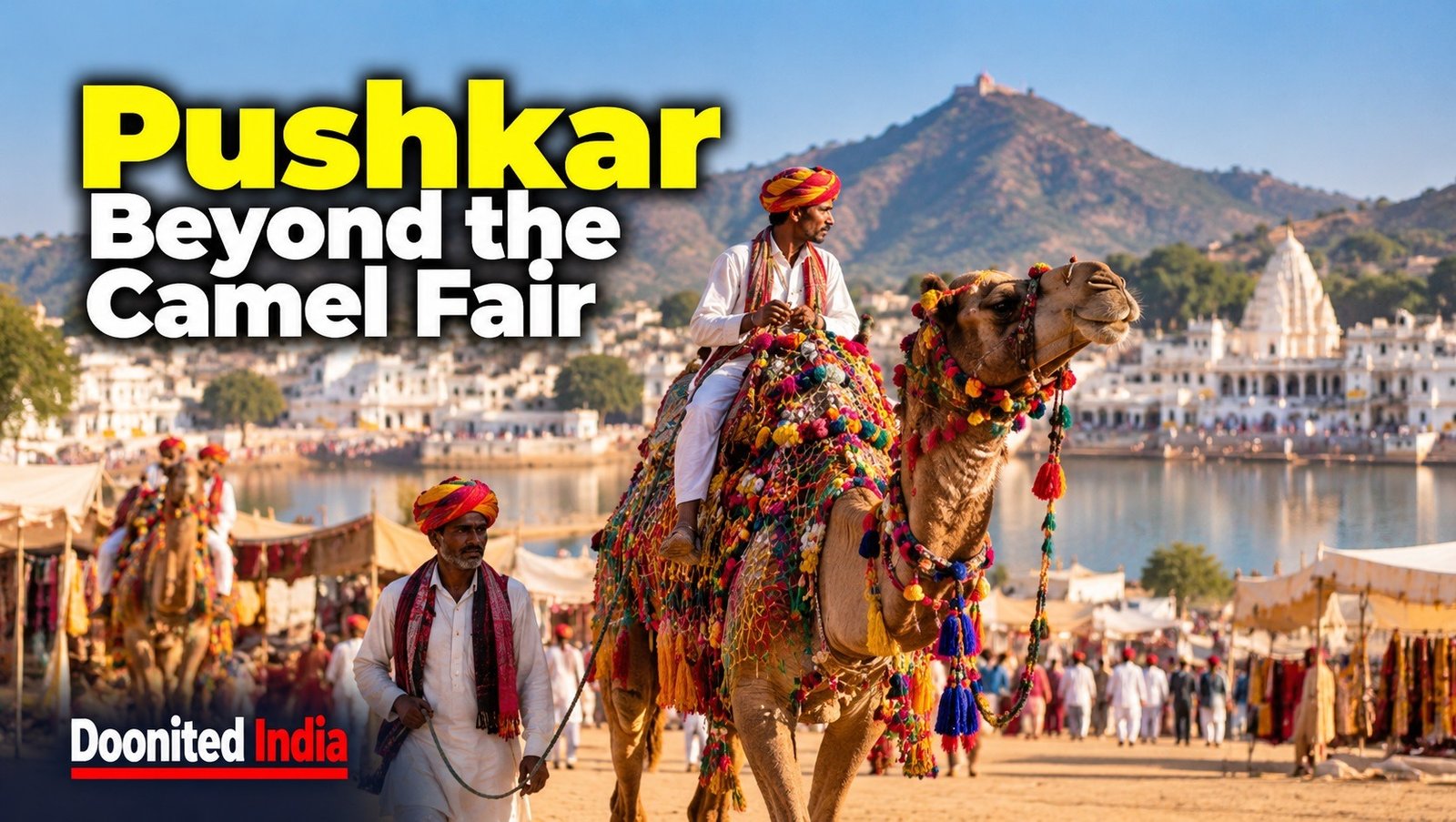
Every autumn, images of Rajasthan’s desert landscape fill travel magazines and social media: elaborately decorated camels, moustachioed traders, colourful turbans, fairground performances and thousands of visitors gathering beneath the vast sky.
But the camel fair is only one chapter of Pushkar’s story.
The town’s deeper identity is built around a sacred lake, temples, pilgrimage traditions, bazaars and a religious culture that predates modern tourism by centuries.
And today, Pushkar has acquired another identity: an international travel destination where pilgrims, backpackers, wellness seekers, photographers, luxury travellers and culture hunters occupy the same compact town.
That transformation raises a more interesting question than whether Pushkar has become popular:
Is tourism changing Pushkar, or has Pushkar simply learned how to absorb tourism on its own terms?
The answer is somewhere between the two.
The lake comes before the camel
The geographical and spiritual centre of Pushkar is not the fairground. It is Pushkar Lake.
Rajasthan Tourism describes the lake as one of the state’s most sacred water bodies and identifies 52 bathing ghats around it. More than 400 temples are associated with the surrounding landscape, making the lake the physical centre of an unusually dense pilgrimage environment. (Rajasthan Tourism)
The mythology is equally central.
According to Hindu tradition, Lord Brahma dropped a lotus flower at the site, leading to the creation of the lake. Pushkar consequently became associated with Brahma, the Hindu creator deity.
The Brahma Temple, situated close to the lake, is the town’s most famous religious landmark. Rajasthan Tourism describes it as a temple dedicated to Brahma and notes that the present structure dates to the medieval period, while the site has a much older religious history. (Rajasthan Tourism)
For Hindu pilgrims, therefore, Pushkar is not simply a beautiful old town.
It is a tirtha — a sacred crossing place between the ordinary and the spiritual.
That distinction is important because modern tourism did not create Pushkar’s identity. It arrived much later and found an identity already firmly established.
A pilgrimage town that became an international address
Pushkar’s international reputation developed gradually.
From the late twentieth century onward, the town became part of the overland and backpacker routes through India. Foreign visitors stayed for longer periods, explored the surrounding desert, practised yoga, attended cultural events and became part of the town’s evolving hospitality economy.
An Oxford University Press study of Pushkar describes precisely this interaction between pilgrimage and international tourism. Anthropologist Drew Thomases’ ethnographic research examines how a Hindu pilgrimage centre with a large influx of visitors has negotiated the economic and cultural changes brought by global tourism. His work is particularly useful because it challenges the simplistic idea that tourism simply replaces religion. Instead, the two can influence each other. (Oxford Academic)
That is perhaps the key to understanding contemporary Pushkar.
The international traveller did not arrive in an empty desert town.
The traveller arrived in a place with its own rules, rituals, businesses, religious specialists, seasonal rhythms and ideas about sacred space.
Pushkar changed.
But it also made the visitor adapt.
The café next to the temple
This is where modern Pushkar becomes visually fascinating.
Walk away from the main pilgrimage spaces and the town’s commercial landscape becomes remarkably cosmopolitan.
Rooftop cafés, guesthouses, yoga centres, small hotels, craft shops and restaurants cater to travellers from many countries. International food has become part of the visitor economy, while traditional Rajasthani snacks and sweets remain firmly embedded in the local food culture.
The result is not exactly Westernisation.
It is cultural layering.
A traveller can begin the morning beside the ghats, spend the afternoon shopping for textiles and jewellery, and end the day watching the sunset from a rooftop café.
The important point is that these experiences do not necessarily compete.
They operate in parallel.
Pushkar’s religious character also places limits on what kind of tourism can develop. The town’s vegetarian food culture and restrictions associated with its sacred identity distinguish it from many other Indian tourist destinations.
In other words, global tourism has entered Pushkar, but it has not completely rewritten the town’s rules.
From religious bazaar to global craft marketplace
Pushkar’s bazaars are another illustration of the transformation.
The visitor economy has created demand for textiles, jewellery, garments, leather goods, decorative objects and other products associated with Rajasthan.
Rajasthan itself has a substantial handicraft and handloom economy, with the state government identifying tourism-driven demand and cultural tourism as important opportunities for artisans. (Rajasthan Rising)
During the Pushkar Fair, the relationship becomes particularly visible. Rajasthan Tourism highlights traditional arts and crafts at the fair, including silver ornaments, patchwork garments, printed textiles and footwear. (Rajasthan Tourism)
This creates a genuine economic opportunity.
A craft that has local cultural meaning can acquire a second market among travellers.
But there is a catch.
Tourism does not automatically preserve craftsmanship.
If the market rewards cheap imitations more strongly than skilled handmade work, commercialisation can weaken the very traditions it appears to celebrate.
The survival of craft therefore depends on whether tourists are willing to pay for authenticity, quality and the labour behind the object — not simply for something that looks “Rajasthani”.
The camel fair is still enormously important
It would be wrong, however, to suggest that Pushkar has somehow moved beyond its famous fair.
The Pushkar Fair remains one of Rajasthan’s major tourism spectacles, combining livestock trading, religious activity, cultural performances and visitor entertainment.
For 2026, Rajasthan Tourism lists the Pushkar Fair for 17–24 November. The official tourism department describes it as an annual camel and livestock fair that has evolved into a major tourist attraction, drawing thousands of visitors. (Rajasthan Tourism)
The fair’s importance lies precisely in its unusual combination.
It is not an invented cultural show created solely for tourists.
Its roots are connected to livestock trading and the Kartik pilgrimage cycle. Tourism has expanded the spectacle around those traditions.
That difference matters.
A staged cultural performance designed for visitors and a living community tradition that happens to attract visitors are not the same thing.
Pushkar’s challenge is to keep that distinction alive.
Rajasthan’s international tourism boom puts Pushkar in a larger story
Pushkar’s transformation is occurring within a much bigger expansion of Rajasthan’s international tourism economy.
According to data supplied by the Government of Rajasthan to the Union Ministry of Tourism, the state recorded 19.45 lakh foreign tourist visits in 2025, compared with 20.72 lakh in 2024 and 17 lakh in 2023. The state has also recorded a dramatic post-pandemic recovery in international tourism compared with the exceptionally low numbers of 2020–21. (Press Information Bureau)
The same data shows why Rajasthan continues to appeal internationally: its tourism proposition is not dependent on one attraction.
Fort cities, palaces, wildlife, desert landscapes, religious sites, cuisine, crafts and festivals collectively form a large cultural ecosystem.
Pushkar fits naturally into that ecosystem.
It offers something particularly valuable in contemporary travel: a destination that can be experienced rather than merely photographed.
But a sacred lake cannot be treated like a tourist backdrop
This is where the Pushkar success story needs a dose of realism.
More visitors bring money.
They also bring pressure.
Sacred lakes are vulnerable to pollution, waste, uncontrolled development and excessive commercial activity. The ghats are simultaneously places of worship, tourism infrastructure and highly visible public spaces.
The contradiction is obvious.
The lake attracts visitors because it is sacred and beautiful.
Those same visitors can contribute to the pressures that threaten its character.
This is why tourism cannot be judged only by hotel occupancy or visitor numbers.
The more useful question is whether tourism contributes to the long-term carrying capacity of the destination.
Does it support conservation?
Does it provide sustainable livelihoods?
Does it encourage restoration of heritage buildings?
Does it respect religious practice?
Does it give local artisans a fair economic return?
And does the money generated by tourism help maintain the very landscape that attracts visitors?
If the answer is yes, tourism becomes part of preservation.
If the answer is no, the town risks becoming a photograph of itself.
The real Pushkar is neither museum nor resort
Pushkar’s greatest strength may be that it has avoided both extremes.
It is not a frozen heritage museum where every tradition has been artificially preserved for visitors.
Nor is it simply a resort town decorated with temples.
It remains a functioning pilgrimage centre while simultaneously accommodating an international hospitality economy.
That coexistence can be uncomfortable.
A sacred ghat and a tourist café do not represent the same worldview.
A pilgrim seeking ritual purification and a traveller seeking an Instagram sunset are not necessarily looking for the same Pushkar.
Yet they can occupy the same town.
That is not necessarily cultural decline.
It can also be cultural resilience.
What Pushkar teaches the modern traveller
There is an important lesson hidden in Pushkar’s transformation.
The strongest destinations are often not those that become something completely new.
They are those that allow new experiences to grow around an identity that already has meaning.
Pushkar’s global appeal works because the lake, temples, ghats, mythology, desert landscape and Rajasthani culture provide the foundation.
The international café, boutique hotel, yoga retreat or craft shop is an additional layer.
The danger begins when the additional layer becomes more important than the foundation.
Pushkar therefore does not need to choose between pilgrimage and tourism.
It needs to make tourism understand pilgrimage.
That means travellers should not see the Brahma Temple merely as another attraction on an itinerary. The lake should not be reduced to a sunset photograph. The ghats should not become just a scenic backdrop. And Rajasthani craft should not become a souvenir category detached from the people who make it.
The future of Pushkar will depend on whether visitors can consume an experience without consuming the identity that created it.
That is the real challenge.
And perhaps the real magic of Pushkar is that, after centuries of pilgrims and decades of international travellers, the town is still negotiating that balance on its own terms.
The camels may make the headlines.
But the lake is still the story.


World Beyond the News
Dolphins Use Individual Signature Whistles
Bottlenose dolphins develop distinctive whistles that function somewhat like individual acoustic identifiers.
The Pacific Is Earth’s Largest Ocean
The Pacific Ocean covers more area than any other ocean basin and stretches between Asia, Australia and the Americas.
Artificial Intelligence Learns Statistical Patterns
Modern machine-learning systems identify patterns in large datasets and use those patterns to generate predictions or outputs.
Why Some Stories Spread So Quickly
Emotion, novelty, visual appeal and easy sharing can make a story travel rapidly across social platforms.