Indian Cinema Enters a New Pan-India Phase
September and October 2026 are bringing an unusually varied Indian theatrical calendar, with Hindi, Tamil, Telugu and other-language films sharing the national release conversation. The change is bigger than a collection of release dates: Indian cinema is increasingly being marketed as a multi-language ecosystem rather than a set of separate regional industries.
For a long time, India’s film industry came with an invisible map.
Hindi cinema occupied one large territory.
Tamil cinema had another.
Telugu, Malayalam, Kannada, Marathi, Bengali and other industries had their own audiences, stars and release circuits.
The map has not disappeared.
But the borders are becoming considerably less useful.
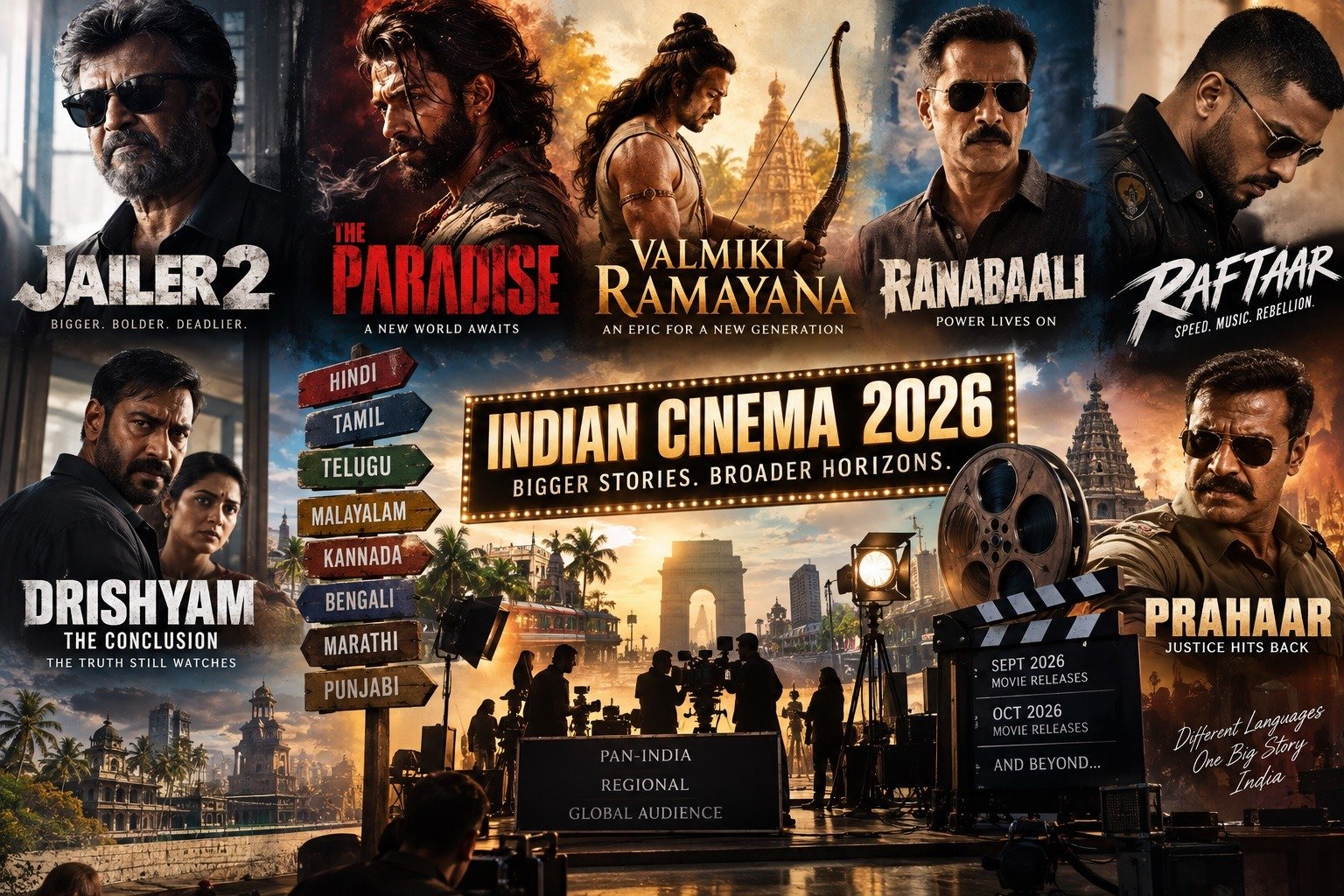
The September–October 2026 theatrical calendar offers a good illustration. Films such as The Paradise, Jailer 2, Ranabaali, Raftaar, Prahaar, Drishyam – The Conclusion and Valmiki Ramayana are arriving within a relatively concentrated period, representing different languages, genres and filmmaking traditions. Current release listings place The Paradise on September 24, Drishyam – The Conclusion and Valmiki Ramayana on October 2, Jailer 2 on October 15, and Ranabaali, Raftaar and Prahaar on October 16.
The interesting story is not that India suddenly has many films.
India has always had many films.
The interesting story is who is now expected to watch them.
The language barrier is becoming a distribution problem — not an audience assumption
The term “pan-India” became particularly prominent when major southern productions demonstrated that a film made in one language could become a national theatrical event.
But the idea has evolved.
It is increasingly possible for audiences to discover a film because of its actors, director, action scale, mythology, franchise connection or cultural curiosity rather than simply because it was made in their language.
That changes the calculation for producers.
A Telugu film does not necessarily have to remain a Telugu-market product.
A Tamil superstar’s film can become a national event.
A Malayalam production can attract audiences far beyond Kerala.
And Hindi cinema, meanwhile, increasingly competes for attention with films coming from every direction.
The result is not the disappearance of regional cinema.
It is almost the opposite.
Regional cinema is becoming more visible nationally.
September begins the conversation
One of the notable September releases is The Paradise, starring Nani and directed by Srikanth Odela. The film is currently listed for September 24, although reports earlier this month suggested that pending post-production work could lead to another date change. As of September 7, no official postponement had been announced.
That uncertainty is worth mentioning because modern film calendars are increasingly fluid.
Large films are not scheduled in isolation.
They are positioned around one another.
A change in one release can affect distributors, exhibitors and competing productions across several languages.
That is another feature of the pan-India market: the competition is now national even when the production is regional.
October becomes the real test
October is where the calendar becomes particularly interesting.
On October 2, Drishyam – The Conclusion and Valmiki Ramayana are both listed for theatrical release.
The two films represent very different forms of Indian popular cinema.
Drishyam belongs to the crime-thriller tradition built around Vijay Salgaonkar and his family’s increasingly complicated story.
Valmiki Ramayana, meanwhile, takes one of India’s most enduring mythological narratives to the big screen.
One sells suspense.
The other draws upon cultural memory.
Both, however, depend on something that increasingly matters in a pan-India marketplace: a story that can travel beyond its original production context.
Then Rajinikanth enters the October race
On October 15, Rajinikanth returns with Jailer 2, the follow-up to the 2023 blockbuster Jailer. Current release listings place the film’s theatrical arrival on October 15.
This is where the concept of pan-India cinema becomes particularly visible.
Rajinikanth is fundamentally associated with Tamil cinema.
Yet his films have long attracted audiences across India.
The actor’s screen image, combined with the scale of the Jailer franchise, means the release is being treated as a national theatrical event rather than a film whose commercial prospects are confined to Tamil-speaking markets.
That is a significant change in the economics of Indian stardom.
October 16 becomes a multilingual collision
The following day, the calendar becomes even more crowded.
Ranabaali, starring Vijay Deverakonda and Rashmika Mandanna, is listed for October 16.
Raftaar, starring Rajkummar Rao and Keerthy Suresh, is also listed for October 16.
And Prahaar – The Ujjwal Nikam Story, starring Rajkummar Rao, Wamiqa Gabbi, Sikandar Kher and Jaideep Ahlawat, is scheduled for the same day.
That creates an unusual marketplace.
Different languages.
Different genres.
Different stars.
Different audience propositions.
But potentially competing for the same urban multiplex audience, the same holiday-season attention and increasingly the same national digital conversation.
The cinema-goer no longer necessarily asks:
“Which Hindi film should I watch?”
The question can become:
“Which Indian film looks interesting this weekend?”
That is a much larger marketplace.
Stars are becoming language-agnostic brands
The pan-India shift is also changing the role of the actor.
A major star increasingly carries recognition beyond the language of the film.
Rajinikanth does not need an introduction in Mumbai.
Nani’s films can generate interest among audiences outside Telugu-speaking markets.
Vijay Deverakonda became nationally recognised through films that originated in Telugu cinema.
At the same time, Hindi actors are increasingly appearing in productions that draw upon regional industries and different linguistic cultures.
The result is an Indian star system that is becoming more interconnected.
It does not mean every actor becomes equally popular everywhere.
It means the possibility of crossing markets has become part of the business model.
But “pan-India” is not a magic word
There is an important caution.
A film does not become pan-India simply because its poster contains five language titles.
Distribution is only the first step.
A genuine national release requires marketing, dubbing or subtitling quality, theatre availability, audience awareness and — most importantly — a story that creates a reason to watch.
A film can be released across India and still remain primarily relevant to one market.
Conversely, a film originating in one language can become genuinely national because audiences discover it organically.
The distinction matters.
Otherwise, “pan-India” risks becoming another piece of marketing vocabulary that means everything and therefore very little.
Theatres are becoming national meeting points
The transformation is particularly significant for multiplexes.
Historically, theatre programming was heavily shaped by language and local audience preferences.
The expanding pan-India model makes programming more complicated.
An exhibitor in Delhi may need to consider a Tamil superstar film.
A Mumbai multiplex may need to allocate screens to a Telugu action film.
A Bengaluru audience may choose among Hindi, Kannada, Tamil, Telugu and Malayalam releases on the same weekend.
That competition can create problems — especially when several large films arrive simultaneously.
But it can also create something valuable:
choice.
Indian audiences are increasingly being exposed to a wider range of domestic cinema without necessarily having to travel outside their own linguistic markets.
Streaming helped create this audience
There is another important piece of the story.
OTT platforms have arguably helped weaken the old language barriers.
A viewer who discovered a Korean drama with subtitles can hardly claim subtitles are an unreasonable technological burden.
A Hindi-speaking viewer who became a fan of a Telugu or Malayalam film through streaming may be more willing to buy a cinema ticket for another film from that industry.
Streaming has therefore created a strange paradox.
It competes with theatrical cinema for time.
But it has also educated audiences to travel across languages.
That cultural familiarity can eventually benefit theatrical releases.
The commercial opportunity — and the risk
For producers, the pan-India model offers a larger potential audience.
But it also raises costs.
A nationwide campaign requires multiple language versions, wider marketing, more dubbing, broader distribution and often larger promotional commitments.
If the film succeeds, the additional markets can significantly expand its reach.
If it does not, the costs of national positioning can make the disappointment considerably more expensive.
There is also the danger of making films too deliberately “national”.
A story can lose some of its local character if every creative decision is made with the imagined pan-India audience in mind.
Ironically, some of India’s biggest cross-language successes have travelled precisely because they remained deeply rooted in their own cultural worlds.
DOONITED VIEW: The new pan-India film is not one cinema — it is many cinemas sharing one audience
The most important change is therefore not that Indian cinema is becoming uniform.
It is becoming interconnected.
Tamil cinema can compete nationally.
Telugu cinema can travel.
Malayalam cinema can find audiences far beyond Kerala.
Hindi cinema can no longer assume that linguistic familiarity automatically guarantees national attention.
And audiences themselves are becoming more adventurous.
The September–October 2026 calendar captures that transition unusually well.
The Paradise represents Telugu cinema’s continuing national ambitions.
Jailer 2 brings one of Tamil cinema’s biggest stars into a nationwide theatrical conversation.
Ranabaali extends the same cross-market logic.
Drishyam – The Conclusion demonstrates the continuing power of a Hindi franchise.
Valmiki Ramayana taps into a story whose cultural recognition predates every modern film industry.
And Raftaar and Prahaar add different Hindi-language propositions to the crowded October landscape.
The result is a fascinating change in the basic question surrounding Indian cinema.
It used to be:
Which industry’s film are you watching?
Increasingly, the question is:
Which Indian story has earned your ticket?
That is the real pan-India phase.
Not one language replacing another.
Not Bollywood versus the South.
But an increasingly connected Indian audience deciding, film by film, which stories deserve the big screen.
And for the audience, there is one wonderfully simple consequence:
Friday suddenly requires considerably more homework.


World Beyond the News
Why Elephants Stay Close to Their Herd
Elephants live in highly social family groups and use calls, touch and body movements to maintain strong bonds.
Most of the Deep Ocean Remains Difficult to Explore
Extreme pressure, darkness and distance make deep-ocean exploration one of Earth’s greatest scientific challenges.
Spacecraft Can Travel Without Traditional Roads
Spacecraft use carefully calculated trajectories and gravity assists to travel enormous distances through space.
Why Movie Trailers Are Released in Stages
Major films often use teaser trailers, full trailers and final promotional spots to build awareness over time.