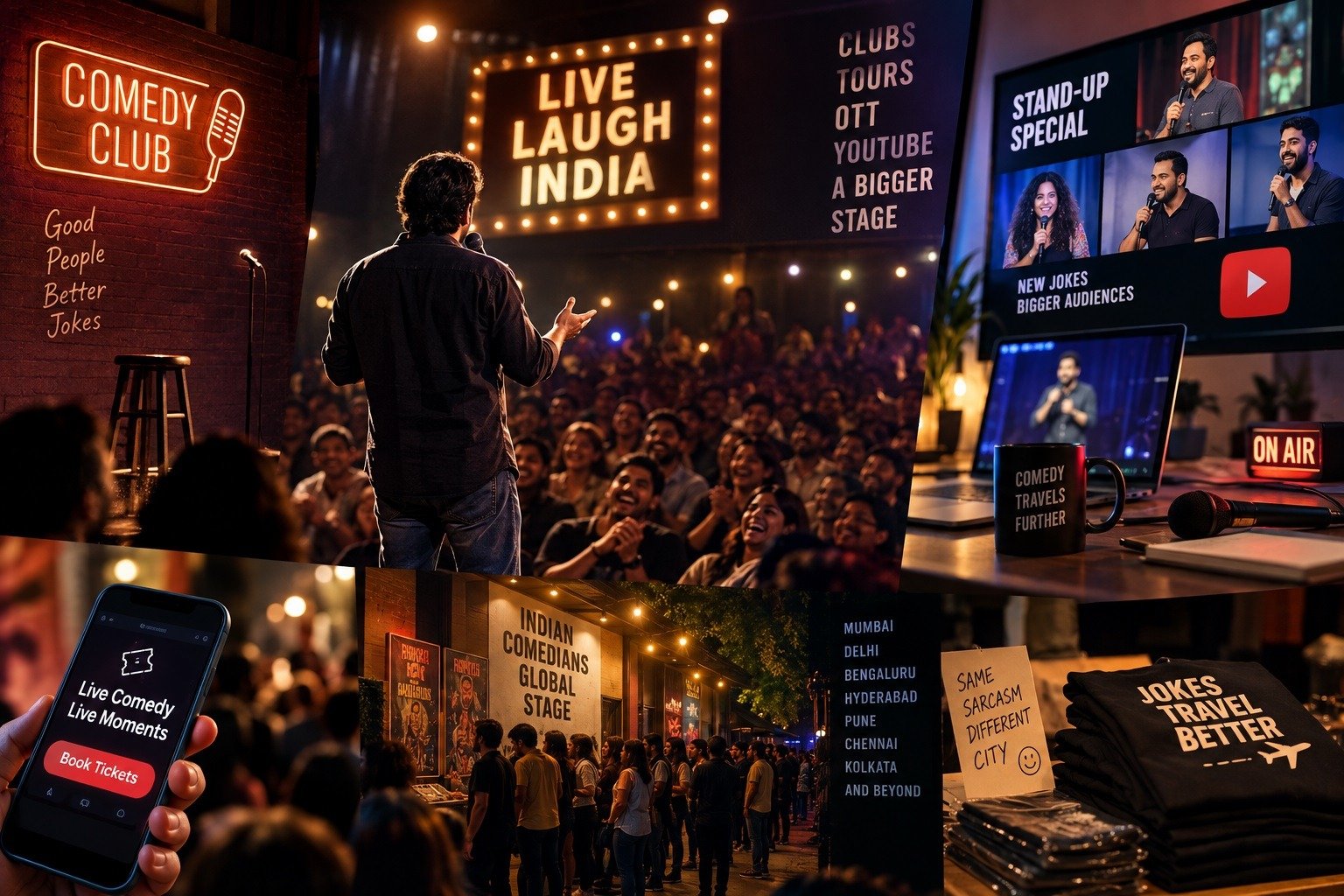
India’s Stand-Up Comedy Economy Has Changed
Stand-up comedy has evolved from a niche urban performance scene into a multi-platform entertainment business, with comedians now earning audiences through live tours, OTT specials, YouTube, comedy clubs, multiplexes and ticketing platforms across India.
There was a time when watching stand-up comedy in India required knowing somebody who knew somebody who knew where the tiny comedy room was.
The venue might have been a café.
The stage might have been approximately the size of a dining table.
The microphone may or may not have worked.
And the audience was usually close enough to the comedian for eye contact to become part of the performance.
That world still exists.
But alongside it, something much bigger has developed.
Indian stand-up comedy has become a commercial entertainment ecosystem — one that connects live shows, touring circuits, streaming specials, YouTube audiences, digital clips, ticketing platforms and increasingly sophisticated venues.
The transformation is visible in the September entertainment calendar as well, when comedy sits alongside concerts, theatre and cultural programming rather than being treated as a fringe night-out option.
The joke, it seems, has acquired a business model.
From 50-seat rooms to thousands of tickets
The scale of live comedy has changed considerably.
Industry estimates cited by Business Standard suggest that around one-third of India’s roughly 90,000 live events in 2025 were comedy events. The same report quoted BookMyShow’s live-entertainment leadership saying that typical comedy audiences had grown dramatically over five years, with shows moving from audiences of around 50 to performances drawing more than 5,000 people.
The exact economics are difficult to measure because stand-up revenue is spread across multiple businesses.
There is the live ticket.
Then there are venue partnerships.
Brand sponsorships.
Streaming deals.
YouTube advertising.
Short-form video monetisation.
Corporate performances.
Merchandise.
And, increasingly, national tours.
That makes stand-up unusual in the entertainment industry.
The same joke can effectively have several commercial lives.
It can be performed on stage on Friday, clipped for YouTube on Saturday and become a social-media reel on Sunday.
The audience does not necessarily see the same content in the same format.
The comedian’s business, however, can benefit from all three.
YouTube changed the discovery process
Perhaps the biggest structural change came from digital video.
Before YouTube, a comedian largely needed a physical stage to build an audience.
Now an unknown performer can put a five-minute clip online and potentially reach thousands — or millions — of viewers without owning a theatre, television channel or production company.
That has changed the relationship between discovery and ticket sales.
A viewer might first encounter a comedian through a short clip.
Then watch a longer YouTube performance.
Then follow the comedian on social media.
Then buy a ticket.
The live show becomes the premium physical version of an audience relationship that began online.
This is an important distinction.
Digital video does not necessarily replace the live performance.
It can function as the marketing funnel for it.
OTT turned comedy into a mainstream screen genre
Streaming platforms added another layer.
Indian comedy specials became increasingly visible on major OTT services, giving comedians production values and national distribution that were previously difficult to obtain.
The audience could now discover stand-up from home rather than having to live in Mumbai, Delhi or Bengaluru.
That widened the potential market.
It also changed the economics of the performer.
A successful special could build recognition among people who had never attended a comedy club.
The comedian could then take that recognition on tour.
In other words:
OTT builds familiarity.
YouTube builds reach.
Social media builds community.
Live shows monetise presence.
The four platforms do different jobs.
Together, they create a much stronger business.
Touring is where the geography changes
The emergence of touring comedians is perhaps the clearest evidence that India’s comedy audience is no longer restricted to a handful of metropolitan centres.
BookMyShow’s live-events leadership has cited Zakir Khan performing across more than 40 cities, illustrating how established comedians can operate more like touring musicians than traditional club performers.
That is a major shift in the business model.
A comedian no longer has to depend on one city.
A tour can move through Mumbai, Delhi-NCR, Bengaluru, Pune, Hyderabad, Ahmedabad, Kolkata, Chandigarh and smaller markets.
And the audience does not necessarily have to wait for an international superstar to visit.
The comedian can come to them.
Current ticketing listings demonstrate the depth of that market even beyond the biggest cities. BookMyShow’s event listings include stand-up shows and open-mic formats in cities such as Nagpur, alongside concerts, theatre and other live experiences.
That matters because a national comedy business needs more than superstar acts.
It needs a pipeline.
The comedy club remains important
The rise of large tours has not killed the small comedy room.
In fact, the two models serve different purposes.
A comedy club or open mic is a laboratory.
New material can be tested.
A joke can fail spectacularly.
The comedian can rewrite it.
Try it again.
Discover that it still fails.
Rewrite it again.
Eventually, material that works can move into a larger performance.
That creates a useful ecosystem between open mics, clubs, touring shows and specials.
The small room produces experimentation.
The large venue produces scale.
Streaming produces reach.
YouTube produces discovery.
A healthy comedy industry needs all of them.
Even cinemas are entering the comedy business
The boundaries between entertainment formats are becoming increasingly flexible.
In 2025, DeadAnt and PVR launched a live comedy format that used cinema venues as performance spaces, effectively turning multiplexes into temporary comedy clubs. The concept demonstrated that theatre infrastructure can be repurposed for live comedy rather than being used exclusively for films.
That may sound like a small experiment.
It represents a larger trend.
India already has extensive infrastructure designed to make people sit together in the dark and pay attention to entertainment.
Cinema operators are therefore sitting on spaces that can potentially host other kinds of performances during non-film hours.
Comedy fits particularly well.
It needs a stage.
It needs sound.
It needs seating.
And ideally, it needs a crowd willing to laugh loudly enough that the person in the next row wonders whether they missed the joke.
Ticketing has become part of the ecosystem
The rise of digital ticketing has also removed considerable friction.
Audiences can discover a comedian, check dates, compare prices and purchase tickets from the same digital ecosystem in which they consume entertainment information.
That matters commercially.
BookMyShow’s live-events revenue reached ₹756 crore in FY2025, up from ₹455 crore, reflecting the growing importance of live entertainment to the company’s business. The category includes music and comedy among other live formats.
Competition is also increasing.
Reuters reported in 2026 that Flipkart was planning to enter India’s movie and live-event ticketing market, adding another large digital player to a space that already includes established platforms and Zomato’s District.
More competition in ticketing could mean more ways for audiences to discover events — although the economics of ticketing remain highly competitive.
The audience is buying experiences, not just jokes
The broader live-entertainment trend is important here.
BookMyShow data cited by industry publications showed live-entertainment consumption in India rising 17% in 2025, with Mumbai growing 18%. Comedy was part of the same shift that included concerts, theatre and experiential entertainment.
This suggests that people increasingly view going out as an entertainment category in itself.
The decision is not always:
“Should I watch this particular comedian?”
It can become:
“What are we doing this weekend?”
That is a very different commercial proposition.
A comedy show is competing with a concert, restaurant, film, theatre performance or another social activity.
The comedian therefore sells more than jokes.
The comedian sells an evening out.
But the industry has serious challenges
The growth story should not be confused with guaranteed success.
Live comedy is highly dependent on audience loyalty.
Touring is expensive.
Venue costs can be significant.
Travel and accommodation add overheads.
Ticket prices have to remain high enough to support the production but low enough to attract audiences.
And a comedian who becomes popular online does not automatically become successful on stage.
The live audience is less forgiving.
There is no editing button.
There is no retake.
There is certainly no algorithmic recommendation engine to quietly move an uncomfortable five-minute segment away from the audience.
That is why live performance remains the industry’s real test.
Comedy also faces the question of boundaries
Stand-up has always depended on social observation, satire and uncomfortable subjects.
As comedy reaches larger audiences, however, the stakes become higher.
A joke performed to 100 people in a club exists in one environment.
The same joke clipped, uploaded and viewed by millions can acquire a completely different context.
This is one of the central challenges of modern Indian comedy.
Digital distribution gives comedians extraordinary reach.
It also makes context increasingly fragile.
The industry’s growth therefore requires not only better venues and ticketing systems but also a mature understanding of creative freedom, audience expectations and the responsibilities that accompany mass distribution.
India’s regional comedy opportunity is still underdeveloped
There is another major opportunity.
Much of the national stand-up conversation is still dominated by English and Hindi.
But India’s linguistic diversity creates enormous room for regional-language comedy.
Marathi.
Tamil.
Telugu.
Bengali.
Malayalam.
Kannada.
Punjabi.
And many more.
Local-language comedy can draw on cultural references that do not translate perfectly into Hindi or English — which is precisely why they can be powerful.
A genuinely mature Indian comedy industry should eventually look less like one national comedy scene and more like a network of interconnected regional scenes.
That would create more performers, more venues and more distinctive voices.
DOONITED VIEW: Stand-up has stopped being just a performance and become an ecosystem
The most important change in Indian comedy is not that comedians are becoming famous.
It is that the infrastructure around comedy is becoming commercially meaningful.
YouTube can create discovery.
OTT can create national recognition.
Social media can build a community.
Open mics can develop performers.
Comedy clubs can test material.
Ticketing platforms can fill venues.
Tours can take established comedians across the country.
And live shows can turn digital attention into a physical experience.
That is an actual entertainment business.
The transition also says something broader about Indian consumers.
A generation that spends enormous amounts of time consuming digital content is increasingly willing to pay to be physically present when the experience feels worthwhile.
That is the same behavioural shift driving concerts, theatre, festivals and cultural events.
The screen created the audience.
The stage is now asking them to show up.
And perhaps that is the biggest joke of all.
For years, people worried that smartphones would keep everyone at home.
Instead, the internet may have become one of the things convincing people to leave the house, buy a ticket and sit next to strangers laughing at the same joke.
That is not merely the rise of stand-up comedy.
It is the development of India’s experience economy — one punchline at a time.


World Beyond the News
Why Elephants Stay Close to Their Herd
Elephants live in highly social family groups and use calls, touch and body movements to maintain strong bonds.
Most of the Deep Ocean Remains Difficult to Explore
Extreme pressure, darkness and distance make deep-ocean exploration one of Earth’s greatest scientific challenges.
Spacecraft Can Travel Without Traditional Roads
Spacecraft use carefully calculated trajectories and gravity assists to travel enormous distances through space.
Why Movie Trailers Are Released in Stages
Major films often use teaser trailers, full trailers and final promotional spots to build awareness over time.