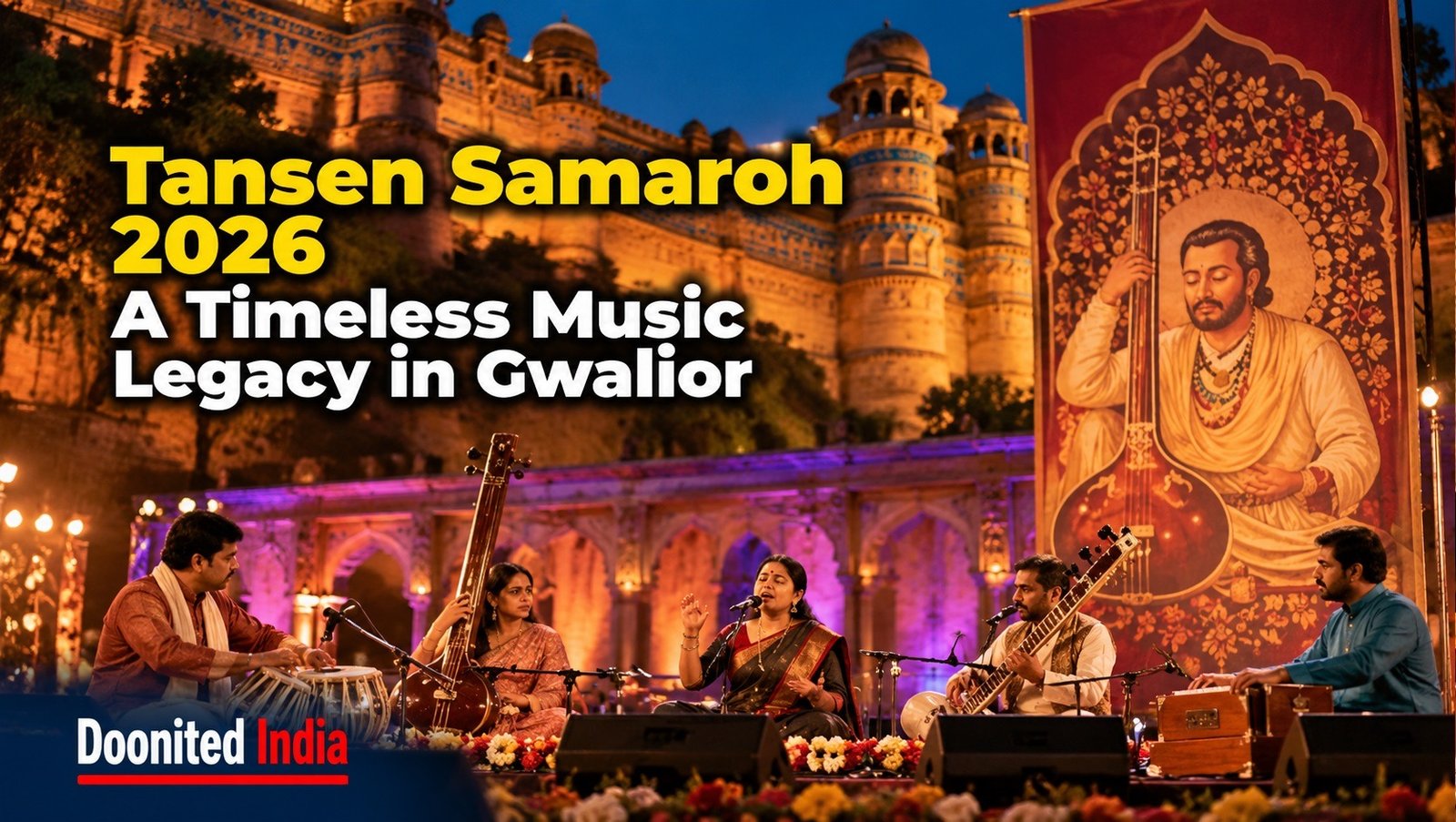
Tansen Samaroh 2026: Can a 16th-Century Musical Legacy Still Speak to the Streaming Generation?
Gwalior’s 102nd Tansen Sangeet Samaroh returns from December 14–19, 2026. But its real significance is not simply that India is remembering a legendary musician. It is whether a centuries-old musical tradition can continue to create new listeners, performers and ideas in an age of playlists, short videos and instant entertainment.
A winter night in Gwalior offers an unusual proposition.
Sit quietly.
Listen to a raga unfold.
Do not expect a chorus to arrive in thirty seconds. Do not expect a three-minute song structure. Do not expect the performer to explain everything before the first note.
Indian classical music asks for something that modern entertainment rarely demands: time.
That makes the continuing popularity of the Tansen Sangeet Samaroh particularly interesting.
The 102nd edition is scheduled for December 14–19, 2026, with the main venue at Tansen Samadhi Sthal in Gwalior. The festival is organised by the Ustad Alauddin Khan Sangeet Evam Kala Akademi under the Madhya Pradesh government’s Department of Culture, in association with the district administration, Archaeological Survey of India and Madhya Pradesh Tourism.
The official Incredible India listing describes the event as a platform for established Indian and international artists, younger performers, workshops, discussions and exhibitions — and lists admission as free.
That last detail deserves more attention than it usually receives.
Because if classical music is to survive beyond specialist circles, access matters.
And if Tansen Samaroh is to remain relevant in the 21st century, its most important audience may not be the person who already knows a raga.
It may be the young listener who does not.
The festival is really asking a modern question
The easiest way to write about Tansen Samaroh is to begin with Tansen.
The harder and more interesting approach is to begin with the audience.
What makes somebody under 25, accustomed to Spotify playlists, YouTube clips and algorithmically selected music, sit through an extended Hindustani classical performance?
The answer cannot simply be heritage.
Heritage explains why something deserves to be preserved.
It does not automatically explain why somebody today will care about it.
That is the challenge facing almost every classical art form in the world.
Tansen Samaroh’s response has been to keep the tradition public and participatory rather than turning it into a museum exhibit. The official festival material highlights performances, emerging artists, discussions and educational activities alongside established names.
In other words, the festival is not merely presenting an old musical tradition.
It is trying to maintain the ecosystem that allows that tradition to reproduce itself.
Tansen is larger than the historical record
Mian Tansen occupies an unusual position in Indian cultural memory.
He is associated with the court of Mughal emperor Akbar and is traditionally counted among the emperor’s celebrated Navaratnas. His name has become inseparable from Hindustani classical music, particularly from the historical development of North Indian vocal traditions.
But the legend surrounding Tansen is often larger than what historians can establish with certainty.
Stories of his extraordinary musical powers — including the famous associations with ragas capable of invoking rain or fire — have become part of India’s cultural imagination.
They should be understood as legend and tradition, not presented as scientifically established fact.
That distinction does not diminish Tansen.
If anything, it makes his legacy more interesting.
Very few musicians become historical figures, cultural symbols and folklore characters at the same time.
Tansen did.
The tomb is part of the argument
The festival’s setting gives the story another dimension.
Tansen’s tomb in Gwalior stands near the mausoleum of the Sufi saint Muhammad Ghaus, who is traditionally regarded as an important spiritual influence in Tansen’s life. The historic complex itself represents layers of Gwalior’s architectural and cultural history.
The choice to hold a major classical music festival in this heritage setting is therefore more than decorative.
The location connects place, memory and performance.
Music is not being presented in an anonymous conference hall.
It is being performed in a city where the Tansen story has become part of the cultural geography.
That relationship between heritage and living performance is one of the reasons Gwalior was recognised by UNESCO as a Creative City of Music in 2023. Gwalior appears in UNESCO’s Creative Cities Network under the Music category.
UNESCO’s Creative Cities programme is not a World Heritage designation. That distinction matters. It recognises cities using creativity and cultural industries as part of their development and international cooperation.
Gwalior’s designation therefore reinforces a useful idea:
music is not simply part of the city’s history; it can also be part of its future.
Gwalior Gharana: the city behind the festival
The Tansen story can sometimes overshadow the larger musical ecosystem of Gwalior.
That would be a mistake.
The Gwalior Gharana is one of the major traditions of Hindustani classical vocal music and has played an important role in the development and transmission of the khayal tradition.
Its importance illustrates why classical music cannot be preserved simply by remembering famous historical names.
A gharana survives through teachers and students.
A style survives because somebody learns its vocabulary.
A composition survives because somebody continues performing it.
A musical idea survives because another generation decides it is worth learning.
This is where the festival becomes more significant than a commemorative ceremony.
It provides a meeting point between generations of musicians.
The real test is the next generation
There is a tendency to assume that young people have lost interest in classical music.
The reality is more complicated.
Young listeners may discover classical music through film, fusion, social media, educational content, concerts or individual artists before ever attending a traditional recital.
The entry point has changed.
The music has not necessarily disappeared.
Tansen Samaroh’s inclusion of emerging performers and educational activities is therefore strategically important. Incredible India specifically describes opportunities for young artists alongside established performers and highlights discussions, workshops and exhibitions as part of the festival ecosystem.
This matters because performance alone cannot guarantee continuity.
A young musician needs teachers.
Teachers need students.
Students need stages.
Stages need audiences.
Audiences need reasons to return.
The festival sits somewhere in the middle of that chain.
From dawn ragas to digital playlists
Classical music’s relationship with technology is sometimes presented as a conflict.
It does not have to be.
A recording can introduce a listener to a raga.
A short video can make an artist discoverable.
A livestream can take a performance beyond Gwalior.
A podcast can explain concepts that may seem intimidating to a newcomer.
Digital platforms can therefore become the front door to an art form that once required physical proximity to a teacher or concert hall.
But technology has a limitation.
An algorithm is very good at recommending something similar to what you already like.
Classical music sometimes asks listeners to enter unfamiliar territory.
That requires curiosity.
A festival can provide the human experience that an algorithm cannot fully reproduce: watching a musician build a performance in real time, understanding the relationship between performer and accompanists, and discovering how a raga develops rather than simply consuming its most immediately recognisable fragment.
The modern opportunity is therefore not to choose between the concert stage and the smartphone.
It is to connect them.
Why the open festival matters
The official 2026 Incredible India listing identifies Tansen Samaroh as a no-ticket event.
That makes the festival potentially important as a cultural-access model.
Classical music can acquire an unfortunate reputation for being exclusive — financially, socially or intellectually.
Some of that perception comes from the specialised vocabulary surrounding it.
Raga names, tala structures, gharanas, stylistic lineages and performance conventions can appear intimidating to newcomers.
A free public festival changes the first barrier.
You can simply arrive.
You do not need a degree in musicology to listen.
You may not understand everything.
That is perfectly acceptable.
Most people do not understand every technical aspect of the first art form they fall in love with.
They understand that something has moved them.
The explanation can come later.
But a festival cannot preserve music by itself
This is where the romantic narrative needs a reality check.
A six-day festival, however prestigious, cannot by itself guarantee the survival of classical music.
Continuity depends on institutions beyond the festival: music schools, gurus, universities, cultural organisations, recording opportunities, performance circuits and sustainable livelihoods for musicians.
There is also a broader question about audience development.
If the same specialist audience attends every year, the festival may be preserving a tradition without significantly expanding its social base.
That would not make it unsuccessful.
But it would make the question of younger and first-time audiences much more important.
The long-term measure of success should therefore not simply be the number of performances.
It should include questions such as:
How many new listeners discovered classical music here?
How many young musicians found a stage?
How many students connected with teachers?
How much of the festival’s content reaches audiences beyond Gwalior?
Those are harder questions than counting applause.
They are also more useful.
Tansen’s most important legacy may not be a raga
It is tempting to search for Tansen’s legacy in individual ragas and compositions.
There is another possibility.
His most enduring legacy may be the idea that music can travel across political, linguistic and cultural boundaries without losing its identity.
Tansen’s story belongs to a period when Indian musical traditions interacted with the Mughal court and with wider Persianate cultural influences.
Over centuries, Hindustani music continued to evolve.
That is important because tradition and change are not opposites.
A musical tradition survives precisely because it can be transmitted while remaining capable of interpretation by new generations.
A tradition that cannot change eventually becomes a museum object.
A tradition that changes without remembering where it came from becomes something else.
The difficult task is to maintain the conversation between the two.
Why the world should be listening
For international audiences, Hindustani classical music offers something increasingly rare in global culture: an art form in which time itself becomes part of the composition.
There is no requirement that every musical experience be compressed into a three-minute product.
A raga can develop gradually.
Silence can matter.
Improvisation can matter.
The performer can respond to the moment rather than reproducing an identical sequence every night.
That is not an antiquated concept.
It is, in some ways, remarkably contemporary.
At a time when much digital entertainment is designed for rapid consumption, classical music offers an alternative proposition:
attention can itself be an artistic experience.
The question after Tansen
When the 102nd Tansen Sangeet Samaroh opens in Gwalior in December 2026, there will be performances, heritage, celebrated artists and the inevitable references to a legendary musician.
All of that belongs.
But the festival should also be judged by a harder question.
When the final performance ends and the temporary stage falls quiet, who has been persuaded to keep listening?
If an experienced listener returns, the tradition has been honoured.
If a young musician finds inspiration, the tradition has been extended.
If a first-time listener discovers that a raga can hold attention longer than a social-media clip, the tradition has gained a new audience.
And if an international visitor leaves Gwalior understanding that Indian classical music is not an archaeological relic but a living, evolving practice, the festival has done something larger than commemorating Tansen.
It has made the past useful to the present.
That may ultimately be the finest tribute to a musician whose name has survived for centuries.
Not that India still remembers Tansen — but that India is still finding new reasons to listen.


World Beyond the News
Bees Communicate Where Food Is
Honeybees use movement patterns known as waggle dances to communicate information about food locations.
Street Food Reflects Local History
Many famous street foods developed from migration, trade, local ingredients and the everyday needs of working communities.
A Day on Venus Is Extremely Long
Venus rotates so slowly that one rotation relative to distant stars takes longer than its trip around the Sun.
Human Achievement Continues to Push Limits
Athletes, engineers, scientists and explorers regularly establish new benchmarks in speed, endurance, scale and precision.